
What Are Perpetual Futures and How Do They Work in Crypto
A perpetual future is a crypto derivative with no expiry that tracks an asset's spot price through recurring funding payments between longs and shorts, letting traders take amplified exposure that can be held indefinitely without rolling a contract. In 2025, perpetuals accounted for more than 90% of global crypto derivatives trading volume, with daily global volume described as exceeding $187 billion (Traders Union).
You buy what looks like a Bitcoin position through a trading app. The price moves against you, and suddenly the screen shows a margin warning, a funding charge, and a liquidation estimate. You haven't received BTC, and you haven't agreed to sell coins on a future date. You're holding a contract whose value follows BTC while your account absorbs the gains, losses, costs, and risks.
Table of Contents
- Why Traders Ask What Perpetual Futures Are
- Perpetual Futures Versus Traditional Futures Contracts
- How Funding Rates and Mark Price Anchor Perpetuals
- Margin, Leverage, and Liquidation Mechanics
- Perpetual Futures Across Major Exchanges
- Risks, Market Structure, and Regulatory Shifts
- Practical Use Cases and a Pre-Trade Checklist
Why Traders Ask What Perpetual Futures Are
A first-time trader opens a BTC perpetual expecting something close to a Bitcoin purchase. The screen may show “BTC long,” yet no BTC enters the trader's wallet. There are no private keys to control and no coins to transfer. What the trader holds is a derivative contract, an agreement whose value changes with an underlying asset.
The word perpetual refers to the contract's open-ended life. Traditional futures end on a specified date, while perpetual futures have no expiration date. A position can remain open for an indefinite period if the account maintains enough margin and pays trading fees and funding. Funding helps keep the contract price near the spot market, preventing an undated contract from drifting too far from its reference price (Kraken's explanation of perpetual futures).
Three points often create confusion:
- Borrowed capital magnifies each move. A modest Bitcoin price change can produce a much larger percentage gain or loss relative to the margin deposited.
- Funding is a recurring cash flow. Depending on the rate, longs pay shorts, or shorts pay longs. It is an ongoing holding cost or receipt, not a single opening fee.
- The trader does not take delivery. The position is normally settled through the account balance rather than by transferring the underlying coin.
Funding deserves special attention because it behaves like a moving cost of carry. A position can move in the expected direction and still deliver a disappointing return if repeated funding payments consume too much of the gain. Conversely, a favorable rate can reduce the cost of holding a position, but that rate can change as market positioning changes.
The structure predates crypto markets. In 1992, Yale economist Robert Shiller proposed perpetual futures for illiquid assets such as residential real estate and labor-cost indices. His design used daily cash settlement and funding flows between long and short holders, allowing exposure to continue without rolling into a new contract. BitMEX later launched its XBTUSD perpetual swap on May 13, 2016, helping bring the format to major commercial scale (historical overview and 2025 market data).
Practical rule: Treat a perpetual as magnified exposure to an asset, not ownership of that asset.
Market mood can influence whether traders crowd into long or short positions, but sentiment does not explain margin, funding, or settlement. For a market-psychology perspective, see this guide to análisis del sentimiento de traders. Understanding the contract starts with separating exposure from ownership, then tracking the costs that keep the position open.
Perpetual Futures Versus Traditional Futures Contracts
Traditional futures and perpetual futures both let traders gain exposure without necessarily owning the underlying asset. Their risk profiles diverge because one contract has a scheduled endpoint, while the other replaces expiry with an ongoing payment mechanism.
Consider a quarterly CME Bitcoin future. Its price reflects expectations and carrying costs over a defined period, and the contract settles on a specified date. A BTC perpetual on a crypto venue has no such endpoint. Instead, the funding rate repeatedly transfers value between long and short holders when the contract trades at a premium or discount to spot.
| Mechanic | Traditional Futures | Perpetual Futures |
|---|---|---|
| Expiry | Fixed settlement date | No expiration date |
| Settlement | May involve physical delivery or cash settlement, depending on the contract | Cash-settled account exposure with recurring funding |
| Cost of carry | Reflected in the futures basis, the difference between futures and spot | Expressed directly through the funding rate |
| Position management | Longer exposure may require rolling into a later contract | No scheduled roll is required |
| Capital structure | Margin supports the position, while delivery terms can matter at settlement | Margin supports open-ended leveraged exposure |
| Typical fit | Hedging a defined calendar period or trading spreads across expiries | Continuous directional exposure, short selling, and active hedging |
The key change isn't that perps remove a date. Funding replaces the traditional pressure of expiry and basis convergence with a repeated cost-of-carry transfer. If a perpetual trades above spot, positive funding generally makes longs pay shorts. If it trades below spot, negative funding generally makes shorts pay longs. Arbitrage traders can respond to that incentive, helping pull the contract toward its reference market.
That structure suits a trader who wants a BTC long or short without selecting a monthly or quarterly maturity. It also suits markets that operate continuously, including crypto markets that don't follow a conventional exchange calendar. The trade-off is that an open-ended position can accumulate funding costs for as long as it remains open.
A dated future may fit a miner hedging revenue for a known delivery window or an institution trading calendar spreads. A perpetual may fit a shorter-term directional trader, a market maker, or a hedger who values continuous access and doesn't want to roll contracts. Resources designed for futures traders can help readers compare workflows, but the instrument should follow the objective, not the other way around.
How Funding Rates and Mark Price Anchor Perpetuals
Funding is the mechanic that makes an expiry-free contract workable. It also creates the cost that many beginners underestimate.
The reference prices
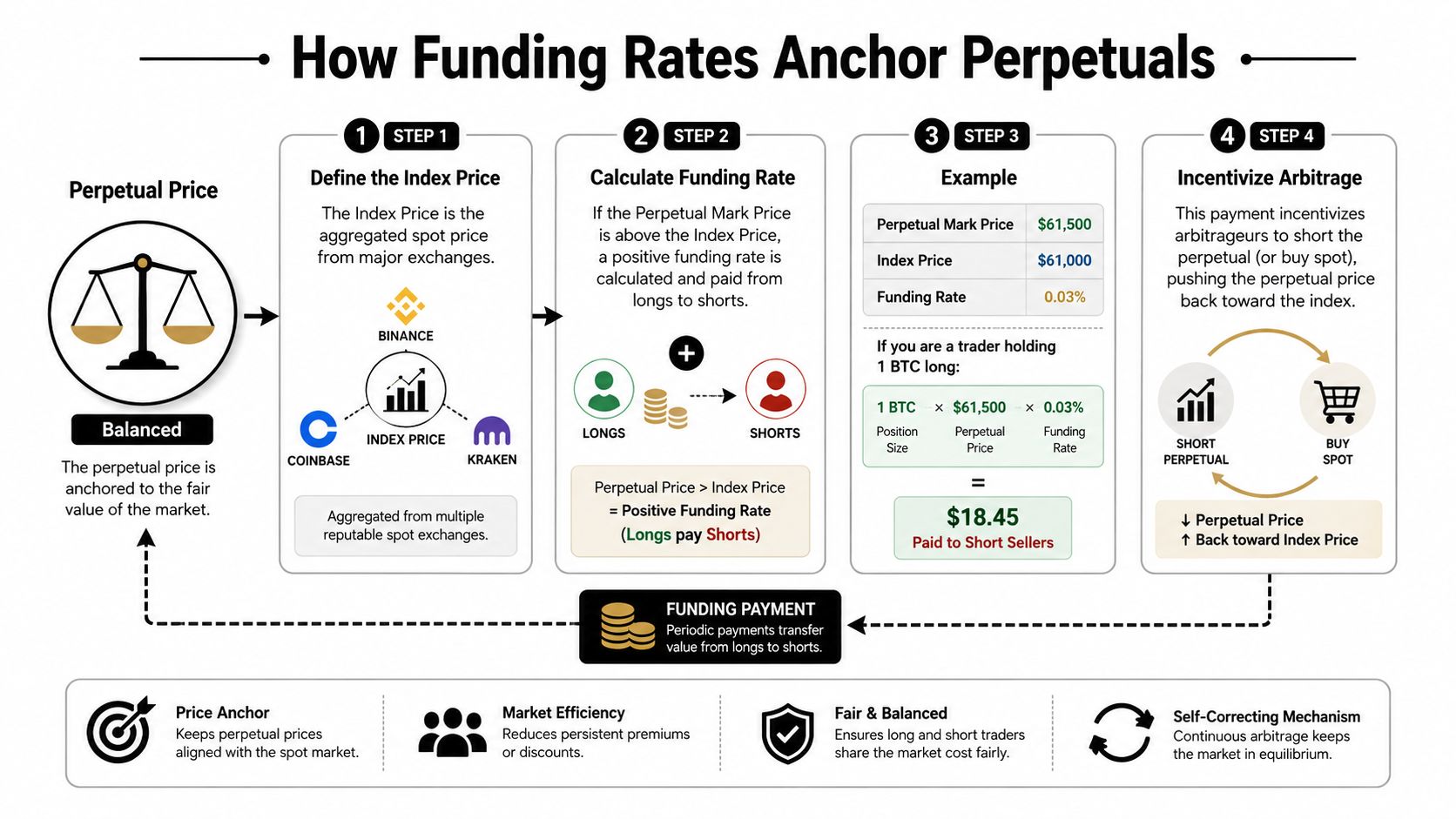
The index price represents a spot reference assembled from prices across relevant trading venues. The mark price is a calculated price used by a venue for risk controls, including margin and liquidation. It generally smooths the relationship between the contract and its reference market instead of relying only on the most recent trade.
A useful way to understand the process is to follow the direction of the premium:
- The venue compares the perpetual's price with the spot index.
- If the perpetual trades above the index, the contract has a premium and funding is typically positive.
- Longs pay shorts at the scheduled funding time.
- That payment makes holding the crowded side more expensive and can encourage trades that bring the contract closer to spot.
- If the perpetual trades below the index, funding is typically negative and shorts pay longs.
Funding is typically exchanged every 8 hours, and the rate is based on the perpetual's premium or discount versus the spot index, together with an interest-rate component (academic treatment of perpetual contracts).
A worked example
Suppose a BTC perpetual trades at $70,500, while its index is $70,000. If the funding rate is 0.01%, a trader with a $100,000 long position pays about $10 per funding interval when the exchange applies that rate. The payment goes to short holders, not to the exchange as a conventional trading commission.
The reverse applies below the index. If the perpetual trades at a discount and funding is negative, short holders pay long holders. The exact calculation depends on the venue's contract rules, position value, and funding formula, so the displayed rate should be checked before entry.
Funding can dominate a trade's outcome. A trader might correctly predict a BTC rally but lose much of the directional edge if positive funding remains expensive while the position stays open. The rate shown as “predicted” on an exchange dashboard is an estimate for a future interval, not a guaranteed charge or payment.
For a broader explanation of how prices form across markets, see price discovery. Funding doesn't make a perpetual identical to spot, because margin, fees, and liquidation remain. It does create a repeating incentive that lets a contract behave like continuously available spot exposure, without requiring a final settlement date.
Margin, Leverage, and Liquidation Mechanics
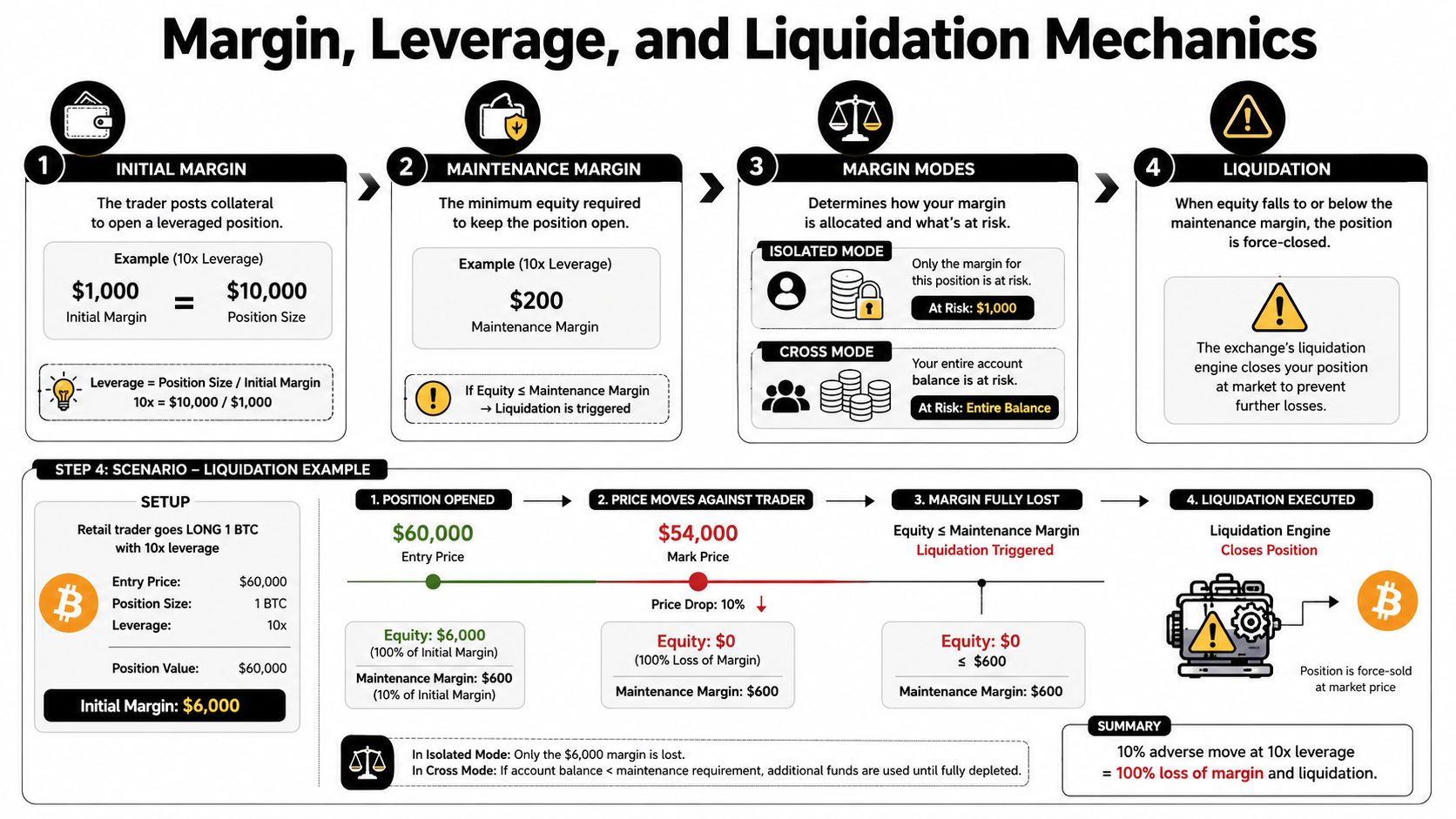
Margin is the collateral supporting a position. Initial margin is required to open the trade, while maintenance margin is the minimum equity the venue requires to keep it open. If account equity falls below the maintenance threshold, the liquidation engine can close some or all of the position (overview of funding, margin, and liquidations).
The multiplier determines how much notional exposure the margin controls. A trader using 10x with $1,000 of initial margin controls a $10,000 position. A favorable move can produce a substantial return on the deposited margin, but an adverse move consumes that margin just as quickly.
The relationship is easiest to see with a BTC example. Suppose a trader goes long 1 BTC at $60,000 using 10x, posting $6,000 of initial margin. If BTC falls to $54,000, the position has lost $6,000 before considering fees, funding, and the venue's liquidation buffer. That is a 10% price decline and a complete loss of the initial margin in this simplified illustration. The actual liquidation price can be higher because maintenance margin, fees, funding, and position tiers affect the calculation.
Isolated and cross margin
Isolated margin limits the collateral assigned to a position. If that position fails, the trader generally risks the margin allocated to it rather than the entire account balance. Cross margin uses eligible account collateral across positions, which can delay liquidation in some circumstances but exposes more of the account if losses continue.
The liquidation trigger isn't necessarily the last traded price. Venues commonly use the mark price to reduce the chance that a brief wick or thin order-book print causes an avoidable forced close. Robinhood's perpetual-futures terms specify an initial margin floor of 20%, a maintenance margin floor of 10%, and a 5% close-out threshold for full liquidation, with partial liquidation possible when margin falls below maintenance (Robinhood's liquidation terms).
Some exchanges liquidate in stages, reducing the position before closing it entirely. Insurance funds can absorb certain losses when liquidated accounts don't cover their obligations, while auto-deleveraging may reduce profitable opposing positions if a cascade exhausts available protection. Those systems limit some counterparty damage, but they don't turn excessive borrowing into a safe strategy.
Perpetual Futures Across Major Exchanges
Exchange comparisons become useful only when they focus on contract rules rather than brand recognition. Binance, Bybit, OKX, Hyperliquid, and Robinhood can differ in maximum position size, funding schedules, margin treatment, fee tiers, liquidation design, and access rules.
The requested venue-specific table below should be treated as a framework, not as a verified live fee sheet. The provided verified data confirms Robinhood's margin thresholds, but it doesn't provide a reliable, current set of BTC borrowing limits, Tier 1 maker and taker fees, or funding intervals for every named venue. Those fields should be checked directly on each venue before trading.
| Exchange | Max Leverage (BTC) | Funding Interval | Maker Fee (Tier 1) | Taker Fee (Tier 1) |
|---|---|---|---|---|
| Binance | Verify current contract terms | Verify current contract terms | Verify current fee schedule | Verify current fee schedule |
| Bybit | Verify current contract terms | Verify current contract terms | Verify current fee schedule | Verify current fee schedule |
| OKX | Verify current contract terms | Verify current contract terms | Verify current fee schedule | Verify current fee schedule |
| Hyperliquid | Verify current contract terms | Verify current contract terms | Verify current fee schedule | Verify current fee schedule |
| Robinhood | 5x product cap is stated in the supplied brief | Verify current contract terms | Verify current fee schedule | Verify current fee schedule |
Hyperliquid's on-chain design can offer a different transparency model because order and settlement activity may be inspectable on the relevant network, but transparency doesn't remove smart-contract, oracle, liquidity, or governance risk. A centralized exchange may offer a familiar interface and established account controls, while a decentralized venue may shift more responsibility to wallet security and protocol interaction.
A trader comparing venues can use a market-data workflow, including a financial data scraper for TradingView, to organize publicly available observations. That tool isn't a substitute for reading current contract specifications. Check the actual funding cadence, fee schedule, mark-price rules, insurance arrangements, geographic restrictions, and withdrawal process before depositing collateral.
Risks, Market Structure, and Regulatory Shifts
A trader opens a large long perpetual during a rising market. Funding turns positive, liquidation orders cluster below the market, and a modest price drop begins forcing positions out. The contract's open-ended design can therefore intensify moves through funding-driven positioning, forced liquidations, and arbitrage between derivatives and spot.
Perpetual activity has become a major part of crypto derivatives trading. In 2025, one industry estimate described daily global volume as exceeding $187 billion, with perpetuals accounting for more than 90% of global crypto derivatives volume. A separate estimate placed centralized perpetual volume at roughly $62 trillion, showing how a crypto-native contract developed into a dominant market structure (2025 volume estimates).
Funding acts like a moving cost of carry. When traders crowd into longs, positive funding can steadily reduce their returns, even if the underlying price rises. A sharp fall can then trigger liquidations, creating forced selling and pushing prices lower. That decline may trigger further liquidations, while arbitrageurs and hedgers adjust related spot and derivatives positions.
Perpetuals can amplify volatility even when no trader intends to move the spot market.
The market microstructure matters here because order-book depth, liquidity, and execution rules influence how quickly forced orders move price. Thin liquidity can turn a liquidation cascade into a wider market event.
Regulation adds another layer of risk. In 2025, the CFTC opened a public comment process on perpetual-style derivatives, while Europe's ESMA indicated that products marketed as perpetual futures may be treated as CFDs under existing intervention measures (CFTC public comment process). That classification can affect controls, disclosure duties, retail access, and whether a venue may offer the product onshore.
Regulatory analysis has referenced a $9 trillion estimate for total perpetual volume across venues in a single month, nearly triple spot volume (regulatory analysis of perpetual futures). The practical lesson is clear: assess jurisdiction, registration status, counterparty exposure, custody arrangements, and retail protections alongside fees and interface speed. A platform available to one trader may be restricted for another, and offshore availability does not mean the product is permitted where you live.
Practical Use Cases and a Pre-Trade Checklist
A perpetual can serve a legitimate trading or hedging purpose when the position size, funding cost, and liquidation distance are planned before entry.
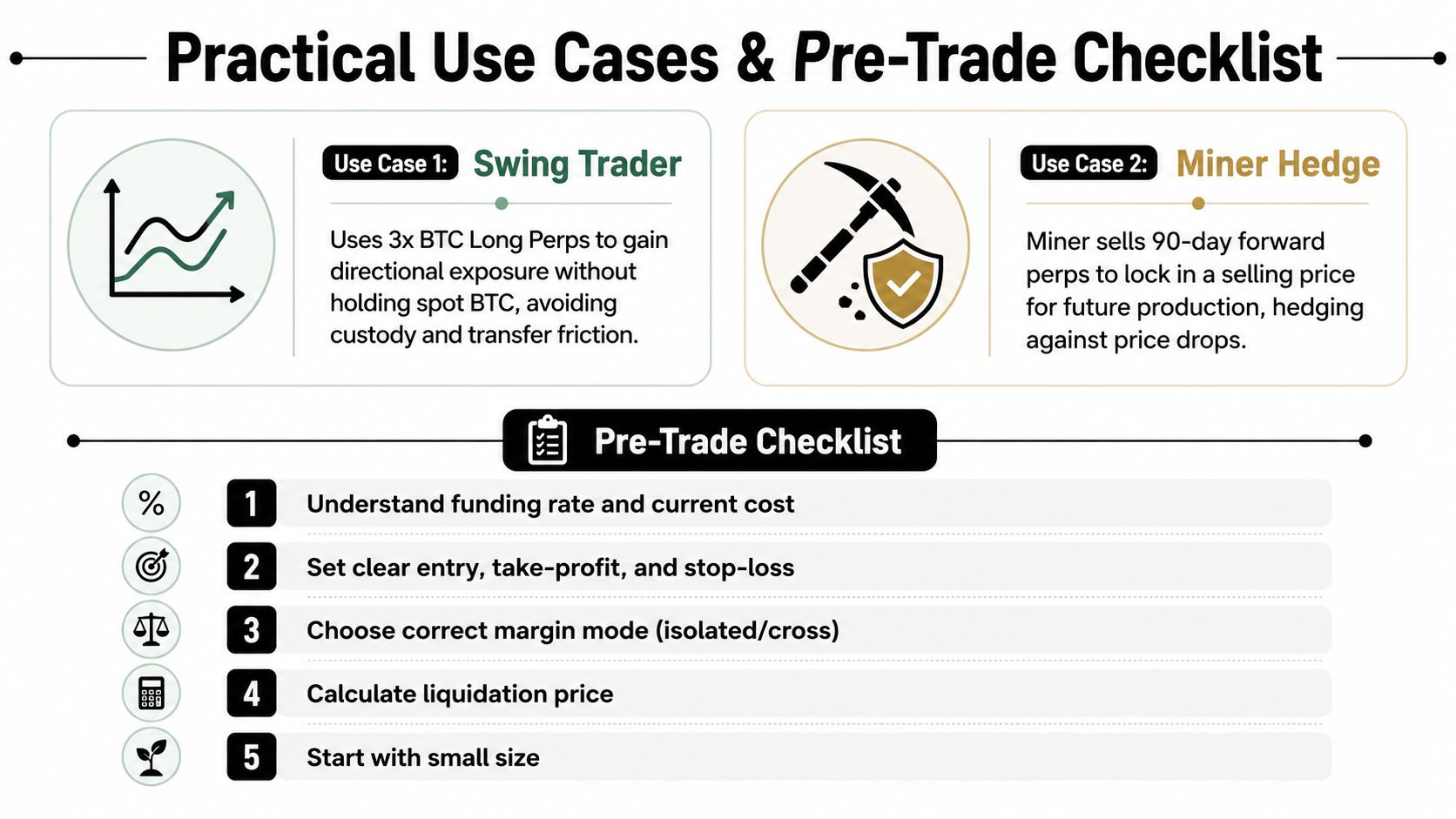
A swing trader might use a 3x BTC long perpetual to obtain directional exposure without purchasing, transferring, or storing spot BTC. The trader still needs to select isolated or cross margin, estimate the funding burden, define an exit, and leave enough collateral between the entry price and liquidation price. Avoiding custody friction doesn't remove exchange or liquidation risk.
A miner can use a short perpetual against expected Bitcoin production to reduce exposure to a price decline before selling the coins. This hedge doesn't guarantee a fixed outcome, because funding can change, the hedge may not match production timing, and the position remains exposed to venue and margin rules. It can, however, offset some directional risk when the hedge is sized carefully.
Seven questions before placing a trade
- Venue: Is the exchange accessible and permitted in your jurisdiction, and can you withdraw collateral when needed?
- Leverage cap: What maximum position size applies to this contract, and is the planned exposure small enough to survive normal volatility?
- Margin mode: Is isolated or cross margin appropriate for the position?
- Funding: What is the current rate, who pays, and what could the cost become if the position remains open?
- Stop placement: Is the stop based on a sensible market level rather than placed too close to the mark-price liquidation process? Guidance on how to set stop losses can help structure that decision.
- Liquidation buffer: How far is the liquidation estimate from the intended stop, and have fees and funding been included?
- Settlement timing: Could a funding settlement or withdrawal delay affect the position?
Coiner Blog publishes educational guides and analysis covering perpetual-futures funding, DeFi, Web3, Bitcoin, Ethereum, Layer 2 networks, tokenomics, AI and crypto, and real-world asset tokenization. Visit Coiner Blog to deepen your understanding of crypto market mechanics and build a more disciplined research process before using advanced trading tools.