
What Is Agentic Automation: A Crypto and Web3 Guide

You check a DeFi position before bed, set a liquidation alert, and put your phone down. Hours later, a software agent has read a price feed, evaluated your collateral, selected a safer lending route, submitted a transaction, and settled the change on-chain. No one typed “confirm” at the moment the position moved.
That scenario captures the practical meaning of agentic automation. It isn't merely an AI chatbot, and it isn't just a faster script. It's a system that can interpret changing conditions, plan several steps, use software tools, and execute a defined objective with limited human intervention. In crypto, the idea becomes especially concrete because wallets, smart contracts, oracles, decentralized exchanges, DAOs, and Layer 2 networks already expose programmable execution surfaces.
The important question isn't whether autonomous software sounds impressive. It's whether the agent can act safely, prove what it did, and justify the capital or authority it controls.
Table of Contents
- When Your Crypto Wallet Acts on Its Own
- What Agentic Automation Actually Means
- How Agentic Automation Works Under the Hood
- Agentic Automation vs RPA vs Agentic AI
- Real Crypto and Web3 Use Cases for Agentic Automation
- Tooling and Frameworks Powering Crypto Automation
- Security, Governance, and Regulatory Risks for Autonomous Agents
- A Practical Checklist for Crypto Readers
When Your Crypto Wallet Acts on Its Own
At 3 a.m., a keeper bot notices that a lending position is approaching a dangerous collateral threshold. It reads current oracle data, checks available liquidity, compares the cost of repayment with the cost of selling collateral, and chooses a route through a decentralized exchange. A signing policy permits the transaction because it stays inside the wallet's approved asset and spending limits. The transaction lands, the position is rebalanced, and the wallet's state changes in one on-chain sequence.
A different agent might monitor a mempool and react to a pending liquidation, while a DAO delegate could scan governance discussions, summarize sentiment, and prepare a vote. These systems don't all need a language model, but they share an important property: software initiates a decision and connects that decision to an executable action.
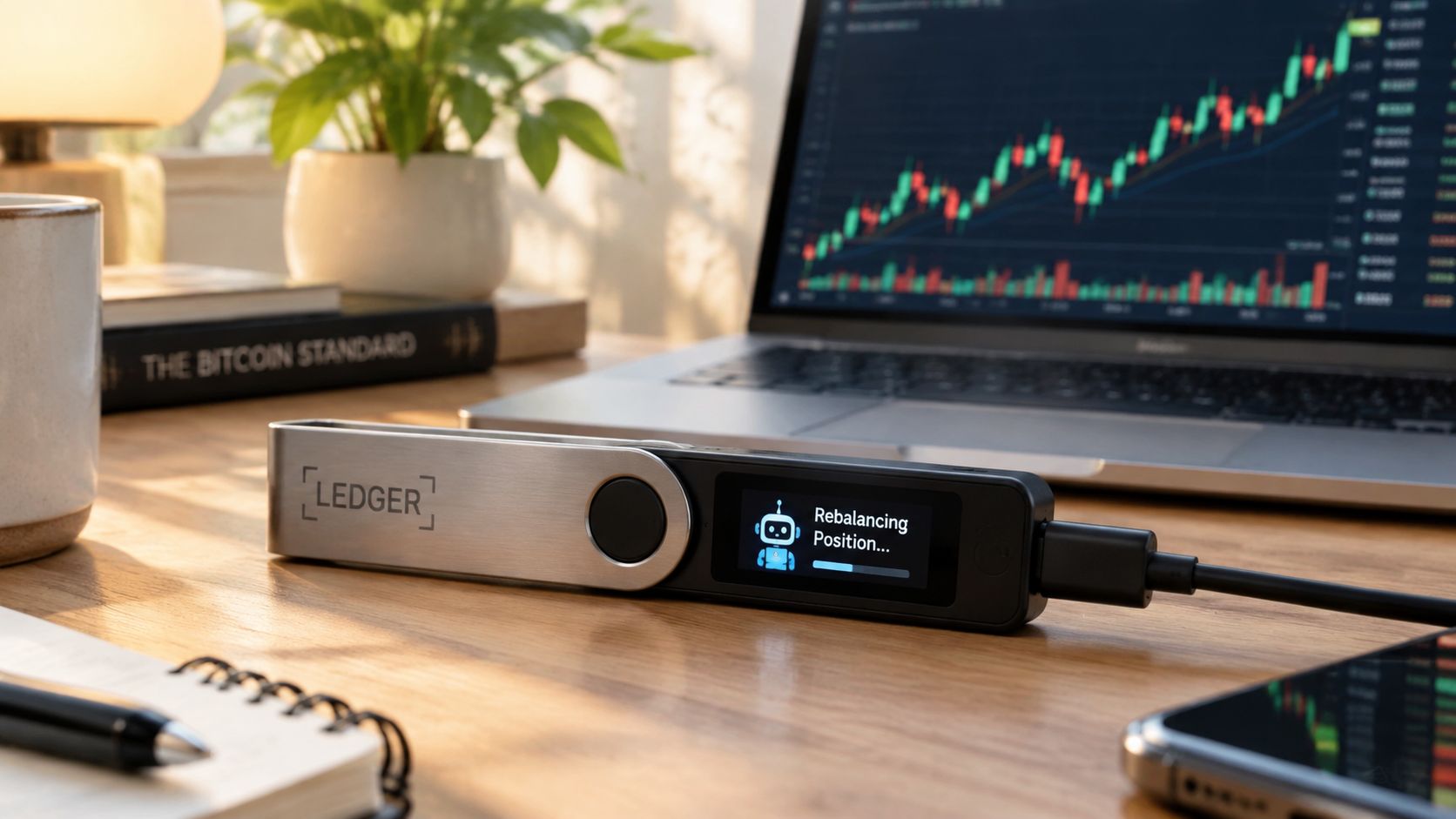
A conventional automation rule might say, “If collateral falls below a threshold, sell a fixed amount of ETH.” An agentic system can examine the broader context, including liquidity, gas conditions, available routes, and the result of an earlier call, before deciding what to do next. That flexibility also creates more ways to fail, which is why key custody and execution boundaries matter from the start.
For readers exploring programmable wallets, account abstraction wallets provide a useful foundation. They can support features such as spending policies, session-style permissions, and transaction flows that are more suitable for software-controlled execution than a single unrestricted private key.
The rest of this guide answers what is agentic automation from a crypto-native perspective. The focus is the execution layer where AI reasoning meets signed transactions, smart contract state, and real capital, not an abstract enterprise software diagram.
What Agentic Automation Actually Means
Agentic automation is software that can perceive context, reason toward a goal, and act through tools. The phrase combines two ideas:
- Agentic behavior means the system pursues an objective, chooses intermediate steps, and adapts when conditions change.
- Automation means those decisions connect to an executable workflow, such as an API call, a transaction, a governance vote, or a notification.
A useful mental model is the perceive, reason, act loop.
Perceive
The agent gathers relevant state. In a DeFi deployment, that might include oracle readings, pool liquidity, lending health, wallet balances, gas estimates, governance posts, or the status of a previous transaction. Agentic automation turns LLM-based agents into workflow-executing systems that can handle both structured data and less structured context, as described by UiPath's explanation of agentic automation.
Reason
The agent interprets the state against a goal. “Keep the treasury's stablecoin exposure inside an approved range” is a goal, not a complete transaction recipe. The system may need to decide whether to swap, stake, claim rewards, repay debt, or wait. It can also decompose the objective into smaller tasks, evaluate tool results, and revise the plan after a failed call.
Act
The agent uses an adapter to perform an approved action. That could mean reading a contract, submitting a swap, voting on a proposal, routing an intent, or asking a human to approve a high-risk step. The agent doesn't magically control the blockchain. It needs a wallet, a signing mechanism, network access, contract permissions, and a policy that defines what it may do.
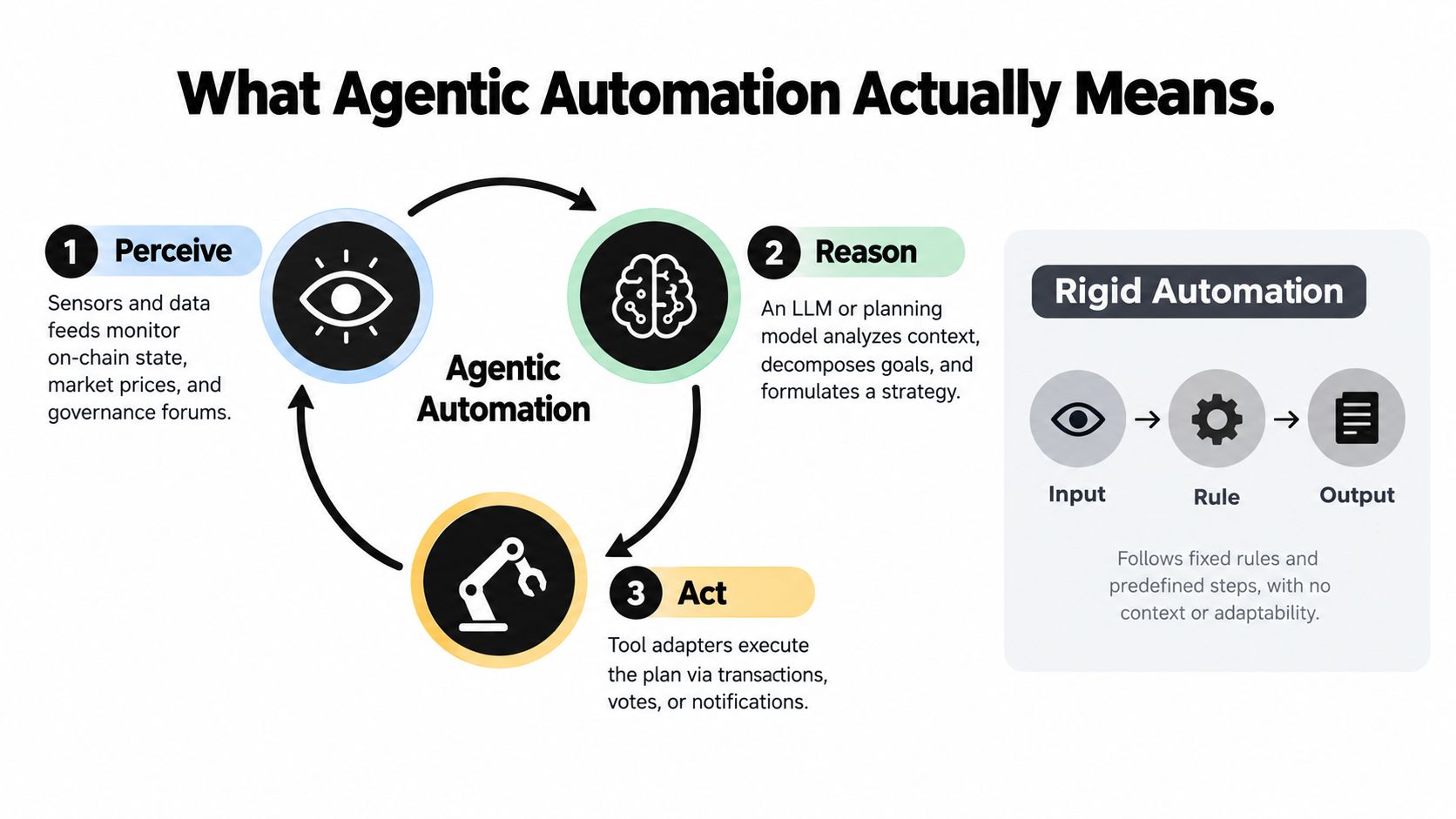
That distinction separates an adaptive agent from a rigid script. A script follows a predetermined sequence. An agent can choose the sequence, select among tools, and stop when the goal is satisfied or a safety condition is triggered.
Multi-agent coordination
A larger system may assign separate roles to specialized agents. One watches network conditions, another compares stablecoin liquidity, a third checks governance context, and an orchestration layer combines their outputs before a transaction is proposed. Shared memory can preserve wallet nonces, prior decisions, and observed outcomes.
This pattern resembles a DAO with specialized contributors, except the contributors are software processes that communicate through an execution framework and ultimately interact with contracts. For a broader conceptual treatment, this 2026 guide to agentic automation offers useful context on how agents move from isolated reasoning to coordinated workflows.
How Agentic Automation Works Under the Hood
A production crypto agent usually has several layers. Treating the LLM as the entire system is a design mistake because the model only supplies part of the decision process. The rest of the stack controls context, tools, permissions, execution, and evidence.
The model and planner
The LLM or reasoning model interprets instructions and unstructured information. It might summarize a DAO proposal, explain why a position is exposed, or compare possible actions. A separate planning component, whether explicit or built into the runtime, breaks a goal into subtasks and sequences them.
For example, “reduce treasury risk” could become:
- Read current balances and protocol exposure.
- Check approved risk limits.
- Compare available withdrawal and swap routes.
- Simulate the proposed calls.
- Request approval or submit through a scoped signer.
- Verify the receipt and update memory.
The planner should not be allowed to invent arbitrary contract calls. It should select from typed tools that expose known capabilities.
Tool adapters and execution
Tool adapters connect reasoning to blockchain primitives. An adapter may wrap a contract ABI, read an oracle, query an RPC endpoint, estimate gas, route a DEX swap, or send a transaction to a signing service. A smart contract remains deterministic once called, so the agent's uncertainty sits mainly in choosing the call, parameters, timing, and sequence. The basics of that execution model are covered in this guide to what a smart contract is.
The signing layer deserves separate treatment. A hot key gives an agent direct authority, while MPC, smart accounts, session keys, and Safe modules can constrain which transactions are possible. The safer design assumes the model may produce a bad instruction and ensures policy controls reject it before funds move.

Orchestration and memory
The orchestration layer coordinates tool calls, retries, handoffs, approvals, and logging. Frameworks such as LangChain, CrewAI, Autonolas, and custom runtimes can fill this role, although the right choice depends on the application's reliability and audit requirements.
Memory has at least two jobs. Short-term memory tracks the current workflow, returned values, transaction receipts, and nonce state. Longer-term storage can preserve approved preferences, historical outcomes, and governance context. Neither should be treated as unquestionable truth. Cached gas estimates can become stale, and a prior successful route may become unsafe after liquidity or contract conditions change.
Prompt injection is another architectural concern. A malicious governance post, token metadata field, oracle-adjacent payload, or web page can contain instructions designed to redirect the agent. The system should separate data from commands, validate tool arguments, simulate transactions, and enforce allowlists outside the model's control.
Agentic Automation vs RPA vs Agentic AI
Crypto teams often use these terms interchangeably, but they describe different layers of capability.
| Dimension | RPA | Agentic AI | Agentic Automation |
|---|---|---|---|
| Trigger model | A fixed event or rule | A user prompt or contextual request | An event, goal, or changing on-chain condition |
| Decision-making | Follows predefined branches | Reasons, drafts, and recommends | Plans, chooses tools, and adapts during execution |
| Execution surface | User interfaces and scripted APIs | Usually text or analysis output | APIs, smart contracts, wallets, votes, and notifications |
| Adaptability | Low when inputs or screens change | High in interpretation, limited in execution | High across multi-step workflows, within policy limits |
| Crypto relevance | Repetitive transfers or monitoring rules | Research, proposal summaries, and trading analysis | End-to-end treasury, DeFi, governance, and marketplace actions |
RPA, or robotic process automation, mimics a known sequence. A crypto example would be a bot that checks a fixed condition and calls the same function with predetermined parameters. It can be fast and predictable, but it won't understand that a route has become illiquid or that an oracle reading conflicts with another signal unless those cases were explicitly programmed.
Agentic AI supplies the reasoning layer. It can read a governance thread, explain a liquidation risk, or draft a rebalancing plan. A chat-only agent may identify the right action but stop before signing anything.
Agentic automation combines the two. It gives a planning system access to execution tools while placing those tools inside an orchestrated workflow. If a DEX call reverts, the agent can inspect the reason, choose an approved alternative, or escalate rather than blindly retrying the same transaction.
Consider a DAO treasury facing an abrupt oracle deviation. An RPA bot may continue following its fixed threshold logic. A chat agent may describe the exposure and recommend a response. An agentic automation system can read the deviation, evaluate permitted routes, simulate a treasury transaction, submit it through a Safe process, and confirm the resulting state.
Practical rule: Use deterministic automation where the path is known. Use an agent when the workflow contains ambiguity, changing inputs, or several valid routes.
The distinction matters because agents introduce variability. That variability can help with exceptions, but it also demands stronger testing, observability, and permission design than a simple scheduled script.
Real Crypto and Web3 Use Cases for Agentic Automation
Crypto already contains many environments where software watches state and initiates actions. The agentic upgrade adds context and flexible planning to those execution loops.
Trading and liquidity
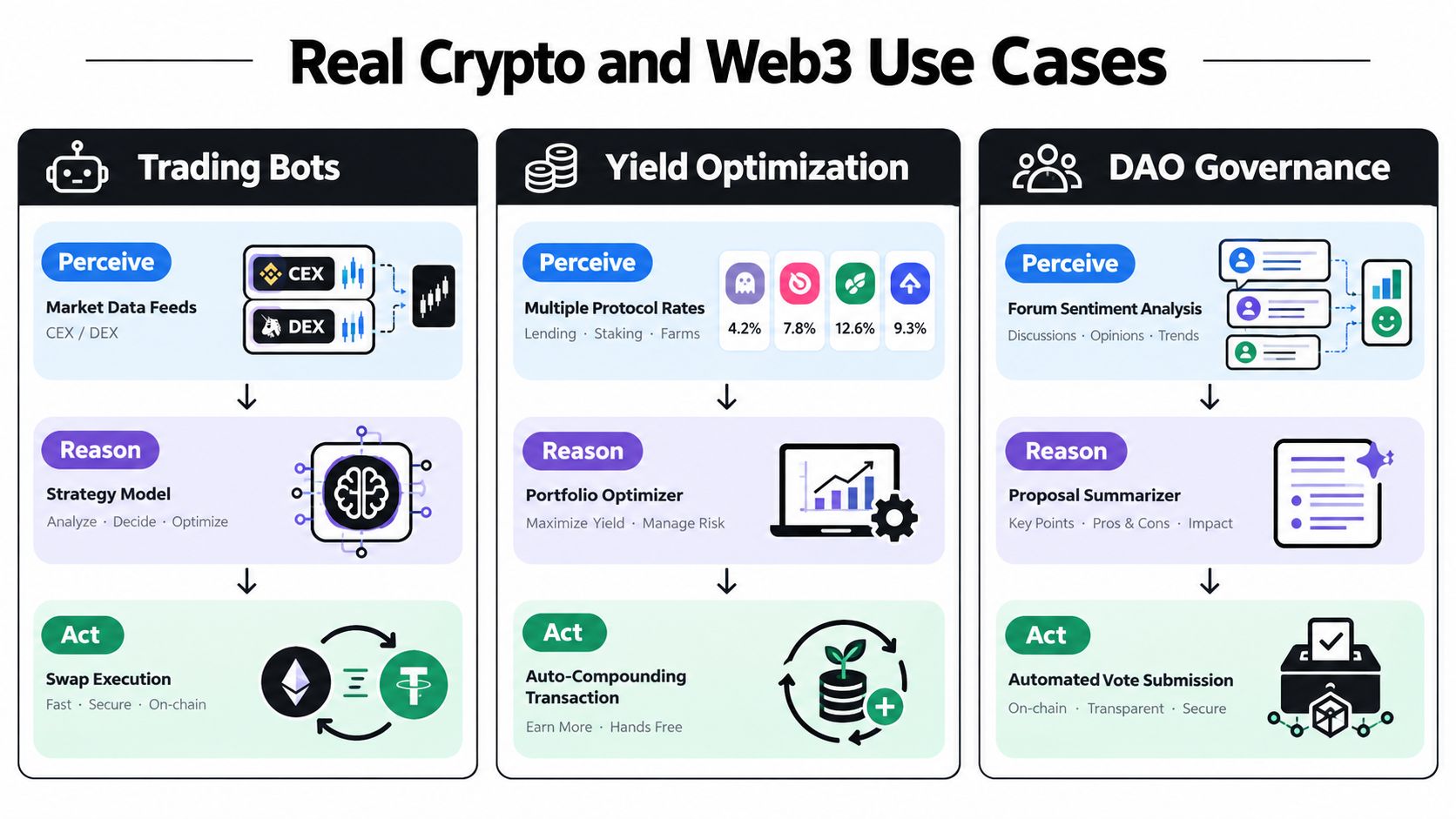
A trading agent can perceive centralized and decentralized order books, funding conditions, pool depth, and transaction costs. It reasons over whether an apparent spread is executable after slippage, fees, latency, and settlement risk. It then acts by routing an approved swap or intent through a chosen venue, potentially using a private relay to reduce exposure to predictable execution.
The key isn't that the agent “knows” the market. It's that the system connects market observations to a bounded execution policy. A strategy still needs limits on assets, price impact, position size, and venues.
Lending and yield
A DeFi automation agent can monitor collateral health, protocol rates, reward availability, and withdrawal conditions. It may claim rewards, move liquidity, harvest a position, or rebalance lending exposure across protocols such as Aave, Morpho, or Pendle when the configured risk conditions change.
The perceive step reads protocol state. The reasoning step compares routes and checks policy. The action step signs a transaction, or places the proposed transaction in a human approval queue. Agentic automation can help with multi-step operations that are difficult to manage manually, while still leaving the user responsible for defining acceptable risk.
NFTs and marketplace activity
An NFT marketplace agent can perceive listing prices, collection liquidity, traits, wallet inventory, and marketplace rules. It reasons over whether a listing is underpriced, whether a trait combination fits the strategy, and whether the purchase remains within a budget. It can then bid, sweep a floor, or list an asset through an approved marketplace adapter.
This use case shows why context matters. A fixed floor-sweeper may buy assets that look cheap but carry unusual transfer restrictions or weak liquidity. An agent can add richer checks, although its judgment still needs deterministic validation before a purchase is signed.
DAO governance
A DAO agent can monitor forum discussions, proposal changes, delegate preferences, and treasury balances. It can summarize competing arguments, simulate possible outcomes, draft a rationale, and prepare a vote. After approval, an execution layer can submit the vote or route an approved treasury action through a Safe multisig.
The agent shouldn't replace governance merely because it can post quickly. A proposal's authority, quorum requirements, timelock, and multisig policy remain on-chain constraints. The agent is most useful as a coordinator that turns scattered information into a reviewable action.
These patterns extend beyond DeFi into Web3 operations, tokenized real-world assets, Layer 2 treasury management, and AI-assisted protocol administration. In every case, the useful test is the same: what does the system perceive, what decision does it make, and which exact transaction or message does it execute?
Tooling and Frameworks Powering Crypto Automation
A crypto-native agent stack usually splits into off-chain intelligence and on-chain authority. The first side handles reasoning, planning, tool calls, and memory. The second side determines what the agent can sign and how the network receives the intended action.
Off-chain builders may choose LangChain or LlamaIndex for retrieval and tool integration, then use CrewAI, AutoGen, or LangGraph for multi-step coordination. Autonolas is another relevant direction for agent services designed around decentralized coordination. These frameworks can help define roles, route outputs between agents, retain workflow state, and add checkpoints around sensitive actions.
The wallet layer should be narrower than the reasoning layer. MPC can distribute key control, while account abstraction and ERC-4337-style smart accounts can support programmable validation and execution rules. Session keys can authorize limited activity for a defined period or purpose. Safe modules can constrain an agent's transaction scope without handing it unrestricted treasury authority.
On-chain execution can also use intent-based systems. With an intent, the agent specifies a desired outcome rather than constructing every low-level transaction detail itself. Systems such as UniswapX, 1inch Fusion, and CoW Protocol are relevant examples of execution models where solvers or relayers help fulfill a stated trade objective.
A practical pipeline looks like this:
- Reasoning runtime: Interprets context and creates a plan.
- Tool layer: Reads contracts, prices, balances, and governance data.
- Signing primitive: Applies wallet policy, caps, session permissions, and approvals.
- Intent or execution layer: Routes the desired outcome to a protocol or solver.
- Verification layer: Checks receipts, state changes, and exceptions.
Builders who want to test an agent without assembling every operational component can examine resources such as Donely's zero-devops agent launch. Whatever tooling you choose, the model should remain replaceable. Policies, signing boundaries, and audit trails shouldn't depend on a single prompt or vendor.
Security, Governance, and Regulatory Risks for Autonomous Agents
An autonomous agent compresses the path from observation to action. That can reduce manual delay, but it also compresses the path from a bad input to a financial loss.
A malicious payload may attempt prompt injection through a governance forum, token metadata, or an external data source. A compromised key vault can turn a harmless reasoning error into an unauthorized transfer. A DAO that lets an agent influence a multisig may face governance manipulation, while predictable transaction timing can expose the system to sandwiching, replay attempts, or targeted interference.
Security controls should sit outside the model. Spending caps, contract allowlists, asset restrictions, simulation checks, circuit breakers, nonce protection, and on-chain rate limits can reduce the blast radius. A human approval gate remains sensible for unusual treasury moves, governance upgrades, or transfers that fall outside normal policy.
The trust gap is substantial. One survey reported that only 6% of companies fully trust AI agents for core business processes, while 31% identify cybersecurity and privacy as the main barrier, according to Fortune's coverage of the survey. Those findings don't prove that every crypto deployment is unsafe, but they do challenge the idea that autonomy alone creates reliable production value.
Regulation adds another layer. Teams must assess whether an agent's activity creates obligations involving custody, money transmission, market conduct, sanctions screening, or governance responsibility. MiCA, FinCEN guidance, and the EU AI Act can affect the surrounding organization even when the agent itself is only software. The exact treatment depends on the service, jurisdiction, control model, and transaction activity, so legal review belongs in the deployment process.
For a practical security primer, Agntz's guide to securing AI agents is a useful companion. Crypto users should also review how to avoid crypto scams before connecting an unfamiliar agent to a wallet.
A Practical Checklist for Crypto Readers
Before deploying an autonomous agent, ask:
- Is the workflow agent-shaped? If it only checks one condition and calls one function, a deterministic bot may be safer.
- What must the agent perceive? List contracts, oracles, market data, governance sources, and any untrusted text.
- Where should reasoning happen? Keep complex planning off-chain, but make execution policies explicit and independently enforceable.
- What can the wallet sign? Separate analytics access from transaction authority, and use a smart account, session key, MPC setup, or Safe module where appropriate.
- What happens after failure? Define simulation, retries, escalation, kill switches, and a complete audit trail before launch.
A useful maturity ladder starts with a read-only analytics agent, then moves to a dry-run agent that proposes transactions, a spending-capped agent with narrow permissions, and finally a fully autonomous system. Each step should earn broader authority through testing and observable reliability, not enthusiasm.
Agentic automation is best understood as an on-chain execution layer with an AI planning interface. Start with a bounded workflow, protect the signer, verify every state change, and keep human control over decisions whose downside your treasury can't absorb.
Coiner Blog publishes practical guides and balanced analysis on DeFi, Web3, AI and crypto, smart contracts, Layer 2 networks, NFTs, and tokenized real-world assets. Visit Coiner Blog to explore more crypto-focused explainers and risk-aware technology coverage.