
Fungible vs Non Fungible Assets in Crypto Explained Clearly
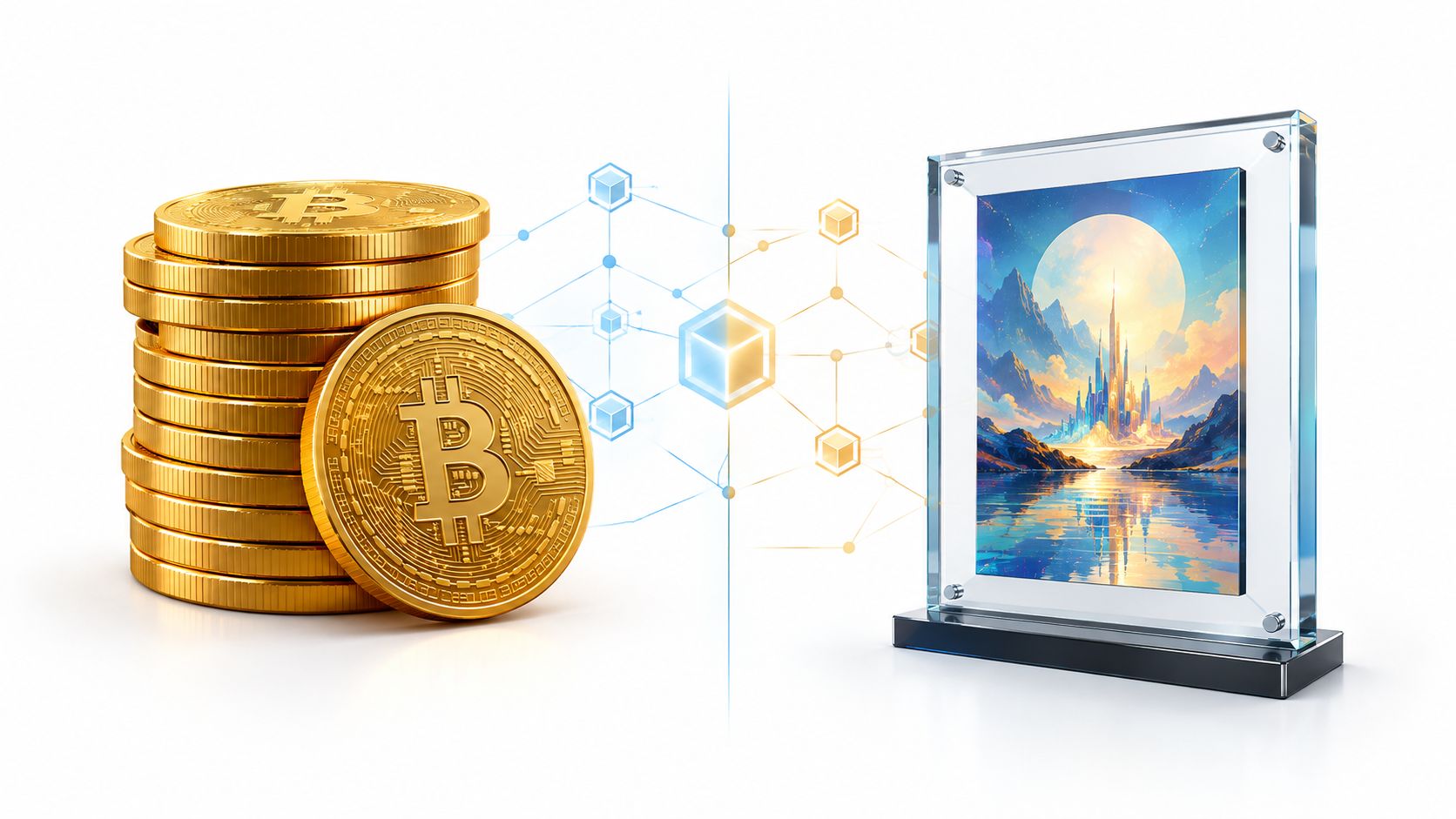
You've probably felt the difference already without naming it.
A stablecoin swap on Ethereum, Solana, or a Layer 2 network can feel routine. You pick a pair, check the rate, approve the token, and move on. Then you open an NFT marketplace and everything slows down. Suddenly you're comparing traits, token IDs, floor prices, and whether a specific piece matters to anyone else.
That gap in experience is the fastest way to understand fungible vs non fungible. One category is built for interchangeable units and smooth transfer. The other is built for unique ownership and item-level identity. Most explainers stop there. The more useful view is that crypto is increasingly living in the messy middle, where assets can act fungible in one context and non-fungible in another.
Table of Contents
- Why This Swap and That NFT Feel So Different
- Technical Standards Behind Each Asset Type
- Side by Side Comparison of Fungible and Non Fungible Assets
- Where Each Asset Type Actually Gets Used
- Valuation, Liquidity, and Pricing Dynamics
- How to Verify Any Asset on Chain
- The Hybrid Ground Between Fungible and Non Fungible
- Practical Takeaways and Common Pitfalls
Why This Swap and That NFT Feel So Different
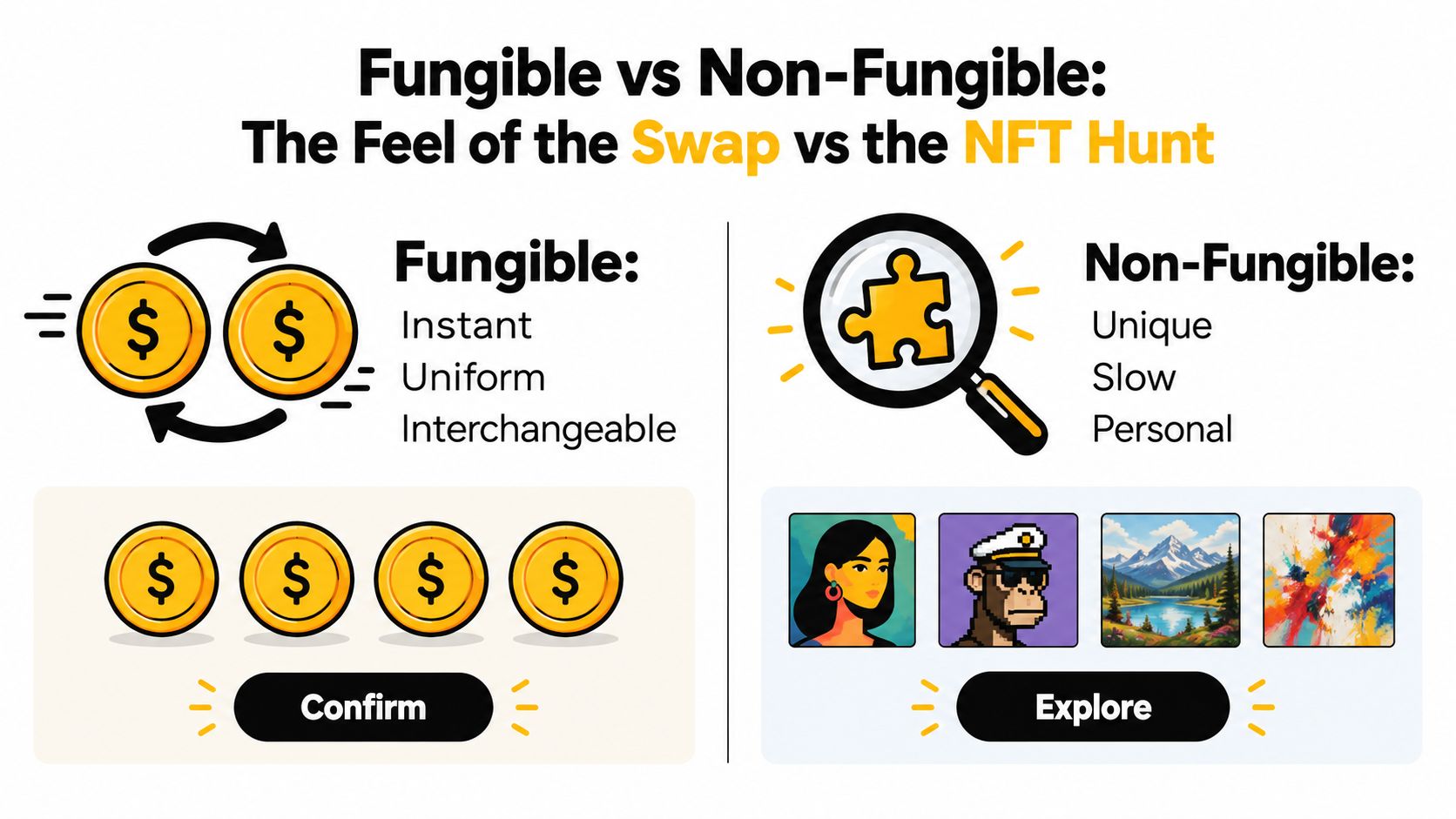
If you swap USDC for USDT, you usually don't care which exact unit you receive. You care about the amount, the route, the fee, and whether the price stays close to par. That's fungibility in action. Each unit of the same asset is interchangeable with every other unit of that asset.
Legal and commercial practice used that idea long before blockchain. Legal scholarship describes fungible things as items “of which any unit is from its nature or by mercantile usage treated as the equivalent of any other unit,” while another definition says fungible moveable goods are customarily determined by number, measure, or weight, as discussed in Michigan Law Review scholarship on fungibility and NFTs. Cash, barrels of oil, and commodity grain fit the model. One unit can replace another without changing the deal.
Interchangeable doesn't mean more important
Readers often confuse fungible with “more useful” and non-fungible with “less practical.” That isn't right. Fungibility describes interchangeability, not quality or utility.
An NFT can provide access, represent a deed, track a game item, or prove provenance. It's still non-fungible if each token is individually identified. If you want to create NFT art with AI, the output may be visually similar to other works in a collection, but on-chain ownership still points to a specific token rather than a generic balance.
Why the user experience changes
When an asset is fungible, wallets and exchanges can treat your holdings as a balance. You own 100 units, then 90 after a transfer, then 110 after another deposit.
With a non-fungible asset, the system tracks which item you own, not just how many. That one change affects everything:
- Trading speed: Swaps can be instant because buyers accept equivalent units.
- Pricing logic: NFT buyers evaluate the exact token, not a generic unit.
- Liquidity shape: Fungible assets pool into markets. NFTs stay scattered across listings.
- Emotional behavior: People trade tokens. They shop for NFTs.
Practical rule: Ask one question first. “If I receive a different unit of the same asset, do I care?” If the answer is no, you're usually looking at something fungible.
Technical Standards Behind Each Asset Type
On-chain, fungibility isn't a vibe. It's encoded in token standards and contract logic.
Token Standards at a Glance
| Standard | Asset Type | Identification Method | Batch Transfer | Metadata Handling |
|---|---|---|---|---|
| ERC-20 | Fungible | Account balances by address | Commonly balance-based transfers, not item-specific token IDs | Usually minimal at the token level |
| ERC-721 | Non-fungible | Unique tokenId per asset |
Not designed around fungible batch balances | Per-token metadata such as name, description, image URI, and traits |
| ERC-1155 | Multi-token | Contract uses token ID plus balance query | Supports batch-style handling across token IDs | Can represent fungible, non-fungible, and semi-fungible items |
How fungible contracts think
Ethereum documentation describes ERC-20 as the dominant standard for fungible tokens, where each unit is interchangeable with any other unit of the same token, with examples including virtual currencies, staking tokens, and voting tokens in the Ethereum token standards documentation.
That design usually means the contract tracks balances per address rather than assigning identity to each unit. Your wallet doesn't need to know which exact token you hold. It only needs to know how many. That's why DEXs, DeFi lending pools, and routing systems can move ERC-20 assets so efficiently.
If you want a deeper walkthrough of how this standard works in practice, Coiner Blog also has a guide on ERC-20 tokens and how they work.
How NFT contracts think
ERC-721 is different by design. The standard interface for NFTs on Ethereum was proposed in January 2018, and its purpose is to track and transfer unique tokenized assets such as deeds, artwork, or songs in the official ERC-721 specification.
Instead of “Alice owns 10 units,” the contract records something closer to “Alice owns token 4812.” That token can carry metadata, either directly on-chain or by referencing a URI. According to a code-level breakdown of ERC-20 and ERC-721 behavior, ERC-20 tokens are interchangeable and divisible, while ERC-721 tokens are indivisible and tracked by unique identifiers with optional metadata such as name, description, image URI, and trait lists in this technical comparison.
ERC-1155 sits between the two
ERC-1155 matters because it weakens the clean binary that many explainers rely on. Ethereum and OpenZeppelin documentation describe ERC-1155 as a multi-token standard that can manage fungible, non-fungible, and semi-fungible tokens inside a single smart contract, using an additional token ID in balance queries, as explained in the Ethereum ERC-1155 overview.
That makes ERC-1155 especially useful in gaming and inventory systems. One contract can manage stackable items such as gold, limited consumables, and one-of-one gear at the same time.
A token standard doesn't decide whether an asset is valuable. It decides how software recognizes, transfers, and accounts for that asset.
Side by Side Comparison of Fungible and Non Fungible Assets
The definition alone is often not enough to grasp the full implications. The cleanest way to fix that is to compare how each asset behaves when you try to trade it.
Fungible vs Non Fungible Core Comparison
| Criterion | Fungible Asset | Non Fungible Asset |
|---|---|---|
| Liquidity | Usually pools into shared markets where any unit can match any buyer | Depends on finding a buyer for that specific item |
| Divisibility | Often divisible into smaller units | Usually transferred as a whole item |
| Pricing | Market gives a live price for the asset class | Price varies by token, traits, provenance, and bidder interest |
| Discoverability | Low effort. Ticker, pair, amount | Higher effort. Collection, token ID, traits, history |
Four places readers get confused
Liquidity is the biggest practical difference. If you hold ETH or USDC, exchanges and automated market makers can route your order into broad pools of demand. If you hold one NFT, you might wait for a buyer who wants that exact item rather than any item from the collection.
Divisibility sounds simple, but it changes who can participate. Fungible assets can usually be sliced into small balances for payments, collateral, and portfolio sizing. Non-fungible assets are typically whole units. You either own the token or you don't.
Pricing is where the market structure becomes visible. A fungible token gets a price per unit. An NFT gets a negotiation. Even when a collection has a floor, buyers still check rarity, visual appeal, and listing quality before they bid.
Discoverability is the hidden friction. A swap interface needs the correct contract and a liquid pair. An NFT purchase often requires reviewing metadata, checking authenticity, comparing nearby listings, and deciding whether uniqueness is a feature or a burden.
The practical takeaway
None of this means fungible assets are “better” and NFTs are “worse.” It means they answer different ownership problems.
Fungible assets are efficient when the market wants uniform units. Non-fungible assets are useful when the market cares about specific identity.
That's why Bitcoin, Ethereum, stablecoins, and most DeFi assets work as fungible instruments, while digital art, deeds, access passes, and many game items lean toward non-fungible design.
Where Each Asset Type Actually Gets Used
Crypto makes more sense when you stop defining tokens in isolation and look at what holders own.
DeFi runs on fungible balances
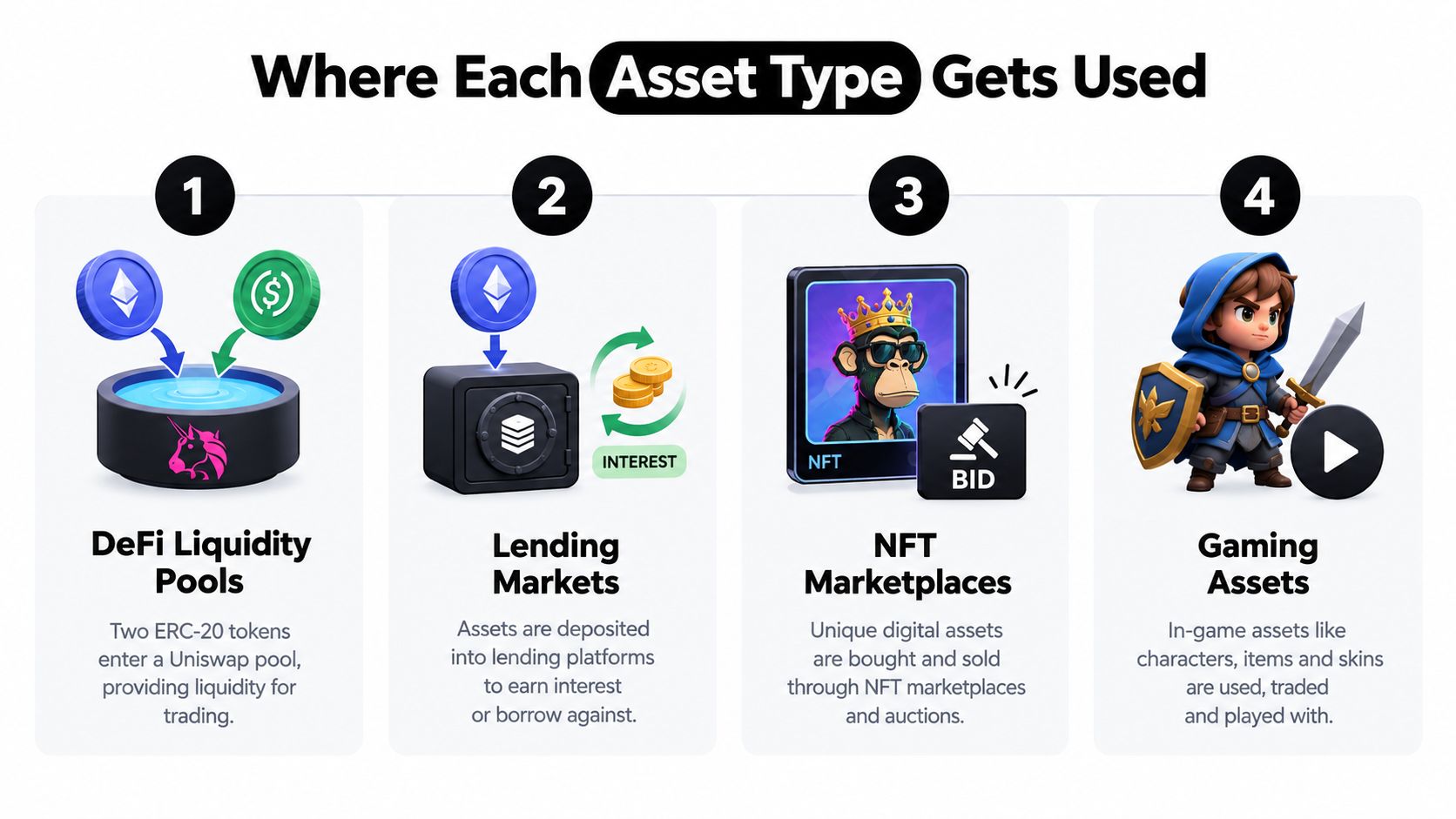
In a Uniswap pool, two fungible assets pair inside an AMM. A USDC and ETH pool doesn't care which exact unit of USDC you deposit. The pool only tracks balances and pricing relationships between the paired assets. That's classic ERC-20 behavior.
Lending markets work similarly. When a user deposits a fungible token into a lending protocol, the protocol often returns a fungible claim token representing that deposit position and the right to redeem under the protocol's rules. The holder owns a transferable claim, not a unique object.
Stablecoin swaps are the cleanest retail example. Swapping between USDC and USDT usually feels routine because the market treats each token as an interchangeable unit within its own supply. Traders still care about liquidity venue, bridge risk, and issuer risk, but not the identity of each individual token.
NFTs and gaming need item-level ownership
ERC-721 became the default language for many collectibles because it records ownership of a specific item. That's useful for profile-picture collections, digital art, tokenized media, and membership-style assets where token identity matters.
A game inventory often needs something more flexible. An ERC-1155 contract can issue stackable fungible items such as gold or ammunition alongside non-fungible items such as a legendary sword. The player doesn't just own “game value.” The player owns a structured inventory with different accounting rules for different objects.
In games, fungibility often depends on the item type. Gold should stack. A named sword with unique stats usually shouldn't.
Tokenization pushes both models into the real world
Tokenization means converting ownership rights to an asset into a digital token on a blockchain, and the distinction matters because fungible tokens can represent interchangeable units such as equal fractions of a painting while non-fungible tokens can represent unique items that can't be exchanged one-for-one, as explained in this XRPL lesson on RWA tokenization.
That creates a useful split in real-world asset design:
- Fungible tokenization: Equal units of a fund, treasury exposure, or pooled asset.
- Non-fungible tokenization: A deed, a title, a specific collectible, or a singular piece of property.
- Mixed systems: A unique underlying asset with fractional claims layered on top.
This is one reason tokenization has become such an active part of Web3 discussion. The chain doesn't just move coins anymore. It can track rights, claims, and objects with very different market behavior.
Valuation, Liquidity, and Pricing Dynamics
Pricing is where the fungible vs non fungible distinction stops being academic and starts affecting execution.
Fungible vs Non Fungible Pricing Mechanics
| Pricing Dimension | Fungible Assets | Non Fungible Assets |
|---|---|---|
| Quote format | Per-unit market price | Item-specific listing or bid |
| Liquidity view | Depth, spread, slippage | Floor, rarity, time-on-market |
| Trade path | Continuous matching or AMM routing | Listing, auction, offer, negotiation |
| Reference value | Strong shared market benchmark | Weak benchmark unless the item is very comparable |
Why fungible markets feel tighter
A fungible market can support continuous quoting because any buyer can accept any equivalent unit. On a centralized exchange, an ETH/USDC market works because the order book doesn't need to care which ETH coin is being sold.
On AMMs, pricing follows a deterministic pool formula. Traders may not think about the math during a swap, but the software can quote a route instantly because the pool treats units as interchangeable. That's what makes slippage, depth, and routing the right language for fungible execution.
Why NFT pricing stays noisy
A non-fungible market doesn't have one order book in the same sense. A collection might have many listings, but each token still has its own identity and can command a different price.
That's why floor price is useful but incomplete. A floor tells you the cheapest listed item in a collection, not the fair value of a particular token with specific traits, provenance, or social status. If you need a refresher on that distinction, Coiner Blog's guide to NFT floor price is a helpful companion.
The bigger insight
Fungibility changes with context.
A token can be fungible for transfer but non-fungible for regulation. A real-world credit can trade like a generic unit until a buyer starts caring about origin, maturity, or jurisdiction. An NFT collection can look non-fungible at the item level but almost fungible at the floor when traders treat many pieces as substitutable.
That's why smart investors don't stop at labels. They ask how the market prices the asset, how quickly they can exit, and what information buyers use when they decide whether two units are “close enough” to substitute.
How to Verify Any Asset on Chain
Before you trade, stake, bridge, or bid, take five minutes and verify what the asset is.
Start with the contract, not the logo
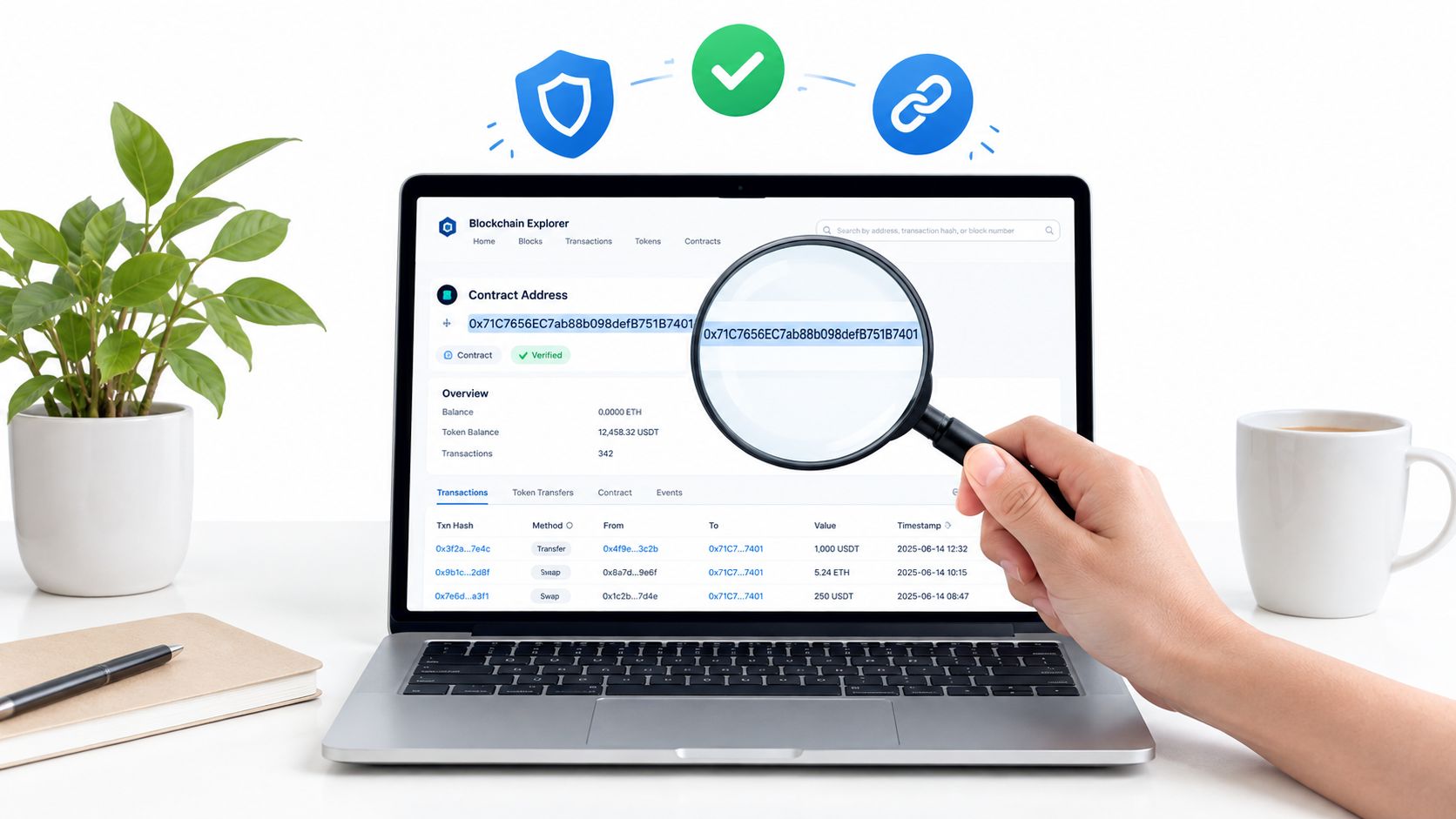
The safest workflow begins with the contract address from the project's official site or app interface. Paste it into an explorer such as Etherscan, BscScan, or Solscan. If you're new to that process, Coiner Blog has a straightforward explainer on what a blockchain explorer does.
Then check the basics:
- Verified code: A verified source code badge makes review easier.
- Contract type: Look for clues that it follows ERC-20, ERC-721, or ERC-1155 behavior.
- Holder distribution: Concentrated ownership can create exit risk.
- Recent transfers: Repetitive or strange activity can signal wash trading or internal shuffling.
What to inspect for fungible tokens
For a fungible token, the key fields are usually decimals, total supply, and balance-related read functions such as balanceOf. You're confirming that the contract behaves like an interchangeable balance system rather than an item registry.
Also inspect permissions. If the owner can mint freely, pause transfers, or blacklist addresses, that may matter a lot more than the token's marketing copy.
What to inspect for NFTs
For ERC-721 and ERC-1155 assets, verify the token ID. Confirm that the token exists, who owns it now, and whether the transfer history looks coherent.
Metadata deserves a quick check too. If the token points to a URI, inspect whether the content looks stable and whether the collection identity matches the marketplace listing.
Verification habit: Don't ask “Is this listed?” Ask “Does the contract behavior match the story being sold?”
Red flags worth taking seriously
- Unverified contracts: Harder to inspect, easier to misrepresent.
- Owner-heavy permissions: Minting or transfer controls can change market behavior.
- Approval sprawl: Old approvals can become a wallet risk.
- Mismatch between standard and marketing: A project might describe uniqueness while issuing a plain fungible token, or imply broad liquidity for an asset that doesn't trade that way.
Before a large swap or purchase, a small test transaction is still one of the best habits in crypto.
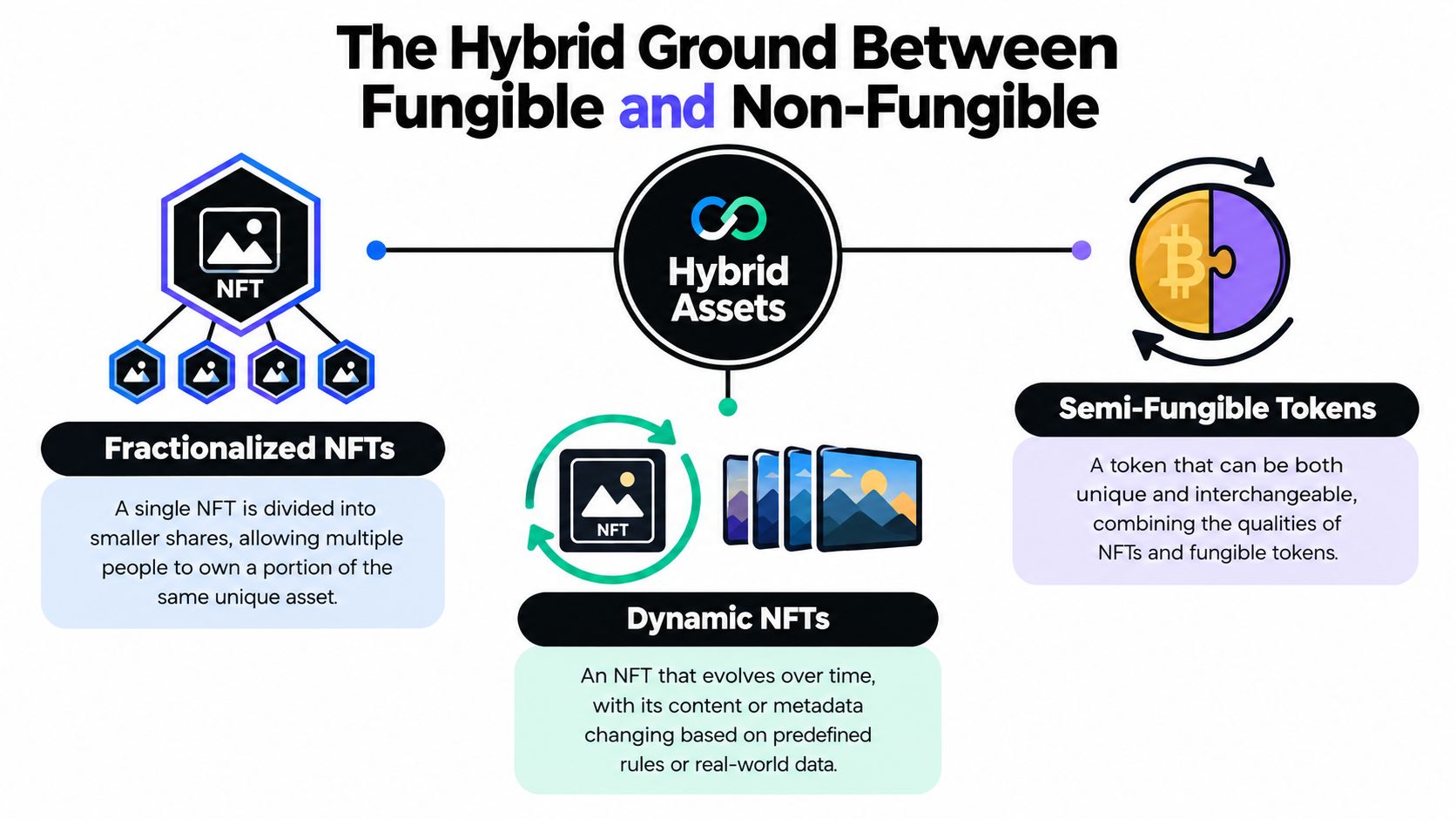
The Hybrid Ground Between Fungible and Non Fungible
The market isn't moving toward a cleaner distinction. It's moving toward hybrids.
Fractional ownership changes the user experience
A fractionalized NFT starts with a unique underlying asset, then places it in a vault contract and issues fungible shares against it. The artwork, deed, or collectible stays singular. The economic exposure becomes divisible.
That model matters because many users don't want the responsibility of buying and exiting a whole illiquid object. They want tradable slices. Outside crypto, the same ownership instinct appears in platforms that let people buy shares in real estate, even though the legal packaging can differ sharply from on-chain versions.
Semi-fungible design is no longer niche
ERC-1155 already showed that one contract can handle fungible and non-fungible logic together. Newer experiments push further by trying to make assets behave like divisible tickets at one stage and one-of-one items at another.
That's why “fungible vs non fungible” increasingly works better as a spectrum than a binary. Trading rules, settlement rules, and legal rights don't always line up neatly.
A short visual explainer helps here:
Real-world assets make the gray area obvious
Some current coverage has noted a renewed rise in NFT sales volume in 2025 even while total market value remained far below earlier peaks, suggesting that utility and transaction frequency may be diverging from headline valuations in this 2025 market coverage on NFT activity. That's a useful clue. The market may care less about pure collectible narrative and more about what the asset does.
Real-world asset tokenization pushes that trend further. A tokenized treasury position may look fungible because units are standardized. Yet maturity dates, jurisdiction, compliance controls, and legal wrappers can make some units meaningfully different in practice. The chain can say “same token.” The regulator or institutional buyer may say otherwise.
The right question often isn't whether an asset is fungible. It's who gets to treat it as interchangeable, under which rules, and for what purpose.
Practical Takeaways and Common Pitfalls
If you only keep one framework from this article, keep this one.
A working checklist
- Verify the standard first: Check whether the contract behaves like ERC-20, ERC-721, or ERC-1155 before you assume anything about liquidity or ownership.
- Review concentration risk: A token can be fungible and still dangerous if a few wallets control too much of the supply.
- Test the exit path: Fungibility matters most when you try to sell. Small test trades reveal more than a polished homepage.
- Check approval hygiene: Old token approvals can become a separate risk from the asset itself.
Mistakes people keep making
Treating an NFT floor as fair value is still one of the most common errors. A floor is a market reference, not a guarantee that your item can sell at that level.
Another frequent mistake is assuming a wrapped version of a fungible asset behaves exactly like the native one in every venue. Bridge design, issuer trust, and redemption conditions can change the risk profile even when the ticker looks familiar.
Hybrid assets add one more trap. People see “fractional,” “tokenized,” or “compliant” and assume the legal and market realities are settled. They usually aren't. Rights, transfer restrictions, royalty structures, and venue support can all shift how tradable the asset really is.
What matters going forward
Token standards will keep evolving. So will enforcement around securities-like behavior, marketplace rules, and programmable metadata.
The strongest habit isn't memorizing definitions. It's learning to ask better questions before you click swap, bid, or bridge. In crypto, the edge often comes from understanding not just what an asset is called, but how it behaves when markets get stressed.
Coiner Blog publishes practical explainers like this for readers who want clearer thinking around tokens, NFTs, DeFi mechanics, and the emerging hybrid layer between them. If you want more grounded breakdowns of how crypto assets work in the wild, visit Coiner Blog.