
Blockchain Technology Basics: A 2026 Explainer

A common definition of blockchain describes it as a digital ledger. While accurate, this overlooks the crucial aspect.
A key breakthrough is that a blockchain lets a group of strangers keep a shared record of what happened without handing control to a bank, platform, or government database. If you've ever wondered why blockchain technology basics matter far beyond crypto prices, that's the starting point.
This matters now because Web3, DeFi, tokenization, NFTs, Layer 2 networks, and AI-linked crypto apps all rest on the same foundation. If the foundation feels fuzzy, the rest of the ecosystem looks like hype. Once the basics click, a lot of the noise disappears and the design choices start to make sense.
Table of Contents
- What Is Blockchain Technology and Why Does It Matter
- The Unbreakable Chain How Blocks and Hashing Work
- How Blockchains Agree on the Truth Without a Central Authority
- Beyond the Ledger Smart Contracts dApps and Tokens
- The On-Chain Revolution Exploring Real-World Use Cases
- Navigating the Frontier Risks Security and Scalability
- Your First Steps into the World of Web3
What Is Blockchain Technology and Why Does It Matter
A shared notebook no single party controls
A good way to understand blockchain technology basics is to think of it as a shared digital notebook. Many participants hold a copy, everyone can check what's been written, and new entries are added in a way that's meant to be hard to secretly change later.
That's different from a normal database. In a traditional system, one company usually owns the server, sets the rules, and can update the record from the center. In a blockchain network, the record is shared across multiple participants, and the system is designed so history is append-only rather than rewritten.
IBM's overview of blockchain history captures why this idea has real depth. Stuart Haber and W. Scott Stornetta proposed a cryptographically secure chain of blocks in 1991, added Merkle trees in 1992, Satoshi Nakamoto introduced the Bitcoin white paper in 2008, and the Bitcoin network went live in 2009, which is widely treated as blockchain's practical mainstream launch in IBM's blockchain timeline.
Why this changes digital trust
The big idea isn't “crypto coin goes up.” It's digital trust without a middleman.
If two people want to exchange value online, the classic problem is simple. Who keeps the official record, and why should everyone trust that keeper? Banks solve that by being the trusted intermediary. Big tech platforms solve it by becoming the central operator. Blockchain tries a different route by making the ledger shared, cryptographically secured, and visible to the network participants.
Practical rule: Blockchain is most interesting when multiple parties need the same record but don't want one party to own the truth.
NIST described blockchain as an append-only ledger that records full transactional history, is cryptographically secure, and is shared across multiple participants, helping solve the double-spending problem without a central intermediary, as summarized in that same IBM blockchain explainer.
That's why blockchain became the base layer for much more than Bitcoin. Once you have an immutable, distributed record, you can build smart contracts, tokenization systems, and decentralized finance on top of it. If you want a broader view of where this heads next, Coiner Blog's guide to what Web3 technology means is a useful next stop.
Here's the simplest mental model:
- Traditional database: One administrator updates records.
- Blockchain ledger: A network agrees on the record.
- Traditional trust: “Trust the institution.”
- Blockchain trust: “Trust the system rules and verify the record.”
That shift is why blockchain matters. It changes how people coordinate online when they don't want to rely on a single gatekeeper.
The Unbreakable Chain How Blocks and Hashing Work
Near the heart of blockchain technology basics is one elegant idea. Records aren't just stored. They're linked.
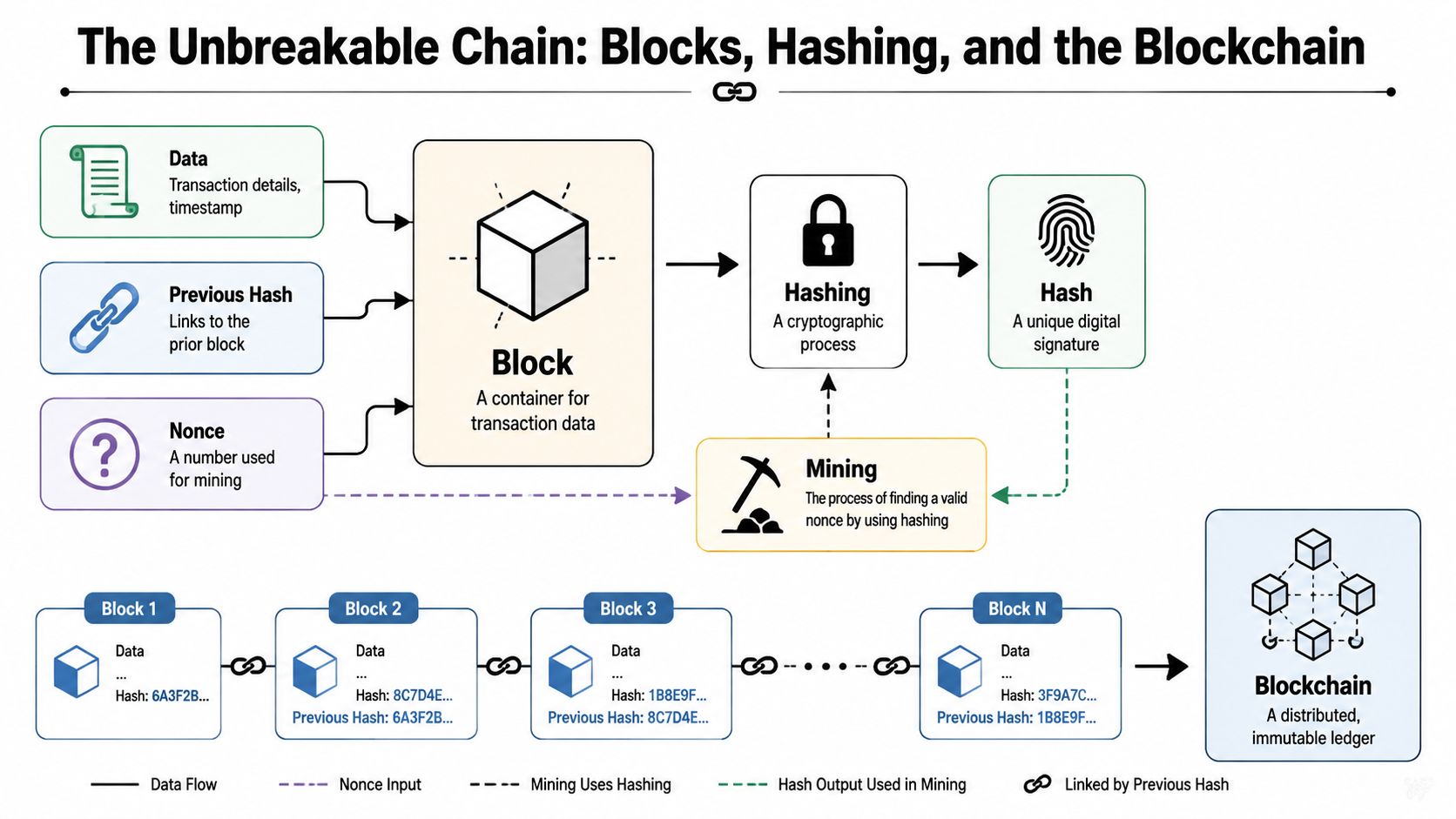
To make that concrete, start with the visual below.
What a block actually contains
A block is a container for data. Depending on the chain, that data can include transactions and metadata that help the network validate and organize the record.
A beginner-friendly way to picture one block is this:
- Data: The transactions or records being added
- Timestamp or ordering data: Information that helps place the block in sequence
- Previous hash: A reference to the block before it
- Hash: A unique cryptographic output tied to the block's contents
You'll also hear the term nonce, especially in mining discussions. That's a value miners vary while trying to produce a valid block under Proof of Work rules.
If you want to see the earliest famous block in context, Coiner Blog has a beginner-friendly look at the Bitcoin genesis block.
Why hashing makes tampering obvious
A hash works like a digital fingerprint for a block's contents. Change the contents, and the fingerprint changes too.
NIST explains the core mechanism clearly in its blockchain report. Each block contains the hash of the previous block, so editing historical data changes that block's digest and invalidates every later block in the chain, as described in NIST IR 8202.
That point trips up a lot of new readers. They hear “immutable” and assume blockchain is magical. It isn't magic. It's structure.
A blockchain resists tampering because the past is chained to the present.
If someone altered an older block, they wouldn't just need to change one record. They'd break the links that connect that block to every block after it. In a shared network, other participants would see the mismatch.
This short video helps if you prefer a visual walk-through.
Here's the practical takeaway:
- Blockchain security isn't just encryption
- It's append-only history
- It's cryptographic linkage
- It's network agreement about the valid chain
That combination makes blockchain a strong fit for audit trails, settlement records, and provenance. It's far less suited to situations where old records need constant silent editing.
How Blockchains Agree on the Truth Without a Central Authority
A blockchain can store records in linked blocks, but that still leaves one huge question. Who gets to add the next block?
That's the job of consensus. Consensus mechanisms help a decentralized network agree on the valid state of the ledger without appointing a single boss.
The consensus problem in plain English
If thousands of computers participate in a blockchain, they need rules for deciding which transactions are valid and which version of the ledger counts as the canonical one.
Without those rules, anyone could spam fake records, reorder transactions, or try to spend the same asset twice. Consensus gives the network a method for settling disputes and continuing with one accepted history.
Two models dominate beginner discussions:
- Proof of Work
- Proof of Stake
Proof of Work is the original model associated with Bitcoin. You can think of it as a competition where participants expend computational effort to earn the right to propose the next block.
Proof of Stake works differently. Instead of racing with hardware, validators lock up network assets and participate according to the protocol's staking rules. It's often easier for newcomers to picture it as a stake-weighted validation system.
Proof of Work and Proof of Stake side by side
| Feature | Proof of Work (PoW) | Proof of Stake (PoS) |
|---|---|---|
| How it chooses block producers | Participants compete through computational work | Validators participate based on assets they stake |
| Primary resource used | Hardware and electricity | Staked tokens |
| Popular association | Bitcoin | Ethereum and many newer chains |
| Barrier to participation | Specialized equipment can matter | Owning stake or delegating stake matters |
| Security intuition | Attacker would need dominant computational power | Attacker would need dominant stake influence |
| Beginner analogy | Puzzle race | Stake-weighted validator selection |
You'll also hear about a 51% attack. That phrase refers to a situation where one actor or coordinated group gains majority influence over the network's validating power, then tries to manipulate transaction ordering or chain history. The exact mechanics differ between PoW and PoS, but the core concern is the same: too much control concentrated in one place.
Consensus is the engine of decentralization. If the engine weakens, the network starts looking more like a database with extra steps.
Neither model is perfect. PoW has a long security track record and a straightforward design philosophy. PoS often aims for different trade-offs around participation and efficiency. The better question isn't “Which one wins forever?” It's “Which security model fits the use case?”
For readers who enjoy the history behind these design choices, Coiner Blog's archive on blockchain history adds useful context.
Beyond the Ledger Smart Contracts dApps and Tokens
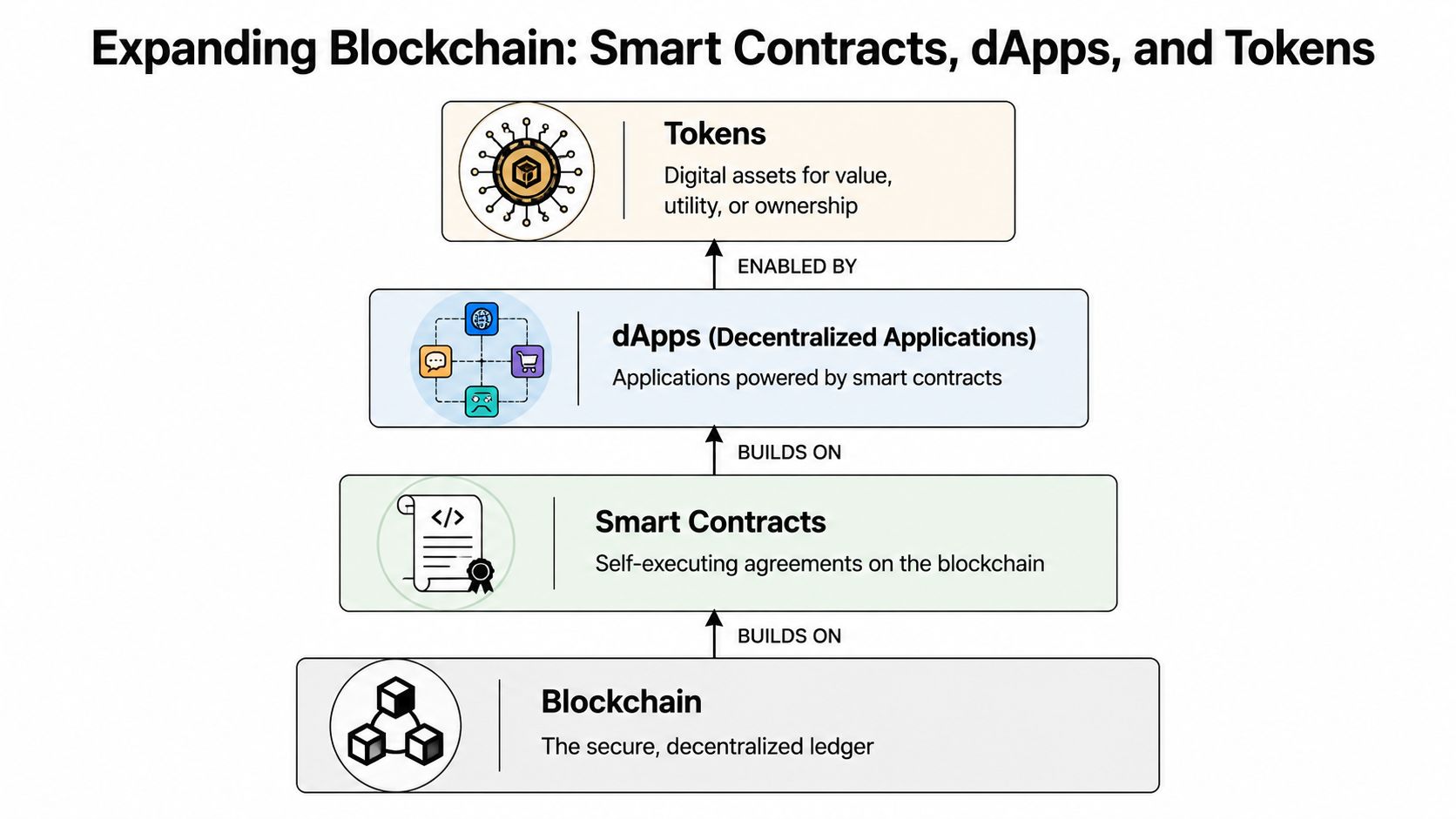
A blockchain that only records transfers is already important. A blockchain that can run programmable logic is where things get much more interesting.
Here, many readers first feel the jump from “distributed ledger” to “Web3 platform.”
Smart contracts turn records into logic
A smart contract is code deployed on a blockchain that executes when its conditions are met. The classic analogy is a vending machine.
You insert the correct payment, choose an item, and the machine dispenses the snack. No cashier needs to interpret your request. The rules are built into the system.
On a blockchain, smart contracts can hold assets, apply rules, and trigger outcomes automatically. That means developers can build systems where users don't just send coins back and forth. They interact with on-chain logic.
Examples include:
- Swaps: Exchange one token for another through protocol rules
- Lending markets: Deposit one asset and borrow another against it
- NFT minting: Create unique on-chain assets with ownership records
- DAOs: Coordinate treasury actions or voting through contract logic
How dApps and tokens fit together
A dApp, short for decentralized application, usually combines a user interface with one or more smart contracts running on a blockchain. The app might look familiar on the surface, but the backend logic relies on the chain rather than a central server controlling every critical function.
That's why people call some blockchains “world computers.” The chain becomes a programmable settlement layer.
Tokens sit on top of that environment. They usually fall into two broad buckets:
- Fungible tokens: Interchangeable units, like a utility token or governance token
- Non-fungible tokens: Unique assets that represent distinct ownership
A fungible token is like one arcade token being equivalent to another. An NFT is more like a deed, membership pass, or one-of-one in-game item.
Smart contracts gave blockchain its second act. They turned secure recordkeeping into programmable digital infrastructure.
This is the layer where tokenomics starts to matter. Once an application has a token, the design questions expand fast. What does the token do? Does it grant governance rights, access, incentives, or in-game utility? Strong projects answer those questions clearly. Weak ones often just wrap speculation in technical language.
The On-Chain Revolution Exploring Real-World Use Cases
The easiest way to make blockchain technology basics stick is to see where they show up in the wild. The most compelling use cases all tie back to the same foundation: shared records, programmable rules, and digital ownership.
DeFi and open financial rails
DeFi, or decentralized finance, rebuilds familiar financial functions with smart contracts. Instead of asking a bank, broker, or payment company to mediate every action, users interact with protocols that handle lending, borrowing, swapping, and yield strategies on-chain.
That doesn't mean the human risks disappear. It means the infrastructure changes.
A decentralized exchange, for example, lets users trade from their wallet rather than depositing funds into a traditional centralized platform. A lending protocol can let users post collateral and borrow against it according to transparent code rules. For readers curious about niche corners of this space, Coiner Blog also covers DeFi sports betting as one example of how on-chain finance extends into new categories.
Three reasons DeFi keeps attention from both builders and investors:
- Open access: Anyone with a compatible wallet can often interact directly
- Composability: One protocol can plug into another like money legos
- Continuous settlement: Systems can run without office hours
NFTs GameFi and digital ownership
NFTs became famous through digital art, but the deeper idea is verifiable digital ownership.
An NFT can represent a collectible, a membership credential, an in-game asset, a ticket, a digital identity marker, or a record of rights attached to a specific item. The important part isn't the JPG alone. It's the ability to point to a blockchain record and say, “This wallet controls this asset.”
GameFi pushes that idea further. In traditional games, players spend money inside an economy they don't own. In blockchain games, developers can design systems where players hold tokens or NFTs tied to characters, items, land, or achievements.
That creates new possibilities:
- Players can move assets between markets.
- Communities can form around shared digital economies.
- Developers can experiment with tokenomics that reward participation, governance, or creation.
Not every GameFi model works well. Some feel more like financial wrappers than games. But the ownership model is a genuine shift.
Where the next wave is forming
Some of the most watched trends in Web3 now sit just beyond the first wave of crypto apps.
Real-world asset tokenization aims to represent off-chain assets on-chain so they can be tracked, transferred, or used in programmable systems. AI and crypto integration explores whether autonomous software agents, data markets, and machine-driven coordination can use blockchain rails for payment, identity, and verification.
The strongest blockchain use cases usually answer a plain question: what becomes easier, fairer, or more open when the record is shared and programmable?
That question filters out a lot of noise. If a project doesn't need decentralization, it may just be forcing blockchain into a problem that doesn't call for it. If it does need neutral infrastructure, transparent rules, and portable ownership, blockchain starts to look far more compelling.
Navigating the Frontier Risks Security and Scalability
Blockchain's design is powerful, but users still get hurt every day for very ordinary reasons. Most losses don't happen because someone broke cryptography. They happen because people trust the wrong app, sign the wrong transaction, or hand control to the wrong counterparty.
Where users actually get hurt
If you're learning blockchain technology basics, keep the risk map simple.
- Smart contract bugs: Code can contain flaws, and flawed code can lock or misroute assets.
- Phishing and wallet scams: Fake websites and malicious signatures trick users into approving harmful actions.
- Centralized exchange risk: If you store funds on a platform, that platform becomes a point of failure.
- Volatility: Token prices can swing hard, even when the underlying tech remains intact.
- Bad tokenomics: Some projects use incentives that look exciting at launch but don't create durable demand.
A useful beginner habit is to separate protocol risk from user behavior risk. The first concerns the system design. The second concerns what you click, sign, or custody.
Reality check: “Decentralized” doesn't mean “safe by default.” It means you're taking on more responsibility.
That's why wallet hygiene matters so much. Read transaction prompts. Start with small amounts. Don't connect your wallet everywhere. Don't treat social hype as research.
For readers who want more context on the security side of the field, Coiner Blog has additional reading on the future of cryptography.
Why Layer 2 matters
Another major challenge is scalability. Base blockchains, often called Layer 1, prioritize security and decentralized verification. But when too many users compete for block space, networks can feel slow or expensive.
That's where Layer 2 comes in.
A simple analogy helps. Think of Layer 1 as the main highway where final settlement happens. Layer 2 is an express lane system built to handle more traffic efficiently, then anchor results back to the main road.
Common ways people talk about the difference:
| Layer | Basic role | Simple mental model |
|---|---|---|
| Layer 1 | The base blockchain | Main road |
| Layer 2 | A scaling system built on top | Express lane |
Layer 2 matters because Web3 can't stay niche if every action feels cumbersome. DeFi, gaming, social apps, and tokenized assets all need smoother user experience. That's one reason scaling remains central to the next stage of blockchain adoption.
Your First Steps into the World of Web3
The best way to understand Web3 is to use it carefully. You don't need to start with complex DeFi strategies or speculative token hunting. Start with basic tools and tight security habits.
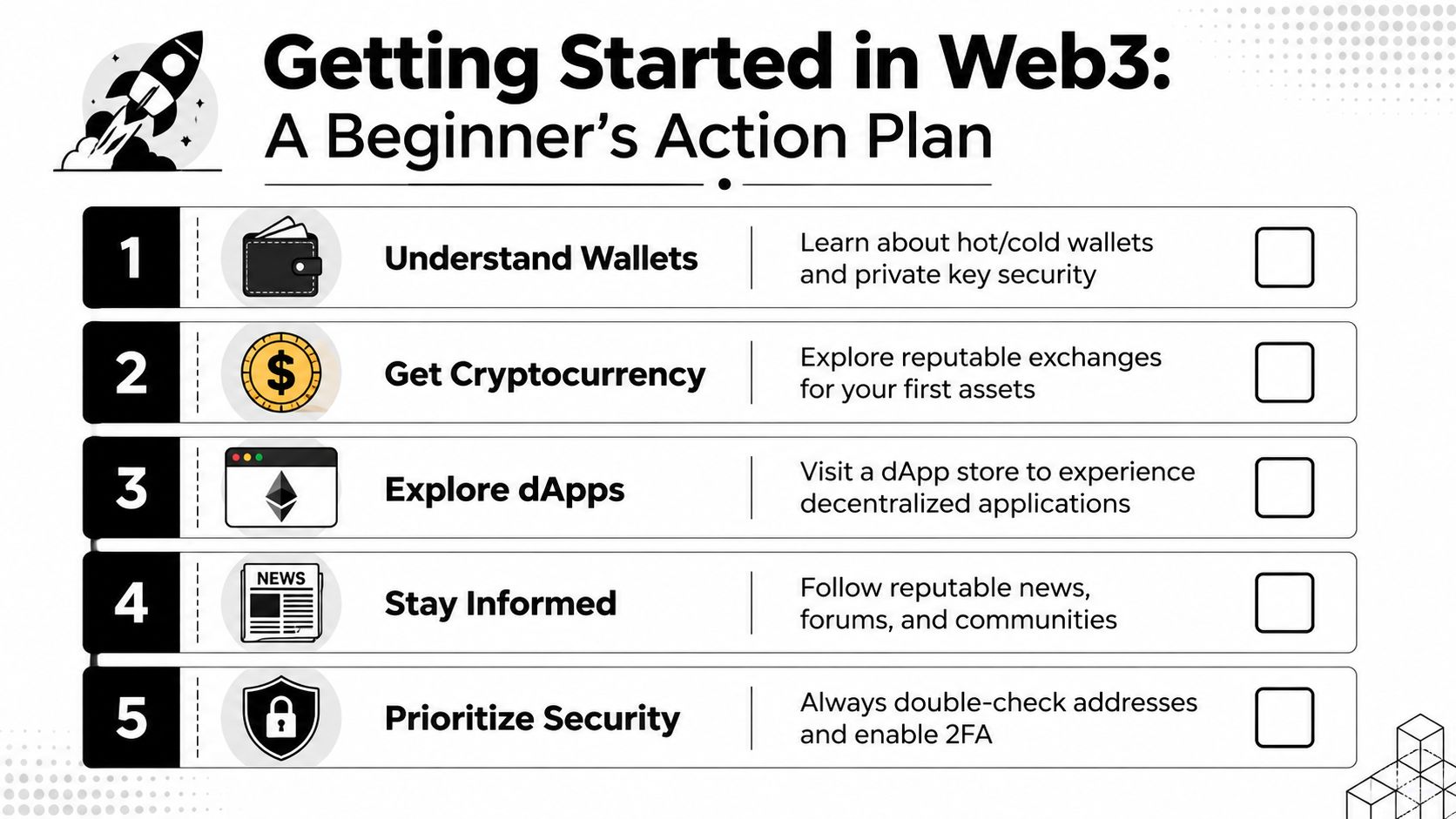
A simple beginner path
Here's a practical starting route:
- Choose a wallet: Beginners often start with software wallets like MetaMask or Phantom because they're easy to install and widely supported.
- Learn the difference between a wallet address and a private key: Your wallet address is meant to be shared for receiving assets. Your private key or seed phrase is not.
- Fund the wallet with a small amount: Keep it small enough that mistakes won't become expensive lessons.
- Try one simple on-chain action: Swap a token, mint a test asset, or connect to a beginner-friendly dApp.
- Track what you sign: Every approval matters.
Security habits that matter from day one
A few habits do more for beginners than any market prediction:
- Write down your recovery phrase securely: Don't leave it in random screenshots or chat apps.
- Double-check addresses and domains: One fake page can drain a wallet.
- Use separate wallets for experimentation: Many experienced users keep one wallet for long-term holdings and another for app testing.
- Read before approving: If a wallet prompt looks unclear, stop.
- Keep learning: Educational resources matter. That can include wallet documentation, protocol docs, and beginner-focused publications such as Coiner Blog when you want broad coverage of blockchain, DeFi, NFTs, and crypto gaming topics.
You don't need to master everything at once. Learn the rails first. Then test small, observe how transactions settle, and build confidence from direct experience rather than hype.
Coiner Blog is a useful place to keep learning if you want more beginner-friendly and intermediate coverage of blockchain basics, Web3, DeFi, NFTs, crypto gaming, tokenomics, and emerging trends like AI integration and Layer 2 networks. Explore the latest articles at Coiner Blog.
7 Comments