
Fundamental Crypto Asset Score: A Guide for Investors
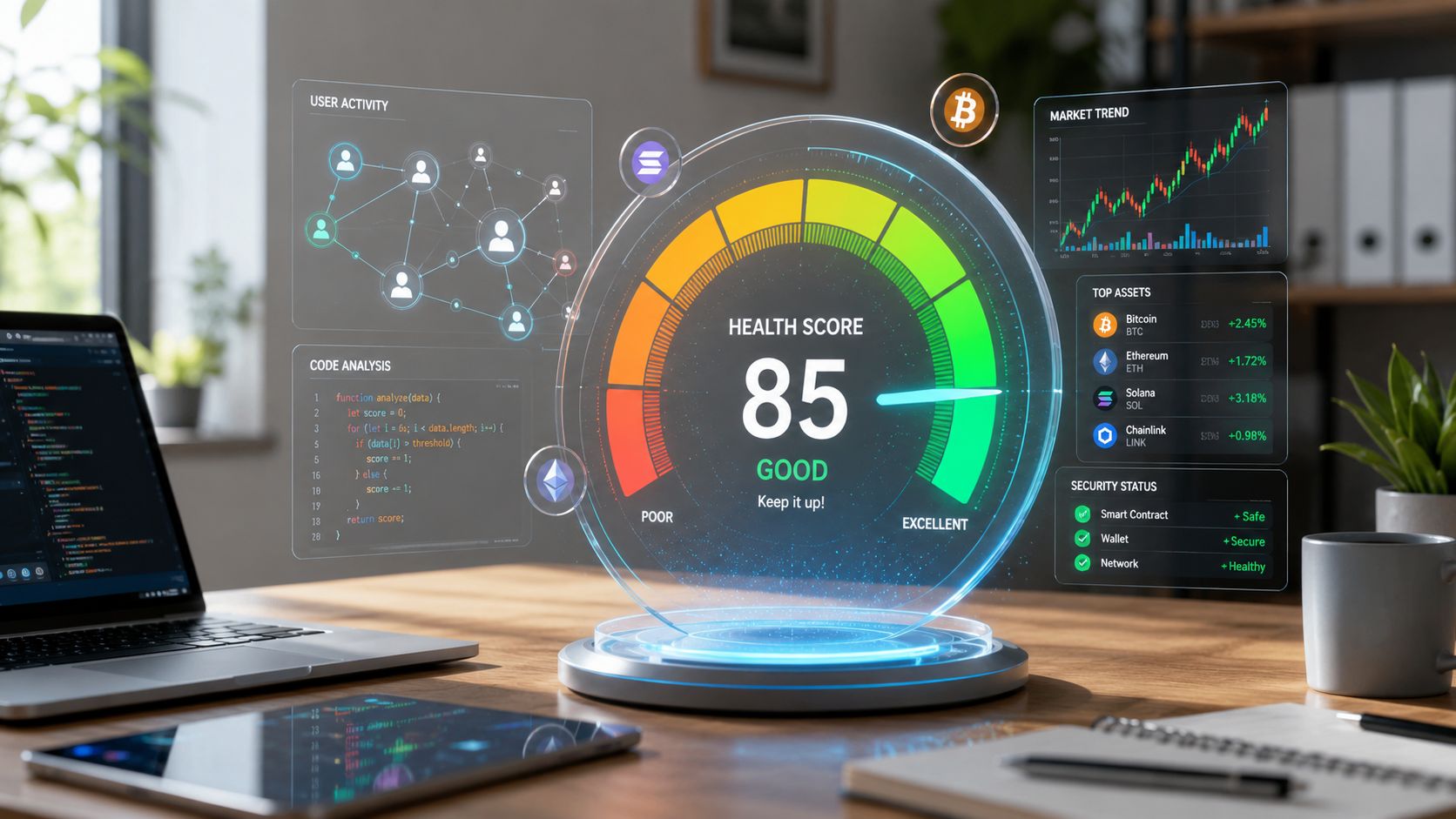
You open a token page, see a slick website, a loud community, and a chart that looks like it's waking up. Then the usual questions start. Is this project being used? Are developers still building? Is the token's value tied to something real, or am I just staring at a story wrapped around price action?
That's the spot a lot of crypto investors are in right now. There are thousands of projects competing for attention across Bitcoin, Ethereum, DeFi, Layer 2 networks, AI-linked tokens, smart contract platforms, and every new Web3 niche that pops up. Price charts help, but they don't answer the deeper question of whether a network has real substance.
That's where fundamental analysis becomes useful. Instead of asking only “Is this going up?”, it asks “Is this alive, active, and economically credible?” One tool built for that job is the Fundamental Crypto Asset Score, or FCAS.
If you're still building your research habits, it also helps to pair tools like FCAS with a broader beginner framework for how to invest in cryptocurrency for beginners. A score can sharpen your research, but it can't replace it.
Table of Contents
- Introduction Navigating the Crypto Market with Data
- What Is the Fundamental Crypto Asset Score
- The Three Pillars of the FCAS Methodology
- How to Read and Interpret FCAS Ratings
- Practical Use Cases for Everyday Investors
- Limitations and What FCAS Does Not Measure
- Conclusion Using FCAS for Smarter Crypto Research
Introduction Navigating the Crypto Market with Data
Crypto is noisy by design. Narratives move fast, token prices move faster, and social feeds can make weak projects look unstoppable for a weekend. Retail investors usually feel that noise most when they're trying to compare very different assets. Bitcoin has one profile, Ethereum another, and a small Layer 2 or DeFi protocol may look promising while hiding weak fundamentals underneath.
A better process starts with separating price from project health. Price reflects what the market is doing right now. Project health reflects whether users are showing up, whether developers are shipping, and whether the network's economics still make sense. Those aren't the same thing.
That distinction matters because crypto often rewards attention before it rewards durability. A token can trend for reasons that have little to do with adoption, smart contract usage, or sustainable tokenomics. Retail investors need a way to cut through that.
Practical rule: If a project looks interesting only when the chart is open, your research probably isn't deep enough yet.
The Fundamental Crypto Asset Score sits in that gap. It gives investors a shorthand for fundamental health, not just market excitement. Used properly, it can help you screen projects faster, compare unlike assets more rationally, and spot warning signs before a headline catches up.
It's not a magic bullet. It's a structured way to ask a better question.
What Is the Fundamental Crypto Asset Score
Think of the Fundamental Crypto Asset Score as a health rating for a crypto project. Not a price target. Not a momentum gauge. More like a compact readout of whether a blockchain network appears active, maintained, and economically grounded.
Cipher created FCAS as a proprietary metric for comparing the fundamental health of crypto projects. It evaluates intrinsic value through on-chain data, project fundamentals, and financial metrics rather than price movements alone, and it adapts traditional finance style fundamental analysis to blockchain's transparent data environment across the $2.5 trillion crypto market according to Cipher's FCAS overview.
What FCAS is trying to answer
Most crypto tools answer one of these questions:
- Price tools ask what the market has done.
- Trading indicators ask what might happen next based on market behavior.
- Fundamental tools ask whether the asset has real underlying strength.
FCAS belongs in the third group. It looks at whether people are using a network, whether builders are improving it, and whether the asset shows signs of market durability rather than temporary hype.
That makes FCAS useful across different categories of crypto. You can look at a smart contract platform, a DeFi protocol, or a Layer 2 network and ask the same broad question: does this project show signs of healthy operation beneath the token price?
What FCAS is not
It helps to be blunt here. FCAS does not tell you that Bitcoin, Ethereum, or any altcoin will rise tomorrow. It doesn't guarantee that a token with strong network data will outperform a weaker one in the short term. Crypto markets can stay irrational for longer than most investors expect.
FCAS also doesn't replace reading documentation, checking tokenomics, or evaluating product-market fit. In Web3, a network can post decent activity while still facing governance issues, weak revenue capture, or a token design that doesn't benefit holders.
FCAS works best when you treat it like an x-ray, not a fortune teller.
That's why experienced investors usually use it as part of a stack. They might combine it with chart analysis, protocol research, treasury analysis, or sector-specific judgment. For retail investors, the biggest value is simpler. It gives you a disciplined starting point when everything else feels noisy.
The Three Pillars of the FCAS Methodology
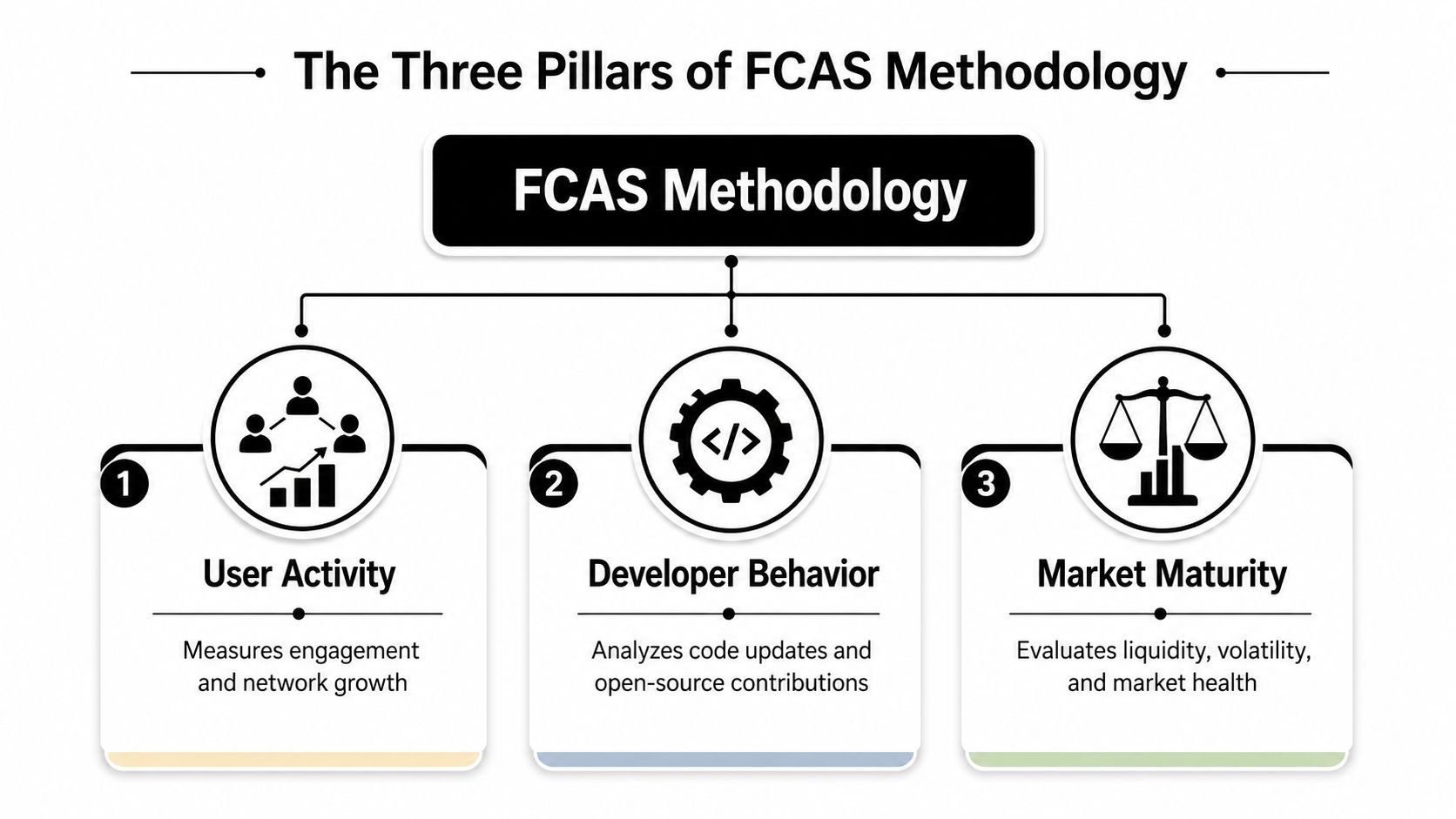
FCAS becomes much easier to trust once you understand what feeds it. Under the hood, the model focuses on three broad pillars. CoinGeek's summary of the methodology says the weighted normalization is approximately 40% user activity, 35% developer activity, and 25% market maturity, and notes that a 20% drop in daily active addresses can reduce an asset's FCAS by 100 to 150 points, potentially shifting its grade from B+ to C in its coverage of CoinMarketCap's FCAS integration.
User activity shows whether a network has life
A blockchain can have a good story and still have very little actual usage. User activity is FCAS's biggest component for a reason. It asks whether real participants are interacting with the network.
This includes signals like active addresses, transaction volume, and fee revenue. In plain language, FCAS wants to know whether people are showing up and doing something meaningful. If users keep interacting with a chain or protocol, that's often a healthier sign than a token chart alone.
For retail investors, this pillar is often the easiest to understand. If a DeFi app says it's essential infrastructure but on-chain engagement looks sleepy, something doesn't line up. If an Ethereum Layer 2 keeps adding wallets and transactions, that may suggest rising utility even before the market fully reprices it.
Developer behavior shows whether the project is still being built
Crypto projects don't stay healthy on autopilot. Someone has to maintain the code, ship updates, fix vulnerabilities, and improve the product. That's why developer behavior carries a large weight.
FCAS looks at project metrics such as team quality and codebase activity. You can think of this as the “construction noise” behind the scenes. A quiet GitHub and a stale roadmap don't prove a project is dead, but they often weaken the case that it's advancing.
This matters a lot in sectors where infrastructure evolves quickly, such as Layer 2 networks, DeFi protocols, and AI-related crypto systems. In these categories, developer momentum often tells you whether a project is adapting or just marketing.
If you want a broader sense of why this kind of signal matters, crypto analysis increasingly overlaps with the challenge of mastering unstructured data, because many useful clues don't arrive as one neat metric. They show up across code repositories, governance threads, documentation updates, and ecosystem activity.
Market maturity adds context
The third pillar gives FCAS some realism. A project can have active users and energetic developers but still live in a fragile market structure. Market maturity helps the score account for that.
This category includes financial metrics and valuation context relative to peers. It's less about excitement and more about resilience. If an asset has weak liquidity, odd valuation relationships, or market conditions that make participation unstable, that should influence how its fundamentals are interpreted.
Here's a simple way to think about the three pillars together:
| Pillar | What it checks | Why it matters |
|---|---|---|
| User activity | Whether people are using the network | Usage is one of the clearest signs of relevance |
| Developer behavior | Whether builders are improving the project | Active development supports long-term viability |
| Market maturity | Whether the asset trades in a more stable context | Strong usage means less if the market structure is fragile |
A useful takeaway sits inside the weighting. FCAS gives the biggest emphasis to actual network use, then close attention to developer work, then market maturity. That priority makes sense for crypto, where transparent on-chain behavior often reveals more than branding does.
How to Read and Interpret FCAS Ratings
A score only helps if you know how to read it. The practical move isn't to stare at a single number and stop there. You use the rating to form a first impression, then you examine what might be driving it.
Start with the grade, then ask why
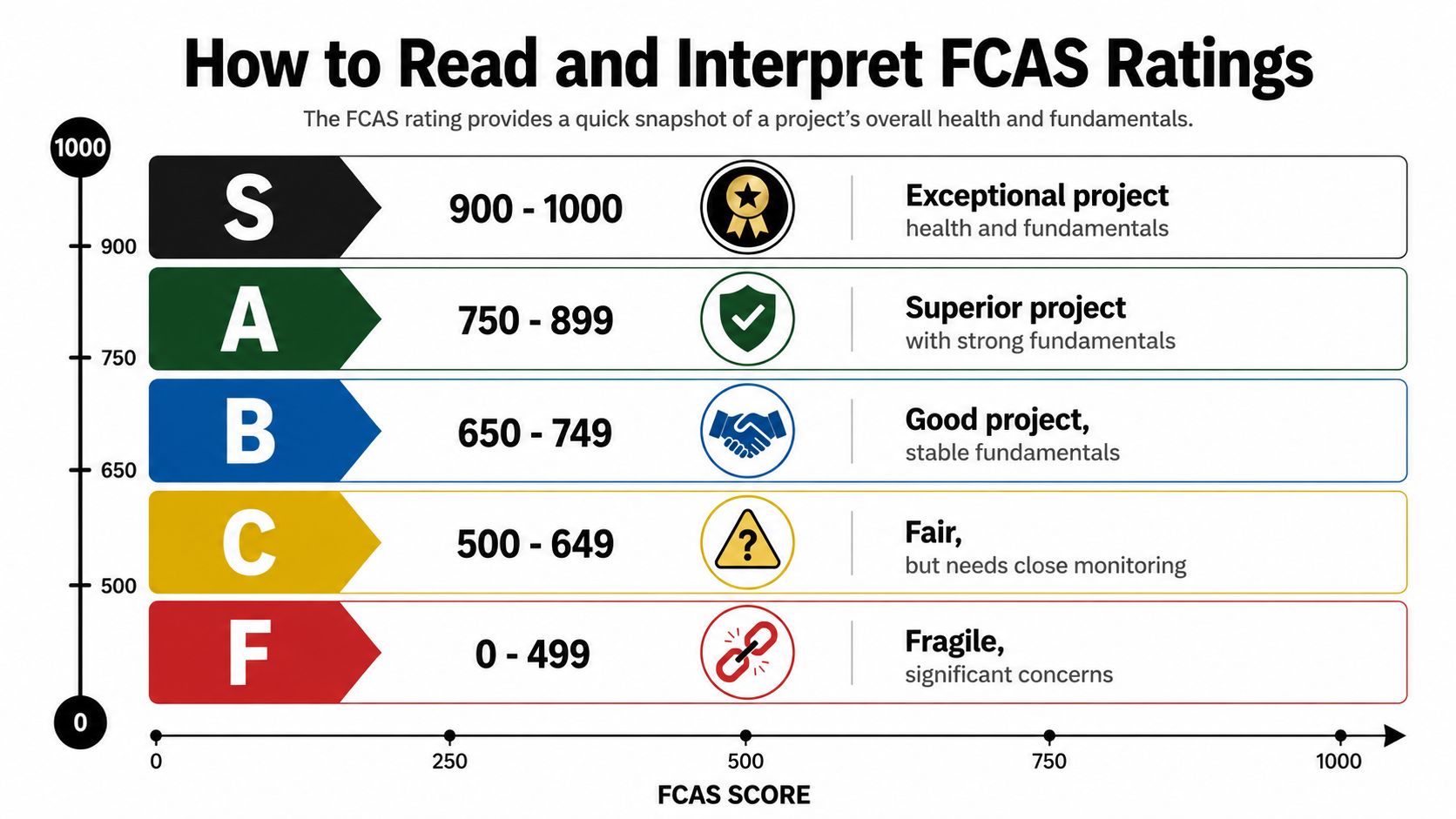
FCAS ratings are commonly shown on a 0 to 1000 scale with letter grades ranging from S, A, B, C, to F, as reflected in the rating framework shown in the infographic above. The basic idea is intuitive:
- S grade: exceptional project health
- A grade: strong fundamentals
- B grade: solid but not elite
- C grade: mixed profile, needs caution
- F grade: fragile or concerning fundamentals
That's helpful, but true value comes from comparison. A raw score becomes more meaningful when you compare two assets with very different personalities. That's where FCAS can reveal things that price action hides.
If you already follow market structure, it's useful to pair this with an understanding of what price discovery means in crypto markets. Price discovery explains how markets arrive at value. FCAS tries to measure whether that value has a strong fundamental base underneath.
A practical comparison
CoinGeek's example is useful because it compares unlike assets instead of pretending all crypto projects should look the same. It notes that an L2 scaling solution with high developer velocity but lower liquidity may score 680 (B+), while a mature DeFi protocol with strong liquidity but stagnant code commits may score 620 (B) in its discussion of FCAS comparisons and drivers.
That tells you something important. FCAS may reward building momentum more than static liquidity, especially in earlier-stage ecosystems.
Here's how a retail investor might read that:
| Project type | What stands out | What FCAS may be signaling |
|---|---|---|
| Layer 2 network | Builders are active, product is evolving, liquidity is lighter | The network may be improving faster than the market structure suggests |
| Mature DeFi protocol | Liquidity is established, but development has cooled | The protocol may be stable, but innovation may be slowing |
Often, readers get confused, assuming the higher score means “better investment.” Not necessarily. It might mean “stronger current fundamentals according to this model.” That's a narrower and more useful statement.
A Layer 2 with a better FCAS than a DeFi protocol doesn't automatically have lower risk. It may still face competition, token release pressure, or weak fee capture. What FCAS gives you is a clue about project health, not a complete investing verdict.
A good FCAS score should trigger more research, not less.
For Bitcoin and Ethereum, the same principle applies. You wouldn't use FCAS to replace your view on macro conditions, ETF flows, regulation, or market cycles. You'd use it to sharpen the question of whether the network's underlying activity supports the story the market is telling.
Practical Use Cases for Everyday Investors
Most retail investors don't need another dashboard. They need a better workflow. FCAS is most useful when it saves you from wasting time on weak projects and helps you organize deeper research on the better ones.
Use FCAS as a first filter
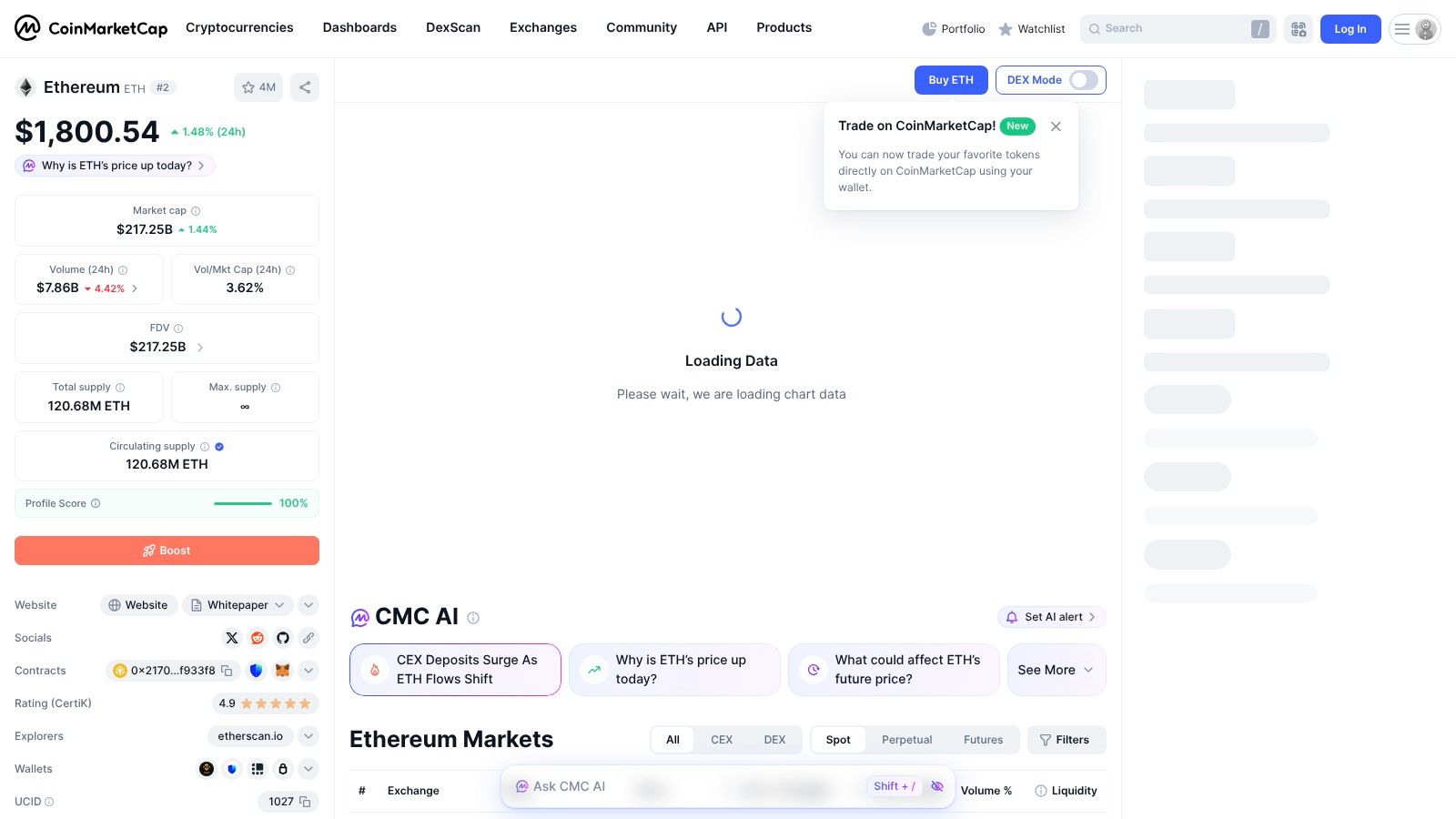
When you're scanning token lists on platforms such as CoinMarketCap, FCAS can serve as a quick quality screen. It won't tell you everything, but it can help you avoid spending hours on projects with weak visible fundamentals.
A simple retail workflow looks like this:
- Shortlist by category. Pick the area you're researching, such as Bitcoin-adjacent infrastructure, Ethereum Layer 2s, DeFi lending, or real-world asset tokenization.
- Check the FCAS profile. Use the score as a fast read on whether the project appears active and maintained.
- Open the project only if the fundamentals look credible. Then review the website, docs, tokenomics, governance, and actual product usage.
That process is especially useful in crowded categories like Web3 infrastructure, where many projects sound similar at first glance.
Use FCAS to track changes over time
FCAS isn't only for initial screening. It can also help you monitor whether a project is getting healthier or weaker.
Look for directional change rather than trying to trade every score move. If a protocol's rating falls, ask what might be happening underneath. Has user activity cooled off? Has developer work slowed? Is the market structure getting less mature? If the score improves, check whether the improvement matches what you're seeing in the product and ecosystem.
A practical checklist helps:
- Before buying: Check whether the score supports the story you've heard.
- While holding: Revisit the rating periodically to see whether the project still looks alive.
- After big news: If a token rallies on announcements, see whether the fundamental profile improves later.
- When comparing alternatives: Use FCAS to compare two projects in the same niche before you go deeper.
Research habit: If a project's fundamentals and marketing are telling two different stories, trust the mismatch and investigate it.
Retail investors often overcomplicate analysis by trying to become full-time on-chain analysts overnight. You don't need that. FCAS works best as a structured checkpoint inside a wider due diligence process.
Limitations and What FCAS Does Not Measure
FCAS is useful because it narrows chaos into a readable signal. It's limited for the same reason. Any single score has blind spots.
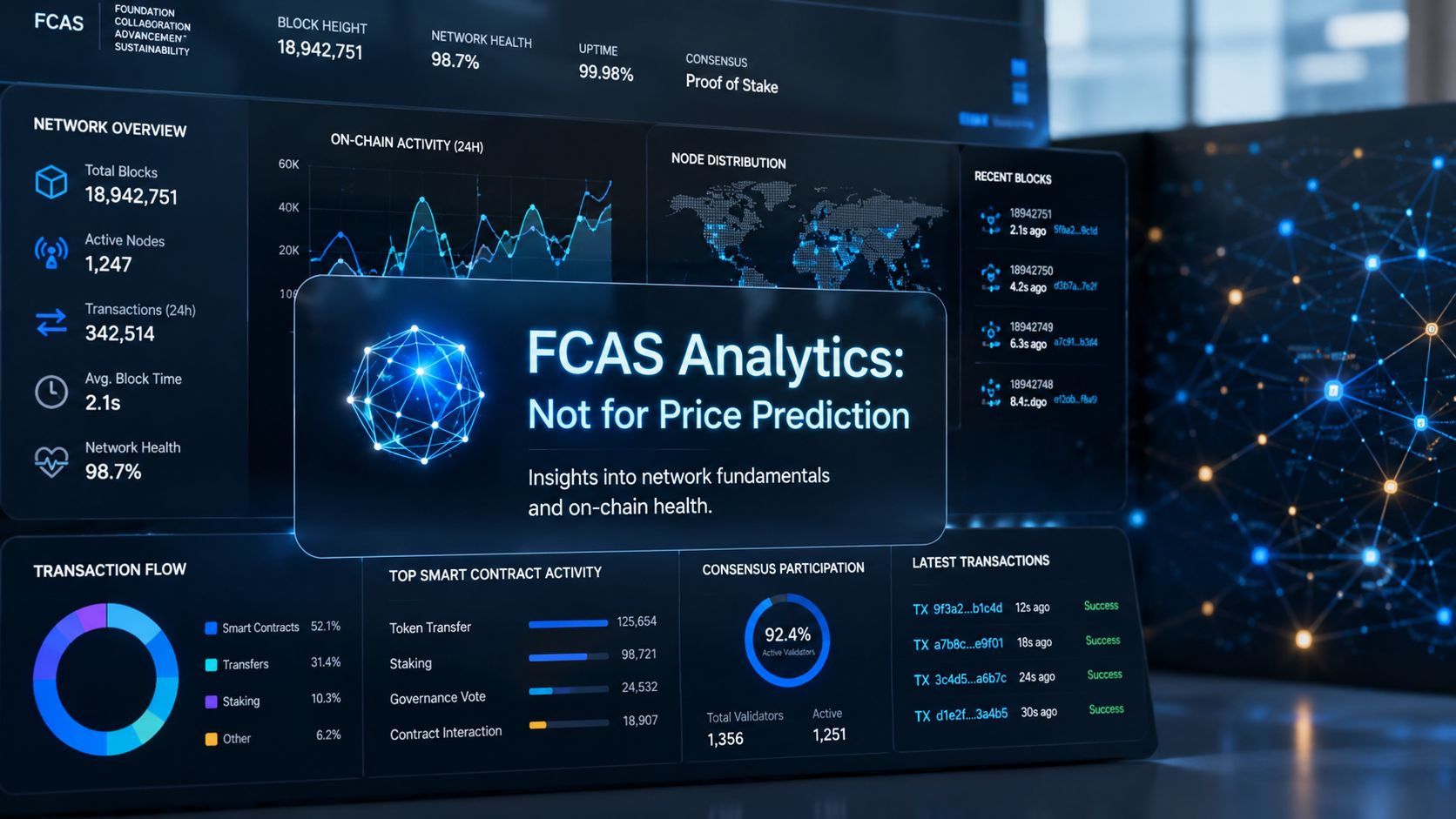
A high score is not a buy signal
Start with the most important limitation. FCAS is not a price prediction tool. A project can show healthy usage and active development, then still get hit by market-wide selling, a regulatory shock, a security issue, or tokenomics that dilute holders.
Some important things sit outside the score's line of sight:
- Team integrity: Data can't fully measure whether leadership is trustworthy.
- Regulatory risk: Rules can change quickly and hit an otherwise healthy project.
- Community quality: A large audience doesn't always mean a durable ecosystem.
- Narrative timing: AI and crypto, DeFi, or real-world asset tokenization can rotate in and out of favor regardless of fundamentals.
- Token design: A useful network can still have a weak token investment case.
That last point trips up a lot of people. The network may be healthy while the token captures little value. FCAS can help you evaluate the project. You still need separate judgment about the asset.
For investors focused on execution risk and trading conditions, it also helps to understand the liquidity of cryptocurrency, because even projects with strong fundamentals can trade poorly in thin markets.
Why institutions also use models like PCA
The conversation becomes more advanced and more honest. Retail guides often present FCAS as if it should be enough on its own. Institutional investors usually don't work that way.
Talos highlights a gap that most coverage skips: existing discussion of FCAS rarely explains how institutions weigh it against principal component analysis, or PCA, for portfolio volatility. Talos also notes that fundamental factor models and PCA diverge significantly, leaving open the question of whether FCAS is a better predictor of drawdowns than statistical PCA models, especially as institutions have adopted hybrid models since 2024 in Talos research on crypto risk models.
You don't need to become a quant to grasp the point. FCAS asks, “How healthy is this project?” PCA asks something closer to, “How does this asset behave inside a portfolio when market factors move?” Those are different questions.
One tool studies quality. The other studies risk behavior.
That matters because a sound asset can still experience brutal drawdowns if it loads heavily on the wrong market factors. Institutions know this, which is why they often combine models instead of choosing one. Retail investors should take the same lesson, even if they use simpler tools.
Strong fundamentals can reduce confusion. They don't remove market risk.
Conclusion Using FCAS for Smarter Crypto Research
The Fundamental Crypto Asset Score is useful because it gives crypto investors a cleaner way to judge whether a project has real activity behind the ticker. It shifts attention away from short-term price noise and toward usage, development, and market context.
That makes it especially valuable in a market where flashy narratives can outrun reality for long stretches. If you're comparing Bitcoin, Ethereum, a DeFi protocol, or a new Layer 2, FCAS can help you ask a better first question: does this asset look fundamentally healthy right now?
That said, the score works best at the start of research, not the end of it. It won't tell you whether a token's economics are attractive, whether the team will execute, or whether broader market conditions are about to turn hostile. And it definitely won't replace the risk modeling used by larger professional players.
Use FCAS to build a shortlist. Then keep going. Read the docs, inspect the tokenomics, check product usage, look at developer activity directly, and ask whether the token benefits from the network it represents.
That's how better crypto research usually works. Not through one perfect metric, but through a handful of good ones used with discipline.
If you want more clear, balanced crypto guides like this one, visit Coiner Blog for practical explainers on Bitcoin, Ethereum, DeFi, Web3, tokenomics, Layer 2 networks, AI and crypto, and the risks that matter just as much as the upside.