
Security Edge Coin: What It Means and How to Verify It

What are you looking for when you type security edge coin, a coin with a tamper-resistant rim, a crypto token called Edge, or a security concept borrowed from Web3? The phrase gets used in three very different ways, and the confusion is real enough that people often end up reading the wrong kind of source for the question they meant to ask. If you're trying to verify a physical coin, understand a crypto asset, or avoid a scam that borrows the language of security, the first step is knowing which meaning you're dealing with.
Table of Contents
- What People Actually Mean by Security Edge Coin
- The Core Idea of a Security Edge on a Coin
- Where Security Edges Came From and Where They Are Going
- Crypto Projects That Use the Edge Name
- How Edge-Based Anti-Counterfeiting Actually Performs in 2025-2026
- How to Verify a Security Edge Coin Safely
- Risks, Red Flags, and Common Misconceptions
- Where to Follow Updates and What to Do Next
What People Actually Mean by Security Edge Coin
The phrase security edge coin sounds specific, but in practice it points to three different topics. One is numismatics, where a security edge means a coin rim with ridges, grooves, lettering, or dot patterns designed to make counterfeiting harder. Another is crypto, where people often mean a token whose name includes Edge, such as Edge (EDGE) or Edgecoin (EDGT). A third is cybersecurity, where “edge” can refer to edge devices, which is a separate topic entirely.
That overlap is why search results feel messy. The same query can pull up minting articles, exchange listings, and security guidance that has nothing to do with coins at all. For a reader trying to check whether a piece of metal or a token is genuine, that ambiguity creates a real problem, because the verification steps are completely different in each case.
The Three Meanings You'll See Most Often
If you're holding a physical coin, you're probably dealing with the minting meaning. If you're looking at a ticker, wallet, or exchange page, you're in crypto territory. If someone is talking about edge infrastructure or device hardening, they're using the term in a cybersecurity sense, not a coin sense.
Practical rule: identify the object first, then verify the right way. A coin under your fingers, a token in your wallet, and an edge device in a network are all secured differently.
For crypto readers, the key point is that this article is not investment advice. It's a plain-language guide to an overloaded phrase, with enough detail to help you separate a real security feature from a branding trick. For physical coins, authenticity can change with context, mint, and year, so primary sources matter every time.
The Core Idea of a Security Edge on a Coin
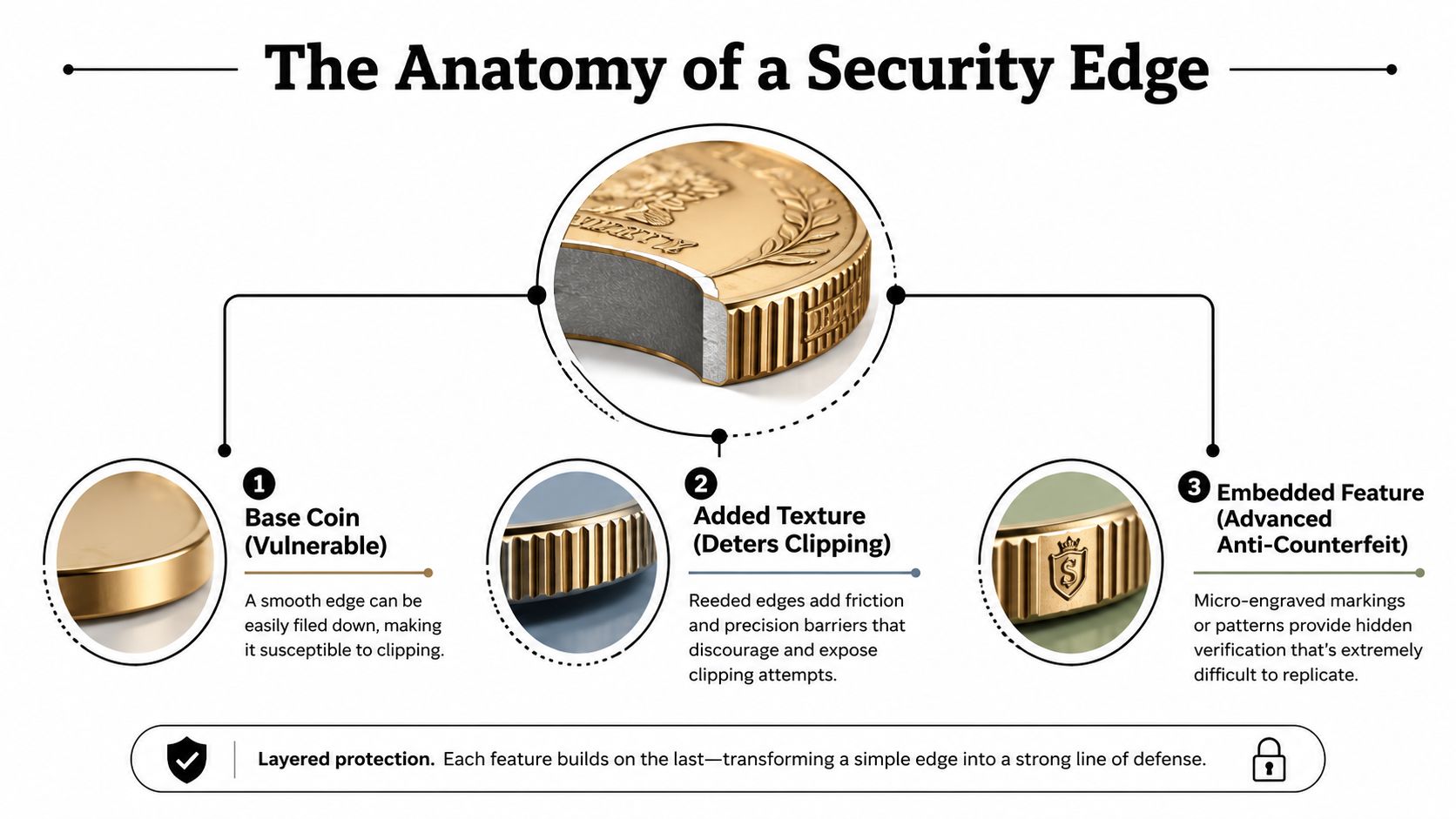
A security edge is the textured side of a coin, often called the third side because it matters just as much as the face and the reverse. A plain milled edge is simple and uniform, while a security edge adds detail that is harder to copy cleanly. That extra detail gives inspectors, machines, and even casual users a fast way to spot a mismatch.
Why the Edge Matters More Than It Looks
Think of a coin as a tiny 3D object. The face is like a photograph, easy to compare at a glance, but the edge behaves more like a fingerprint. Counterfeiters often focus on getting the front design close enough to fool the eye, then fail on the rim because it takes specialized tooling to reproduce it accurately.
That's why a security edge is more than decoration. Grooved sections, reeded sections, and sometimes micro-lettering or dot patterns create a surface that is both tactile and visual. If the spacing is off, the grooves are shallow, or the edge text is missing, the coin can look convincing but still fail a proper check.
How Mints Use Edge Complexity
Mint designers don't add edge features casually. They combine reeding and grooving to make duplication harder, and they may add lettering or symbols to create a recognizable pattern that can be checked by touch or by machine. The edge also helps distinguish denominations without relying only on the face design.
A good way to think about it is this, the edge is the part counterfeiters can't ignore. If they only copy the visible surfaces, they leave the rim as a weak point. If they try to copy the rim too, they need better tooling, tighter tolerances, and more time, which raises the cost of forgery.
A strong security edge doesn't prove a coin is authentic on its own. It just makes a fake easier to catch.
Where Security Edges Came From and Where They Are Going
Reeded edges weren't invented as a design flourish. They were adopted in the late 17th century in England to stop people from clipping precious metal off the rim, and that history is tied to Isaac Newton's time as Warden of the Royal Mint Why coins have ridges or reeded edges. The basic idea was simple, make the edge harder to shave without leaving a visible trace.
From Anti-Clipping to Everyday Authentication
That old anti-clipping logic still matters because the edge is easy to overlook and hard to copy well. Numismatists describe the edge as the third side of a coin, and modern edge treatments can combine grooved and reeded sections on the same piece The edge as the third side of a coin. The more layered the pattern, the more opportunities there are for a mismatch to show up.
Modern examples go further than old ridges. British coinage examples described in the sources include alternating milled and unmilled sections and micro-lettering around the rim, and automated systems can reject coins that don't match the expected pattern Machine-readable coin edge examples. That means the edge isn't just for collectors or historians, it can be part of a working authentication system.
Why This Still Matters in a Digital Age
The coin analogy becomes useful for crypto readers. In Web3, people often talk about trust surfaces, proofs, and verification layers. A coin edge serves a similar role in the physical world, it's a low-friction signal that helps a person or machine confirm that an object belongs where it claims to belong.
The broader lesson is that security usually works best when it's layered. A rim pattern helps. A face design helps. Weight and diameter help too. No single detail does all the work, but together they raise the odds that a fake gets caught before it circulates.
Crypto Projects That Use the Edge Name
The crypto side of this phrase causes most of the search confusion, because Edge appears in more than one project name without pointing to the same thing. Edge (EDGE) is a Web3 infrastructure token tied to a decentralized cloud and network model. CoinGecko lists 41 million EDGE in circulating supply, a $2.25 million market cap, and $2,253.71 in 24-hour trading volume. Historical descriptions say it was formerly called DADI and was built around using “spare capacity” from distributed devices for decentralized web services, file storage, and content delivery, which places it in the earlier wave of decentralized infrastructure projects that grew alongside Web3 service layers Edge on CoinGecko.
Edgecoin (EDGT) sits in a different category. CoinMarketCap describes it as a stablecoin that mirrors the U.S. dollar, with a structure that is very different from a utility token used for infrastructure Edgecoin on CoinMarketCap. For retail readers, that difference matters because a token name can sound similar while its job, liquidity profile, and risk profile are not the same.
Side-by-Side Comparison
| Token | Type | Total Supply | Circulating Supply | Notable Listing |
|---|---|---|---|---|
| Edge (EDGE) | Web3 infrastructure token | Not stated in the verified data | 41 million EDGE | CoinGecko snapshot |
| Edgecoin (EDGT) | Stablecoin | 1,000,000,000 EDGT | 210 million EDGT | ProBit Global, CEX.IO, Coinsbit, P2B, HitBTC |
A simple way to separate the two is to ask what problem each project tries to solve. Edge (EDGE) is about distributed infrastructure, while Edgecoin (EDGT) is about a dollar-mirroring asset with exchange-based distribution. The coin analogy helps here, because two coins can share a similar rim treatment and still belong to different mints, different eras, or different systems. The same logic applies in Web3, where names often overlap while the underlying design stays distinct.
That naming overlap can blur search results and lead readers toward the wrong asset. It also makes verification steps more important, especially when a project description is short and the ticker looks familiar. A closer look at the contract, exchange listings, and official project pages gives more reliable context than the name alone, and a practical reference like the future of cryptography and verification can help frame why identity checks matter in digital systems.
For readers who track broader crypto infrastructure, the distinction also helps place these assets against familiar categories like Bitcoin, Ethereum, Layer 2 networks, and DeFi. Bitcoin is a monetary network, Ethereum is a smart contract platform, and these Edge-branded assets sit in narrower lanes, one in decentralized infrastructure and one in exchange-mediated stablecoin distribution. The names are similar, but the mechanics are not. If you are sorting through search results or comparing services, a ShortGenius AI ad generator can help teams keep product naming and message clarity aligned, which reduces confusion before it reaches users.
How Edge-Based Anti-Counterfeiting Actually Performs in 2025-2026
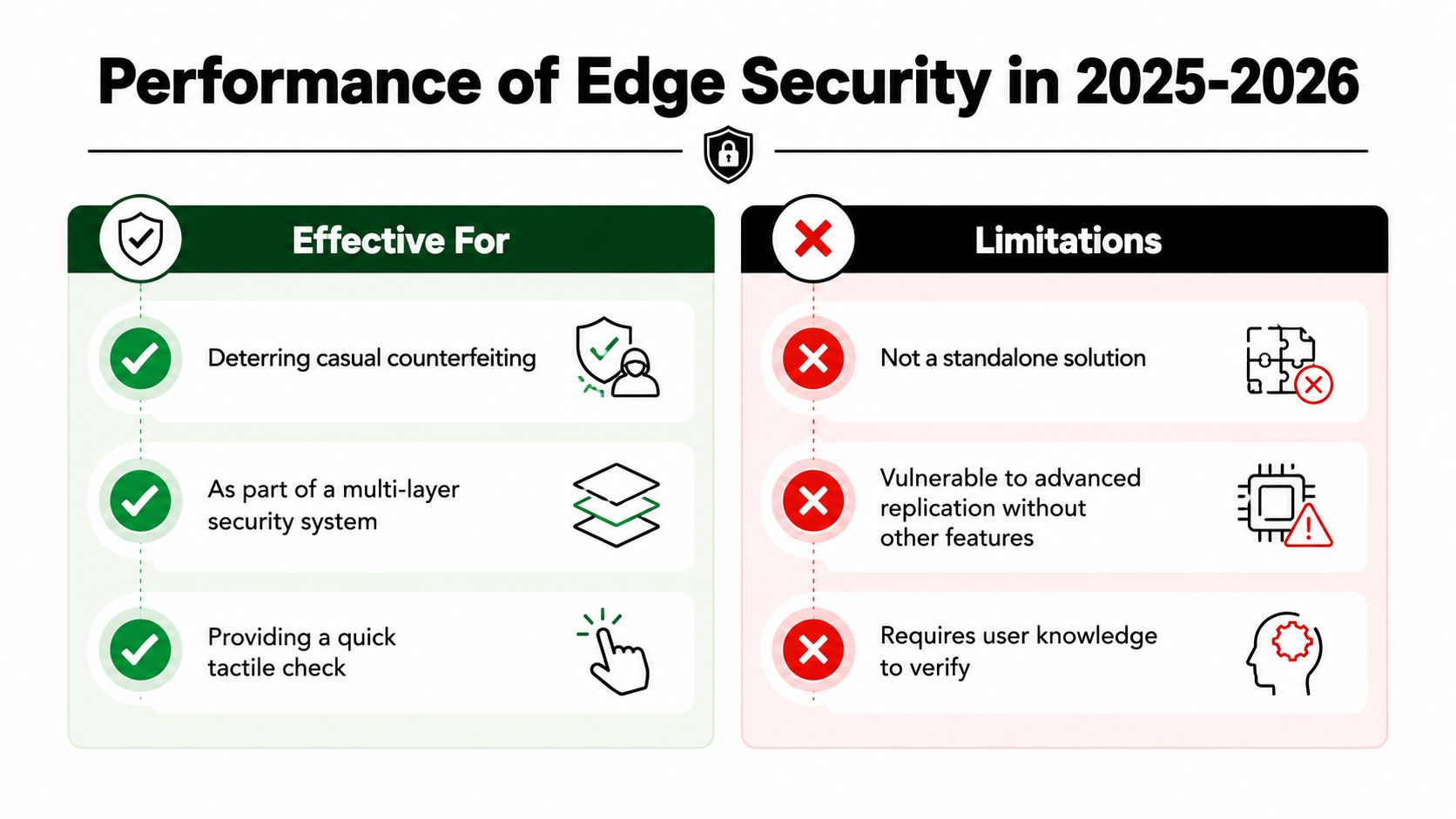
A security edge helps, but it doesn't solve the whole problem. Coverage around coin security features says decorative or engraved edges can deter counterfeiting, yet the primary weakness is usually overreliance on one signal instead of a broader control set Common coin security features. That's true in physical coinage and in cybersecurity, where edge devices need inventory, patching, hardened management, and phishing-resistant MFA rather than a single defense.
What It Does Well
An edge feature is good at raising the cost of casual forgery. A smooth counterfeit rim is easy to spot once someone knows what to feel for, and even a decent fake can fail if the grooves are uneven or the lettering doesn't match. It also works well as a quick tactile check in everyday circulation, especially when people already know what the genuine coin should feel like.
The same layered logic shows up in modern hardware security. Security programs increasingly treat the edge as an operational surface, not a one-off feature. That mindset matters because controls that are easy to verify often become the first line of defense, not the only line.
Where It Breaks Down
Edge features fail when users assume they're sufficient on their own. A counterfeit can still mimic a lot of the visible design, and if the person checking it doesn't know the expected pattern, the edge doesn't help much. Machine validation helps too, but only if the equipment is configured to look for the right pattern.
For readers who want to keep an eye on how hardware security thinking is evolving in Web3 and adjacent infrastructure, the broader cryptography discussion at Future of cryptography is a useful companion read. It helps frame why modern authentication keeps moving toward layered, verifiable systems instead of single-point trust.
A practical example of where this mindset appears in crypto is media and hardware provenance. As more systems push authentication to the edge, the question isn't “does this one detail look right?” It's “do the independent checks line up across the object, the ledger, the issuer, and the device?”
ShortGenius AI ad generator can be useful for teams that need to turn that kind of security explainer into short-form video, but the important point here is the message, not the format. A strong edge-based control is one part of a larger verification stack, not a shortcut around it.
How to Verify a Security Edge Coin Safely
Verification starts by deciding whether you're holding a physical coin or checking a crypto asset. For a coin, your hands and a loupe do most of the work. For a token, the essential checks happen on a block explorer, an official project page, and reputable market listings. Mixing those workflows is where people get tricked.
Physical Coin Checks
Feel the rim first. Uniform, crisp reeds or grooves should feel consistent all the way around. A patchy edge can point to wear, damage, or a forgery.
Inspect the edge under magnification. A loupe helps you look for micro-lettering, hidden symbols, or spacing errors. If the coin should have edge text and it's missing, that's a problem.
Compare weight and diameter. A scale and caliper catch mismatches that a visual check can miss. If the edge looks right but the dimensions don't, treat the coin as suspicious.
Check an official mint reference. Mint websites and official catalog pages are the best place to confirm what the edge is supposed to look like for that issue. That stops you from relying on memory or on a seller's photos.
Practical rule: if the rim, weight, and official reference don't agree, don't trust the coin.
Crypto Asset Checks
Verify the contract or token page on a block explorer. A copied token name can hide a cloned contract, so the address matters more than the branding.
Cross-check the asset on CoinGecko or CoinMarketCap. Market pages help you confirm whether the listing, supply, and trading venues match the project you think you found.
Use the official wallet app or project site, not a DM link. Social media messages are a common place for fake links and impersonation.
Look for consistency across sources. If the project's whitepaper, exchange listing, and blockchain record don't line up, slow down before interacting.
For a deeper look at identity checks on-chain, the guide at Blockchain identity verification pairs well with this workflow. The core habit is the same in both physical and digital settings, verify the object against an authoritative source, not against a screenshot.
Risks, Red Flags, and Common Misconceptions
A security edge coin can look convincing and still be wrong. A clean rim does not prove a coin is genuine, and a polished crypto page does not prove a token is sound. The edge is one clue, useful as part of a wider check, but never enough on its own.
Red Flags That Deserve Skepticism
- Unverifiable contract addresses. If the token address cannot be checked on a trusted explorer, the asset may be a clone or a copycat listing.
- Anonymous teams with no audit history. A project can still be legitimate, but no clear accountability raises the risk.
- Guaranteed-return language. Any marketing that promises certainty should trigger immediate caution.
- Copy-paste whitepapers. Reused documents often show that a project is relying on branding more than substance.
Physical coins need the same discipline. If a seller says the edge proves authenticity but will not show the mint reference, the year, or the expected edge pattern, that claim is too thin to trust. The edge helps support authentication, it does not replace it.
For readers who want a practical scam checklist, How to avoid crypto scams offers a useful companion guide. It reinforces a simple habit, trust claims less, verify more. For checking wallet addresses and transaction histories, a tool like Crypto Wallet Search can add another layer of verification before you act.
A Better Mental Model
Use layers. The edge, the face, the issuer, the ledger, and the market listing each answer a different question. A fake may pass one weak check, but it has a harder time passing several independent ones.
That same layered approach shows up in edge-device security. One control can be bypassed, but a setup built around inventory, patching, hardened management, and strong authentication is much harder to defeat. The same logic applies to coin verification, whether the object is metal or a token on-chain.
Where to Follow Updates and What to Do Next
If you remember only three things, keep them simple. A security edge coin may mean a physical coin with a reeded or grooved rim, an Edge-branded crypto asset like EDGE or EDGT, or a broader edge-security concept from cybersecurity. Each one needs a different verification method, and none of them should be trusted from a name alone.
For ongoing research, check CoinGecko and CoinMarketCap for token listings, official mint websites for physical coin specifications, and major cybersecurity guidance for edge-device security practices. Crypto and numismatic details change quickly, so it's worth rechecking the source material before you act on anything that depends on current status.
A good final checklist looks like this. Identify the meaning, verify the source, compare the edge or contract against an authoritative reference, and revisit the analysis when the project, mint, or market conditions change. If the claim only works when no one checks it closely, it's not a strong claim.
If you want more clear, source-based breakdowns like this, Coiner Blog publishes practical crypto explainers that focus on how assets, infrastructure, and security work. Visit Coiner Blog for more guides on Web3, tokenomics, and verification habits that help you separate real signals from marketing noise.