
How to Create a Memecoin: From Idea to Launch

Most advice about how to create a memecoin gets the order wrong. It treats the contract like the hard part, then acts as if launch success comes from pressing deploy and posting a ticker. In practice, the code is the cheap part, while the decisions around concept, supply, liquidity, anti-bot protection, and post-launch survival decide whether the token becomes tradable or just another forgotten address.
That reality is even starker in 2025 and 2026. Recent launch guides show that deployment can be standardized and low-friction, while visibility is the scarce resource, not code. In one memecoin launch overview, the practical sequence is still the same basic workflow, choose a chain, create the token, verify it, and add liquidity, but the strategic burden sits outside the contract itself, especially once a market is already flooded with new tokens how-to-create-a-memecoin beginner guide.
Table of Contents
- The Honest Truth About Launching a Memecoin in 2026
- Designing the Concept, Tokenomics, and Supply Model
- Picking the Right Blockchain for Your Launch
- Deploying the Smart Contract and Verifying It Publicly
- Security Hardening and Anti-Manipulation Checklist
- Liquidity, Launch Mechanics, and Early Community Growth
- Should You Actually Launch a Memecoin
The Honest Truth About Launching a Memecoin in 2026
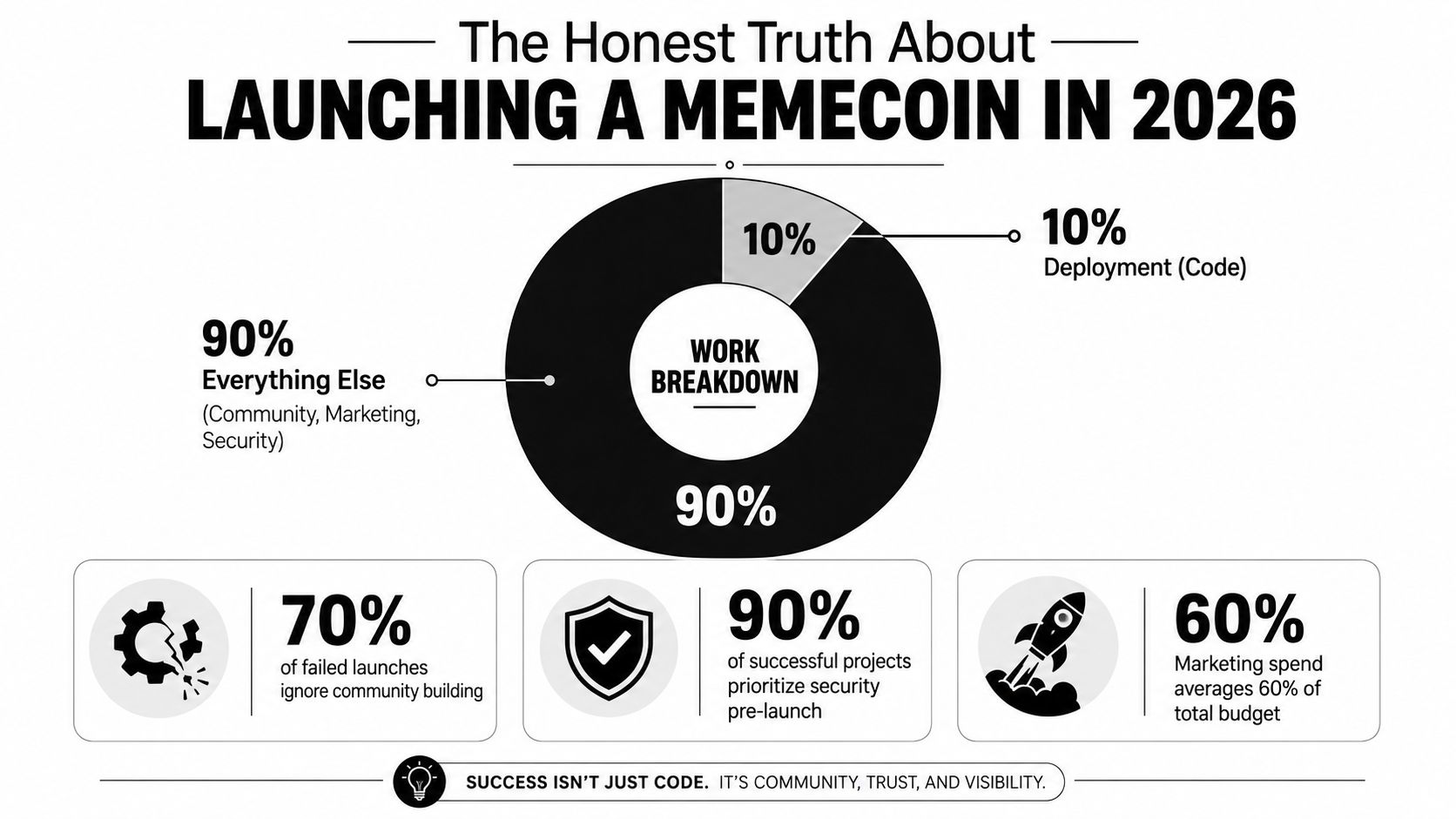
The most useful way to think about how to create a memecoin is to stop treating launch day like the finish line. Deployment is usually the easiest part, because the main bottleneck is everything that happens before and after the contract goes live, from naming and tokenomics to liquidity and community trust. Recent no-code launch guides make that obvious by moving creators toward templates, launchpads, and wallet-based configuration instead of custom development KuCoin's no-code launch guide.
What actually breaks first
Failed launches usually do not die from syntax errors. They die from weak token design, thin liquidity, bot-heavy first minutes, or a name that confuses buyers before they ever read the contract. One practical guide notes that the standard sequence still runs through wallet setup, contract creation, deployment, and verification, but it also makes clear that liquidity is what turns a token into something tradeable, not just something that exists on chain beginner ERC-20-style workflow.
That shift matters because memecoin creation has become standardized. The technical work is no longer the moat. Attention, trust, and execution discipline are. A creator can use a builder or a launchpad, but if the token has no believable story, no sensible supply structure, and no plan for early market behavior, the launch can still collapse on contact with the market.
Practical rule: if you can't explain why someone would hold the token after the first hour, the contract is probably the least important part of the project.
The competitive field is also crowded enough that visibility is the scarce asset. A July 2025 update from Pump.fun said creators had generated more than $2.5 billion in fees and that roughly 12 million tokens had been created on the platform, which shows how much new supply is fighting for the same slice of attention Pump.fun economics note. In that environment, the launch is less a coding milestone and more a market-entry test.
Costs and friction are lower, but not free
Launch cost is not the same thing as launch readiness. A Base-token creator guide says 0.01 to 0.02 ETH is typically enough for creation fees, while Solana launch advice from a 2026 video recommends about 5 to 12 SOL of starting liquidity, with 10 SOL described as the “sweet spot” Base and Solana launch guidance. Those figures show how low the technical barrier has become, but they also underline a harder truth, a token without liquidity is not market-ready.
That is why the work starts before code and continues after deployment. If you want the launch to survive, you need a concept that travels, a supply model that matches the story, and a market structure that doesn't hand the first buyers a reason to dump.
Designing the Concept, Tokenomics, and Supply Model

The first real decision is not technical, it's narrative. A memecoin works when the joke, mascot, or cultural angle is simple enough to repeat and flexible enough to survive parody. If you need a long explanation before anyone understands the concept, the meme probably isn't carrying enough weight.
Build the meme before you build the token
A strong concept should answer three questions fast. What is the joke, who is it for, and why would anyone share it? That last part matters more than people admit, because memecoins spread through social identity and easy repetition, not through complicated utility claims.
Once the concept is clear, map it to token parameters. Independent launch guides consistently recommend deciding on token supply, decimals, burn or mint mechanics, and allocation splits before launch, not after Bitdegree's memecoin guide. If the token is meant to feel abundant and playful, a larger supply can fit the story. If the brand is trying to signal scarcity or tighter control, a smaller supply may fit better, though the trade-off is that buyers often anchor to price-per-token optics more than they admit.
A useful way to think about supply is that it shapes perception first and economics second. Buyers often react to the number on the screen before they calculate market cap.
Use a one-pager before you touch tooling
Write a simple launch brief and keep it short. It should cover the meme concept, total supply, decimals, whether the token has burn or mint logic, whether there are fees, and where the allocation goes. That one-pager becomes your internal reference when you start building, because changing these parameters midstream can create confusion and suspicion.
The allocation question is especially important. A transparent split between deployer holdings, liquidity, and any team reserve is a trust signal, because buyers want to know whether the project is built to circulate or built to be dumped. Some launch guides also recommend creating an official website and a whitepaper to explain the project and build confidence Bitdegree's memecoin guide. Even if the whitepaper is short, it forces you to state the logic cleanly.
| Common Memecoin Supply Ranges and Their Narrative Fit | |||
|---|---|---|---|
| Total Supply | Common Narrative | Price-Per-Token Feel | Liquidity Implication |
| 1 billion | Cleaner, more restrained meme brand | Feels less “dusty” per token | Easier to reason about smaller visible balances |
| 10 billion | Familiar memecoin scale | Cheap-looking units without going extreme | Often comfortable for community trading |
| 100 billion | High-abundance meme identity | Strong “many tokens, small unit price” feel | Can support playful branding, but liquidity still has to be real |
| 1 trillion | Ultra-mass market meme style | Very low visible unit price | Can look fun, but needs careful framing so buyers don't misunderstand the economics |
The table is not a law, just a way to align narrative with psychology. The wrong supply can make an otherwise decent idea feel awkward before the market has even had a chance to react.
Picking the Right Blockchain for Your Launch
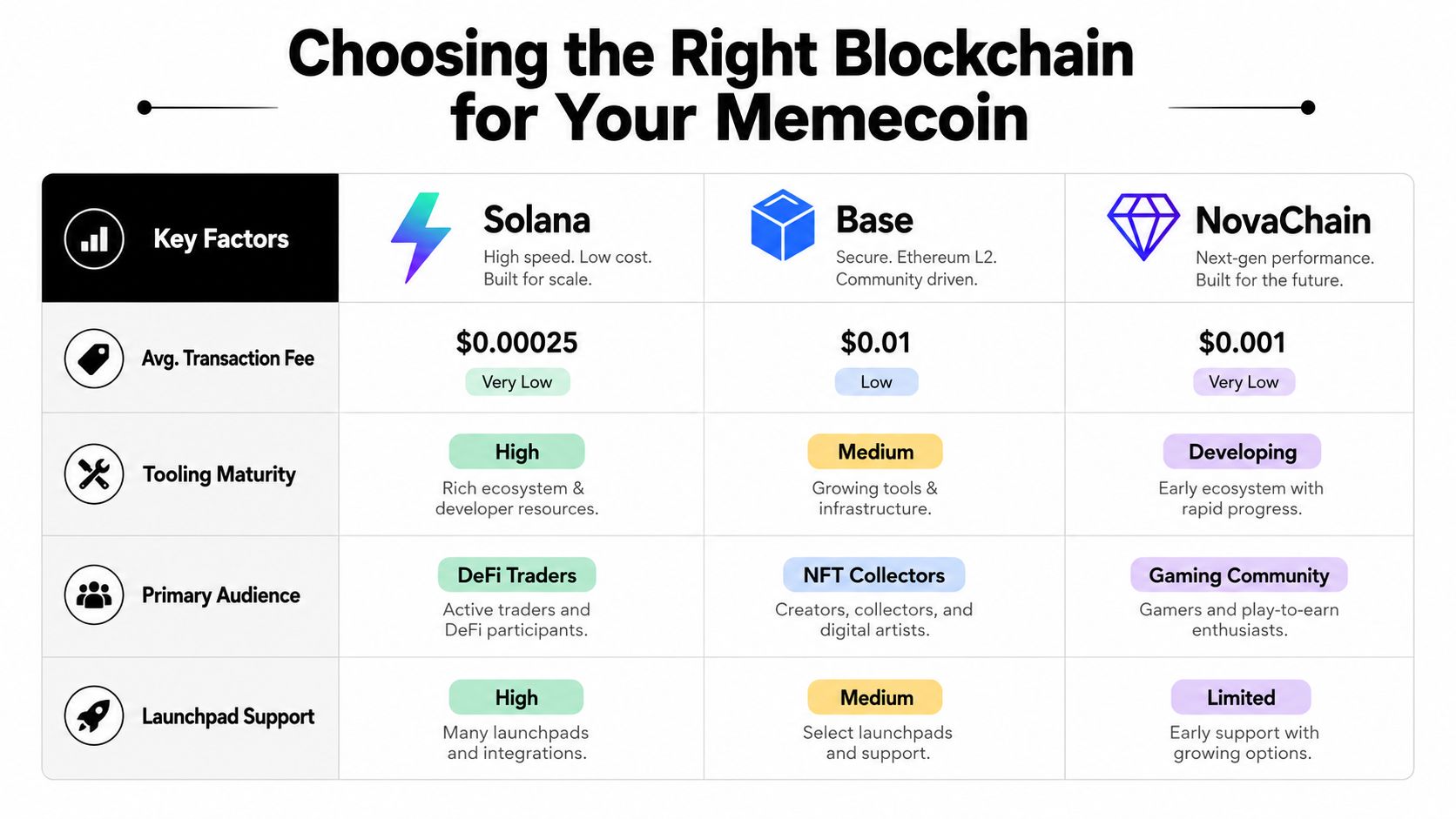
Chain choice should not be a popularity contest. It should be a fit test between your budget, your audience, and the kind of memecoin culture you want to enter. A token that needs very cheap interaction and fast community churn belongs in a different place than a token trying to look more established from day one.
Compare the chain, not the marketing
Ethereum still carries the strongest credibility signal for serious projects, but it is also the most expensive environment in this set. Base and Solana-style launches are much cheaper to start, and one Base guide says 0.01 to 0.02 ETH is typically enough for creation fees before liquidity is added Base launch guidance. Solana launch advice in the same broader launch ecosystem points to 5 to 12 SOL of starting liquidity, with 10 SOL as a practical target Solana launch guidance.
That does not mean the cheapest chain is the best chain. Pick the chain where your intended buyers already trade this kind of token. Meme culture is cluster-based, and users tend to follow the venues they already trust, whether that's Ethereum, BNB Chain, Base, or Solana.
Let the audience decide the venue
Use three filters. First, where do the buyers already spend time. Second, what tooling is mature enough for the launch flow you want. Third, which DEX and launchpad ecosystem can support the token after it goes live.
For first-time creators, low-fee ecosystems can reduce mistakes and friction, especially when they use launchpads instead of hand-building every step. That said, if your audience expects a more established environment, a cheaper chain can work against you by making the project feel disposable.
A simple rule helps here.
Practical rule: choose the chain where your meme already belongs culturally, not the chain with the smallest gas bill.
For launch mechanics, ecosystem fit matters as much as technology. If you are working on Ethereum or a major EVM chain, tool familiarity is strong, and the ERC-20 workflow is well understood. For a plain-language overview of that standard, the ERC-20 background on Coiner Blog's token primer is a useful reference point for the token format itself.
If you can name one chain and explain that choice in one sentence, you're ready to move forward. If you can't, the project probably needs more thinking before deployment.
Deploying the Smart Contract and Verifying It Publicly
The deployment step is simpler than many expect. You can build it with code, or you can use a no-code creator, but the sequence still looks familiar, set the token parameters, compile or configure the contract, deploy it, then verify it on a block explorer so anyone can inspect it.
The standard workflow
A beginner-friendly guide lays out the classic EVM path as installing MetaMask, using Remix IDE, creating a Solidity file, compiling it, deploying it, and then verifying the contract on an explorer beginner MetaMask and Remix workflow. Another practical launch guide describes the same idea more broadly, define the concept, choose the chain, create a wallet, set token parameters, deploy the smart contract, and verify it publicly on Etherscan or BscScan before adding liquidity step-by-step memecoin guide.
If you use a launchpad or token creator, that same logic gets compressed into a form-based flow. You still need to decide the name, symbol, supply, decimals, and any optional mechanics such as burn or fee logic. The interface is easier, but the underlying responsibility doesn't change.
Verification is part of the product
An unverified contract is a trust problem. Buyers, aggregators, and DEX front ends treat source visibility as a basic credibility check, and missing verification can become a tradability blocker. For a conceptual overview of what a smart contract is, Coiner Blog's smart contract explainer gives the right mental model before you start treating the code as a public artifact.
The launch sequence is usually straightforward once the parameters are finalized:
- Prepare the wallet: fund the deployer wallet on the target chain.
- Load the template or builder: use Remix, a launchpad, or a token creator.
- Enter the token settings: name, symbol, supply, decimals, and optional logic.
- Deploy the contract: confirm the transaction in your wallet.
- Verify the source: publish or match the source on the appropriate explorer.
- Share only the verified contract address: that's the version people should trade.
The no-code route lowers friction, but it also tempts people to move too fast. Don't. If you can't verify the contract publicly, you're asking buyers to trust a black box.
Security Hardening and Anti-Manipulation Checklist
This is the part most launch guides skip, and it's where many memecoins get exposed. A token can be technically valid and still be unsafe to buy if the creator hasn't thought through copycat tickers, bot sniping, liquidity behavior, or hidden permissions.
Check the attack surface before launch
Start with the simplest threat, name confusion. Practical launch advice often tells creators to check whether a name already exists, because copycat tickers and impersonation are real risks in a market with millions of cryptocurrencies and countless near-duplicate brands risk-first memecoin launch discussion. That same supply problem is why a clean ticker and a clear brand matter more than people think.
Then move to trading protection. Solana-style launch guidance explicitly mentions max transaction limits and anti-bot measures as part of token configuration, which makes sense because bots can eat the first wave of liquidity before human buyers even react Solana-style launch guidance. A max-wallet limit can also reduce early concentration, but if you set it too tight, you may block real users and suppress volume.
Aggressive anti-bot settings solve one problem and create another. They can keep snipers out, but they can also frustrate legitimate buyers who arrive early and want to build a position.
Liquidity locks help, but they are not magic
Liquidity locking is a trust signal because it shows the creator isn't free to yank the pool immediately. It also creates a trade-off. If a real bug appears and the liquidity is locked too tightly or for too long, the team may have less room to respond. That's why the lock decision should match the seriousness of the launch and the confidence level of the code.
A practical hardening plan usually covers four things:
- Ticker collision checks: confirm the name and symbol aren't already circulating in confusingly similar forms.
- Ownership and control: understand whether the contract keeps admin powers, renounces them, or limits them.
- Anti-bot settings: define max-transaction, max-wallet, or cooldown logic before launch.
- Liquidity handling: decide how much to lock, where, and under what conditions.
Monitor the right signals after launch
The first hours matter. Watch contract status, holder concentration, and changes in liquidity. A sudden shift in pool depth can be a warning sign, and a lopsided holder distribution can tell you that a few wallets control too much of the supply. The key is to treat launch as a live system, not a one-time event.
For builders who want a broader process view, the risk-first framing is more valuable than the hype around virality. If you harden the token well, you're not making it “safe,” but you are making it less fragile.
Liquidity, Launch Mechanics, and Early Community Growth
A verified contract does not make a memecoin tradeable by itself. The market still needs liquidity, and the community still needs a clear way to understand what just launched. Those two pieces have to move together. A token with no pool looks fake. A pool with no attention looks empty.
Seed the market like you mean it
On EVM-style launches, the usual move is to add liquidity to a DEX such as Uniswap or PancakeSwap after the contract is verified. On Solana-style paths, the tooling changes, but the logic stays the same. Buyers need a place to trade, and that pool needs enough depth that the chart does not look broken from the first minute. For a clearer picture of how automated pools work, the Coiner Blog's AMM explainer breaks down why price movement starts the moment liquidity enters the pair.
Early visibility is partly mechanical. Launch guides often tie stronger early chart movement on DexScreener to active trading and meaningful volume, which is why teams watch those signals so closely after launch KuCoin launch guide. That does not guarantee success, but it shows how quickly the market decides whether a token has real traction or just a loud announcement.
Community comes before the pair, not after it
Pre-launch presence matters. X, Telegram, and Discord should not look empty on launch day, because people check those channels for basic legitimacy before they buy. A dead chat raises doubt fast. If you want practical community mechanics, actionable community strategies from Bazzly are a useful reference for structuring engagement without turning every post into noise.
A clean launch sequence usually looks like this:
- Before the contract is public: publish the concept, visual identity, and community channels.
- Before the pair goes live: make sure the wallet, explorer link, and contract verification are ready.
- After liquidity is added: announce the contract address once, clearly, and avoid flooding the feed with repeated shilling.
If the token launches on one chain but the existing community lives elsewhere, bridges can help people participate, but they also add friction and more places for something to go wrong. Keep the first launch simple if the goal is momentum, not infrastructure experiments. A smaller, easier-to-explain launch usually gives holders fewer reasons to hesitate.
The market structure matters as much as the marketing. Memecoin launches live or die on the overlap between pool depth, trading access, and social energy, and all three need to hold together long enough for the first buyers to trust the chart.
Should You Actually Launch a Memecoin
The better question is not whether you can launch one. It's whether a memecoin is the right container for what you're trying to build. A token can be the right answer if you already have a community, a sharp narrative, and a budget that can survive the messy part after launch.
If you're starting from zero, the math gets harsher. The platform economics are crowded, the attention cycle is short, and a lot of launches compete for the same buyers. If your idea could work better as a meme brand, a profile-picture NFT collection, or a points system, those options can carry less operational risk while still capturing community energy.
For creators thinking about community migration or audience design, Xholic AI's step-by-step guide for X creators is useful context because it shows how much of launch success still depends on distribution, not just token mechanics.
Ask yourself three questions. Do you already have a real community to migrate. Does the narrative get stronger over time, or does it burn out after the first post. Can you fund the launch, the community, and the follow-through for months instead of days.
If any answer is no, walk away. A clean no is better than launching a token that doesn't have enough support to survive.
If you want more grounded crypto guides like this, with clear mechanics and fewer myths, visit Coiner Blog for practical coverage of tokenomics, DeFi, Web3, and real launch trade-offs. It's a good place to keep learning before you commit to a token launch, especially if you want the next step to be informed rather than impulsive.