
How to Rebalance Portfolio in Crypto: Steps That Work
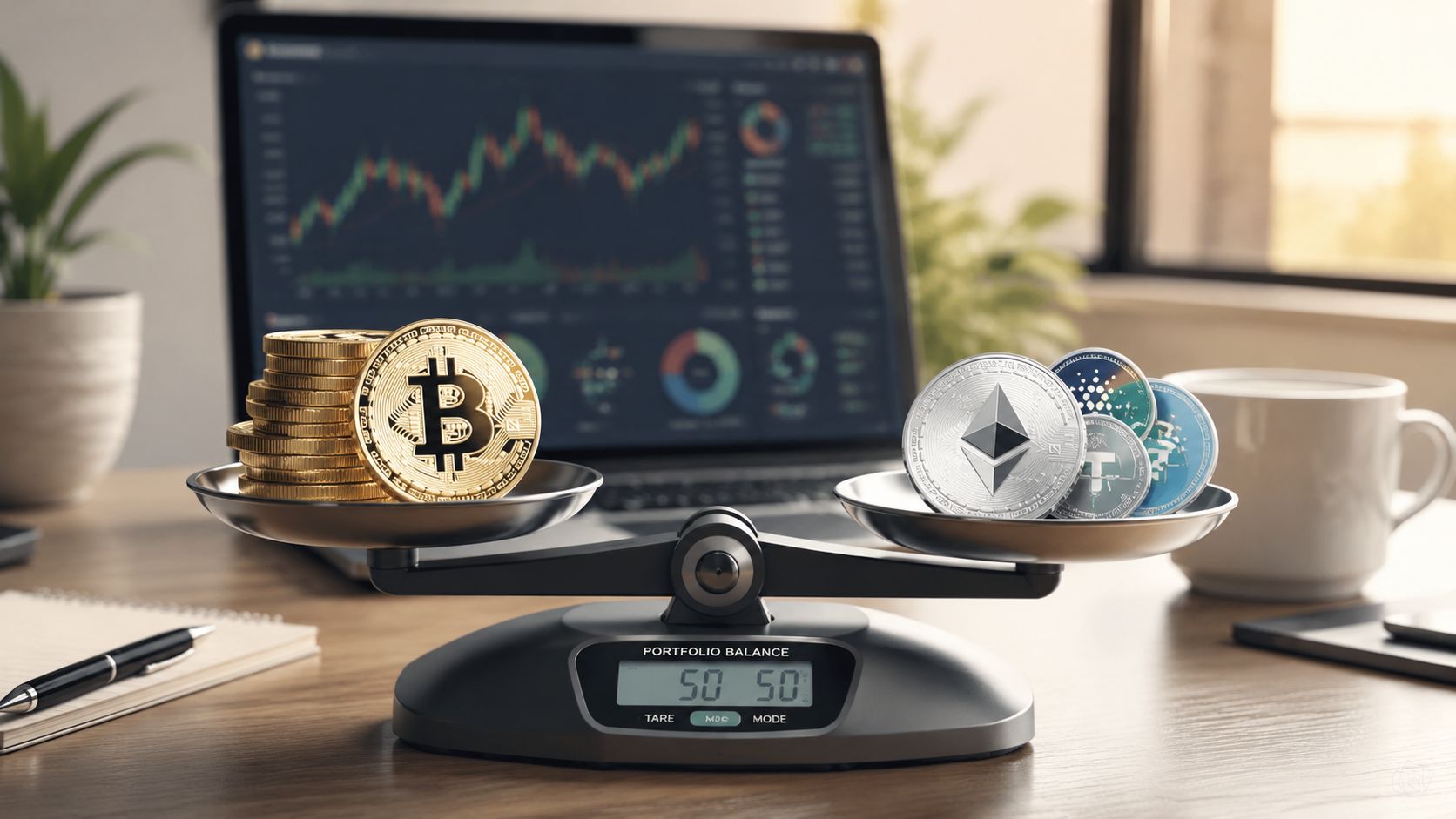
Six months ago, your crypto portfolio looked deliberate: 50% Bitcoin, 30% Ethereum, and 20% altcoins. After a strong mid-cap rally, the same account might now show 38% BTC, 27% ETH, and 35% altcoins. You haven't changed your plan, but your portfolio has become materially more aggressive.
That quiet shift is why learning how to rebalance portfolio allocations matters. Rebalancing means trimming positions that have grown beyond their intended role and directing capital toward assets that have fallen below target. In crypto, the process also has to account for exchange custody, DEX execution, gas, slippage, liquidity pools, smart contracts, and taxes.
Table of Contents
- Why Rebalancing Matters for Crypto Investors
- Setting Goals and Target Allocation
- Choosing a Rebalancing Strategy
- Executing Trades on CEX, DEX, and DeFi
- Managing Fees, Slippage, and Impermanent Loss
- Tax and Recordkeeping for Rebalancing
- Automation Tools, Scripts, and Your Rebalancing Policy
Why Rebalancing Matters for Crypto Investors
A portfolio can keep the same labels while its risk profile changes sharply. In the example above, altcoins have moved from a satellite allocation to the portfolio's largest risk contributor. A reversal could therefore produce a deeper drawdown than the original plan allowed.
Beyond its return effects, rebalancing preserves a target asset mix and controls drift. A 60/40 equity-bond portfolio left untouched from 1989 would have reached roughly 80% equities by the end of 2021, showing how market movements can alter risk without a new investment decision (Elm Wealth's portfolio rebalancing overview).
Crypto portfolios can drift much faster. A large Bitcoin move, a speculative Layer 2 rotation, or a tokenomics failure can push one sleeve far beyond its intended role. A portfolio designed to combine Bitcoin's relative maturity, Ethereum's smart-contract and DeFi exposure, and a measured allocation to emerging networks may start behaving like a concentrated altcoin trade.
Rebalancing is a risk rule
The operating rule is straightforward:
- Set target weights.
- Measure current weights.
- Sell or redirect part of overweight positions.
- Buy underweight positions, or add to them with new cash.
- Record the trade and update the portfolio ledger.
This process applies a version of “sell some winners, buy some laggards” without requiring a market forecast. It also creates a psychological barrier against FOMO. You do not need to predict whether a rally will continue. You need a written boundary that tells you when an asset has become too large for the risk it is meant to carry.
That rule requires practical judgment in crypto. A threshold breach on a liquid CEX may be easy to correct, while the same breach on a thin DEX market can involve gas, slippage, and execution risk. A DeFi position may also carry impermanent loss or smart-contract exposure. Rebalancing should therefore specify both the allocation trigger and the acceptable trading route.
The history of rebalancing also explains its place in diversified investing. Its popularization in the 1940s, including work associated with Sir John Templeton and others, reflected the need to maintain an intended balance between growth and stability instead of allowing market leadership to dictate the portfolio.
A simple drift example
The following illustration shows how a rally can change both weights and risk classification. The post-rally values demonstrate portfolio drift, not a market forecast.
| Asset | Target Weight | Starting Value ($10k) | Post-Rally Value | Drifted Weight | Risk Tier Shift |
|---|---|---|---|---|---|
| Bitcoin | 50% | $5,000 | $5,000 | 38% | Core exposure becomes relatively smaller |
| Ethereum | 30% | $3,000 | $3,550 | 27% | Broad smart-contract exposure remains near target |
| Altcoins | 20% | $2,000 | $4,550 | 35% | Satellite risk becomes dominant |
| Total | 100% | $10,000 | $13,100 | 100% | Portfolio becomes more speculative |
The exact figures matter less than the decision they expose. Does the current allocation still match your tolerance for volatility, liquidity risk, and drawdowns? Trading costs, taxes, gas, slippage, and pool exposure then determine whether to correct the drift immediately, stage the trades, or use new contributions first.
Setting Goals and Target Allocation
Don't begin with a token list. Begin with the job the portfolio must perform.
Ask three questions:
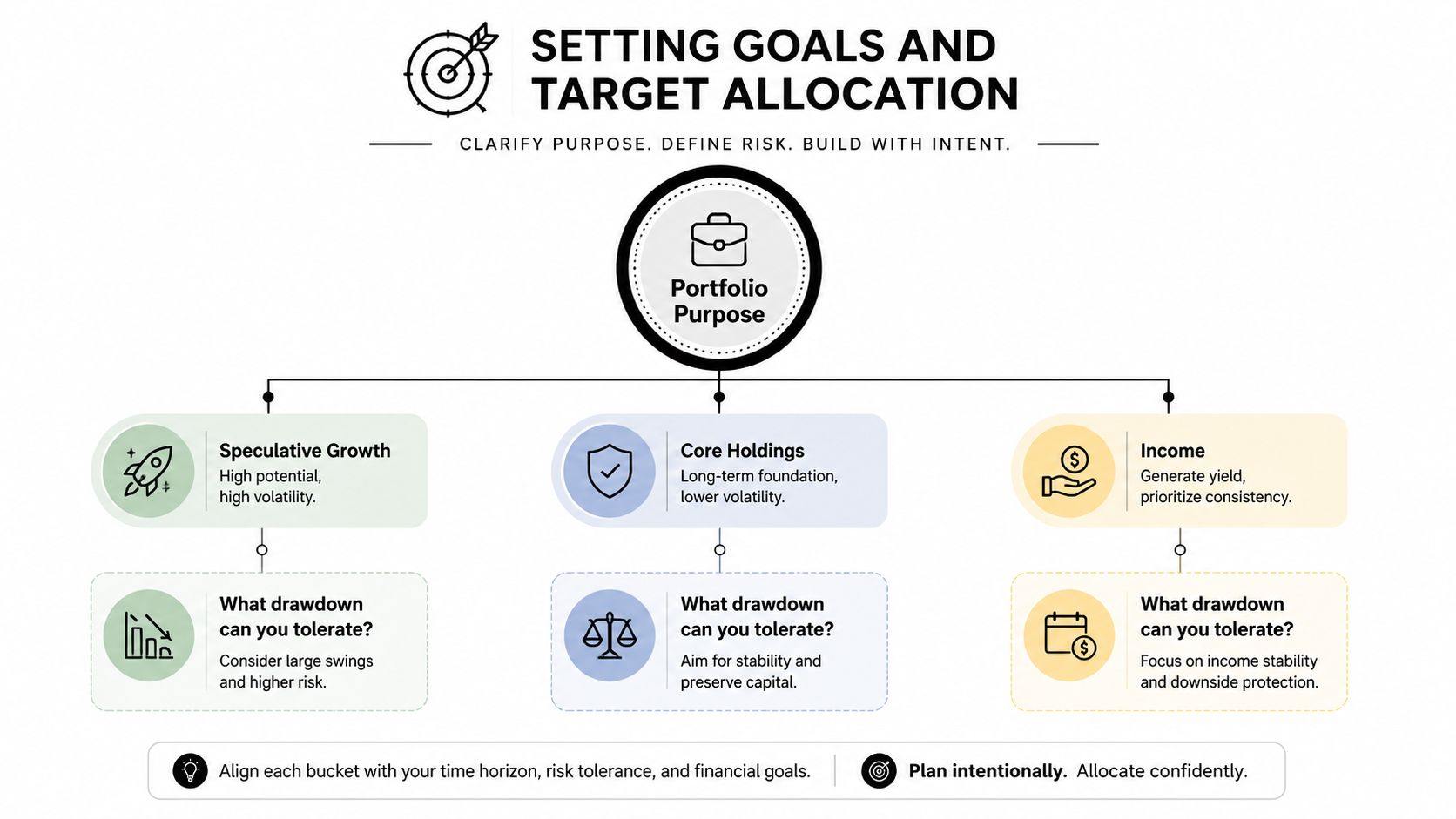
- Purpose: Is this portfolio for speculative growth, core holdings, income, or a combination?
- Drawdown tolerance: What level of loss would make you abandon the plan?
- Time horizon: Are you investing against a long-term objective, or are you trading a shorter cycle?
A portfolio built around Bitcoin, Ethereum, and a stablecoin reserve has a different purpose from a Web3 venture basket containing small-cap governance tokens, DeFi positions, and Layer 2 projects. Neither structure is automatically correct. The allocation should reflect the risk you can hold, not the risk that looks attractive during a rally.
Three useful allocation templates
These are planning frameworks, not universal recommendations:
| Profile | Bitcoin | Ethereum | L2 and major altcoins | Stablecoins |
|---|---|---|---|---|
| Conservative | 60% | 25% | 10% | 5% |
| Balanced | 45% | 25% | 20% | 10% |
| Aggressive | 30% | 20% | 30% | 20% |
Bitcoin usually anchors the portfolio because it can serve as the primary crypto reserve rather than a collection of protocol-specific bets. Ethereum represents exposure to smart contracts, DeFi, staking, and the broader application layer. The satellite sleeve can include established Layer 2 networks, major altcoins, AI and crypto infrastructure, or real-world asset tokenization projects, but its size should reflect the possibility that an individual project can fail.
Stablecoins aren't risk-free. They introduce issuer, reserve, depegging, platform, and regulatory risks. Their role is liquidity, optionality, and a source of capital for future purchases, not guaranteed safety.
Write the policy before the market tests it
Record the target allocation, the assets permitted in each bucket, the maximum satellite exposure, and the conditions that trigger action. Decide whether staking rewards, airdrops, liquidity-provider fees, and token vesting count toward the relevant asset sleeve.
You should revisit the strategic allocation infrequently, at most once or twice a year, rather than rewriting it after every red candle. A target that changes whenever sentiment changes isn't a target. For investors building a broader resource plan across wallets, exchanges, and protocols, a guide to streamline asset management can also help organize holdings before trade decisions begin.
Choosing a Rebalancing Strategy
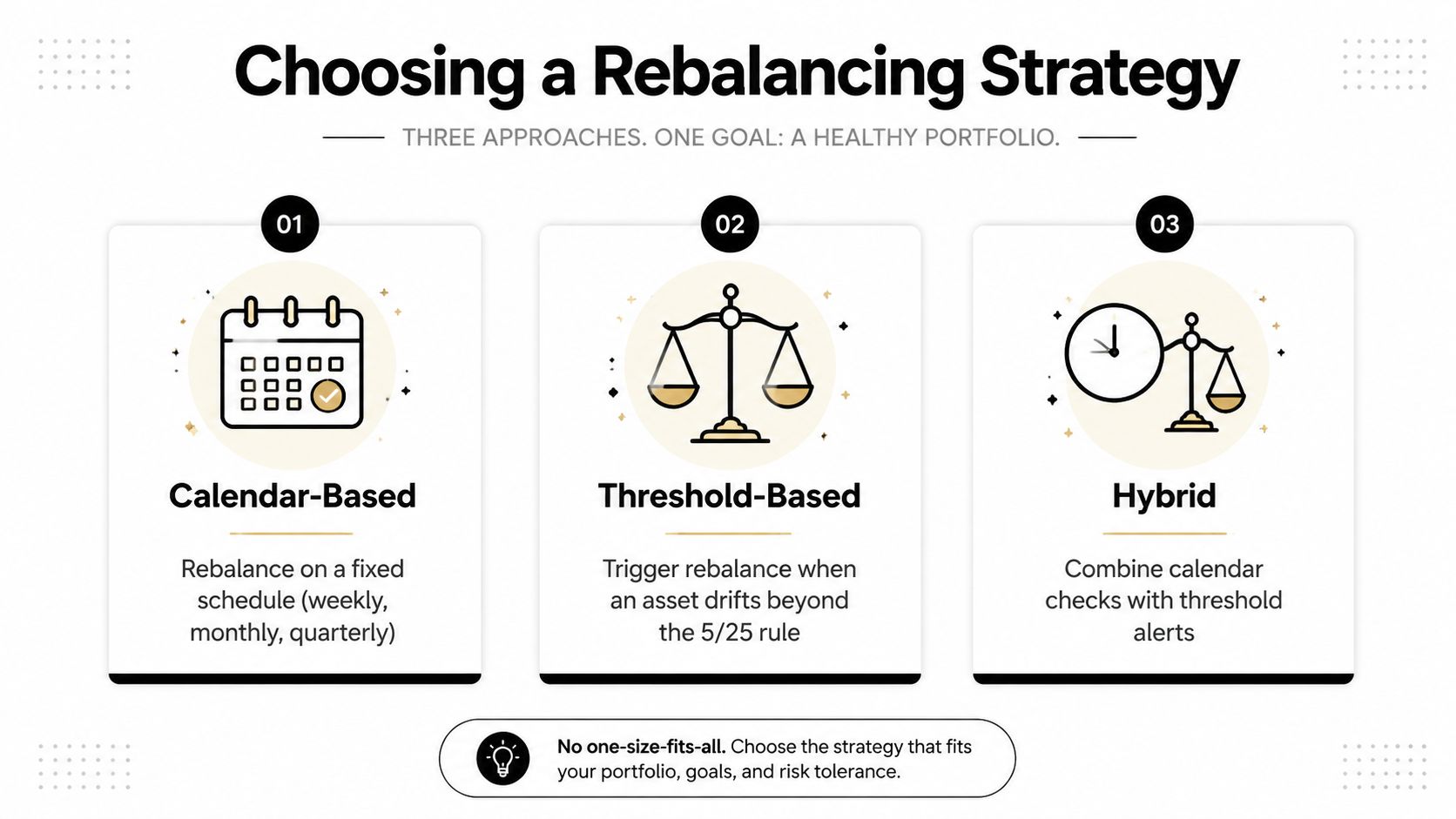
Crypto investors typically choose calendar-based, threshold-based, or algorithmic and range-based rebalancing. The right choice depends on how much drift you will tolerate, how often you can monitor positions, and whether fees, taxes, gas, and execution risk make frequent trades uneconomic.
Calendar-based rebalancing
Set a fixed review date and trade only when the allocation needs correction. A quarterly or annual review is simple to document and limits impulsive decisions. Its drawback is timing. A sharp crypto rally or selloff can push an asset outside your acceptable range before the next scheduled check.
The U.S. Securities and Exchange Commission notes that many professionals recommend reviewing portfolios every six to 12 months. Vanguard research describes annual rebalancing as often optimal, while also finding that monthly or quarterly schedules can be too frequent and a two-year interval too infrequent (SEC guidance on rebalancing).
Threshold-based rebalancing
The 5/25 rule combines an absolute band for larger allocations with a relative band for smaller sleeves. A 60% target would generally trigger action above 65% or below 55%. A smaller sleeve can trigger after moving 25% relative to its target (White Coat Investor's explanation of the 5/25 rule).
For a portfolio targeting 50% BTC, 30% ETH, and 20% altcoins, Bitcoin's band might be 45% to 55%. An altcoin sleeve can breach its relative threshold after a smaller absolute move. Thresholds respond to meaningful drift, though volatile tokens may cross them repeatedly during choppy markets, creating unnecessary trades.
Algorithmic and range-based rebalancing
Automation can monitor allocation bands continuously and submit trades after a breach. Tight ranges may fit market-neutral strategies or portfolios with deep liquidity. They are harder to justify for a retail account paying material gas, spreads, swap fees, and taxes on each adjustment. On-chain bots also require safeguards for failed transactions, stale prices, contract permissions, and thin liquidity.
Practical rule: Use a calendar review with threshold alerts unless the portfolio is large, liquid, and inexpensive to trade.
Vanguard's analysis of return data from 1926 to 2021 found annual rebalancing beat several more frequent approaches by small basis-point differences, including 6 to 14 basis points versus quarterly rebalancing with a 5% threshold and 21 to 28 basis points versus monthly rebalancing without a threshold (Vanguard's rational rebalancing analysis). For crypto, write the rule before choosing the tool: review on a set schedule, trade only after a defined band breach, and automate only when lower execution costs and reliable controls outweigh added technical risk.
Executing Trades on CEX, DEX, and DeFi
The allocation decision is only half the job. Execution determines how much of the intended rebalance reaches the portfolio.
On a centralized exchange, you typically sell an overweight asset into a stablecoin or fiat pair, then purchase the underweight asset through a liquid spot market. Binance, Coinbase, and Kraken offer different order books, fees, withdrawal controls, and custody arrangements, so compare the actual route rather than assuming the cheapest headline fee will produce the best fill.
A DEX aggregator such as 1inch, CoW Swap, or Jupiter searches across liquidity sources. Route selection, price impact, MEV protection, token approvals, and wallet signing all matter. Limit orders can reduce execution uncertainty when the market is liquid, while market orders prioritize completion. A practical discussion of market orders versus limit orders is useful before automating either approach.
DeFi adds another layer. Balancer pools, Aave positions, Convex strategies, Tokemak vaults, and similar protocols may require deposits, withdrawals, claims, swaps, or compounding transactions. You also inherit smart-contract, oracle, bridge, governance, and liquidity risks.
Worked execution example
Suppose a portfolio starts at 50% BTC, 30% ETH, and 20% stablecoins. After a Bitcoin rally, it reaches 60% BTC, 25% ETH, and 15% stablecoins. The objective is to restore the target, not to predict whether Bitcoin will keep rising.
A clean sequence is:
- Calculate the current portfolio value and the dollar amount represented by each target weight.
- Sell enough BTC to reduce its position from 60% to 50%.
- Direct part of the proceeds to ETH until ETH returns to 30%.
- Place the remainder in stablecoins until the reserve reaches 20%.
- Confirm the final weights after fees and execution costs.
- Record every transaction, including the asset sold, proceeds, cost basis, and destination wallet.
If ETH is already close to target, don't force a multi-leg swap just to make the spreadsheet look perfect. New contributions, staking income, or a future withdrawal can correct a small difference more efficiently.
| Venue | Order Types | Settlement | Custody | Best For |
|---|---|---|---|---|
| CEX | Market and limit spot orders | Exchange ledger settlement | Exchange custody until withdrawal | Liquid pairs and straightforward execution |
| DEX | Route-aware swaps, limit or intent orders | On-chain settlement | Self-custody wallet | Wallet-native assets and transparent routing |
| DeFi vault | Deposit, withdraw, claim, compound | Smart-contract settlement | Wallet plus protocol custody model | Yield positions and structured allocations |
Batch transactions where possible, but don't approve unlimited token spending without understanding the allowance. Check network congestion before signing, and avoid treating a failed transaction as harmless. A failed swap can still consume gas, while a poorly routed transaction can create unnecessary slippage.
Managing Fees, Slippage, and Impermanent Loss
Rebalancing only makes sense when the correction is larger than the friction. Trading fees, bid-ask spreads, price impact, gas, withdrawal charges, and taxes can turn a sensible allocation adjustment into expensive activity.
The relevant comparison isn't just the platform's stated fee. A low-fee order on a thin market may fill worse than a slightly higher-fee order in a deeper market. DEX routes can also differ because one path may use more pools, more approvals, or more transactions.
Where the drag appears
- Trading fees: Centralized and decentralized venues charge different rates, and account tiers or routing methods can change the final cost.
- Slippage: Liquid BTC and ETH pairs usually offer better execution than long-tail tokens, but a volatile market can widen every route.
- Gas: Ethereum mainnet transactions can become uneconomical for smaller accounts, particularly when the rebalance requires several approvals and swaps.
- Impermanent loss: Liquidity providers can underperform holding the assets when pool prices move apart. This matters in an ETH and staked-ETH pool as well as in more volatile token pairs.
A common operational rule is to skip a small rebalance when total friction exceeds 0.5% of trade notional, batch multi-leg trades into one route where safe, and consider Layer 2 networks or intent-based protocols for smaller trades. These are practical thresholds, not guarantees, and you should verify live costs before signing.
| Venue | Trading Fee | Typical Slippage | Gas Cost | Notes |
|---|---|---|---|---|
| CEX | Depends on exchange and account tier | Usually reflected in spread and order-book depth | None for internal trading | Withdrawal and custody risks remain |
| DEX aggregator | Depends on route and liquidity source | Often low for liquid pairs, higher for thin tokens | Network-dependent | Compare price impact and MEV protection |
| DeFi vault | Protocol and strategy-dependent | May arise during deposits or withdrawals | Network-dependent | Adds smart-contract and liquidity exposure |
For a deeper look at how pool divergence affects returns, use an impermanent loss calculator before treating an LP position as a passive allocation. A pool that appears to rebalance automatically may be selling the outperformer and accumulating the underperformer continuously, while exposing you to fee variability, contract risk, and changing pool composition.
Tax and Recordkeeping for Rebalancing
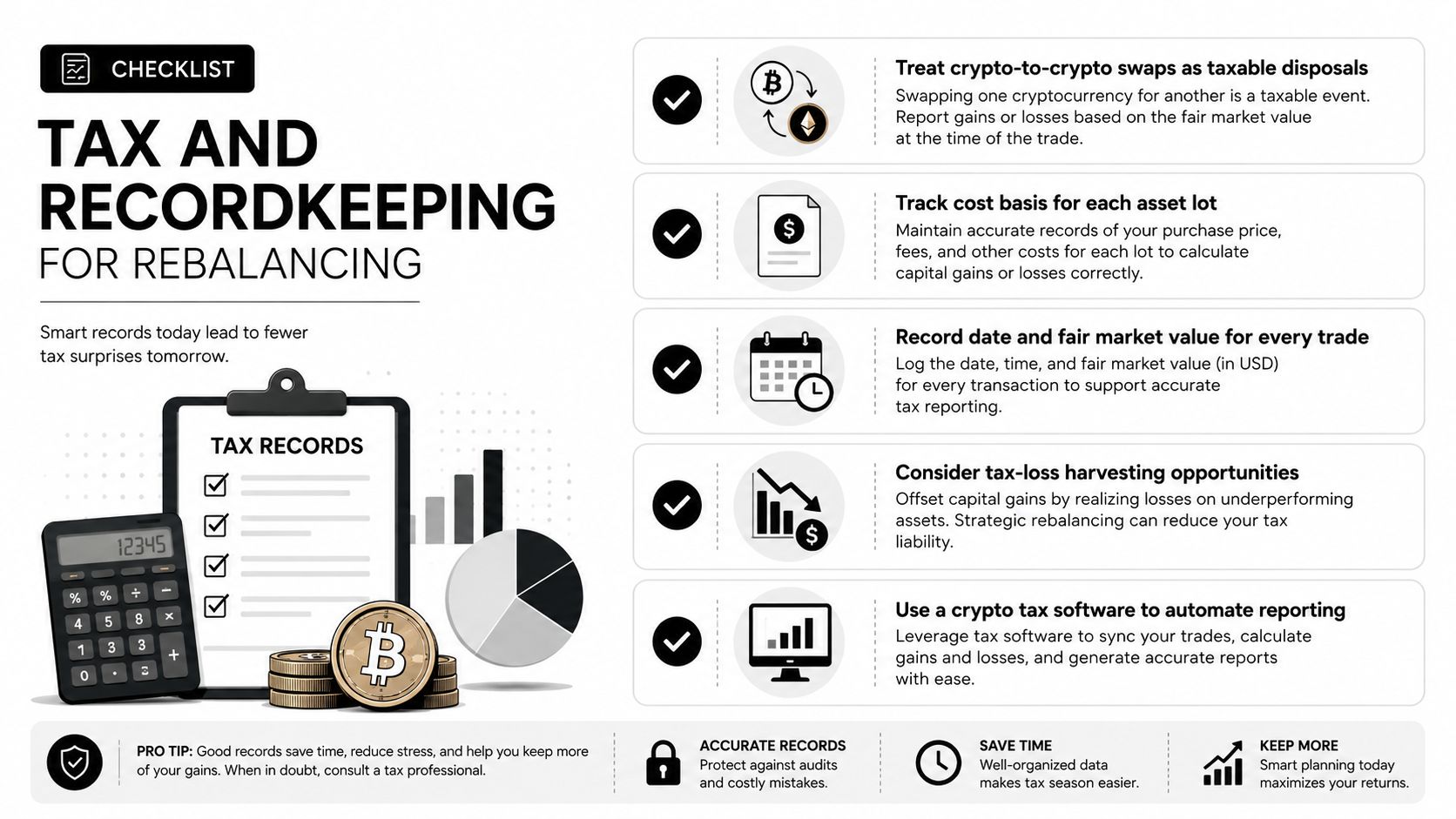
In many jurisdictions, exchanging one cryptocurrency for another is treated as a disposal of the asset sold. In the United States, IRS Notice 2014-21 established that virtual currency can be treated as property for federal tax purposes, so a BTC-to-ETH swap can create a reportable gain or loss even when no fiat enters the account. Rules differ across countries, and regulatory treatment can change, so use current guidance for your jurisdiction. For broader compliance context, consult this IRS rules 2026 guide, while confirming details with a qualified tax professional.
Build an audit trail
A rebalancing spreadsheet or tax platform should capture:
- Date and time: Include the transaction timestamp and relevant tax year.
- Asset and quantity: Record what you sold, bought, deposited, or withdrew.
- Proceeds and fair market value: Keep the value used for the transaction.
- Cost basis and lot method: Track FIFO, LIFO, or specific identification where permitted.
- Wallet and counterparty: Reconcile exchange exports with on-chain wallet history.
- Transaction fees: Store exchange, network, and protocol charges separately.
Crypto-to-crypto swaps, staking rewards, liquidity-provider activity, bridge transfers, and DeFi claims can create different reporting questions. Don't rely only on an exchange CSV. Reconcile wallet addresses, transaction hashes, and internal transfers so a withdrawal isn't accidentally recorded as a sale.
Use losses deliberately
Tax-loss harvesting is available in taxable accounts, not tax-advantaged accounts such as IRAs or 401(k)s. Realized capital losses can offset capital gains and, if losses remain, up to $3,000 per year of ordinary income can be deducted, with excess losses carried forward to future tax years (Investopedia's tax-loss harvesting guide).
A practical crypto use case is selling a losing asset, realizing the loss, and redeploying the proceeds into a similar but not identical holding while keeping the portfolio's risk exposure aligned. Be careful with local rules, wash-sale restrictions where applicable, token wrappers, and rapid repurchases. Tax-advantaged structures such as self-directed IRAs or UK SIPPs may change the treatment, while Singapore generally doesn't impose a capital-gains tax, but eligibility and surrounding tax obligations still require professional review.
Automation Tools, Scripts, and Your Rebalancing Policy
A written policy comes first; automation executes those instructions. Keep it to one page, covering target weights, permitted assets, drift bands, review schedule, trading venues, minimum order size, and tax rules. Include the conditions that pause trading, such as abnormal gas costs, thin liquidity, or a protocol incident.
A practical quarterly workflow is:
- Review allocations and flag threshold breaches.
- Check CEX liquidity, DEX price impact, gas, and protocol status.
- Use new cash or staking income for small corrections where possible.
- Place only the trades required to restore the target band.
- Export transaction records and reconcile balances afterward.
| Tool Category | Examples | Best For | Key Limitation |
|---|---|---|---|
| Exchange bots | 3Commas, Binance portfolio bots, OKX automation | Rule-based CEX execution | Custodial and API-key risk |
| DeFi automation | Yearn V3, Beefy, Idle, Enzyme, Set Protocol | Vault and strategy management | Smart-contract exposure |
| On-chain rebalancers | Balancer, Tokemak, Symmetric | Programmatic pool allocation | Liquidity and protocol risk |
| Lightweight scripts | Python with ccxt, Zerion or DeBank APIs | Custom monitoring and alerts | Requires testing and tax-lot logic |
Scripts can calculate drift and send alerts without withdrawal permissions. If an API is required, disable withdrawals, restrict access by IP where supported, and test with small amounts. A bot cannot infer your tax lots, liquidity requirements, or risk tolerance, while a smart contract can fail even when its allocation logic is correct. Automated DeFi positions also need a review for impermanent loss and changing pool conditions.
For a broader comparison of monitoring options, review our selection of the best crypto portfolio trackers for 2026. Before selecting implementation software, find the best rebalancing tool for your venues, custody setup, and reporting needs.
Before signing: Confirm the drift, trade size, route, slippage, gas, token approvals, custody destination, and cost basis record.
A durable portfolio process uses a written rule set and repeatable reviews. Automation then applies those rules consistently, while human checks handle taxes, liquidity, security, and changing protocol risk.