
Cryptocurrency Paper Trading: Master Risk-Free Strategies
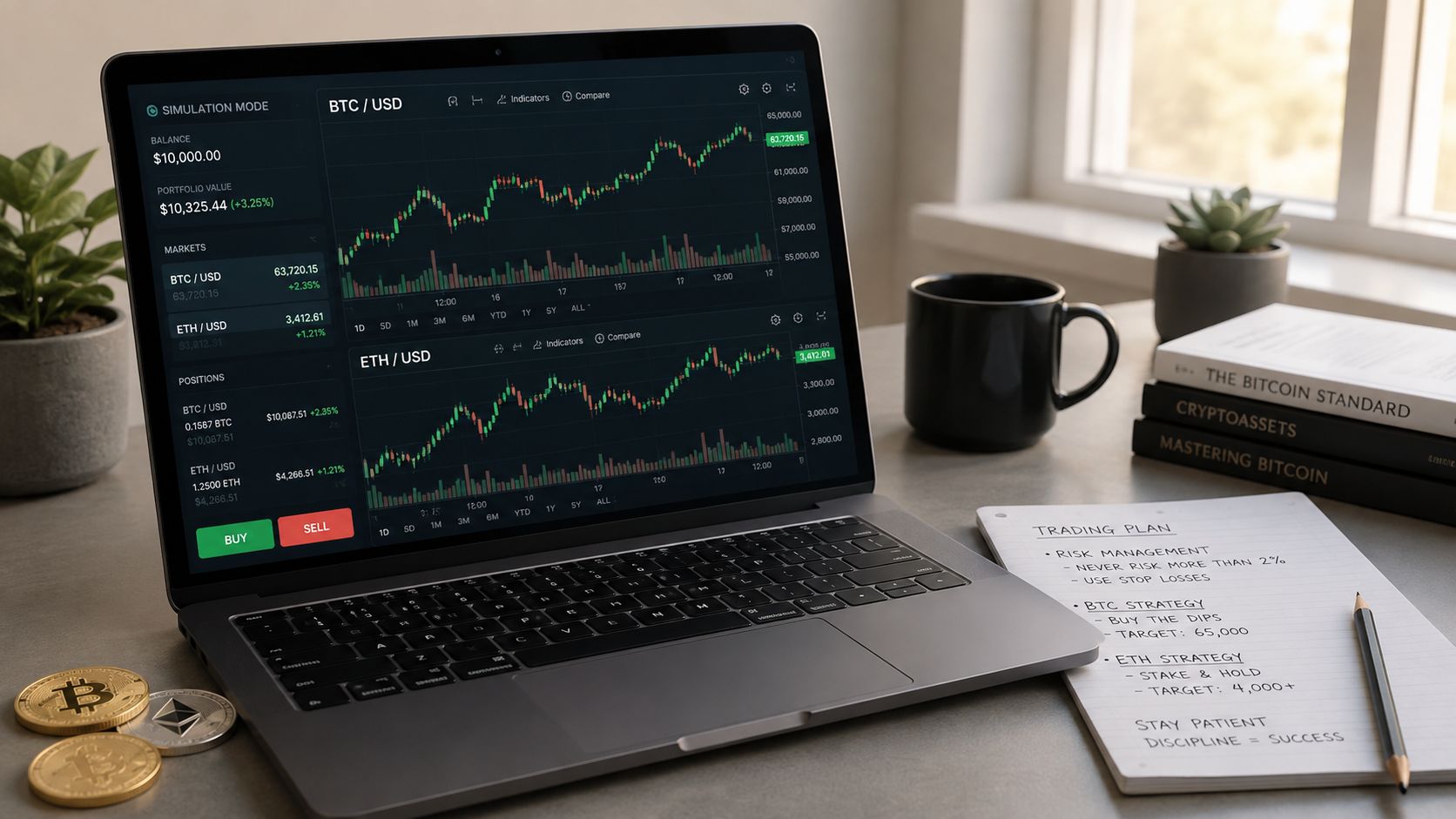
You can feel the pull of crypto without wanting to learn it the expensive way. Bitcoin moves fast, Ethereum keeps evolving, and every chart seems to promise an easy entry until real money is on the line and the same move looks a lot less friendly. That's where cryptocurrency paper trading earns its place, not as a toy, but as a controlled way to practice order entry, test rules, and learn how your own reactions change when the market starts moving.
Table of Contents
- What Is Cryptocurrency Paper Trading
- Benefits and Limitations of Paper Trading
- Choosing Your Paper Trading Environment
- Setting Up Your First Paper Trading Session
- Essential Metrics and Strategies to Practice
- Transitioning From Paper to Live Trading
What Is Cryptocurrency Paper Trading
A first encounter with crypto often feels like standing at the edge of a very loud, very fast room. You want to participate, but the volatility is obvious, and the idea of taking an early loss can make even a confident reader hesitate. Cryptocurrency paper trading solves that problem by letting you practice before real capital is exposed.
A simulated market, not real profit
Paper trading is a simulated trading method where you place mock buy and sell orders with virtual funds while watching live market prices. The gains and losses are not real, so they can't be converted into cash. Platforms often call it a demo account, a sandbox, or a testnet, and the point is simple, practice first, risk later. A solid plain-language explanation of that setup is available from dYdX's paper trading guide.
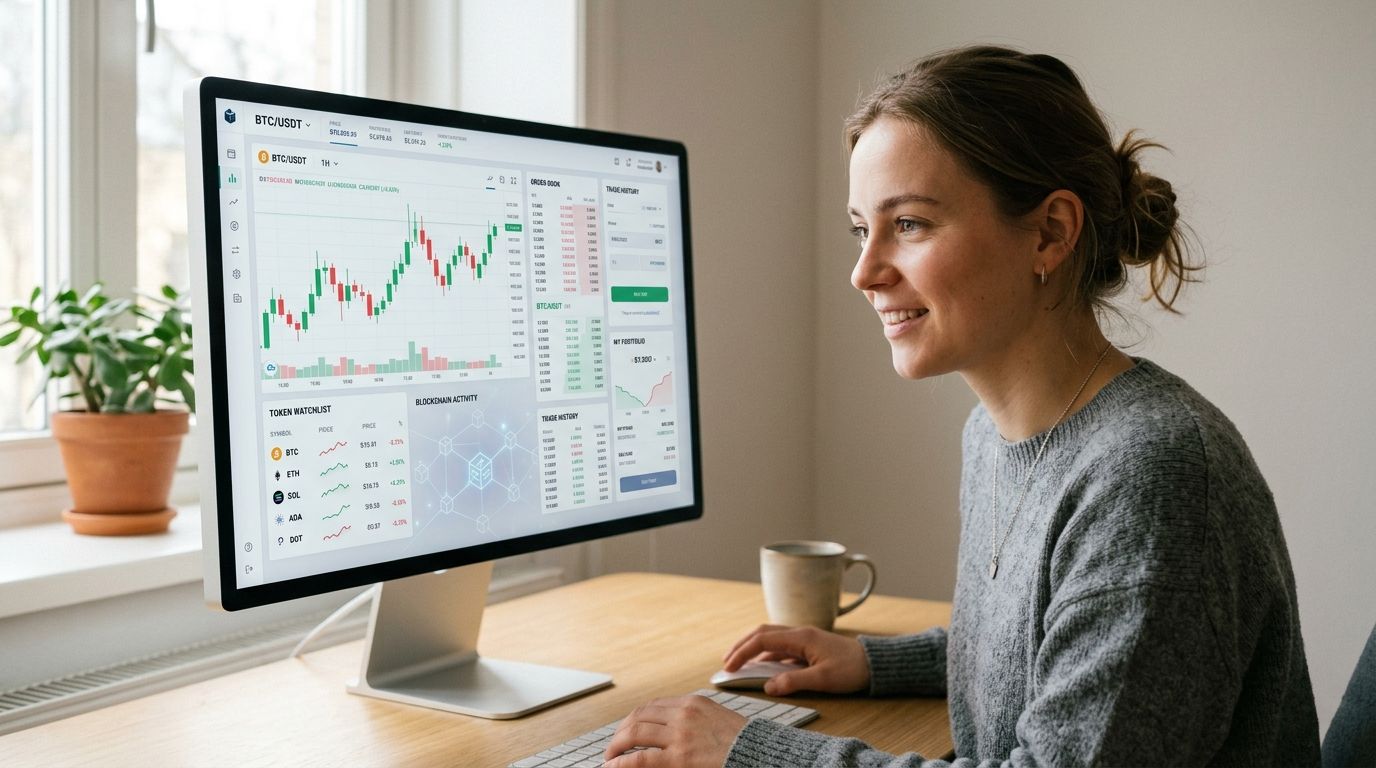
That distinction matters because the goal isn't to pretend you've made money. The goal is to learn how Bitcoin or Ethereum behaves on a screen, how order buttons work, and how your plan holds up when price starts to swing. If you can't execute a clean trade in a simulated environment, real money usually makes the same weaknesses more expensive.
Practical rule: treat the demo account like a rehearsal room, not a playground.
Why the label matters
The phrase “paper trading” can sound old-fashioned, but the idea is still current. It's useful because crypto markets are active, fragmented, and full of decision points that can overwhelm a new trader. Simulated practice gives you room to make basic mistakes, like entering the wrong size, using the wrong order type, or chasing a setup you didn't plan to take.
It also lets you become fluent in the mechanics before you add emotion. That's a bigger advantage than it sounds like. Many people think they need more market predictions, when what they really need is cleaner execution, steadier habits, and a repeatable process.
Benefits and Limitations of Paper Trading
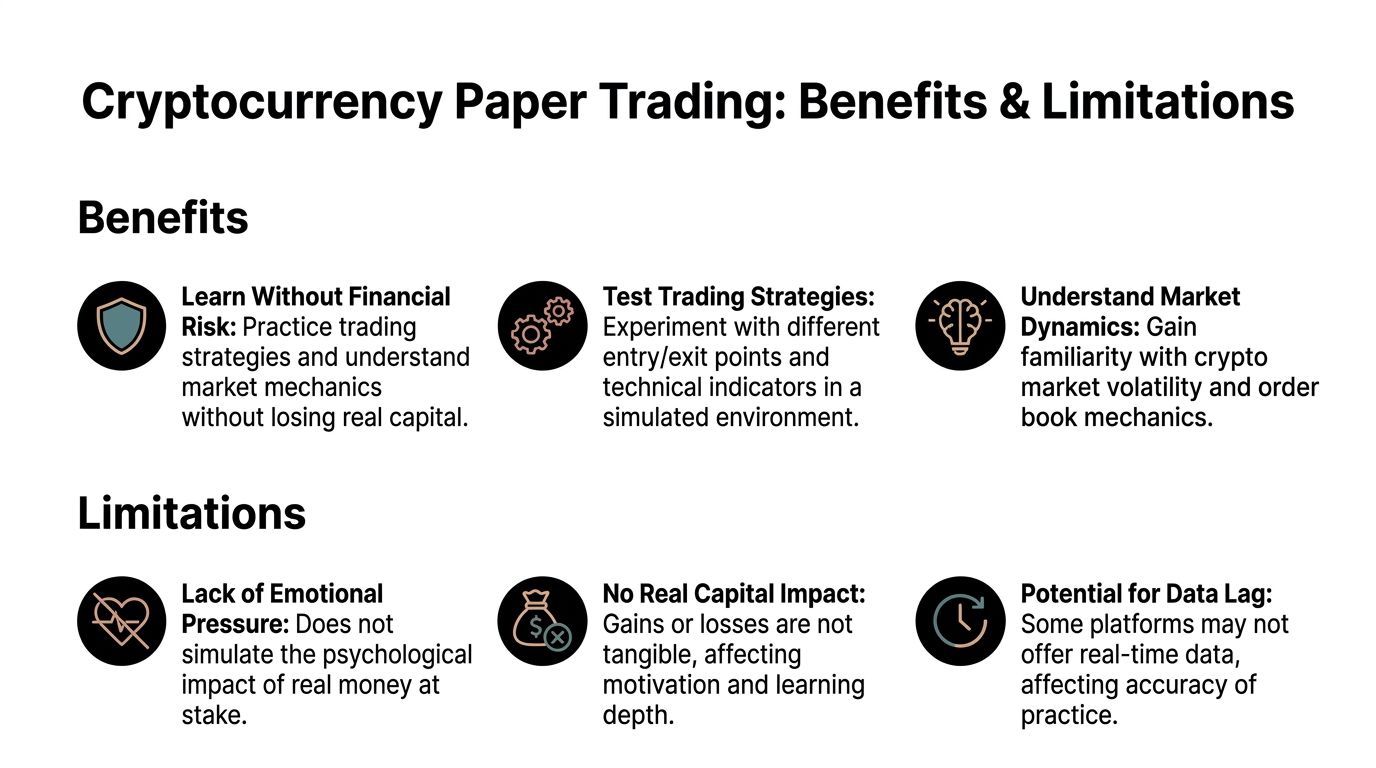
The strongest reason to paper trade is also the simplest one. You get to practice without turning every mistake into a financial loss. That makes it easier to focus on the craft, especially if you're still learning how limit orders, market orders, and stop-losses behave in a crypto interface.
What paper trading does well
A good demo environment helps you test more than button clicks. It lets you practice backtesting, position sizing, and risk management under changing market conditions, and many exchanges offer demo accounts that include BTC and other crypto assets or derivatives. That's useful because the trader can study whether a strategy survives realistic volatility before risking real money, as noted in ChangeHero's guide to crypto paper trading.
It also helps with order types. A trader can see the difference between using a limit order to test queue-based fills and a market order to observe slippage behavior. That's not abstract theory, it's the kind of operational detail that determines whether a strategy is tradable.
What paper trading doesn't teach well
The gap shows up in the emotional layer. A simulated loss doesn't feel the same as a real one, so the pressure to hesitate, chase, overtrade, or move a stop can be much weaker. That means a paper account can make you look more disciplined than you'll feel once money is involved.
There's also a realism problem. If the platform doesn't model slippage, fees, margin behavior, or imperfect fills, the demo can flatter a strategy that wouldn't survive live conditions. For risk structure itself, a deeper reference like this risk management guide is more relevant than a generic trading tutorial.
Paper trading is strongest when it shows you how a plan works mechanically. It's weakest when you assume mechanical success automatically transfers into emotional control.
A balanced way to think about it
The right expectation is modest and useful. Paper trading can help you build consistency, validate rules, and learn platform behavior. It can't fully reproduce the stress of real losses or the tension that comes from seeing a live position move against you.
So the best mindset is not “Can I win in demo?” but “Can I repeat my process cleanly?” That question keeps the focus on skill, not scoreboard vanity.
Choosing Your Paper Trading Environment
A paper trading setup should match the skill you want to build. If you want to get comfortable with one exchange's screens before risking real funds, an exchange-native demo is usually the cleaner starting point. If your goal is to study charts, compare setups across different markets, or use more flexible analysis tools, a third-party simulator usually fits better.
Exchange demo accounts
Exchange demo accounts usually mirror the order flow you will use later in live trading. That matters because it shrinks the gap between practice and execution, especially for traders who want to move from simulation to live orders without relearning menus, wallet screens, or order panels. The interface itself becomes part of the training, and that repetition helps your hands learn the steps before pressure enters the picture.
The other advantage is that your paper workflow can stay close to your future live workflow. Crypto trading often creates mistakes through platform friction, not just bad analysis, and live trading exposes those mistakes quickly. A trader who already knows where the stop button sits is less likely to freeze when a position moves the wrong way.
Third-party simulators
Third-party tools are more useful when analysis matters more than platform familiarity. They often give you stronger charting workflows, more flexible replay tools, and a wider view of market structure. That makes them useful for traders who want to test setups across different coins or timeframes without being tied to one exchange's interface.
If you are still learning price action, a chart-first tool can help you separate pattern recognition from order placement. A clear visual read of candles makes it easier to understand why a setup looks strong, weak, or late. For a practical companion, how to read candlestick charts is a useful reference.
Side-by-side comparison
| Feature | Exchange Demo Accounts | Third-Party Platforms |
|---|---|---|
| Main purpose | Practice on the same interface used for live trading | Analyze charts, test ideas, and review setups |
| Best for | Transitioning to a specific exchange | Broader technical study and strategy exploration |
| Learning curve | Lower if you will later trade on that exchange | Can be higher because the tools are richer |
| Execution realism | Usually stronger for order entry and workflow | Depends on the platform's simulation model |
| Ideal user | Trader focused on live readiness | Trader focused on charting and experimentation |
A simple way to choose is to ask whether you are training your hands or training your eye. If your weak point is execution, use the exchange. If your weak point is reading setups, use the charting tool. Many traders eventually use both, but there is no need to start with both.
Setting Up Your First Paper Trading Session
A paper trading session works best when it feels controlled from the start. Open the platform with a plan, not with curiosity in the driver's seat. If you begin by clicking around and placing trades at random, you are rehearsing impulse, not trading.
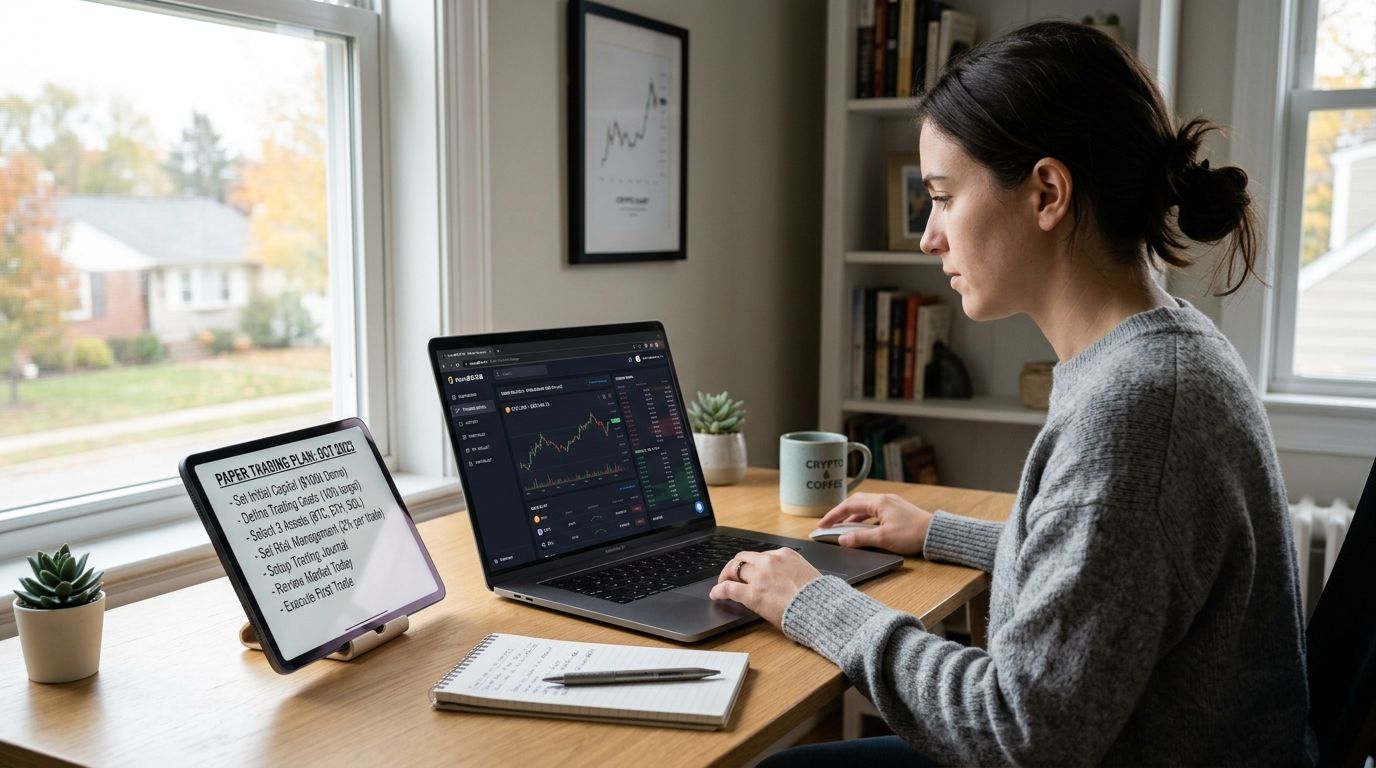
Start by deciding what kind of market you are training for, then make the account reflect that choice. Spot and derivatives behave differently, so your setup should match the place you expect to trade later. Use a fake balance that feels close to the amount you would risk, then write down the entry rules, exit rules, maximum loss per trade, and maximum daily loss before anything is placed. That kind of preparation turns simulation into practice for decision-making, not just a tour of the interface, which is why GTS's paper-trading checklist is a useful baseline.
The account should also stay narrow at first. A small watchlist makes it easier to notice whether your choices are improving or whether you are hopping from one coin to another. Bitcoin and Ethereum are often enough for an early session because they are widely watched and easier to compare across trades than a long list of thinly traded tokens.
Write the rules before the first order
A new trader often wants to jump straight to the question of when to buy. A better place to begin is with the conditions that make a trade valid, the point where the trade becomes wrong, and the amount of loss you are prepared to accept if it fails. Those three parts work together, because without them every trade can be justified after the fact.
Write the plan down before the first order. Use your journal to record the entry price, exit price, date and time, position size, stop-loss, target, and the reason you took the trade. If you can't review a trade later without guessing, the session is teaching you very little about your process.
Train one skill at a time
The first session is not meant to prove you can make fake profits. It is meant to show whether you can follow your own rules when nothing is on the line. That includes keeping your risk fixed when a setup feels tempting, and not changing the plan halfway through because the chart starts moving in your favor.
A good way to keep the review honest is to understand your rate of return after the session and compare it with the quality of your execution. A trade record plus a return check gives you a clearer picture than a short winning streak, because it shows whether the process can survive more than one outcome.
Before you add more complexity, make sure your basic market reading is sound. If candle structure still feels unclear, this candlestick guide pairs well with a trade journal because it helps you connect the chart you saw with the decision you made.
Use the first session to build habits
The value of paper trading is not in the fake money. It is in the habits you repeat while you know the result cannot hurt you. That is the closest rehearsal you get before live trading, and it exposes the gap between what feels reasonable in your head and what you can do under pressure.
A disciplined first session should leave you with a clean record, a few honest mistakes, and a better sense of where your process breaks down. If you can keep the session structured, your next trades become easier to evaluate.
Essential Metrics and Strategies to Practice
A paper account becomes useful the moment you stop treating it like a scoreboard and start using it like a training log. A trade can look profitable and still reveal weak habits, while a flat or losing trade can still be useful if it shows you followed your rules under calm conditions. The goal is to see whether your process survives repetition, not whether a single session feels encouraging.
Track the right numbers
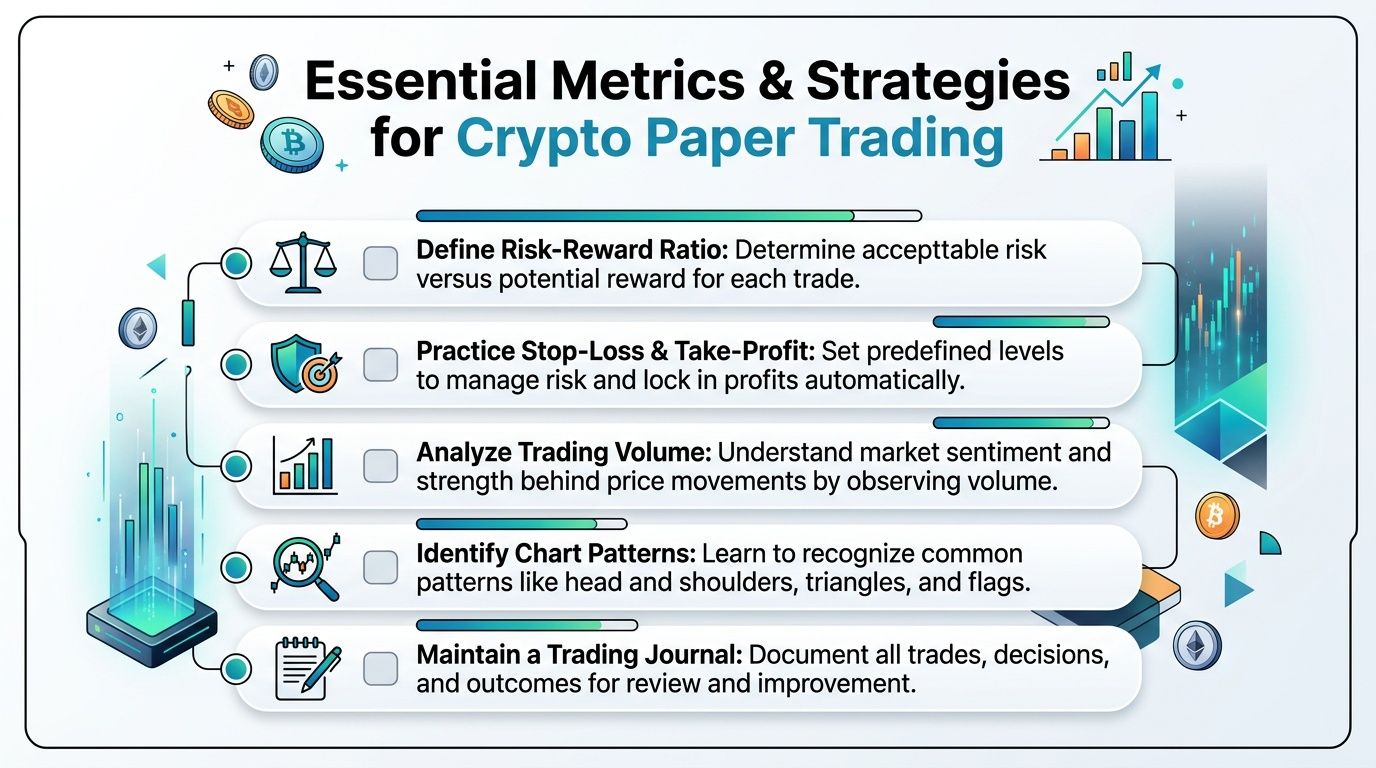
Start with the numbers that expose behavior. Risk per trade shows whether you stayed consistent, reward target shows whether your exits were realistic, and trade compliance shows whether you followed the plan you wrote before the market moved. Once those are steady, add review points such as average hold time and how often your entries matched the setup rules. Those extra details help you separate a repeatable process from random luck.
If you want a clean way to judge the outcome of repeated practice, it helps to understand your rate of return with a calculator that does not blur the line between fake and real outcomes. A journal plus a return review gives you more to work with than a short winning streak, because it shows whether your edge survives more than one outcome. The point is not to celebrate one good session, it is to see whether your rules can hold up across many trades.
Practice strategies that can be tested cleanly
Simple strategies are easier to examine. Moving average crossovers, support and resistance reactions, and volume-confirmed breakouts are easier to record than a system built from many indicators that all seem to matter at once. Their value comes from clarity. You can point to the exact rule that triggered the entry and the exact reason it failed or worked.
Research on indicator-driven crypto trading keeps returning to moving averages, Bollinger Bands, RSI, MACD, volume, and on-chain data because each input can change the signal you see. That is why a paper session should log the indicator values, the setup, and the exit rule for every trade. If you later review the chart and cannot tell whether the decision came from trend-following, momentum, or liquidity and sentiment changes, the strategy was never really tested. This research note on indicator-driven crypto trading supports that habit of tracing the signal back to its source (this research note on indicator-driven crypto trading), and these strategy ideas can give you a broader set of patterns to compare once your notes are consistent.
Use a journal like a lab notebook
A journal works best when it answers one narrow question, did I follow the rules, and what happened when I did? Write the setup in plain language, record the entry, exit, and reason for both, then mark whether you deviated from the plan. That kind of record turns a paper session into evidence instead of memory, and it makes the gap between intention and execution harder to ignore.
A good paper trader does not chase more trades. They chase cleaner records. That shift is what turns simulation into training.
Transitioning From Paper to Live Trading
The move from demo to live is where most of the hidden work shows up. A paper account can reward a neat system, but a live account asks a different question, can you follow the same system while money is at risk? That question matters because even good traders can start behaving differently the first time a trade has real consequences.
Use readiness checks, not hunches
A useful threshold is consistency. If your paper trading is still changing every few sessions, or you're still rewriting your rules after losses, you're not ready yet. Live trading should start only when the process is stable enough that you can explain your decisions without improvising after the fact.
Behavior matters here as much as statistics. Among traders who used paper trading before their first live trade, 57.1% placed that first live trade within 30 days of their first paper trade, and 75.2% within 60 days (Alpaca's data-backed guide). That pattern suggests many traders use paper trading as a short calibration phase rather than a long apprenticeship.
Start small and expect the emotional shift
Live trading changes the body's response to the trade. You'll notice hesitation, urgency, and the temptation to rescue a position that should've been closed. Those reactions are normal, which is exactly why the first live account should be sized small enough that mistakes are educational instead of destabilizing.
The goal is to reduce tuition to the market. If you're prepared to lose the amount you fund, you can focus on execution instead of panic. If you're not prepared for that, wait and keep refining the demo process.
Keep the transition gradual
The best handoff from simulation to reality is incremental. Start with small size, keep journaling every trade, and compare live behavior against your paper behavior without pretending the two environments are identical. The paper account taught you your rules. The live account teaches you whether you can still follow them when emotion enters the room.
The market will reveal gaps quickly, but that's not a failure. It's the point of the exercise.
Coiner Blog covers the parts of crypto that matter when you're trying to learn without getting blindsided, from Bitcoin and Ethereum basics to DeFi, Web3, and practical risk management. If you're building a disciplined approach to cryptocurrency paper trading, visit Coiner Blog for more guides that focus on real-world use, not hype.