
What Is a Rollup: A Practical Guide to Layer 2 Scaling
A rollup is a Layer 2 system that batches transactions off-chain and posts compressed data back to a Layer 1 chain like Ethereum. That design matters because it can cut fee pressure and raise throughput without asking the base chain to do every job itself.
You've probably felt the pain already. A swap that should be quick sits pending, an NFT mint gets crowded out by a gas war, or a simple on-chain action costs more than you expected. Rollups exist to make those moments less painful by moving execution away from Layer 1 while still anchoring security there, so users don't have to choose between speed and the base chain's trust model.
Table of Contents
- The Scaling Problem That Created Rollups
- How a Rollup Actually Works
- Optimistic Versus ZK Rollups Explained
- Fees, Gas, and the Blob Upgrade
- Where Rollups Are Used in DeFi, NFTs, and Gaming
- Choosing the Right Rollup as a Builder or User
- Common Misconceptions About Rollups
- Next Steps, Resources, and What to Watch
The Scaling Problem That Created Rollups
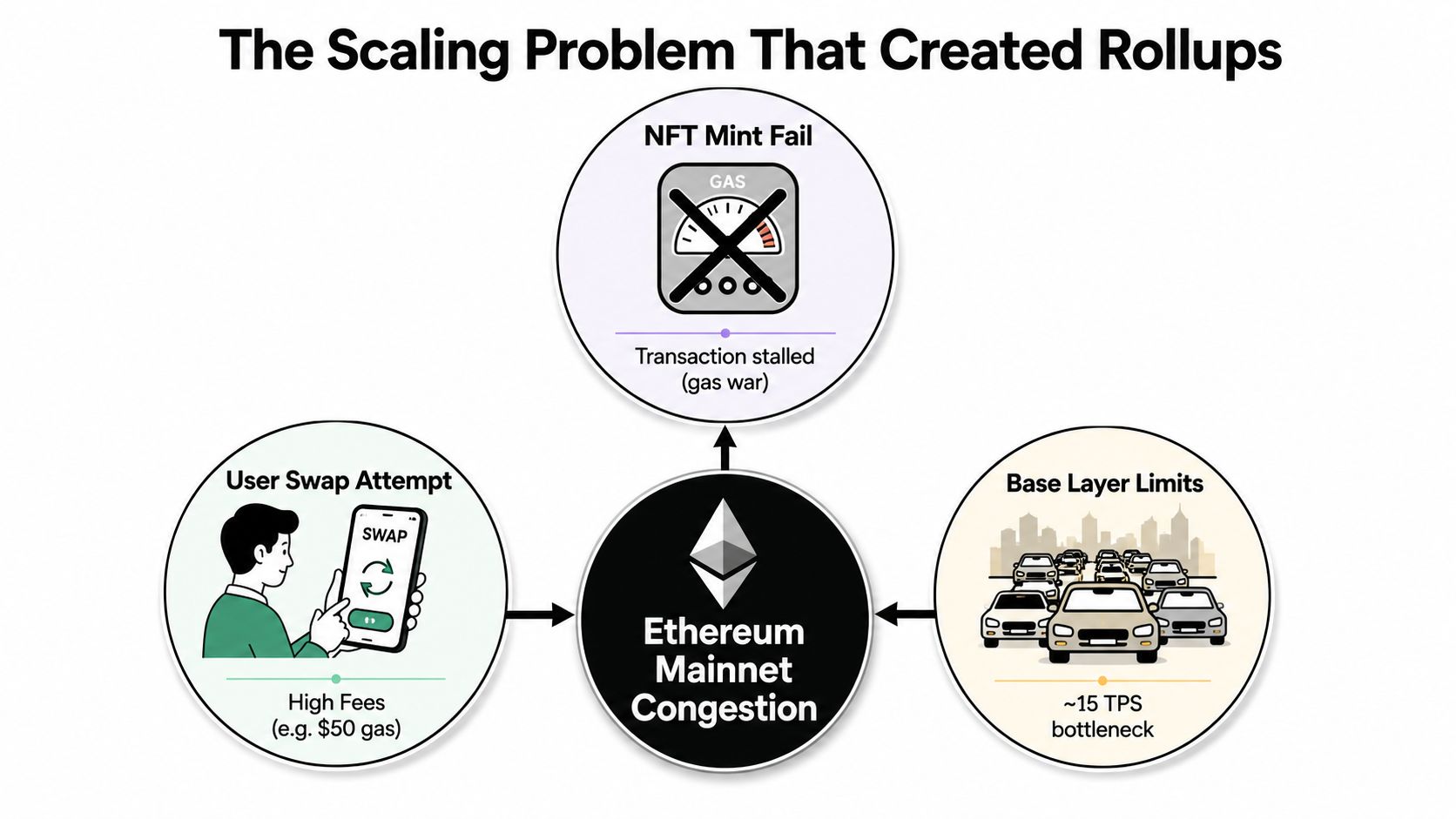
A busy Ethereum mainnet can make a simple token swap feel like a traffic jam. You click confirm, watch the transaction sit there, and wonder whether the fee is worth the trade at all.
That frustration is the core reason rollups took off. A rollup is a Layer 2 blockchain scaling system that executes transactions off-chain and then posts compressed transaction data, commitments, or proofs back to a Layer 1 chain for settlement and security, while preserving Layer 1 as the finality and security anchor as described in the rollup overview. In plain English, a rollup takes work away from the base chain, then sends back a compact record so Ethereum can still act as the source of truth.
The useful way to think about it is this. Ethereum is the settlement layer, but it is not trying to process every single action directly forever. Rollups step in when the demand is really about faster execution, not a different chain identity.
Practical rule: if a blockchain task feels repetitive, high-volume, and fee-sensitive, it is a strong candidate for batching.
That's why rollups show up everywhere from DeFi trading to NFT minting to gaming loops. The core idea is simple, but the trade-off is where the real story starts. Users get less congestion and often lower fees, but they also depend on how the rollup posts data back to Layer 1 and how quickly that Layer 1 can confirm it.
For readers who want to separate the base layer from the layers built on top of it, the L1, L2, and L3 breakdown is a useful companion.
How a Rollup Actually Works
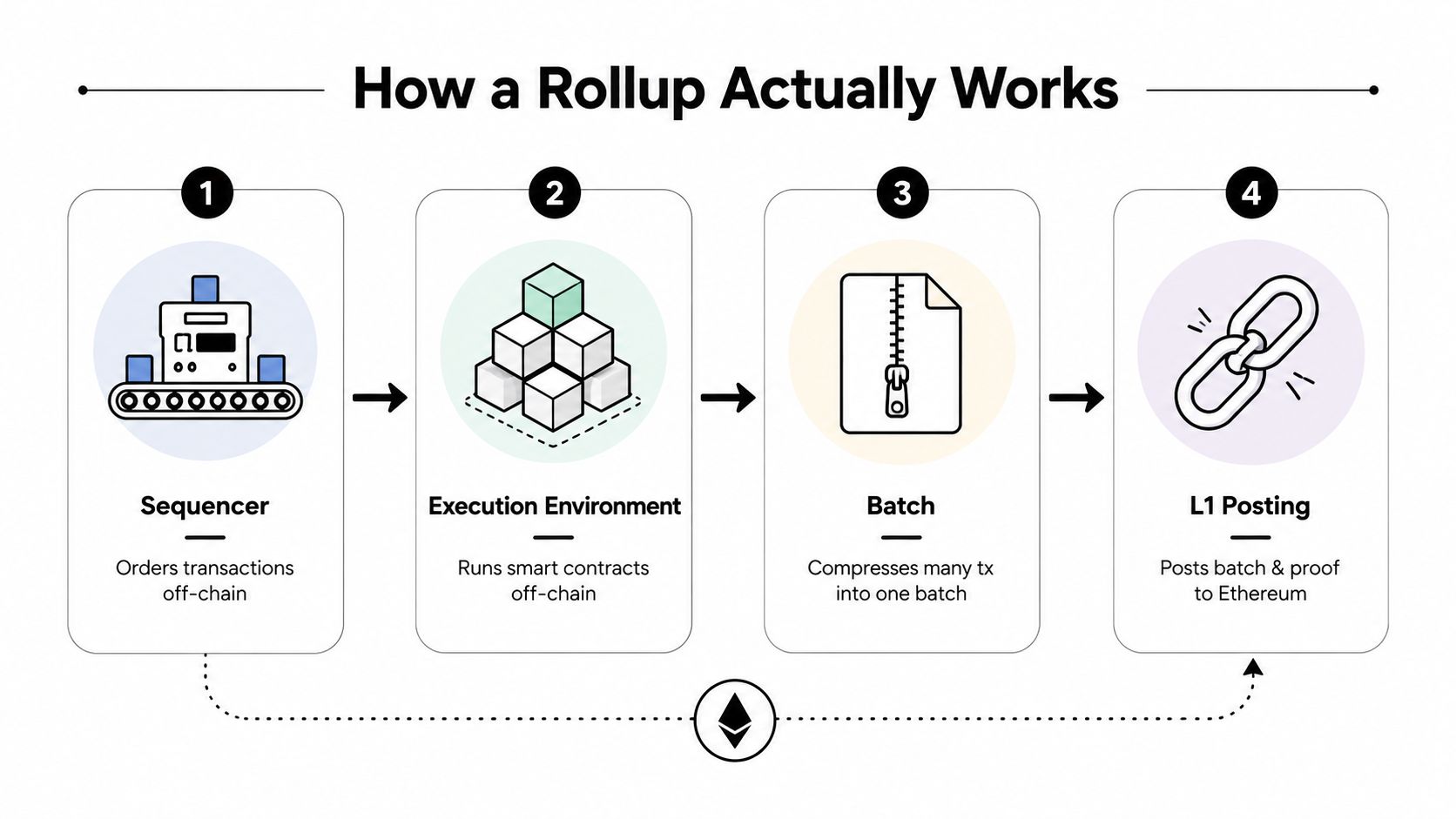
A rollup is easiest to understand if you follow one transaction from start to finish. A user sends a swap, mint, or contract call, and the rollup's sequencer orders it off-chain before the network runs the actual computation in an execution environment.
That off-chain step is often overlooked. The rollup is not skipping work; instead, it relocates the expensive part of the work away from the base chain, then bundles the result into a batch that can be posted later.
Execution, settlement, and data availability
A mailroom packs hundreds of letters into one tracked parcel. The sender still wants proof the delivery exists, but they do not want to pay for each letter to travel as a separate shipment. Rollups work the same way; they compress many transactions into one submission and let Layer 1 settle the final result.
A good mental split is:
- Execution: the rollup computes what happened off-chain.
- Settlement: Layer 1 accepts the rollup's posted result.
- Data availability: enough information is left on-chain, or available to the chain, for others to verify what happened.
That separation matters because a rollup does not replace the base blockchain. It pushes execution off-chain while relying on Layer 1 for settlement, security, and data availability, and that is central to how rollups lower fees while preserving Ethereum's security model as explained here.
For people tracing tokens across exchanges and wallets, it also helps to understand the movement side of the equation. A practical overview of understanding wallet and exchange flows makes the user journey feel a lot less abstract.
Rollups borrow security from Layer 1, they don't create a new security island.
The bridge is the final piece. When users move assets between L1 and L2, they rely on bridging logic that lets the rollup inherit Ethereum's settlement layer rather than competing with it. That's why rollups reduce throughput pressure on mainnet instead of replacing mainnet outright.
A short explainer video can help if the mechanics still feel slippery.
Optimistic Versus ZK Rollups Explained
The question isn't whether a rollup is fast. It's how the rollup convinces Layer 1 that the batch it posted is correct. That choice splits the design into two very different security philosophies.
In blockchain, a rollup is a Layer 2 scaling solution that increases throughput by batching multiple transactions off-chain and submitting them to the main chain as a single transaction. The two dominant designs are ZK-rollups and optimistic rollups, and that's the split that matters most when you're deciding what to use as Moonpay explains.
Optimistic rollups
Optimistic rollups use an assume-valid model. They post the batch and let anyone challenge it during a dispute window if they think something is wrong. If a verifier spots bad behavior, they can submit a fraud proof and trigger a correction process.
That model is attractive because it is conceptually simpler for builders and often easier to implement. The trade-off is that withdrawals usually wait for the challenge window to pass, which is why users often experience slower exits than they expect.
ZK rollups
ZK rollups take the opposite route. They post a cryptographic proof that the batch was computed correctly, so Layer 1 can verify the result without waiting for the same challenge process. Users feel that as cleaner finality and a tighter security story, but builders pay for the complexity of creating those proofs.
For a deeper technical comparison, the ZK proof background helps explain why cryptographic verification changes the trust model so much.
Here's the comparison at a glance:
| Aspect | Optimistic Rollups | ZK Rollups |
|---|---|---|
| Proof type | Fraud proof model | Validity proof model |
| Security assumption | Correct unless challenged | Correct because cryptographically proven |
| Withdrawal feel | Slower because of dispute period | Faster because proof verification is direct |
| Builder complexity | Usually easier to ship | Usually harder to build and maintain |
If you want a broader comparison lens, the rollup design discussion from Blocsys Technologies is a useful way to think through the trade-offs without treating one model as universally better than the other.
The cleanest summary is this. Optimistic rollups trust with a dispute period. ZK rollups trust through cryptography. That is not just a technical preference, it changes what a user feels in withdrawal time, what a builder pays for in proof generation, and how much faith the system places in its own verification path.
Fees, Gas, and the Blob Upgrade
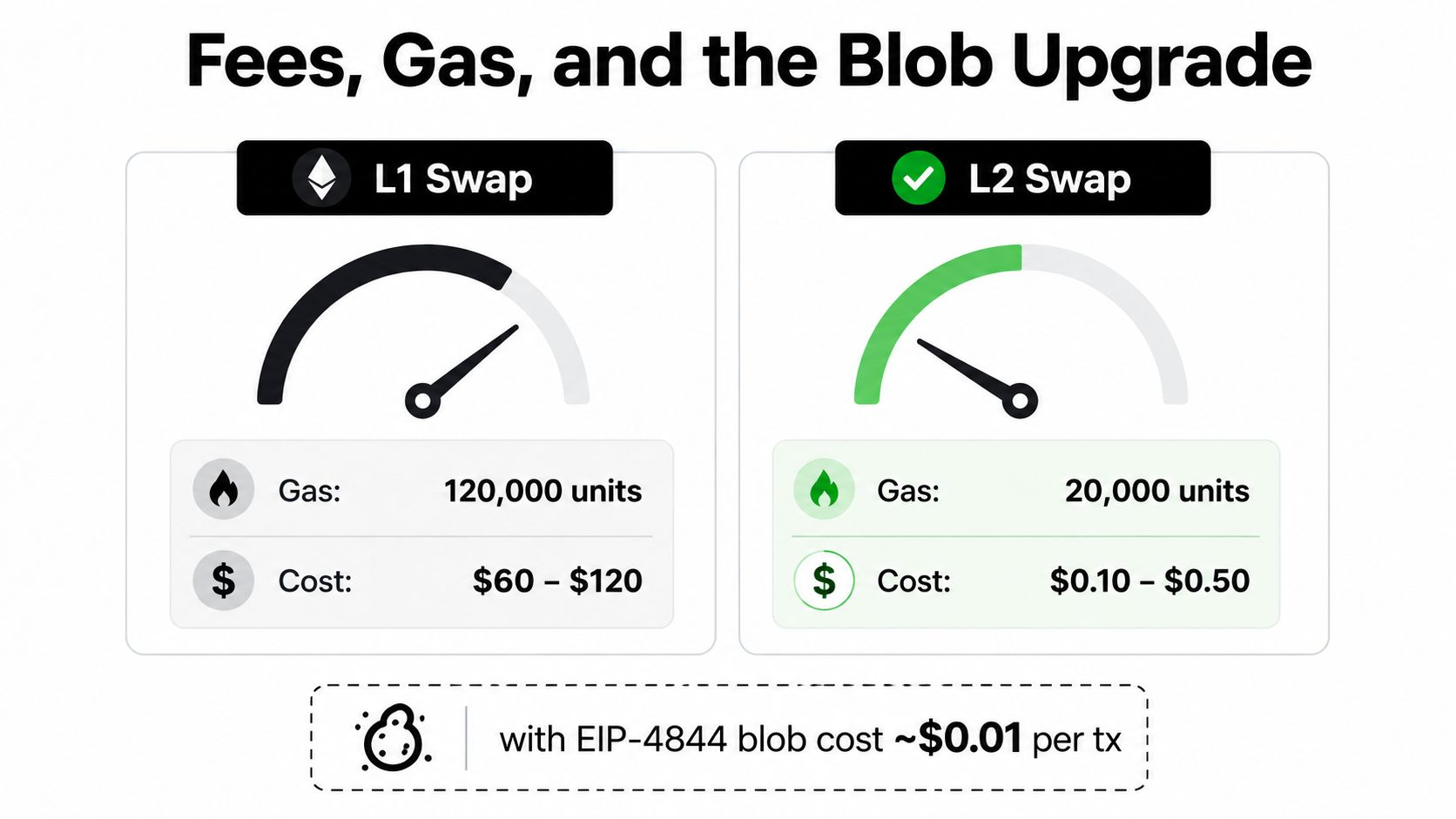
Rollups matter most when you look at the fee line, not the marketing line. A swap on Layer 1 has to pay for every bit of execution and data posting directly on the base chain, while a swap on a rollup typically pays for batched execution plus the cost of posting compressed data back to Layer 1.
That difference is why rollup users often notice the savings immediately. After Ethereum's blob upgrade, Crypto.news reported that blobs reduced rollup transaction costs by more than 90% on most layer 2 networks by offering a cheaper alternative to calldata for posting data in its rollup coverage. The important part is not just the percentage, it is the structural shift, because data posting is one of the biggest pieces of the rollup cost stack.
What users actually feel
A trader sees lower friction on repeated actions. A creator sees cheaper minting. A gamer sees the difference between a chain that can support frequent actions and one that makes every move expensive.
Fees are not just a protocol number, they shape whether people actually keep using the app.
The catch is that rollup fees still sit inside Ethereum's broader market conditions. If Layer 1 gas rises, the cost of posting rollup data can rise too, and the user experience can change by design depending on how the rollup handles data availability and settlement.
For readers who care about market structure as much as mechanics, MEV basics are worth keeping in mind, since ordering, batching, and transaction inclusion all interact with fee pressure in subtle ways.
The practical takeaway is simple. Blobs made rollups cheaper, but they did not make them fee-independent. L2 costs can be dramatically lower than L1, yet they still ride on Layer 1 conditions and the architecture choices a rollup team makes.
Where Rollups Are Used in DeFi, NFTs, and Gaming
Rollups make sense when users need a chain to feel less expensive without losing the discipline of Ethereum-style settlement. That's why the most visible usage clusters around activity that happens often, not just activity that is expensive once.
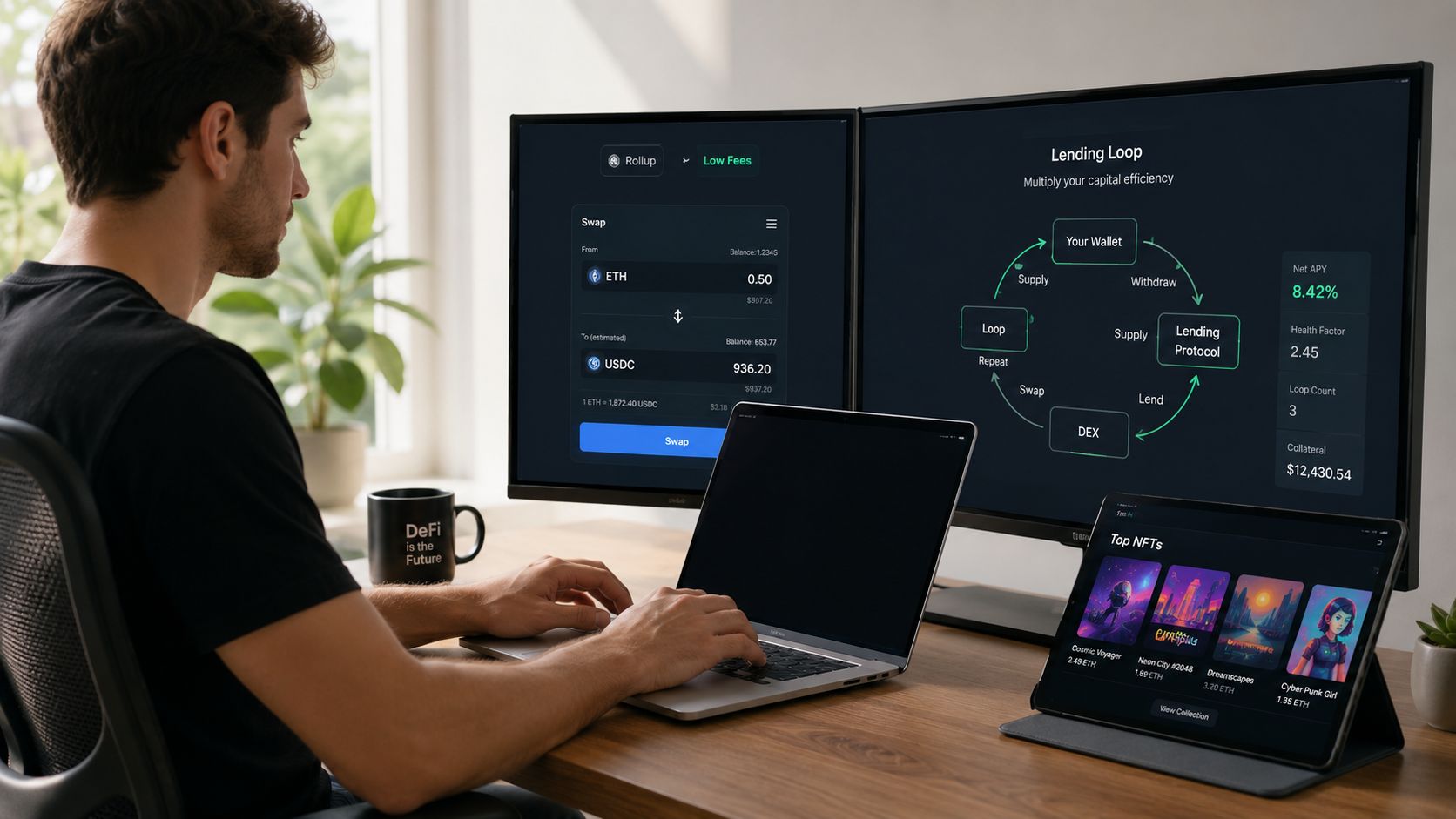
DeFi
A trader using a rollup can swap more freely, loop a lending position, or rebalance without feeling punished by every small move. The appeal is obvious, but the hard part is liquidity, because users still care whether the assets they want are easy to find and easy to bridge.
That's why DeFi users often compare rollups indirectly through the health of the ecosystem around them. A chain can be cheap and still feel awkward if liquidity is thin or bridges are clunky.
NFTs
Creators like rollups because minting can become much more practical when the chain stops charging mainnet-style fees for every action. That matters most for larger collections and for drops where the difference between participation and silence can be a few dollars in friction.
The trade-off shows up later in secondary markets. NFT buyers still care about discoverability, marketplace depth, and whether the asset can move cleanly between venues.
For readers following marketplace debates, the Uniswap V4 fee criticism discussion is a useful reminder that fee design always has knock-on effects for user behavior, even when the protocol goal is efficiency.
Gaming
Gaming is where rollups often feel the most natural. A game with frequent on-chain actions needs throughput and low latency more than it needs a one-off settlement event, and that is exactly the environment rollups are built to support.
GameFi studios lean toward rollups because they can make in-game transactions feel ordinary rather than precious. That matters if a title wants players to act naturally instead of rationing every on-chain move.
The pattern is consistent across the three use cases. DeFi needs liquidity and security. NFTs need cheap minting and discoverability. Gaming needs throughput and low latency. The technology is the same, but the pain point is different.
Choosing the Right Rollup as a Builder or User
A builder shouldn't start with the label, they should start with the user problem. Rollups improve throughput and fees by batching transactions off-chain, yet they still depend on Layer 1 for verification and data availability, so fees, latency, and user experience still vary by design and market conditions as QuickNode notes.
That means the right choice depends on what the application needs most. If the project lives or dies by fast exits and strong cryptographic guarantees, ZK may fit better. If the team wants simpler implementation and can tolerate a dispute period, optimistic designs are often easier to ship.
A practical decision frame
- Choose optimism when: your team values mature tooling, simpler operations, and a path that fits existing EVM workflows.
- Choose ZK when: the app benefits from stronger cryptographic proofing and users care much about rapid finality.
- Consider app-chain or hybrid paths when: your product needs custom execution, specialized data handling, or a tighter control surface than a general-purpose rollup can offer.
For power users, the best question is less about ideology and more about infrastructure. Does the chain have real liquidity, a bridge people trust, a security model you can explain to another person, and a roadmap that sounds credible instead of aspirational?
The ecosystem is still consolidating, so a good answer in 2026 may not be the same answer that made sense in 2024. That's normal in blockchain infrastructure, where tooling, data availability, and proof systems keep moving underneath the user experience.
If you only want to pick one chain today, favor the networks that are already usable, transparent about their security assumptions, and moving toward better decentralization in sequencing.
Common Misconceptions About Rollups
The first myth is that rollups are separate blockchains with separate security. They're not. They inherit Layer 1 security assumptions, and that means the base chain still anchors the trust model.
The second myth is that rollups are free. They aren't. Fees are lower, sometimes much lower, but there is still a cost to execution, data posting, and eventual settlement, and those costs can rise when Layer 1 gas gets expensive.
The third myth is that faster automatically means safer. ZK rollups can offer faster proof-based finality, but they still depend on the correctness of their proof system and the infrastructure that runs it. Optimistic rollups, meanwhile, lean on the dispute process, which is a different kind of trust altogether.
The fourth myth is that interoperability is solved once you move to Layer 2. It isn't. Moving assets between rollups usually means using a bridge, and bridges have their own operational and security risk surface.
A simple way to keep the picture honest is to separate convenience from trust. Rollups usually improve convenience, but they don't abolish the need to think about validation, sequencing, bridging, and the role of Layer 1 as the anchor.
Next Steps, Resources, and What to Watch
If you want to go deeper, start with the docs from the rollups you use. Then compare how they describe settlement, data availability, and withdrawal behavior, because those details matter more than branding.
A practical learning checklist looks like this:
- Read official documentation first. The wording around security and withdrawals tells you a lot about the design.
- Check rollup status dashboards. L2Beat is useful for tracking how rollups are categorized and how their security model is presented.
- Compare bridges carefully. UX changes fast, but bridge risk doesn't disappear because a chain is popular.
- Watch proof-system progress. ZK proving is improving, and that changes the long-term economics of the whole category.
The trends worth watching are shared sequencing, better interoperability between rollups, further data-availability improvements, and ongoing work that makes ZK proving cheaper and more general. Those changes could reshape which rollup philosophy wins in which market.
The safest habit is still the oldest one. Do your own research, compare the security assumptions, and treat rollups as evolving software rather than finished infrastructure.
If you want more plain-English breakdowns of Ethereum, Layer 2s, DeFi mechanics, and the practical side of crypto infrastructure, Coiner Blog keeps publishing guides that connect the technical details to what users experience. Visit Coiner Blog for more analysis that helps you judge fees, risk, and real-world usability with a clearer head.