
Order Book Trading Explained: Read Depth and Trade Smarter
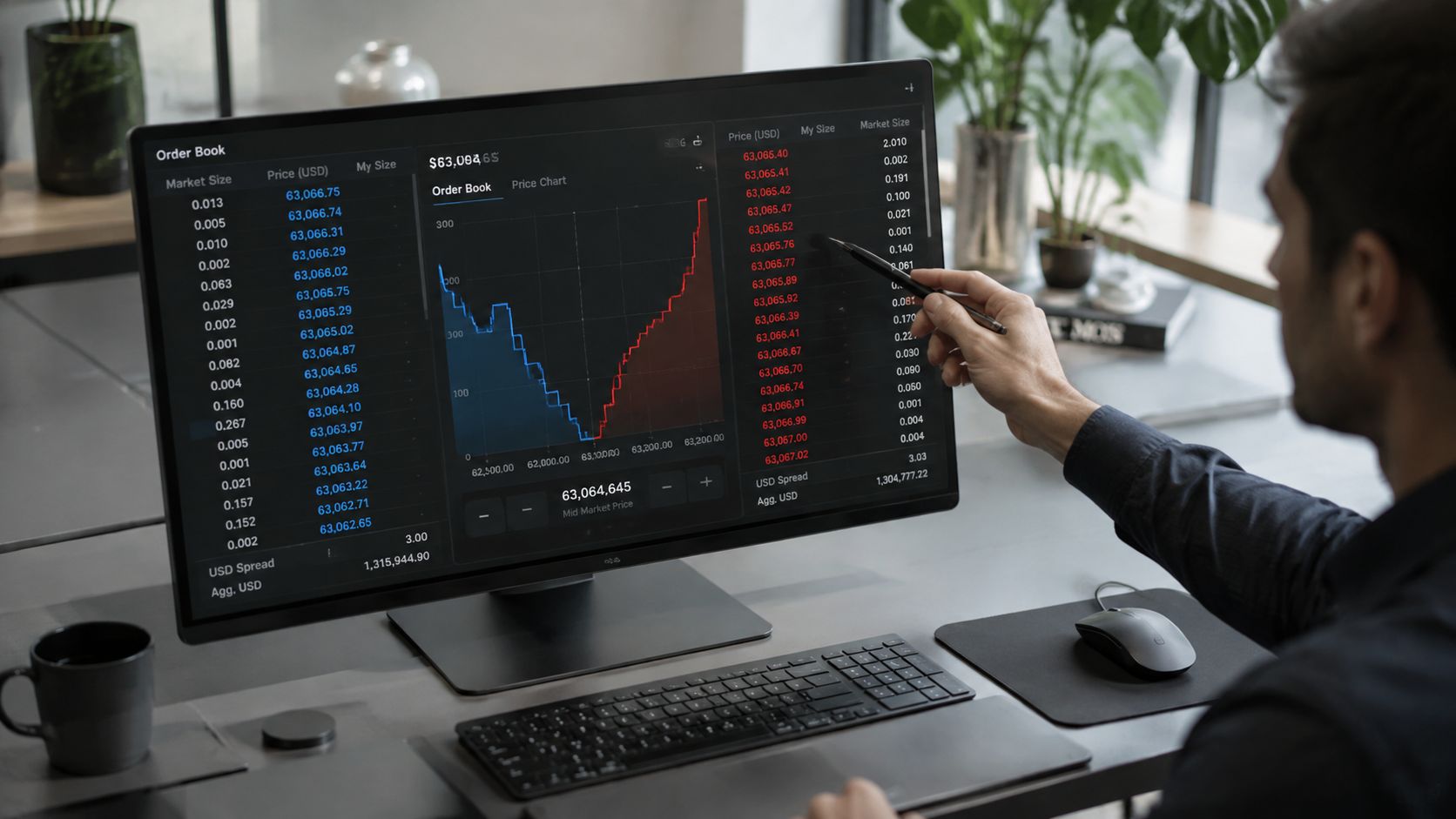
You place a Bitcoin limit order, then watch the bids and asks flicker before the trade fills. A large buy wall appears below the market, disappears, and reappears at another price. The spread tightens, your order moves up the queue, and a sudden market sell consumes several price levels before you can react. The screen looks informative, but it can also create false confidence.
That tension defines order book trading. The order book shows where participants have displayed an interest in buying or selling, yet displayed interest isn't the same as dependable liquidity. To use the book well, you need to understand its mechanics, read spread and depth, estimate execution costs, and recognize when fragmented venues, delayed feeds, or manipulation make the signal unreliable.
The foundation matters beyond crypto. In Q1 2025, electronic order books handled USD 42.72 trillion in share trading, despite a 2.7% decline from the prior quarter, according to the London Stock Exchange's historical analytics data. Domestic shares represented 96% of that value, while the Americas accounted for 52%, APAC 41%, and EMEA 7%. Those figures place electronic order books at the center of global market structure, not merely at the edge of crypto trading.
This guide starts with the basic queue of bids and asks, then moves through Level 2 data, execution tactics, liquidity traps, and the differences between centralized order books and DeFi automated market makers. By the end, you'll have a more useful question than “Is there a big wall?” You'll be asking whether that wall is real, reachable, persistent, and relevant to the venue where you plan to trade.
Table of Contents
- Introduction to Order Book Trading and Why It Still Matters
- How Limit Order Books Work Under the Hood
- Reading Order Book Depth Spread and Level 2 Data Like a Trader
- Practical Order Book Trading Strategies You Can Apply
- Risks of Thin Liquidity and How to Spot Manipulation
- Centralized Order Books Versus AMM Models in Crypto
- Tools Data Feeds and Next Steps for Confident Execution
Introduction to Order Book Trading and Why It Still Matters
An order book is easiest to understand as a queue outside a busy market stall. Buyers write down the highest price they're willing to pay. Sellers list the lowest price they'll accept. The market operator matches compatible instructions, and the queue changes whenever someone joins, cancels, or completes a transaction.
Crypto exchanges turn that queue into a live digital display. On a BTC/USDT market, the bid side contains buy orders, while the ask side contains sell orders. The closest bid and closest ask define the current quoted market. Orders farther from the middle may represent potential liquidity, but they aren't guaranteed to remain available.
A beginner often sees a large bid and labels it support. That interpretation is too strong. The order could be genuine, but it could also be too far away to matter, split across another venue, or canceled before price reaches it. Experienced traders treat the book as a changing set of intentions rather than a promise.
Practical rule: A displayed order is evidence of available liquidity only while it remains executable at the stated price and quantity.
Order book trading still matters because matching engines directly connect supply, demand, and execution. A chart can show what price did. The book can show where participants are currently willing to transact, how much liquidity sits near the market, and how aggressively an incoming order may consume it.
That structure supports many assets and market types. Bitcoin and Ethereum spot markets use it extensively, and similar systems operate in traditional equities and fixed income. The London Stock Exchange's market data overview records the scale of electronic order-book activity across major equity regions, while the first quarter of 2025 had already produced USD 73.20 trillion in year-to-date electronic-order-book share trading.
The important lesson is practical: don't use the book alone to predict direction. Use it to understand execution conditions. A trader can hold a bullish view on Ethereum and still choose a poor entry if the ask side is thin, the spread is unstable, or the visible liquidity vanishes under pressure.
How Limit Order Books Work Under the Hood
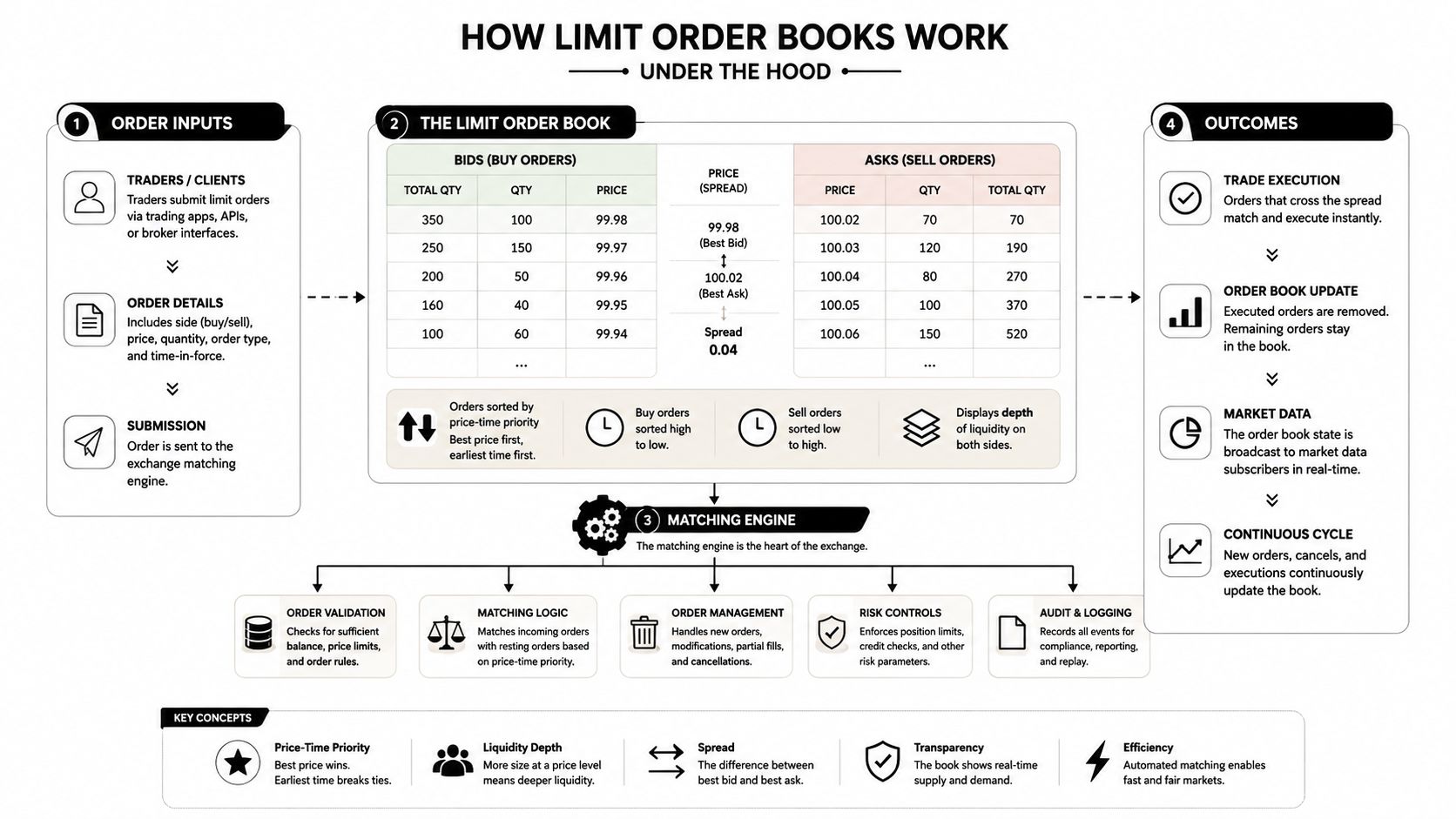
Suppose two people want to trade an asset. One buyer offers a specific price and quantity. One seller does the same. Their orders wait until the prices overlap. A matching engine then checks the instructions and executes the compatible portion according to the exchange's rules.
A limit order specifies the maximum price a buyer will pay or the minimum price a seller will accept. If it doesn't immediately match, it rests in the book. A market order prioritizes immediate execution instead of a specified price, so it consumes the best available orders on the opposite side.
The queue follows price and time
A limit order book is a live list of resting buy and sell orders sorted by price. Most markets use price-time priority, meaning better prices execute first, followed by earlier orders at the same price. The limit order market survey by Parlour and Seppi%20-%20Limit%20Order%20Markets%20A%20Survey.pdf) describes this structure as a mechanism that rewards liquidity providers who arrive early.
For buyers, a higher bid has priority over a lower bid. For sellers, a lower ask has priority over a higher ask. If two traders post the same bid, the order submitted first generally gets the earlier place in the queue. That timing affects fill probability, especially when many participants compete at one price.
The book normally has two visible halves:
| Side | What it contains | Priority |
|---|---|---|
| Bids | Buy orders and their quantities | Highest price first |
| Asks | Sell orders and their quantities | Lowest price first |
The best bid is the highest displayed buying price. The best ask is the lowest displayed selling price. When a market order arrives, the engine starts with the best available price and continues through additional levels if the order is larger than the liquidity at the top.
Why matching changes the market
A small market buy may consume only the lowest ask. A larger buy can “walk the book,” filling at progressively higher asks. The trader receives immediate execution, but the average price may be worse than the first price shown.
Limit orders add resting liquidity when they don't match immediately. Market orders remove liquidity as they execute against existing quotes. Cancellations remove displayed interest without producing a trade. These three actions constantly reshape the book.
The same basic architecture extends beyond crypto. U.S. Treasury central limit order books handled an average of USD 195 billion per day in the first half of 2025, which was 16% higher than full-year 2024, according to Tardis.dev's market-structure research. That growth illustrates how electronic order books have become important across asset classes.
For a deeper foundation in execution, liquidity, and price formation, this market microstructure guide provides useful context. Keep one distinction in mind throughout: the matching engine can enforce priority, but it can't guarantee that visible crypto liquidity is honest, stable, or present on another exchange.
Reading Order Book Depth Spread and Level 2 Data Like a Trader
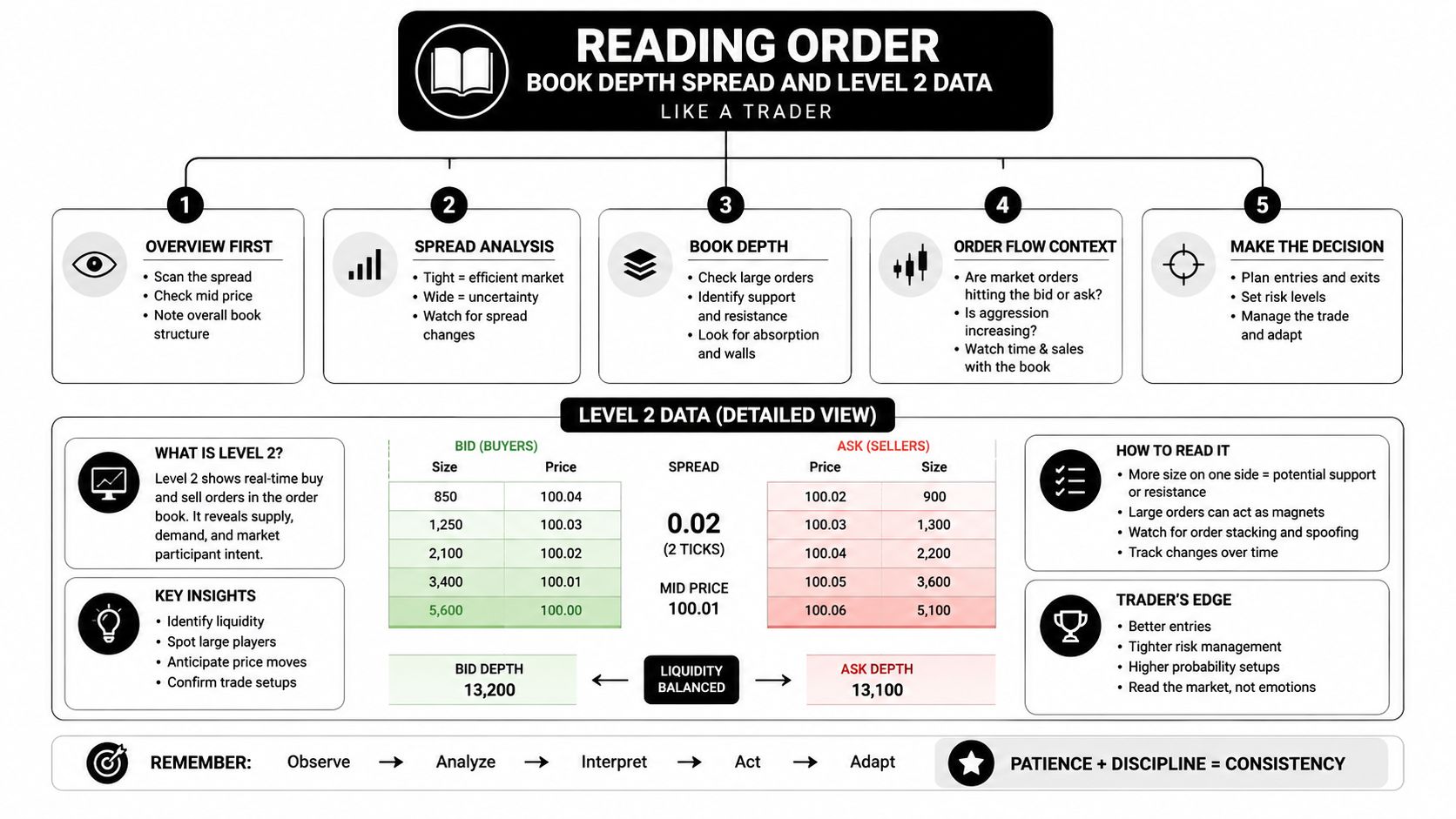
Level 2 data gives you more than the last traded price. It shows multiple bid and ask levels, along with the quantity resting at each level. Think of it as a dashboard with three primary readings: spread, depth, and shape.
The spread is the gap between the best bid and best ask. If the best bid is 99 and the best ask is 101, the quoted spread is 2 price units. If the best bid is 99.9 and the best ask is 100.1, the spread is narrower, so a trader seeking immediate execution faces a smaller quoted cost.
The market microstructure explanation of order-book mechanics defines the bid-ask spread as the difference between the best bid and best ask. It also explains why the spread is non-negative in a functioning market, since the best ask must be at least as high as the best bid. A narrow spread generally signals more liquidity, while a wide spread suggests thinner liquidity and a higher cost of immediacy.
Depth tells you how far price may travel
Market depth means the size resting at each price level. A book might show modest quantity at the best ask, more quantity at the next ask, and a much thinner cluster farther away. If your market buy exceeds the first level, the engine consumes the next levels, raising your average execution price.
A book's shape matters as much as its top quote. Liquidity is often thin close to the mid-price and deeper farther away, but the distribution varies by venue and market regime. The order-book mechanics reference from QuantMemo explains that larger orders can move price more in thin books than in thick books, increasing slippage.
Use a simple reading sequence:
- Check the spread. Is it narrow and stable, or widening between updates?
- Inspect nearby levels. How much quantity exists before the price moves meaningfully?
- Compare both sides. Is one side deep, or does one large order create most of the apparent imbalance?
- Watch persistence. Does the liquidity remain when trades approach it?
- Estimate the fill. Consider the weighted average across every level your order may consume.
Tight doesn't always mean safe
A narrow spread can reflect active quote competition, but it can also represent liquidity that disappears quickly when volatility or informed flow increases. Microstructure research discusses spread reversion and negative serial autocorrelation in quote changes, patterns associated with new limit orders undercutting stale quotes and restoring competitive pricing. The practical meaning is simple: a tight quote can be useful, but it isn't permanent protection.
Traders who want to connect displayed depth with executed buying and selling can consult this order flow analysis guide. Don't treat a depth chart as a prediction machine. Treat it as a live estimate of execution friction, then compare it with actual trades, volatility, and conditions on the venue you use.
Practical Order Book Trading Strategies You Can Apply
Order book trading becomes useful when it changes an execution decision. The same market view can produce different results depending on whether you use a limit order, a market order, or no order at all while liquidity is unstable.
Start with the objective. If your priority is price control, a limit order can specify the maximum price you'll pay or the minimum price you'll accept. If your priority is immediate entry or exit, a market order can fill faster, but it may consume several levels in a thin book.
Use limit orders deliberately
A limit order below the current ask can join the bid queue instead of crossing the spread. That may reduce the price you pay, but it introduces fill risk. Price may never return to your level, or other orders may sit ahead of yours at the same price.
Before submitting, inspect the queue and decide whether the order should remain active if the market moves away. A trader can also divide an intended order into smaller pieces, reducing the chance that one instruction consumes a large portion of nearby liquidity. That approach doesn't remove risk, and it can leave the trader partially filled.
Read imbalance as context, not confirmation
A large difference between nearby bid and ask quantities may indicate temporary buying or selling pressure. It becomes more informative when the displayed liquidity persists, actual trades occur near it, and the same behavior appears across relevant venues.
Don't buy just because the bid side looks larger. A large bid can be canceled, placed too far below the market, or overwhelmed by incoming selling. Likewise, a sell wall can represent genuine supply, a hedge, or an attempt to influence other participants.
Execution insight: A wall matters less than the market's response when trades approach it.
Account for hidden size and market impact
An iceberg order displays only part of a larger instruction. As the visible portion fills, another portion may appear at the same price. Repeated replenishment can signal that more size exists than the interface reveals, although the display alone can't tell you the trader's full intention.
Depth should guide order size and urgency. The QuantMemo explanation of order-book mechanics emphasizes that liquidity is distributed across price levels and that larger orders can create more slippage in thin books. A practical routine is to simulate the order against the visible levels before sending it, then compare the estimated average price with the best quote.
Scalping around the spread can work only when the spread, queue behavior, fees, and latency make the expected edge meaningful. Crypto venues differ in fee schedules and execution rules, so verify current terms directly before relying on a strategy. None of these tactics guarantees a profit. They help you choose how to transact, not whether the market will move in your favor.
Risks of Thin Liquidity and How to Spot Manipulation
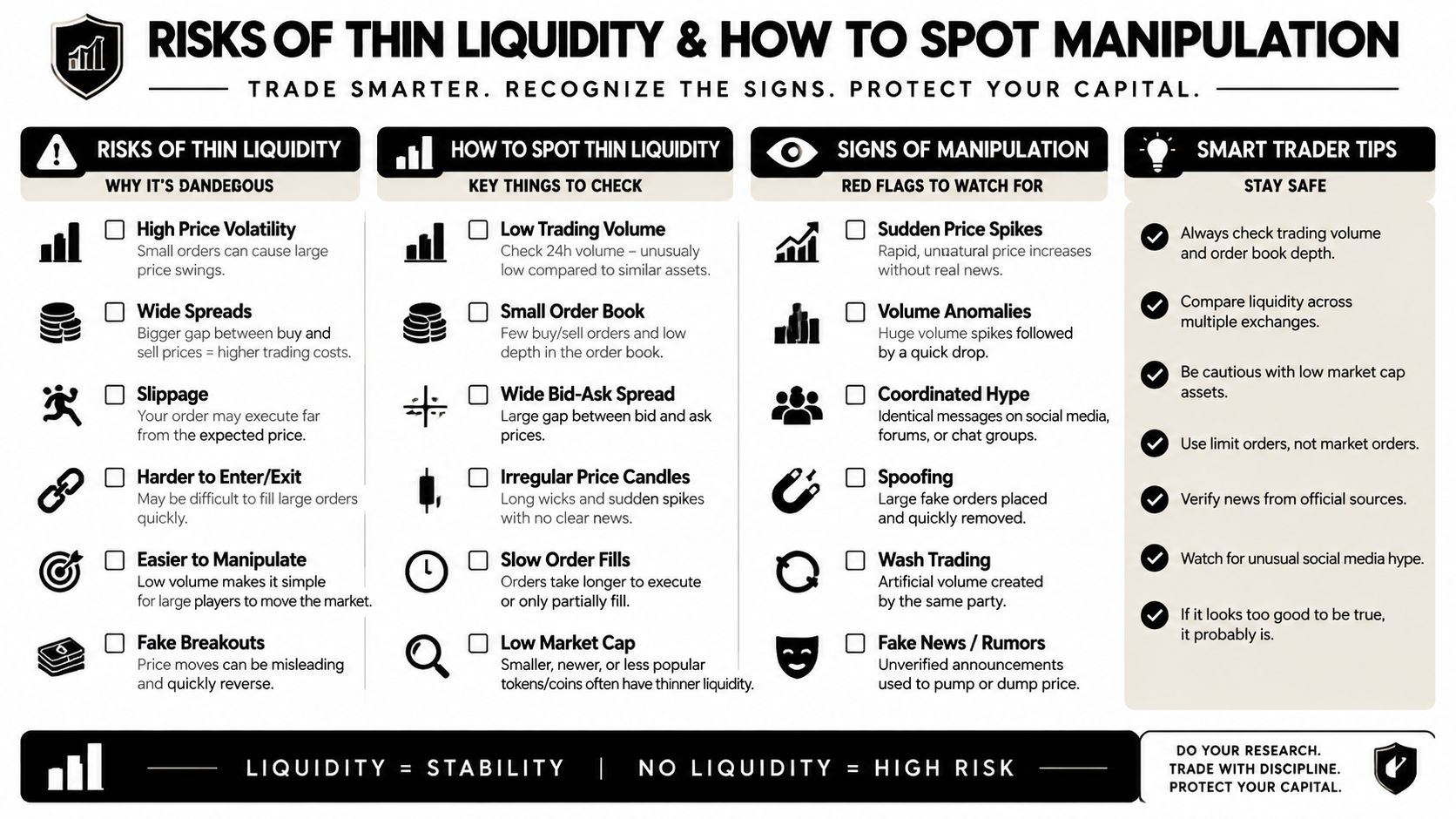
The visible book can be wrong in several ways. It may be incomplete because liquidity is split across venues. It may be stale because your feed arrives after another participant has updated the market. Or it may be deliberately misleading.
Expected informed trading can cause participants to withdraw displayed liquidity. Evidence from a Stockholm Stock Exchange order-flow study found signs of insufficient depth relative to theoretical predictions, while separate limit-order-depth research reported that displayed depth can fall by up to 25% when traders expect informed market orders, as summarized in the Review of Financial Studies research. The mechanism is logical: more information risk reduces resting depth, thinner depth raises execution cost, and higher impact encourages further withdrawal.
Crypto adds specific threats. Spoofing involves placing large orders to create a false impression of demand or supply, then canceling them before execution. Front-running occurs when bots detect a large pending order and trade ahead of it. Both can make displayed liquidity look stronger or more predictable than it really is.
When the feed deserves less trust
A recent Polymarket study found that trade direction inferred from the public order-book feed matched on-chain ground truth only about 59% of the time, according to the research paper on public order-book inference. That result doesn't mean every crypto order book is useless. It means traders shouldn't assume that a public feed reliably identifies whether each trade was buyer-initiated or seller-initiated.
Watch for these warning signs:
- Vanishing walls: Large orders repeatedly disappear as price approaches them.
- One-sided display: A single level creates most of the apparent imbalance.
- Cross-venue disagreement: One exchange shows strong demand while others don't.
- Rapid quote churn: Prices and quantities change too quickly for your feed to represent executable liquidity.
- Activity without dependable movement: Reported trading activity doesn't produce stable depth or credible price discovery.
Wash trading can also create a misleading sense of participation when the apparent activity doesn't represent independent economic demand. For onchain markets, transaction ordering and pending-order exposure add another layer of execution risk. This MEV explainer offers relevant background, but the defensive habit is straightforward: reduce size, verify across venues, and avoid treating one visual signal as proof.
Centralized Order Books Versus AMM Models in Crypto
A centralized limit order book and an automated market maker solve the same broad problem, connecting buyers and sellers, but they expose liquidity differently.
In a centralized order book, traders post bids and asks. The exchange's matching engine pairs compatible orders according to its rules. BTC/USDT and ETH/USDT spot markets commonly use this model, giving participants direct control over price through limit orders.
An AMM, by contrast, uses a liquidity pool and a pricing formula. A trader swaps against the pool rather than matching a specific resting seller. The quoted price changes as the relative token balances change, so a larger swap can create more price impact.
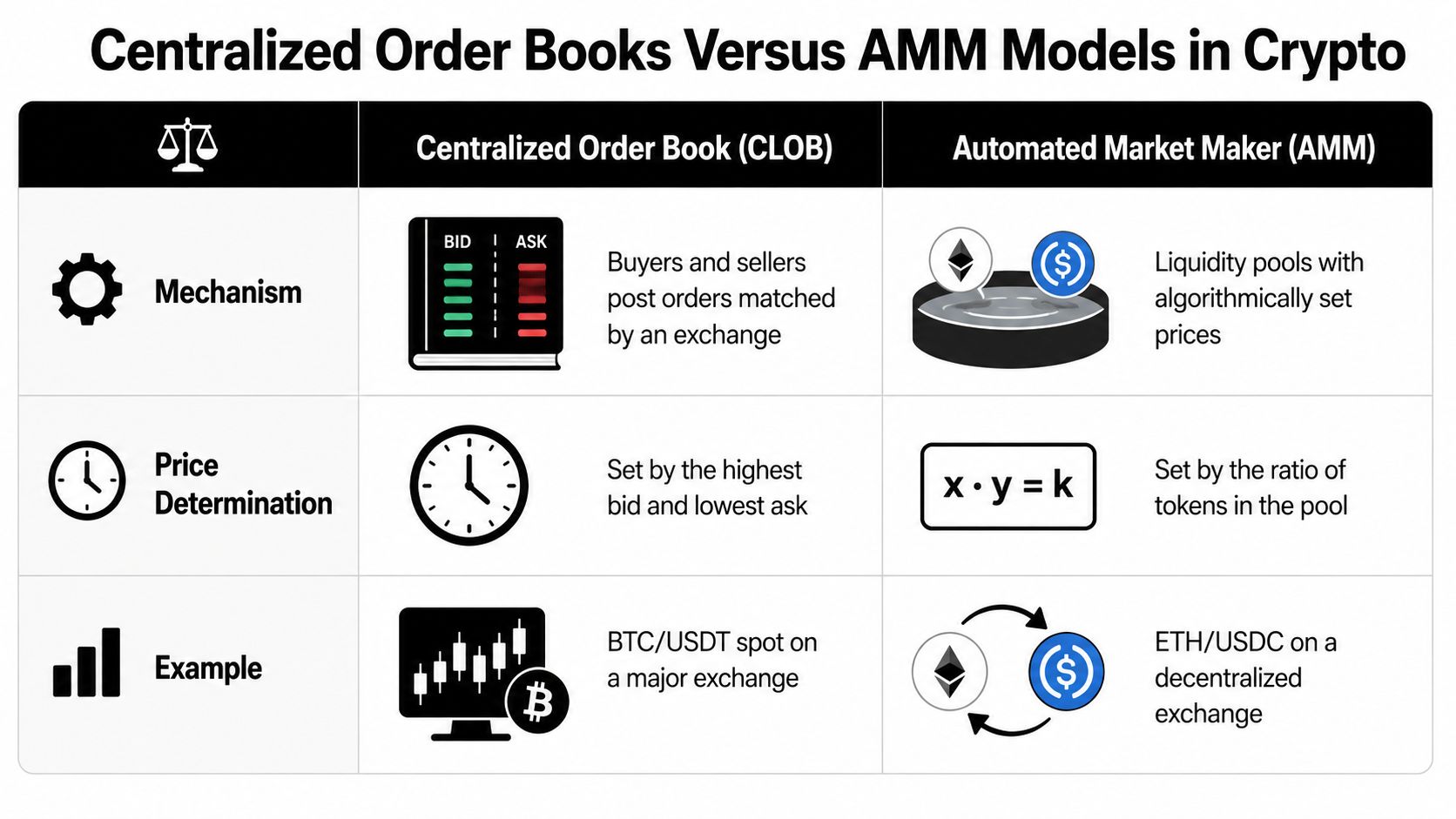
| Feature | Centralized order book | AMM model |
|---|---|---|
| Price setting | Highest bid and lowest ask | Pool balances and a formula |
| Liquidity source | Traders and market makers posting orders | Liquidity providers depositing assets |
| Execution | Matches against visible orders | Swaps against the pool |
| Main friction | Spread, queue position, and fragmented liquidity | Price impact, fees, and pool conditions |
| Custody | Depends on the exchange arrangement | Wallet and smart-contract interaction |
The right model depends on the use case
Order books suit traders who need precise entries, exits, and visible queue information. AMMs can offer permissionless swaps within DeFi, Web3, and Layer 2 ecosystems, where users interact directly with smart contracts rather than a conventional exchange interface.
That difference matters for token design. A liquid BTC or ETH market may support active quoting across many price levels. A thin long-tail token, a tokenized real-world asset, or a new governance token may face different constraints, including limited market makers, contract restrictions, or fragmented liquidity. An AMM can provide continuous quoted swaps, but the pool may be shallow. An order book can show precise intentions, but it may look empty when active participants are absent.
The historical reach of the central limit order book also extends into fixed income. U.S. Treasury CLOBs represented more than 40% of dealer-to-dealer trading, and BrokerTec held 56% of CLOB-executed notional volume in 2025, according to Tardis.dev's market-structure material. Those facts show the model's broad institutional relevance, but they don't make a CLOB automatically superior for every crypto transaction.
For a focused explanation of pool-based liquidity, see this guide to automated market makers. Choose the venue based on execution needs, custody preferences, smart-contract risk, liquidity quality, and the asset's market structure.
Tools Data Feeds and Next Steps for Confident Execution
A reliable order-book workflow starts with the data, not the chart. A top-of-book feed may show only the best bid and ask, while full-depth Level 2 data reveals multiple price levels. Level 3 data can provide more granular order-level information, depending on the venue and feed design.
Industry data vendors now focus on reconstructing full-depth L2 and L3 books across spot, derivatives, and prediction-market venues. CryptoHFTData's market-data coverage reflects a broader shift toward venue-specific microstructure analytics, including research into regime changes in limit-order-book behavior in 2026. The practical implication is that a chart alone rarely explains execution quality.
Before placing an order, check:
- The spread: Is it stable enough for your intended execution?
- Nearby depth: How much size sits before the price levels you may consume?
- Persistence: Do displayed orders remain as trades approach?
- Venue alignment: Does the same liquidity picture appear elsewhere?
- Market regime: Is volatility causing quotes to widen or disappear?
- Operational details: Are current fees, trading rules, and applicable regulations clear for your venue?
Keep a record of the book you saw, the order you submitted, the fill you received, and the liquidity that remained afterward. That feedback turns order book trading from screen-watching into a testable process. Use smaller exposure while learning, avoid unsupported certainty, and remember that order-book signals are observations, not guarantees.
Coiner Blog publishes practical guides and balanced analysis on crypto market structure, Bitcoin, Ethereum, DeFi, Web3, Layer 2 networks, tokenomics, and emerging blockchain applications. Visit Coiner Blog to explore more educational coverage and build a clearer, more disciplined approach to digital-asset markets.