
What Is Ethereum: A Clear Guide

You open a wallet, see ETH, and wonder whether you're looking at a digital currency, a technology platform, or both. The confusion is reasonable. Ethereum can move value like Bitcoin, but it can also run financial applications, digital marketplaces, community organizations, and other software without a central operator controlling every action.
The most useful answer to what is Ethereum starts with its purpose. Ethereum is a public blockchain designed for decentralized computation. Ether, or ETH, is the native asset that pays for using that shared computing environment. Once you understand that relationship, smart contracts, gas fees, proof-of-stake, DeFi, and Layer 2 networks become much easier to connect.
Table of Contents
- Understanding the Concept of Ethereum
- The Evolution of the Network
- How Ethereum Secures Transactions
- Breaking Down Gas Fees and EIP-1559
- Scaling Solutions and Layer 2 Networks
- Ethereum in the Real World
- Getting Started with Ethereum
Understanding the Concept of Ethereum
Think of Ethereum as a global, shared restaurant. Bitcoin is closer to a cash register, built mainly to record direct payments. Ethereum is the whole building, including the kitchen, ordering system, seating area, and rules that let many independent businesses operate inside it.
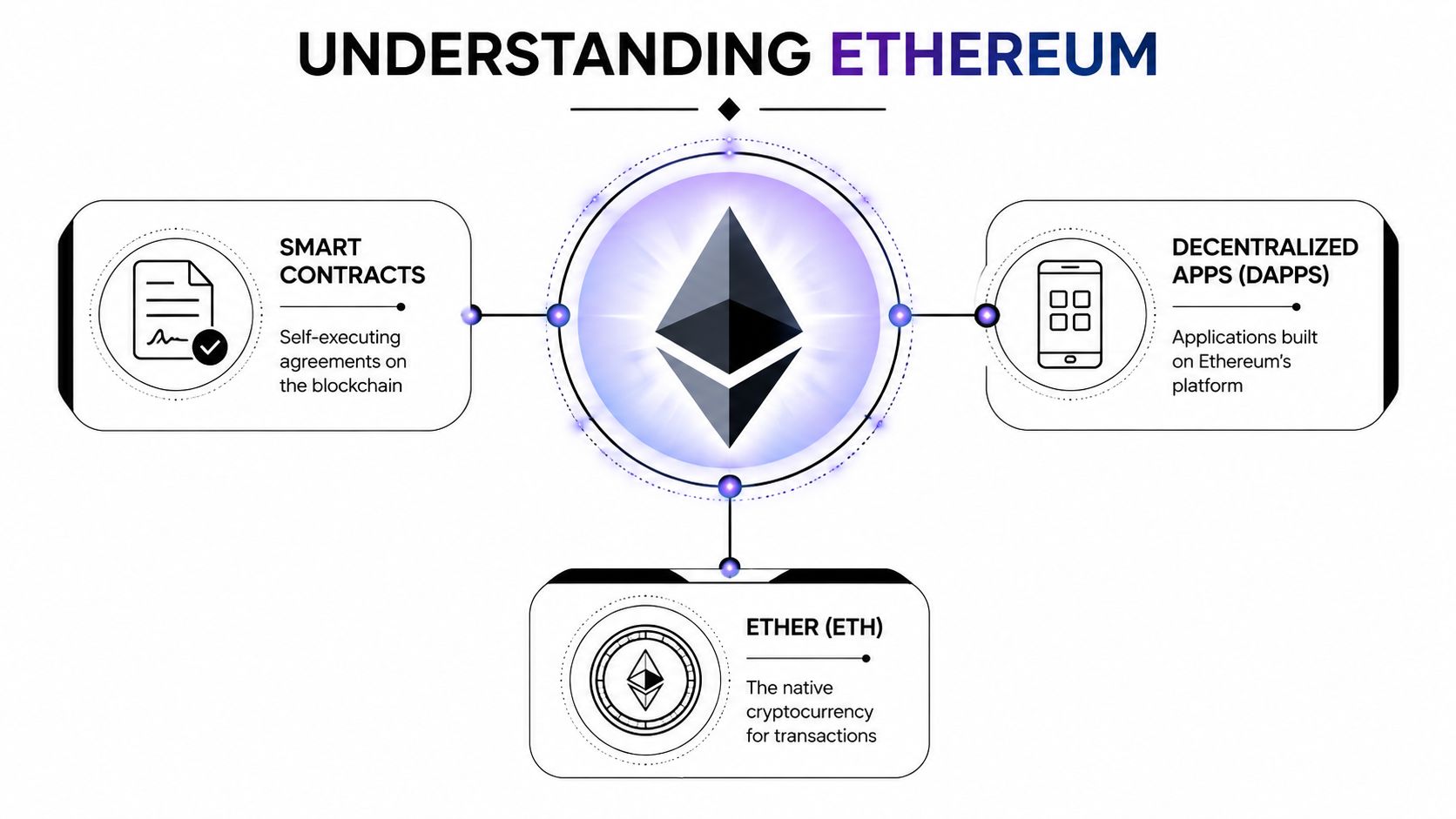
A smart contract is like a recipe combined with an automated kitchen station. It contains rules that execute when someone provides the required input. A decentralized application, or dApp, is the customer-facing menu and ordering experience built around those contracts. ETH pays for the ingredients and the chef's time, meaning the computation and data processing required to complete an action.
That distinction matters because Ethereum doesn't record who paid whom. It maintains a shared execution environment called the Ethereum Virtual Machine, or EVM, where network participants agree on the result of programs. The platform can support token exchanges, lending protocols, collectibles, games, and governance systems, provided developers write the relevant contracts and users accept the associated risks.
The three pieces to keep separate
- Ethereum: The decentralized network and execution platform.
- Smart contracts: Programs stored and executed according to coded rules. A practical introduction to smart contracts can help if the programming concept feels unfamiliar.
- ETH: The native cryptocurrency used for network fees, transfers, and participation in the ecosystem.
Users can also deploy strategies through decentralized applications, including automated yield on Ethereum, but yield products carry contract, market, liquidity, and platform risks. The platform is programmable, not automatically safe.
Core idea: Ethereum is infrastructure for decentralized applications. ETH is the resource used to operate that infrastructure.
The Evolution of the Network
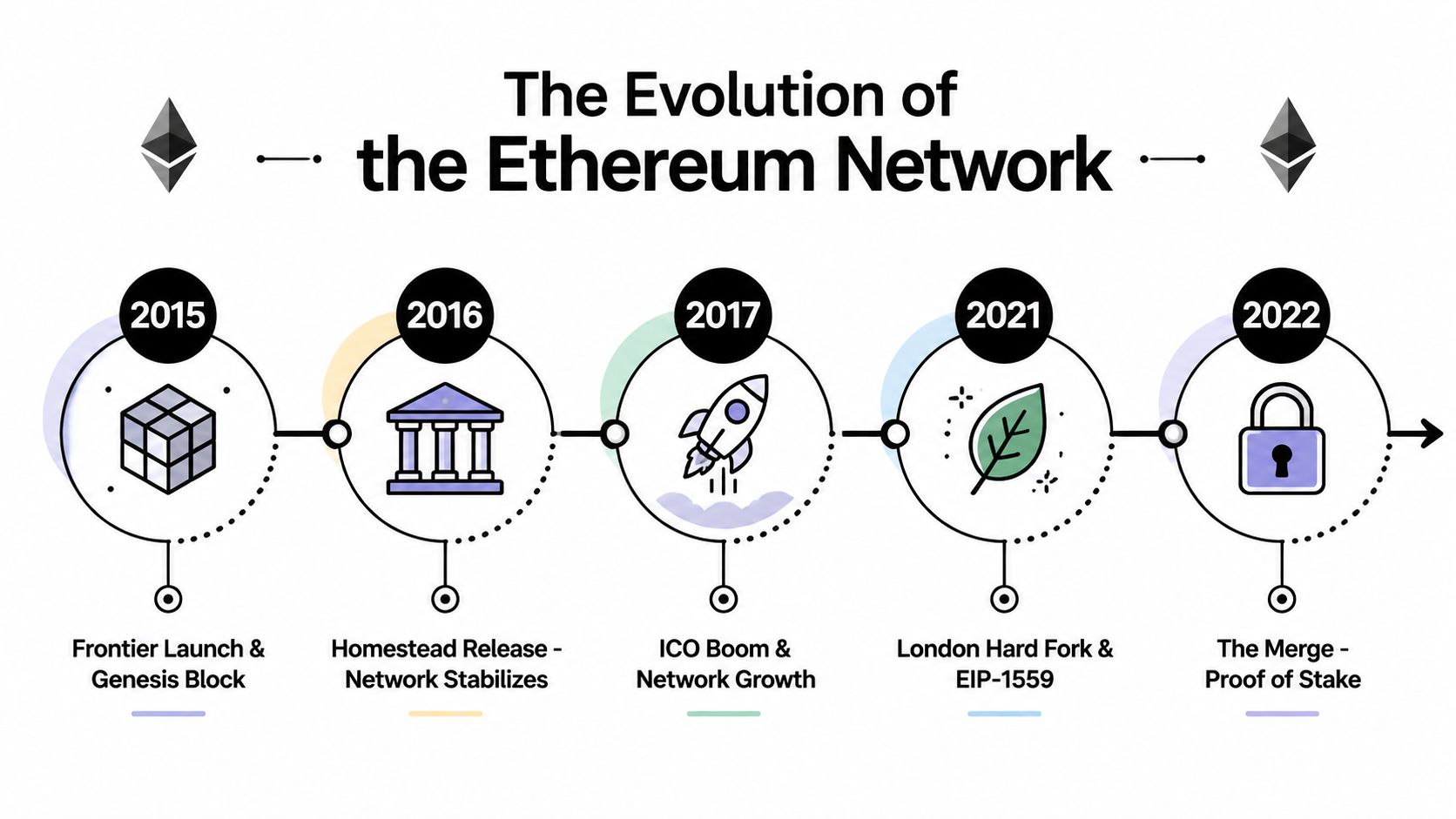
Ethereum's history has two defining dates. The network launched its main network on 30 July 2015, beginning with the Frontier release and the creation of the genesis block. That event put the first live version of a blockchain designed for decentralized applications into operation, rather than limiting the system to payments alone. The launch established the basic environment developers still recognize today, a public chain where code could become part of a shared state.
From computational work to staked capital
For years, Ethereum used proof-of-work. Miners competed with specialized hardware and electricity expenditure to help order transactions and produce blocks. That model made network security depend heavily on physical infrastructure and operational costs.
The second major milestone arrived on 15 September 2022 at 06:42:42 UTC. Ethereum completed the Merge at block 15,537,393, permanently switching from proof-of-work to proof-of-stake. The transition occurred at a terminal total difficulty of 58,750,000,000,000,000,000,000, and the first proof-of-stake block followed 17 seconds later. These historical details are documented in Ethereum's network history.
Proof-of-stake changed the security model. Instead of requiring miners to continually spend resources on computation, the system uses validators who commit ETH as collateral. That doesn't mean Ethereum became a simple payment network. The EVM, smart contracts, and decentralized application model remained central, while the consensus mechanism that coordinates the chain changed underneath them.
| Era | Defining mechanism | What changed |
|---|---|---|
| Frontier era | Proof-of-work | Hardware and energy supported block production |
| Post-Merge era | Proof-of-stake | Staked ETH supports validation and accountability |
The two dates explain Ethereum's broad evolution: a programmable blockchain in 2015 became a proof-of-stake computing network in 2022.
How Ethereum Secures Transactions
Ethereum uses proof-of-stake, a consensus system in which validators lock capital in ETH and help verify and propose blocks. Their stake gives them something valuable to protect. If they act dishonestly, some or all of that ETH can be destroyed, a consequence commonly called slashing.
Becoming a validator requires a deposit of 32 ETH into Ethereum's deposit contract. A validator also needs to operate three software components:
- Execution client: Processes transactions and smart-contract operations.
- Consensus client: Participates in agreement about the chain's head and finality.
- Validator client: Performs the validator's assigned duties and signs messages.
The three-client model separates responsibilities while allowing the network to coordinate transaction execution with consensus. A validator doesn't merely hold ETH in a wallet and receive automatic income. It must run the required infrastructure, remain available, follow protocol rules, and manage operational security. More detail is available in this guide to Ethereum proof of stake.
Why the collateral matters
Proof-of-stake aligns network participation with financial accountability. An honest validator helps the chain process blocks and may receive rewards. A validator that signs conflicting messages, attempts to manipulate consensus, or otherwise violates protocol rules can lose capital.
That incentive structure doesn't remove every risk. Software bugs, poor key management, outages, and mistaken configuration can affect a validator's performance. Centralization also remains an important question if too much validation activity concentrates among a limited group of operators.
Practical rule: Treat staking as an operational responsibility, not as a passive savings account.
For ordinary users, the distinction between running a validator and using a staking service matters. A service may handle infrastructure on the user's behalf, but it introduces reliance on that provider. Self-custody, liquidity, withdrawal conditions, and smart-contract exposure should all be assessed before committing ETH.
Breaking Down Gas Fees and EIP-1559
Gas is Ethereum's unit for measuring computational work. Sending a simple transfer, swapping tokens, creating a contract, and copying substantial data don't place the same load on the network, so they don't consume the same amount of gas.
The basic relationship is:
Transaction fee = gas used × gas price
Ethereum's Yellow Paper assigns costs to individual operations and transaction overheads. CALLDATACOPY, for example, has an inherent cost of 3 gas plus 3 gas per 32-byte word copied, while the common minimum transaction cost is 21,000 gas. Contract-creation transactions add 32,000 gas, which helps explain why deploying code can cost more than sending ETH. These mechanics are specified in the Ethereum Yellow Paper.
What users actually pay
Post-EIP-1559 transactions separate the fee into a base fee and a priority fee. The protocol computes the base fee according to block-space conditions, while the priority fee, or tip, gives validators an incentive to include the transaction. The user also sets a maximum fee, and the transaction can execute only when that maximum covers the base fee plus the tip. Any unused difference is refunded.
Consider a transaction that uses 21,000 gas. If the applicable gas price is 30 gwei, the calculation is:
21,000 × 30 gwei = 630,000 gwei
That example shows the process without pretending the fee is fixed. The gas units depend on the action, while the price per unit changes with demand.
| Action | Typical complexity | Fee implication |
|---|---|---|
| ETH transfer | Relatively simple | Uses the common transaction overhead |
| Token swap | Contract interaction | Requires more computation |
| Contract creation | Code deployment | Adds the contract-creation cost |
| Data-heavy call | More data processing | Can consume materially more gas |
Ethereum's gas documentation explains the fee components and why block-space pricing is algorithmic rather than purely auction-based. Fees can still become expensive during congestion. The key point is that users pay for access to shared computation, not merely for permission to move a coin.
Scaling Solutions and Layer 2 Networks
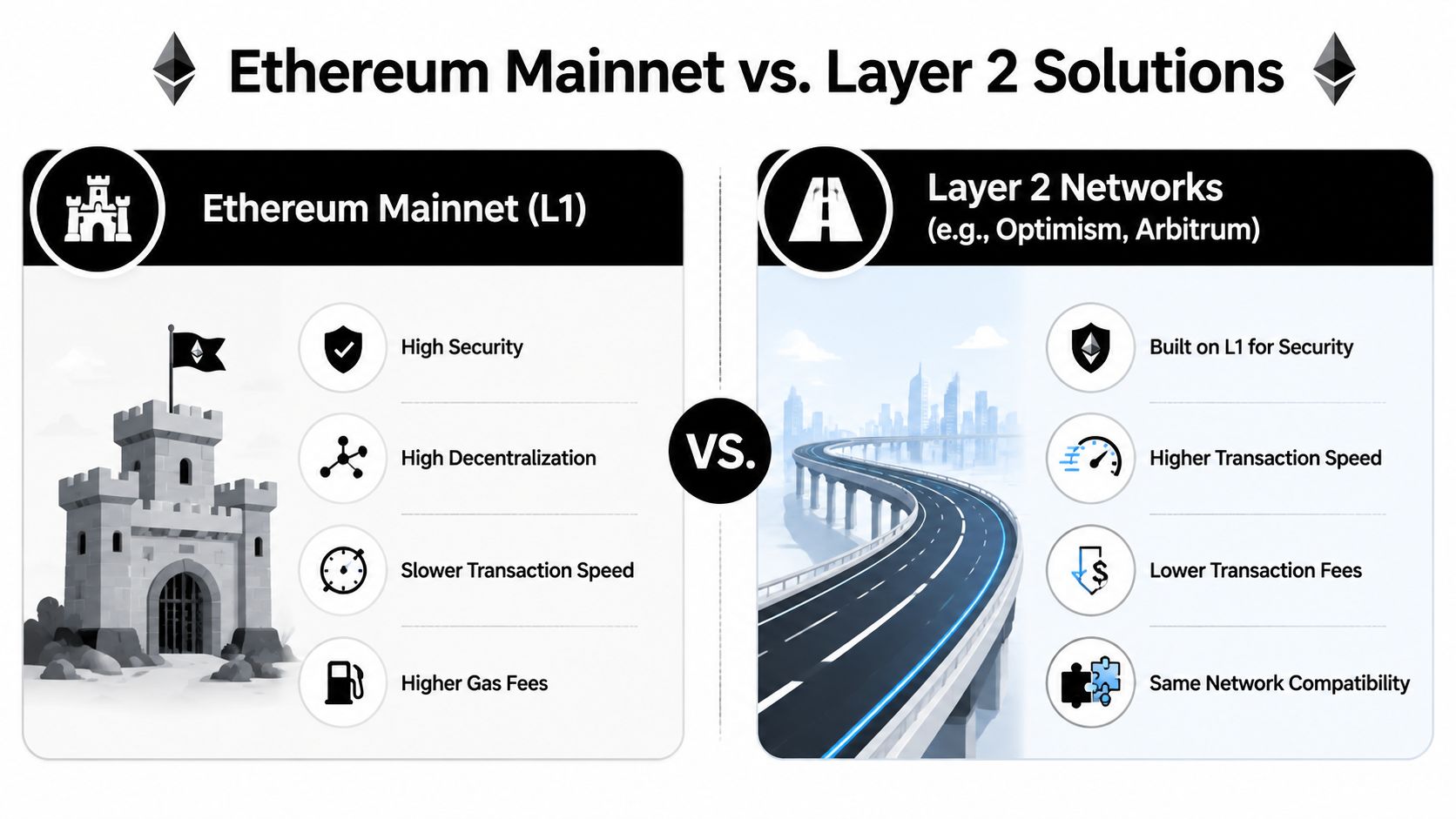
Ethereum's base chain prioritizes a broad security and decentralization foundation, but that foundation can become costly or slower to use when demand rises. Layer 2 networks address the problem by processing activity away from Ethereum mainnet and using Ethereum as the settlement and security anchor.
The analogy is a restaurant with a heavily booked main dining room. The restaurant can add nearby kitchens that handle many orders, then send the final accounting back to the main venue. Customers get a faster experience, while the central restaurant remains responsible for the shared rules and final record.
Mainnet and L2s serve different jobs
Ethereum mainnet, often called Layer 1, offers the base settlement environment. Layer 2 networks, including examples such as Base and Arbitrum, aim to provide higher throughput and lower transaction costs while remaining compatible with Ethereum's development tools and asset standards. Users still need to understand each network's withdrawal process, bridge assumptions, and liquidity conditions.
A 2026 ecosystem report estimated total Layer 2 TVL at roughly $38 billion to $44 billion, with L2 DeFi TVL around $8 billion to $9 billion. The same report noted that Base and Arbitrum held the largest shares of L2 DeFi value. Those estimates are summarized in the 2026 Ethereum L2 ecosystem report.
Another 2026 market analysis reported that Layer 2 networks processed between 5:1 and 10:1 more daily transactions than Ethereum mainnet during Q1 2026, while total value locked across Ethereum L2s exceeded $40 billion. That activity comparison appears in the Ethereum L2 fee and competition analysis.
User takeaway: Lower fees on an L2 don't mean the transaction is happening on Ethereum mainnet. Check the network selected in your wallet before signing.
The scaling tradeoff is practical. Mainnet is the settlement layer, while L2s are increasingly where users trade, move tokens, and interact with applications. That arrangement creates new usability challenges, including fragmented balances, bridge decisions, and the need for wallets and dApps to support multiple environments. A clear overview of Layer 2 scaling solutions can help users compare the available approaches.
Ethereum in the Real World
Ethereum's strongest use cases emerge when people need shared rules, verifiable records, and programmable ownership. Decentralized finance, or DeFi, uses smart contracts to provide functions such as trading, lending, liquidity provision, and collateral management without relying on a conventional central operator for every step.
Ethereum's market position reflects the size of that ecosystem. Recent independent market snapshots placed its market capitalization near $225 billion to $233 billion in mid-2026, keeping it ranked second globally among cryptocurrencies. Multiple 2026 estimates placed Ethereum DeFi TVL between about $37.1 billion and $55.6 billion, while one estimate showed roughly 53.1% of global DeFi total value concentrated on Ethereum. The figures and market context are compiled in this 2026 Ethereum investment analysis.
Applications beyond finance
NFTs use Ethereum-compatible standards to represent distinct digital items and ownership records. The asset might be digital art, an in-game item, a membership credential, or a claim connected to a physical object. The token doesn't automatically guarantee legal ownership of an off-chain asset, so buyers need to examine the contract, issuer, metadata, and rights attached to each project.
DAOs use smart contracts and governance processes to coordinate communities and manage treasuries. Members may vote on proposals, allocate resources, or change protocol parameters. The code can make actions transparent, but governance remains a social and economic system, not a perfectly neutral machine.
Ethereum also provides a base for Web3, where wallets act as identity and authorization tools across applications. AI and crypto can intersect through tokenized incentives, decentralized data markets, and automated agents, but those applications still depend on reliable contracts and clear permission models. Real-world asset tokenization follows the same principle, putting representations of off-chain assets into programmable systems while leaving legal custody and enforcement as separate questions.
The risks are substantial. Smart contracts can contain exploitable logic, token prices can move sharply, governance can become concentrated, and users can lose funds through phishing or mistaken transactions. Ethereum enables open access, but open access also means users must evaluate the code, issuer, custody model, and transaction details themselves.
Getting Started with Ethereum
Start with a clear objective, not a complicated strategy. You might want to hold ETH, test a dApp, explore an NFT marketplace, or learn how a DeFi protocol works. Each activity exposes you to different risks, so separating learning from meaningful capital is sensible.
A careful first route
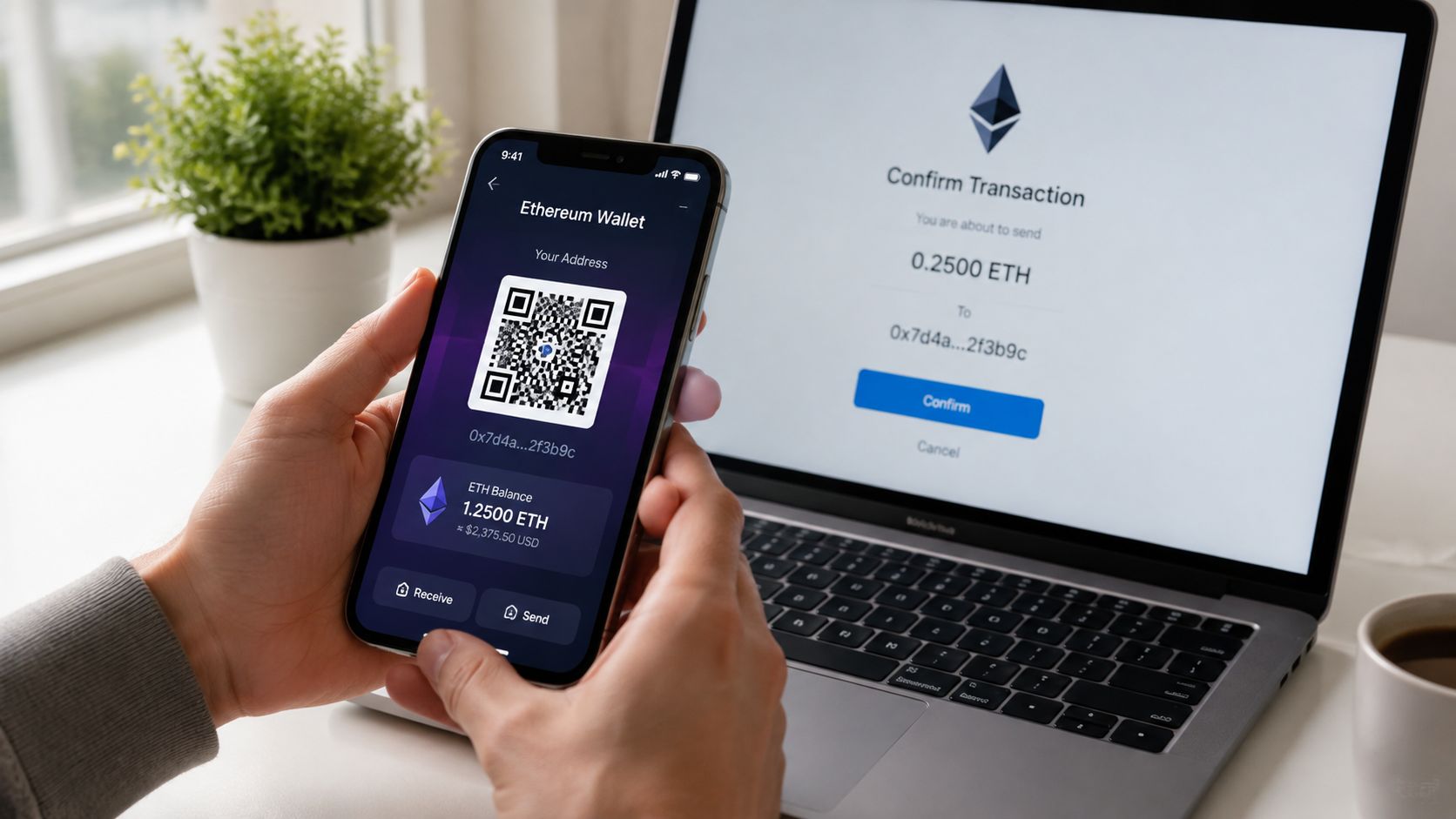
Choose a wallet: A wallet controls the keys used to authorize transactions. It doesn't store Ethereum inside the application in the same way a physical wallet stores cash. For a clearer explanation of custody models, read this guide to a non-custodial wallet explained for traders.
Acquire ETH through a reputable exchange: Review the destination network before withdrawing. Sending funds through the wrong network can create recovery problems.
Secure the recovery phrase: Write it down offline, never share it, and don't enter it into a website claiming to provide support. Anyone with the phrase may be able to control the wallet.
Run a small test: Send a modest amount first or interact with a low-value application. Confirm the recipient address, network, token, gas settings, and contract permissions before signing.
Explore gradually: You can examine a DeFi interface, an NFT marketplace, or a DAO, but read the transaction approval carefully. Token approvals can grant contracts permission to move assets, so revoke unnecessary permissions through a trusted wallet or security tool.
The video below can reinforce the wallet and transaction basics before you connect funds to an application.
Ethereum's fees and network choices deserve attention at every step. Mainnet and L2 transactions may have different costs, assets may exist on different networks, and a bridge can introduce additional technical and counterparty considerations. Treat every signature as an authorization decision, not as a routine click.
Ethereum isn't a guaranteed investment, and this article isn't personalized financial advice. Before committing funds, verify the application's contract address through official documentation, understand what you're authorizing, and use only money you can afford to lose.
Coiner Blog publishes explainers and analysis on Ethereum, Bitcoin, DeFi, Web3, NFTs, Layer 2 scaling, tokenomics, AI and crypto, and real-world asset tokenization. Visit Coiner Blog to keep building a practical understanding of blockchain technology and the risks behind its applications.