
What Is a Cold Wallet? a Complete Guide to Crypto Security
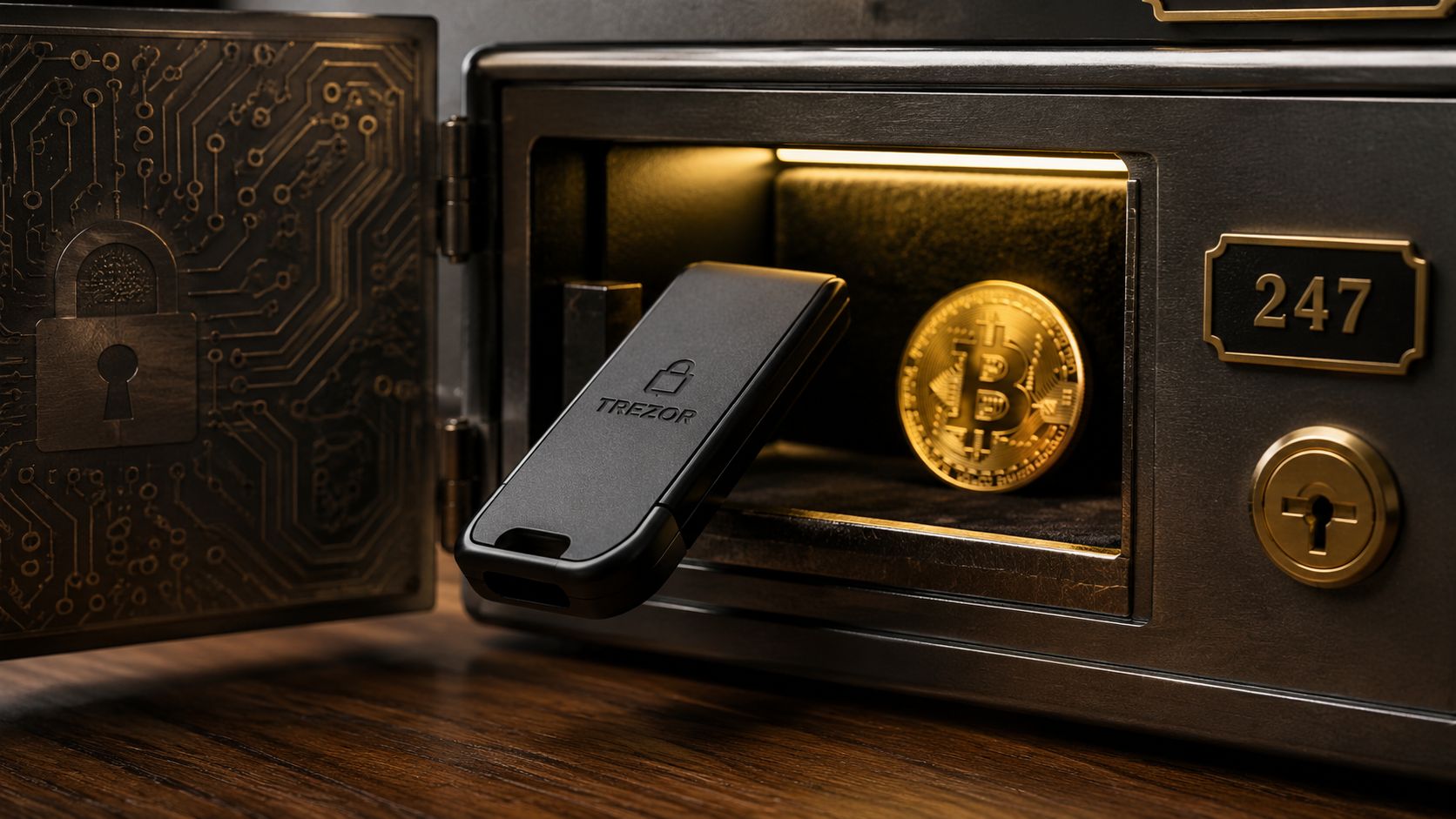
A cold wallet is a crypto wallet that keeps private keys permanently offline so transactions are signed without exposing secrets to an internet-connected device. In 2025, one industry report valued the global hardware wallet market at USD 564.6 million and projected it to reach USD 2,648.3 million by 2034, while another estimated USD 0.61 billion in 2025 and USD 4.33 billion by 2034, showing how offline custody has moved from a specialist practice toward a mainstream security tool.
You may be holding Bitcoin or Ethereum on an exchange, watching breach headlines, and wondering whether your balance could disappear overnight. The important distinction is that your coins aren't stored inside the wallet. They remain on the blockchain. The wallet protects the private keys that authorize transactions, much like a key protects access to a locked account.
A cold wallet works like a safe-deposit box whose signing key never leaves the vault. You can prepare a transaction on an internet-connected computer, move the unsigned transaction to the cold wallet, approve it on the device, and broadcast only the signed result. That separation reduces online exposure, but it doesn't eliminate every risk.
This guide explains how cold wallets work, how hardware and air-gapped designs differ, where offline storage helps, and which overlooked failures can still undermine it. You'll also find a practical setup workflow, a comparison with hot wallets and exchanges, a decision framework for 2026, and answers to common beginner questions.
Table of Contents
- A Simple Way to Think About Cold Wallets
- How Cold Wallets Actually Work
- Types of Cold Wallets and How They Differ
- Security Benefits and the Risks Most Guides Skip
- Setting Up and Using Cold Storage Safely
- Cold Wallets vs Hot Wallets and Exchanges
- Who Really Needs a Cold Wallet in 2026
- Key Takeaways and Frequently Asked Questions
A Simple Way to Think About Cold Wallets
Suppose you've just bought crypto and left it on an exchange because that was the quickest option. Then an exchange breach appears in the news. Your first question probably isn't about cryptography. It's simpler: who controls the key that can move my assets?
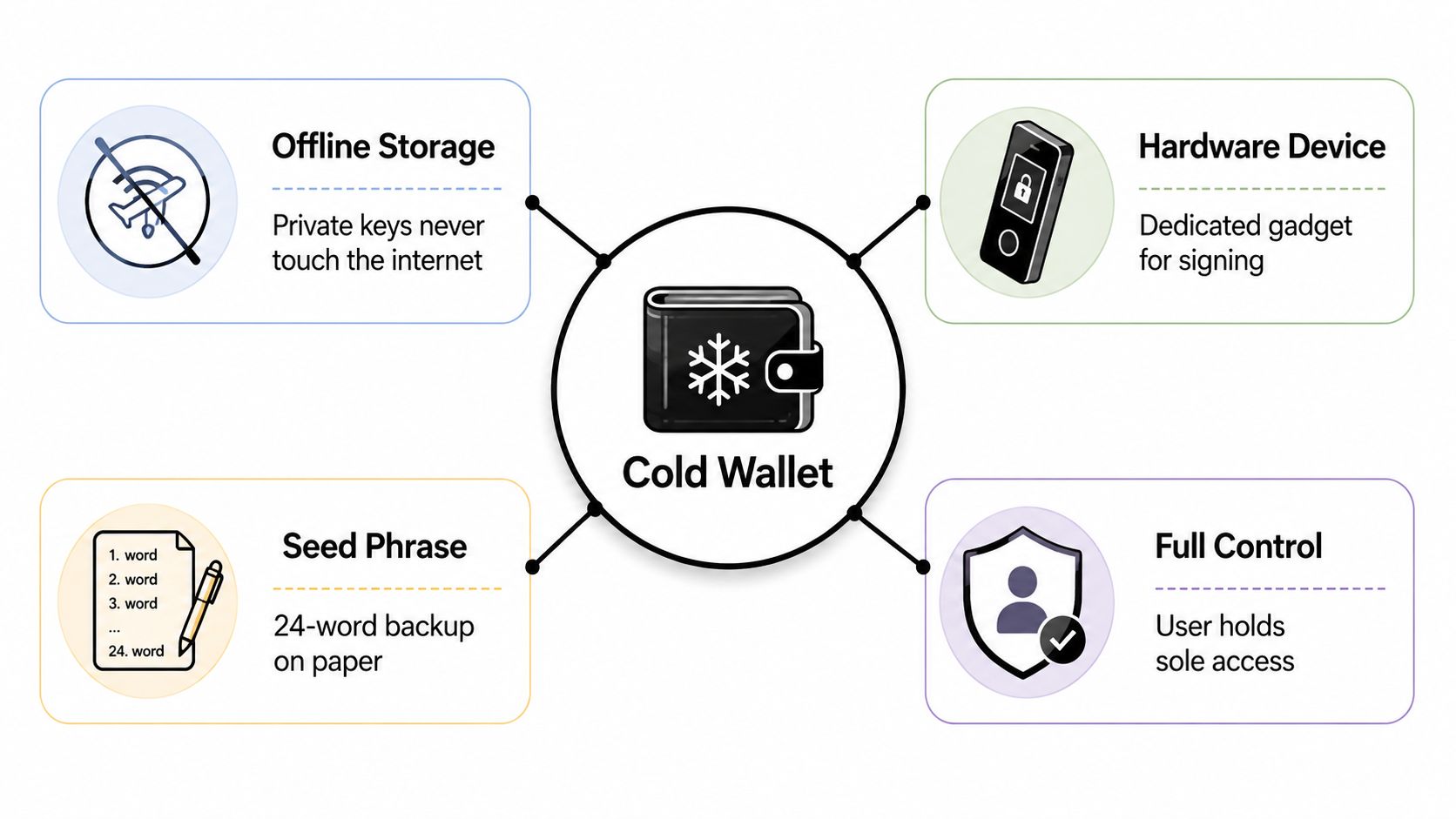
A cold wallet is a system for keeping that key offline. In a non-custodial arrangement, the private key stays under your control, and the device signs transactions without revealing it to the connected computer. The blockchain records ownership and transfers, while the cold wallet safeguards the credential needed to authorize movement.
Think of a physical vault. You can write an instruction to withdraw an item, carry that instruction to the vault, and have the vault validate it internally. The instruction can return with an authorization mark, but the key itself never needs to travel through a public hallway. In crypto terms, the online computer prepares the transaction, the isolated wallet signs it, and the network receives the signed transaction.
Why the distinction matters
A hardware wallet can connect to a phone or computer when you need to use it. A cold wallet, in the strictest description, doesn't interact with outside systems at all and focuses on storage and receiving or transferring funds, as explained in this comparison of hardware wallets and cold wallets.
That difference doesn't make every hardware wallet unsafe. It highlights a design spectrum:
- Online convenience: Hot wallets and exchange accounts make frequent activity easier.
- Offline isolation: Cold-storage workflows reduce the chance that internet malware can extract a private key.
- Operational responsibility: You must protect the recovery phrase, verify firmware, and plan for loss or inheritance.
The central lesson is straightforward: cold storage changes the type of risk you face. It helps with remote attacks, but it places greater responsibility on your physical security and recovery process.
For a broader explanation of personal key ownership, see this guide to not your keys, not your coins.
How Cold Wallets Actually Work
The process starts with a key pair. The private key is secret information used to authorize a transaction, while the public key and derived addresses can be shared to receive funds. A wallet doesn't store Bitcoin or Ethereum directly. It stores, or helps control, the credentials that let you prove authority over assets recorded on their respective blockchains.
A strong hardware design generates the key material inside the device and keeps the private key in protected memory. The key isn't exported to the computer or phone. This is the practical meaning of a private key in crypto, it is the secret that must remain under strict control.
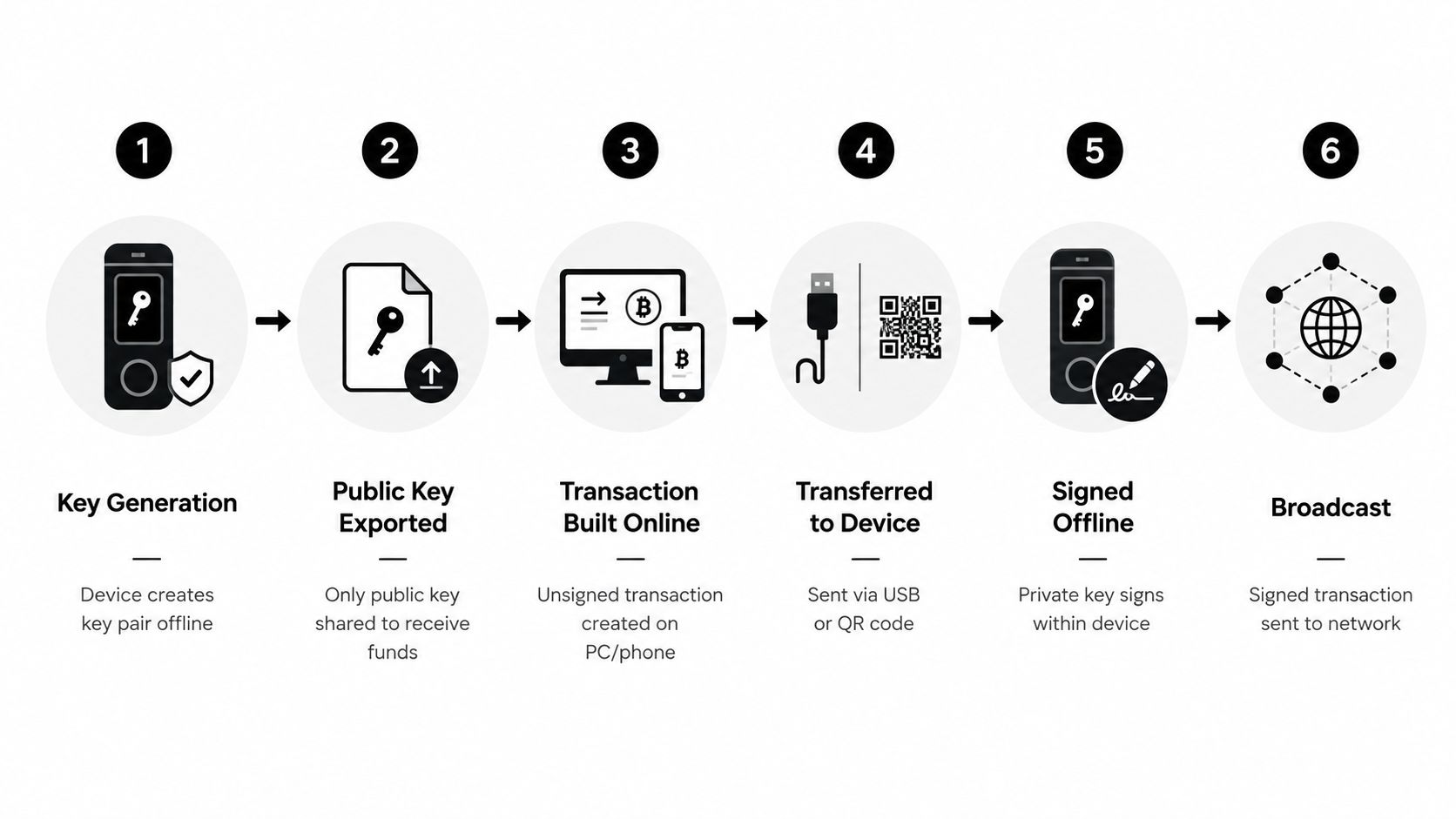
The transaction flow
Imagine a mailbox that anyone can send mail to, but only one locked signet can authorize a withdrawal. The online computer can prepare the paperwork, but it doesn't possess the signet.
- The wallet generates keys: Key creation takes place in the device's isolated environment.
- The public information leaves: You can export a public key or receive address without exposing the private key.
- The online software drafts a transaction: A computer or phone selects the recipient, amount, network fee, and other details.
- The unsigned transaction reaches the wallet: Depending on the design, this may happen through USB, Bluetooth, a QR code, or removable media.
- The device displays and signs: You check the destination and amount on the wallet's own screen, then approve the action physically.
- The connected machine broadcasts: It sends the signed transaction to the blockchain network. The private key remains inside the signer.
Air-gapped signing and recovery
An air-gapped wallet has no live network connection. It may use QR codes or an SD card to transfer transaction data between the online environment and the signer. The wallet doesn't need to connect directly to the internet to verify and sign an instruction.
The seed phrase is the human-readable backup from which wallet keys can be recovered. Common wallet designs use hierarchical deterministic derivation, with BIP-32 defining derivation paths and BIP-39 standardizing mnemonic seed phrases, according to this overview of cold-wallet security architecture.
That backup is powerful and dangerous. Anyone who obtains it may be able to restore the wallet elsewhere, while losing it can make recovery impossible. The device is therefore only one part of the system. The seed-generation process, firmware, transaction display, and backup procedure all matter.
Types of Cold Wallets and How They Differ
“Cold wallet” describes the custody approach, not one universal product shape. Some designs use dedicated hardware, some use complete network isolation, and others rely on carefully controlled physical records.
Cold Wallet Form Factors Compared
| Form Factor | How Keys Stay Offline | Ease of Use | Typical Price Range |
|---|---|---|---|
| Dedicated hardware wallet | Private keys remain inside a dedicated device, often using secure hardware | Relatively approachable | Varies by device |
| Air-gapped signer | QR codes or removable media transfer data without a live network path | More demanding | Varies by device |
| Paper wallet or metal seed plate | Key or recovery information remains on a physical record | Simple in concept, difficult to use safely | Material and preparation costs vary |
| Offline computer or sound-card setup | Key operations occur on a computer kept disconnected from networks | Advanced | Depends on existing equipment |
Dedicated devices often resemble small USB gadgets or compact card-like tools. Some use USB, others Bluetooth, and some rely on QR codes. Their practical differences include supported assets, firmware transparency, recovery standards, secure-element design, and how clearly the device shows transaction details.
Air-gapped devices go further by avoiding a live USB or network trust path. A computer builds an unsigned transaction, the signer reads it through a QR code or removable card, and the signed transaction returns for broadcasting. This can reduce direct exposure, but it adds steps that users must perform correctly.
Paper storage is inexpensive and understandable, yet it creates fragile handling problems. Ink can fade, paper can burn or absorb water, and a photographed phrase can be copied without the owner's knowledge. A metal plate can improve physical durability, but it still requires discreet storage and accurate transcription.
Offline computers and sound-card methods are mainly legacy or advanced do-it-yourself approaches. They can provide control, but the operator becomes responsible for the operating system, randomness, backups, malware prevention, and recovery testing.
Before choosing, compare asset support, firmware openness, recovery compatibility, purchase authenticity, cost, and the consequences of losing the device. A beginner-focused wallet comparison can help frame those questions, but no device removes the need for careful custody.
Security Benefits and the Risks Most Guides Skip
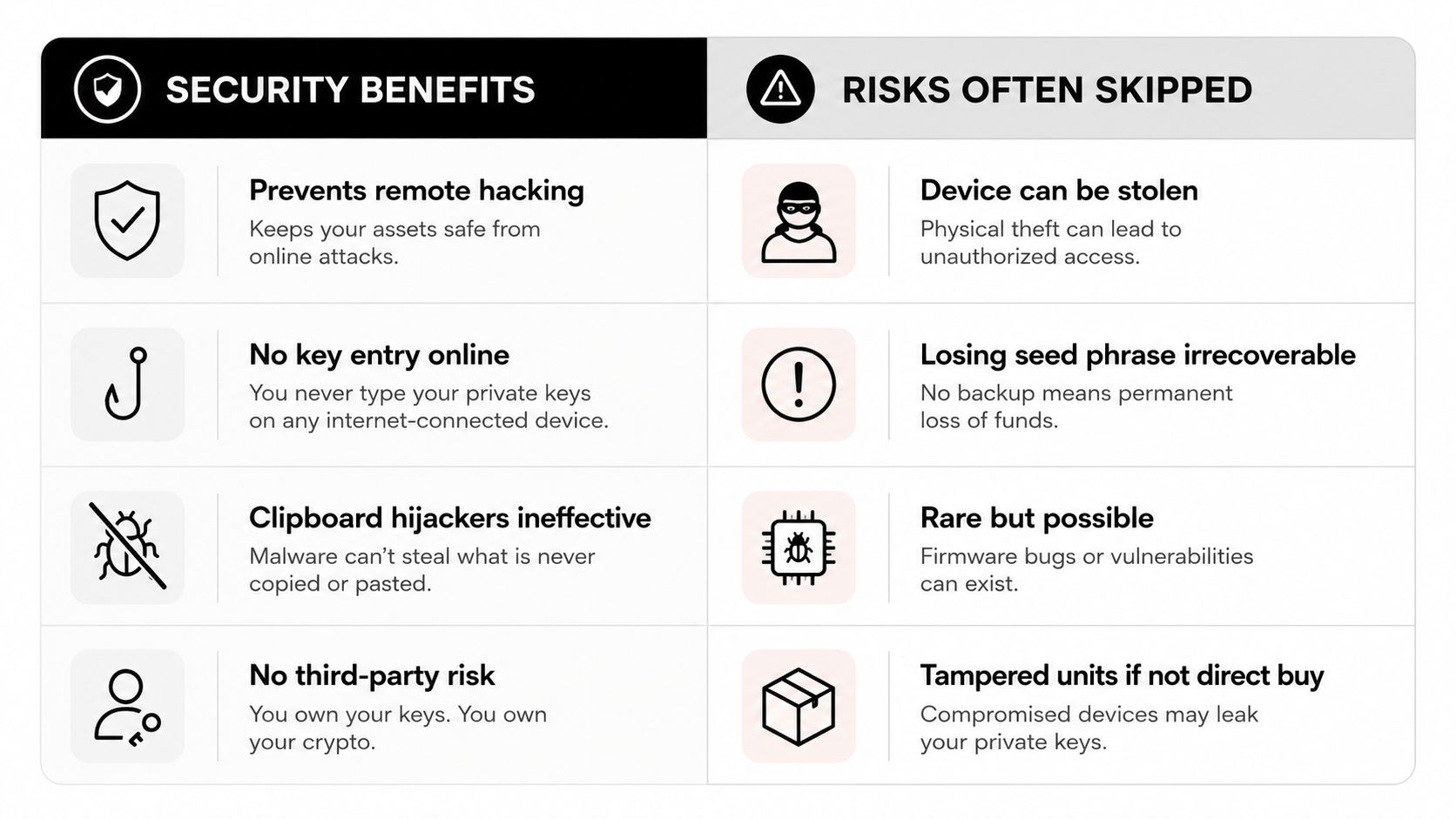
The strongest benefit of cold storage is key isolation. If a private key never enters an internet-connected computer, remote malware cannot search that computer and extract the key. That helps reduce exposure to phishing pages, clipboard hijackers, browser attacks, and other threats aimed at hot-wallet credentials.
An offline signer can also force a useful pause. Instead of approving a transaction inside a browser where a malicious script may alter what you see, you can compare the destination and amount on the device's trusted display before confirming.
Practical rule: Offline is a security condition, not a complete safety guarantee.
The attack surface moves
The recovery phrase becomes the most obvious single point of failure. A paper backup can be photographed, copied, misplaced, or destroyed by fire and flooding. Entering it where someone can watch, or typing it into a website that claims to be a recovery tool, defeats the isolation model.
The device itself also introduces trust questions:
- Firmware integrity: A bug or malicious modification can affect key generation, address display, or signing behavior.
- Supply-chain control: An unauthorized reseller may provide a tampered unit or altered packaging.
- Physical access: Someone who steals the device may attempt to guess the PIN, inspect it, or target the backup.
- Human behavior: Users can approve a fraudulent address if they skip verification on the hardware screen.
Research on cold-storage systems has emphasized that a host compromise doesn't automatically reveal the private key when signing remains isolated, but the signer and its display must still be trustworthy. Dedicated hardware may use secure elements and structured evaluations such as EAL5+, yet certification or tamper resistance doesn't replace safe setup and recovery practices.
The contrarian point became especially important after reporting on a 2026 Coldcard exploit. The incident reportedly drained about 1,367 BTC, with losses near USD 86 million to USD 89 million, and researchers mapped the flaw across more than 4,500 wallets, according to The Straits Times' coverage of the attack. The reported issue involved predictable seed phrases generated by affected firmware, and users needed to create entirely new wallets rather than merely update software.
For readers assessing breach scenarios, this overview of cold-wallet data exposed in a breach offers useful context on why device security and operational controls deserve attention alongside offline storage.
Cold storage lowers online attack exposure, but it raises the importance of seed creation, device provenance, firmware verification, and disciplined backups.
Setting Up and Using Cold Storage Safely
Treat setup as a security procedure, not a quick unboxing task. The first decision is where the device comes from, because a compromised supply chain can undermine confidence before you generate a single key.
Follow the lifecycle carefully
- Buy from the manufacturer: Use the official manufacturer channel and inspect tamper-evident packaging when the device arrives.
- Initialize on the device: Let the wallet generate the recovery phrase internally. Never create it on a computer, phone, website, or random online generator.
- Record the phrase offline: Write the 24-word recovery phrase on the supplied card or transfer it to a suitable metal backup. Don't type it, photograph it, email it, or store it in cloud storage.
- Set a strong PIN: Choose a PIN that isn't reused elsewhere and can't be inferred from personal information.
- Use advanced features cautiously: A passphrase can create an additional wallet layer, but it also creates another secret that must be documented and recovered correctly.
- Verify receiving details: Generate an address and compare the address shown by your companion software with the one displayed on the hardware device.
- Send a small test amount: Confirm that receiving and recovery behave as expected before moving a larger balance.
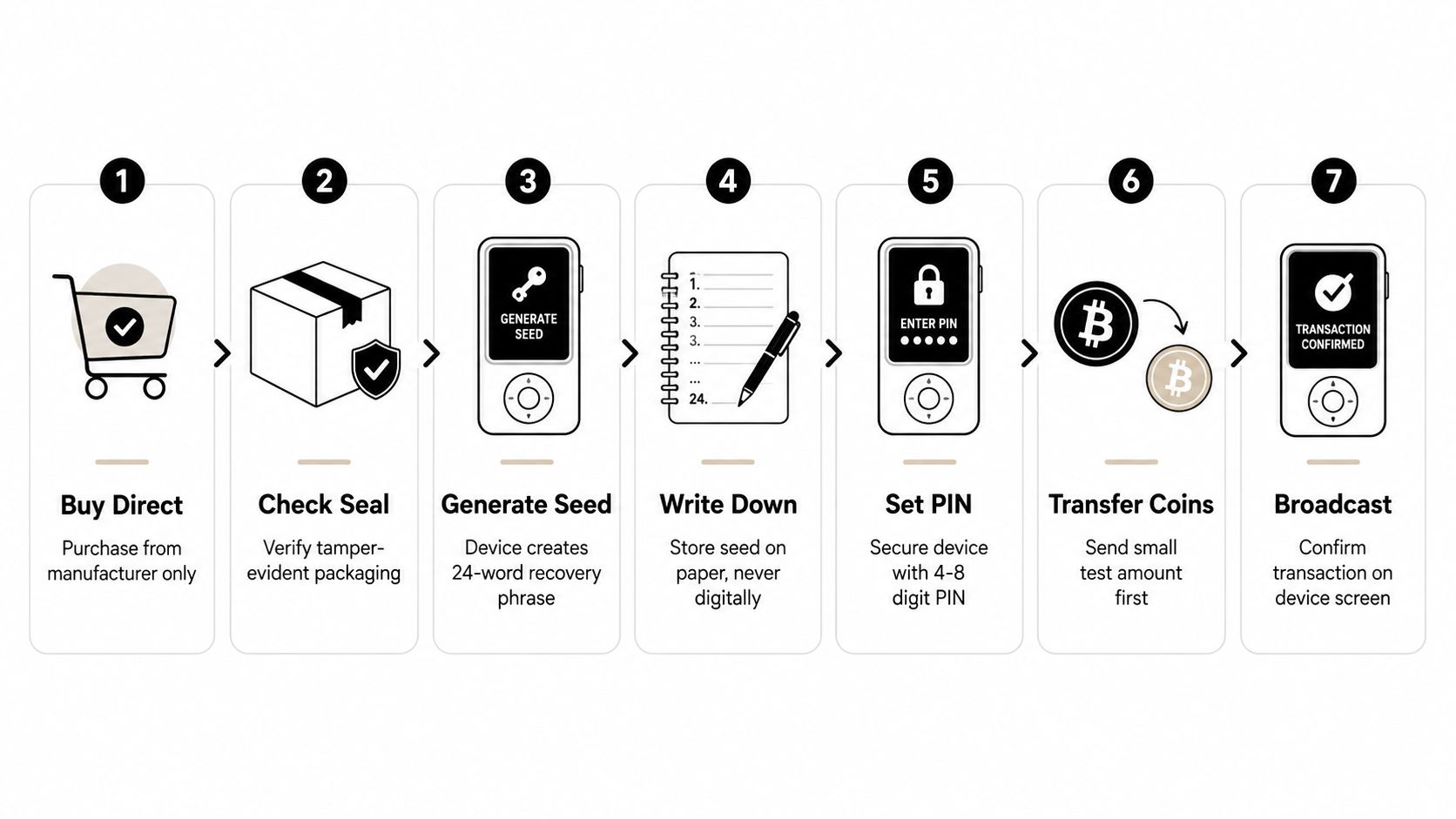
Use the device as a transaction verifier
When sending, build the transaction in the companion application, then inspect the recipient address and amount on the hardware screen. Confirm only after the displayed details match what you intended. Malware can manipulate information on the computer while leaving the private key untouched.
Keep the seed phrase separate from the device. A thief who finds both may gain a straightforward recovery path, while storing them in different secure locations reduces the consequences of losing one item. Consider how a trusted person could access the recovery plan if you become unavailable, without revealing the phrase unnecessarily.
Firmware maintenance requires judgment. Check update instructions through the manufacturer's authentic channels, verify what the update changes, and never enter the seed phrase into an update page. Test recovery with a controlled amount and a properly verified backup, rather than assuming that a written phrase is accurate because it looks complete.
Before sending: Verify the address on the device screen, not only in the computer or phone application.
If you use multisig or air-gapped signing, document the process while it is still familiar. A complex arrangement that nobody can reconstruct during an emergency may create more operational risk than a simpler design used consistently.
Cold Wallets vs Hot Wallets and Exchanges
The choice isn't “safe” versus “unsafe.” It is a trade-off among convenience, exposure, and control.
| Dimension | Cold Wallet | Hot Wallet | Exchange Account |
|---|---|---|---|
| Key location | User-controlled device or offline record | Software connected to the internet | Keys held by the exchange |
| Convenience | Slower, deliberate access | Fast for routine transactions | Fast within the platform |
| Online exposure | Reduced for the private key | Higher because the wallet is online | Platform and account exposure |
| Recovery | Depends on a correctly protected seed or backup | Usually depends on wallet recovery data | May include account support, subject to platform rules |
| Main user risk | Loss, theft, seed exposure, signing mistakes | Phishing, malware, malicious approvals | Breach, account compromise, freezes, or withdrawal restrictions |
| Best fit | Long-term custody and larger personal balances | Spending, applications, and active use | Trading and platform-based activity |
A hot wallet is like a wallet in your pocket. You can use it immediately, but you carry it through a more exposed environment. A cold wallet is more like a home safe. It takes longer to open and use, yet it can keep the majority of your holdings away from routine online activity.
Exchange custody is different from both. An exchange account isn't a wallet in the cryptographic sense for the user, because the exchange controls the private keys. The account balance represents a claim managed through the platform, not direct possession of the signing credential.
A practical arrangement often uses more than one layer. Keep a limited operating balance in a hot wallet for DeFi, Web3 applications, small payments, or active trading, while reserving cold storage for assets you don't need to move regularly. This separation also matters for Ethereum users interacting with smart contracts, where a malicious approval can create risk even if the underlying hardware device remains offline.
Who Really Needs a Cold Wallet in 2026
Cold storage makes the most sense when the cost of losing access would materially outweigh the inconvenience of a slower transaction. That isn't determined by a universal portfolio threshold. Consider holding period, transaction frequency, technical confidence, and how well you can protect a recovery phrase.
Adoption data shows a gap between recognizing self-custody and using it. A 2026 survey reported that 66% of users considered self-custody important and 46% feared major exchange breaches, yet 88% still kept assets on centralized exchanges and only 33% used a cold wallet, according to The Hacker News' report on the survey and Coldcard incident.
A practical decision framework
Long-term holders: If you plan to hold Bitcoin or other major assets for a long period and would feel serious financial pain from a single account compromise, offline custody deserves consideration. Your willingness to maintain backups is as important as the balance itself.
Active DeFi users: A hardware wallet can protect the key used to approve Ethereum, Layer 2, or Web3 transactions, but it won't make a malicious smart contract safe. You still need to inspect permissions, separate long-term holdings from application funds, and avoid signing requests you don't understand.
Small or occasional traders: A hot wallet or exchange account may be adequate for a limited working balance if you accept platform and online risks. The friction of moving every small transaction through cold storage can encourage rushed procedures, which creates its own danger.
Families and organizations: Inheritance and continuity change the answer. A single-person seed backup may be difficult for others to recover, while multisig or professionally governed custody can distribute authority. Multi-party computation, or MPC, offers another custody model, but it requires careful evaluation of the provider, recovery design, and operational controls.
Use cold storage when it matches your behavior, not because it sounds automatically superior. The right question is: Can I follow the backup, verification, and recovery process reliably for as long as I need to hold these assets?
Key Takeaways and Frequently Asked Questions
Four points summarize the practical answer to what is a cold wallet:
- Offline keys: A cold wallet keeps private keys away from internet-connected systems.
- Isolation matters: The security benefit comes from signing internally and exporting only the signed transaction.
- Setup is part of security: Seed generation, firmware integrity, device provenance, and backup hygiene can matter as much as the hardware.
- Use should match behavior: Cold storage suits deliberate, longer-term custody, while hot wallets and exchanges provide faster access with different risks.
Can a cold wallet be hacked?
A device can face firmware flaws, supply-chain attacks, physical attacks, or compromised transaction software. Offline storage reduces remote key-extraction opportunities, but it doesn't make a device invulnerable.
Can crypto disappear if the device breaks?
The blockchain record doesn't depend on the device. If your recovery phrase was generated correctly and stored safely, you may be able to restore access with a compatible wallet. If the phrase is lost or exposed, recovery or security can fail.
Is institutional cold custody the same?
Not necessarily. A custodial provider may hold keys offline on behalf of clients, while self-custody means you control the recovery material. Institutional arrangements can add governance, approval policies, and distributed responsibility, but they also introduce dependence on the provider.
How often should you use a hardware wallet?
Use it whenever you need to authorize a protected transaction, but don't connect it casually or enter recovery information into online forms. Keep routine activity in a separate working wallet and review the cold-storage process when firmware, devices, or recovery plans change.
Multisig and MPC are expanding the custody toolkit by distributing control rather than placing every decision in one device or one seed. They don't remove human responsibility, but they can make recovery and authorization more resilient when designed and tested properly.
Coiner Blog publishes clear guides and analysis on Bitcoin, Ethereum, DeFi, Web3, tokenomics, Layer 2 networks, AI and crypto, and real-world asset tokenization. Visit Coiner Blog to keep building a practical understanding of crypto security, custody, and the wider blockchain ecosystem.