
What Is a Private Key in Crypto Explained

You've probably seen a wallet screen, a seed phrase backup prompt, or a warning that says your keys can't be recovered if you lose them. That's exactly where the confusion starts. A private key sounds like a password, but in crypto it acts more like the master secret that lets you control funds, sign transactions, and prove ownership.
That idea matters far beyond one app or one chain. In mainstream cryptography, a private key is the secret part of an asymmetric key pair used to sign or decrypt data, while in blockchain it's the secret that controls wallet access and authorizes spending. Those overlapping meanings cause a lot of bad advice, especially when people mix up private keys, seed phrases, public keys, and addresses.
If you've ever wondered whether one lost phrase means permanent loss, whether a key can be rotated, or why a wallet asks you to back up 12 or 24 words, this guide breaks it down in plain language. You'll get the basic definition, the mechanics behind how keys work, the security trade-offs, and the practical differences that are relevant when you're holding crypto yourself.
Table of Contents
- Introduction
- Understanding the Key Concepts
- How Private Keys Are Generated and Used
- Differentiating Keys Seed Phrases Public Keys and Addresses
- Security Best Practices and Common Attack Vectors
- Recovery Options and Key Management Strategies
- Practical Wallet Examples for Beginners and Intermediate Users
- Conclusion
Introduction
A lot of people meet the phrase what is a private key at the exact moment something feels urgent. Maybe a wallet setup screen is asking them to store a recovery phrase. Maybe they're trying to send Bitcoin or Ethereum and want to know why a transaction needs approval from a secret string they never see on-chain. The instinct is usually the same, people want to know what they're protecting before they commit to self-custody.
A private key is the secret that gives one person, or one system, control over a crypto asset account. In crypto wallets, that secret authorizes transactions and proves the holder has the right to move funds. In mainstream cryptography, the same term refers to the secret half of an asymmetric key pair used for signing or decryption, which is why explainers often talk past each other.
That overlap matters. If you treat a private key like a password, you'll miss the bigger picture. If you treat it like an address, you'll miss the danger. If you treat it like a backup phrase, you might expose full wallet control without realizing it.
The useful way to think about it is simple. A private key is a control point, not a login hint. Once you understand that, the rest of wallet security starts making sense.
Understanding the Key Concepts
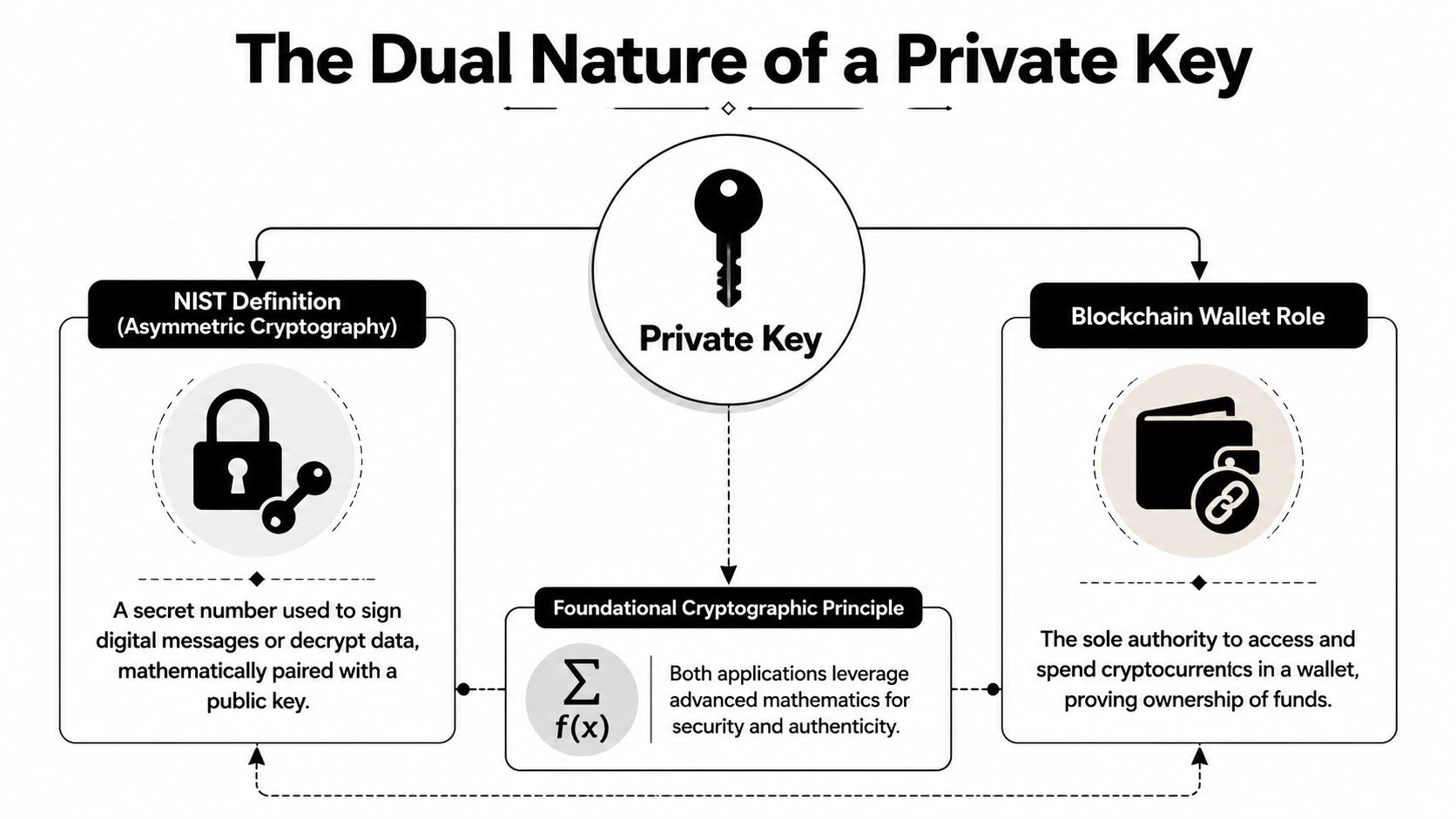
The cleanest way to understand a private key is to split the term into its two most common worlds. In NIST-style cryptography, a private key is the secret part of an asymmetric key pair used to sign or decrypt data, while blockchain explainers use the same phrase for the secret that controls wallet funds and authorizes transactions. That overlap is real, but the job the key performs changes with the system around it, which is why readers get confused so quickly. NIST's private key glossary entry
Two systems, one name
In SSL/TLS and digital signatures, the private key stays hidden while a public key can be shared. The private key proves identity or decrypts something that was locked to the matching public key. In a wallet, the same basic cryptographic principle shows up as authorization. The private key lets the wallet prove, without revealing the secret, that the holder can spend assets tied to an address.
That's why the term can sound like three different things at once. People ask whether a private key is a password, a signing key, or both. The honest answer is that it behaves like a secret credential in every case, but the exact meaning depends on the system using it.
Why the distinction matters
Mainstream cryptography often talks about protecting data, servers, or messages. Blockchain wallets talk about controlling funds. Those are not identical use cases, even if both rely on asymmetric cryptography. A server certificate, a signing workflow, and a self-custody wallet all depend on secrets, but they're managed differently and have different failure modes.
Practical rule: if a source uses “private key” without context, ask whether it means a secret used for signing or decryption, or the secret that controls wallet access and spending.
The distinction also explains why wallet guides and security guides sometimes feel incompatible. Wallet content tends to frame key loss as total loss of access. Enterprise security content, by contrast, often assumes rotation, revocation, access controls, and recovery paths. Both are right inside their own environments, but they're solving different problems.
The key takeaway is simple. A private key is always secret. What it controls depends on the system, but the trust model is the same, whoever has the secret can act as the owner or signer.
How Private Keys Are Generated and Used
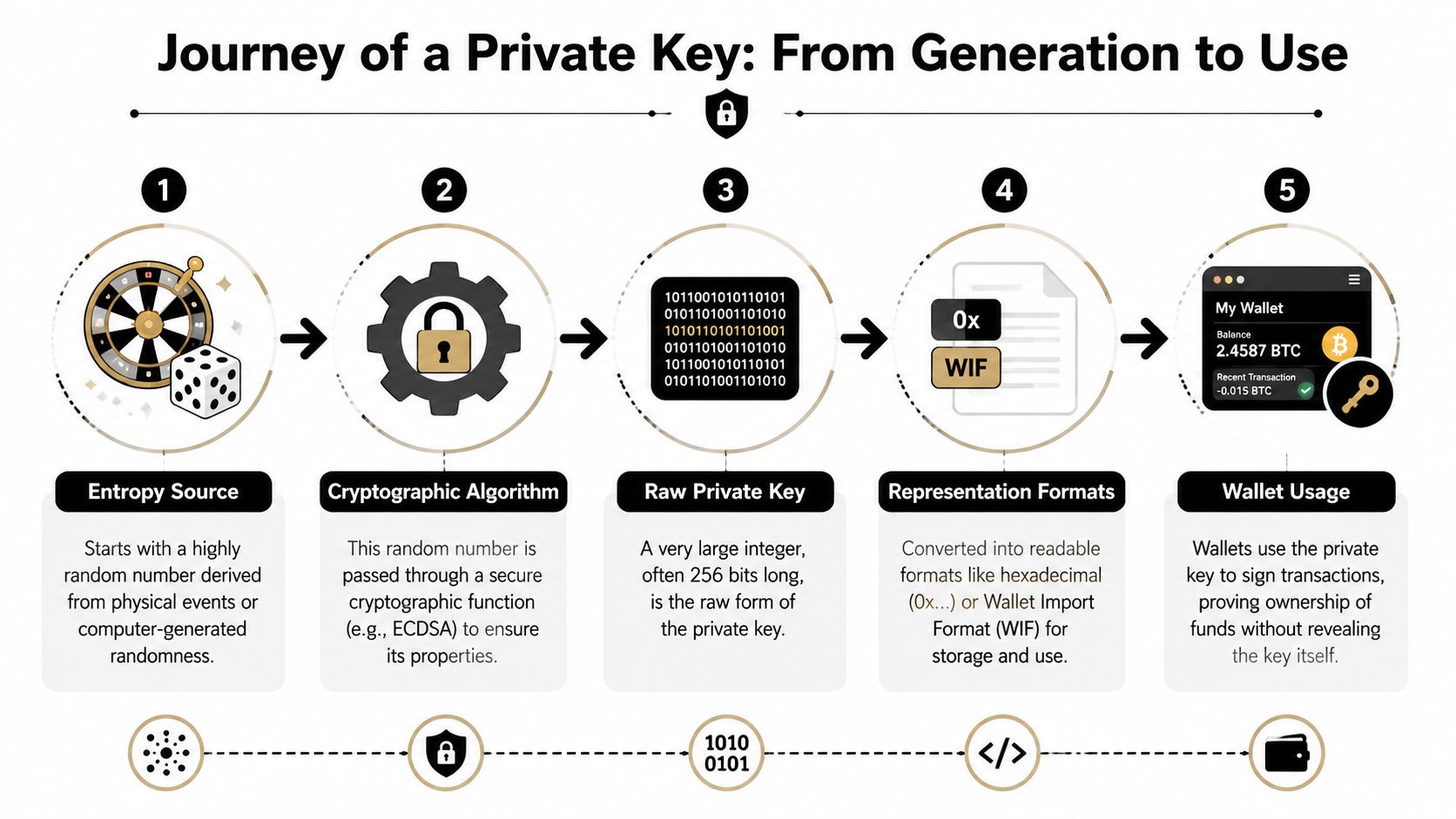
A good way to understand private key generation is to follow the path from randomness to control. A wallet starts with entropy, turns that randomness into a secret number, and then uses that secret to derive the rest of the wallet structure. In Bitcoin and similar systems, that secret is often shown as a 64-character hexadecimal string tied to a 256-bit value, which is why guessing it by force is not realistic with current technology.
From randomness to a usable secret
A private key does not begin as a phrase a person can remember. It begins as a very large random number, and the wallet software performs the steps that turn that number into the secret used for signing. The secrecy matters from the start. If the number were predictable, the wallet would be weak before it ever sent a transaction.
The raw secret is often shown in a format humans can store or inspect, even though the underlying value is meant to stay hidden. Wallet interfaces usually keep that math behind the scenes, because users are not meant to manage the secret directly. That design choice reduces the chance of accidental exposure and keeps the sensitive part of the process out of everyday use.
What the key does when you send crypto
When you approve a transaction, the wallet uses the private key to create a digital signature. That signature proves authorization without exposing the secret itself. Public blockchains rely on that pattern. The network checks the signature, confirms that it matches the relevant public key, and accepts the action without ever seeing the private key.
That same signing step is why private keys sit at the center of Bitcoin wallets, Ethereum wallets, and many Web3 applications. The key does not move coins on its own. It signs the instruction that tells the network the holder is allowed to move them. In DeFi, the same idea also covers swaps, approvals, and interactions with smart contracts.
Why the math matters in practice
A 256-bit secret gives attackers an unrealistic guessing problem under current conditions, so direct brute force is rarely the main concern. Theft usually comes from bad storage, fake websites, malware, or social engineering. That is also why good wallet design tries to keep signing local and to make the secret part of the process hard to expose during normal use.
For readers who want a wider view of where cryptography is headed next, this overview of future cryptography topics is a useful place to start. The practical lesson here is simpler. The wallet uses a secret number to prove control, then keeps that secret out of sight.
Differentiating Keys Seed Phrases Public Keys and Addresses
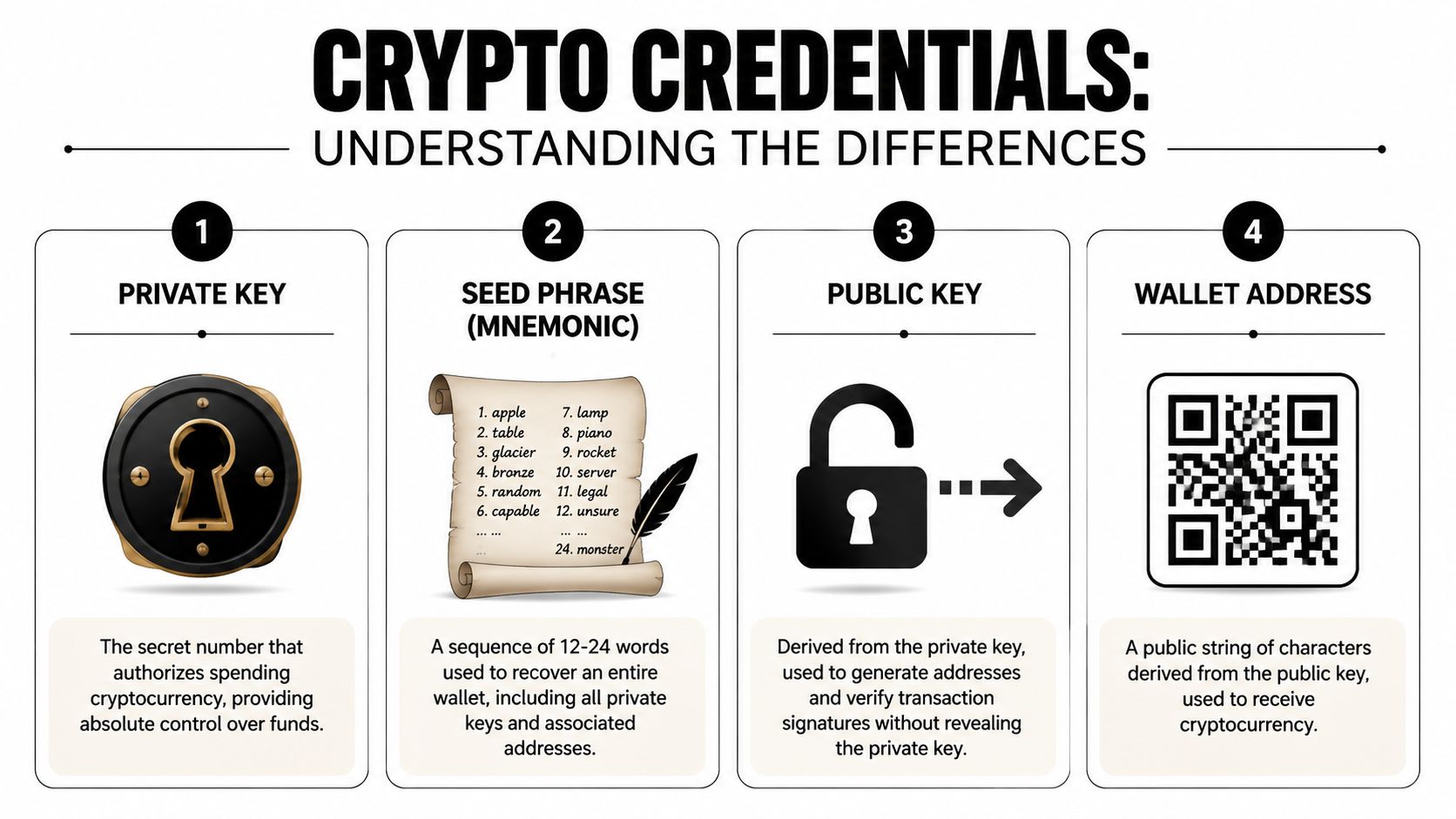
Crypto gets much easier once you stop treating every credential as the same thing. A private key authorizes action, a seed phrase restores access, a public key supports verification, and an address is what other people use to send funds to you. Those four pieces are connected, but they aren't interchangeable.
The four parts in plain language
A private key is the secret control point. If someone has it, they can sign transactions and spend from the wallet. A seed phrase is the human-readable backup that can recreate that same secret, which is why it should be guarded with the same seriousness as the key itself. Banxa's self-custody explanation
A public key is the non-secret partner used for verification and address generation in many systems. It's the thing others can know without gaining spending power. An address, by contrast, is the public-facing label you share when you want to receive crypto. It's not the secret, and it's not the tool that signs anything.
Why beginners mix them up
Wallet interfaces often blur the lines. A recovery screen may mention a phrase. A send screen shows an address. A support article talks about a key. If you're new, it's easy to assume each term is just a different name for the same idea. They're related, but they serve different jobs.
Here's the practical way to separate them:
- Private Key: keep it secret, because it authorizes spending.
- Seed Phrase: keep it secret too, because it can recreate the wallet.
- Public Key: shareable in cryptographic contexts, because it helps others verify signatures.
- Address: shareable for receiving, because it tells others where to send funds.
Any phrase that can recreate a wallet should be treated like the wallet itself.
That's especially important in self-custody. If someone asks for a seed phrase, they're not asking for a harmless recovery detail. They're asking for full control. If they ask for a private key, the risk is the same. If they ask for an address, that's normal, because the address is meant to be public.
The cleanest mental model is this. The private key and seed phrase protect control. The public key and address support visibility. One side is secret, the other side is shared.
Security Best Practices and Common Attack Vectors
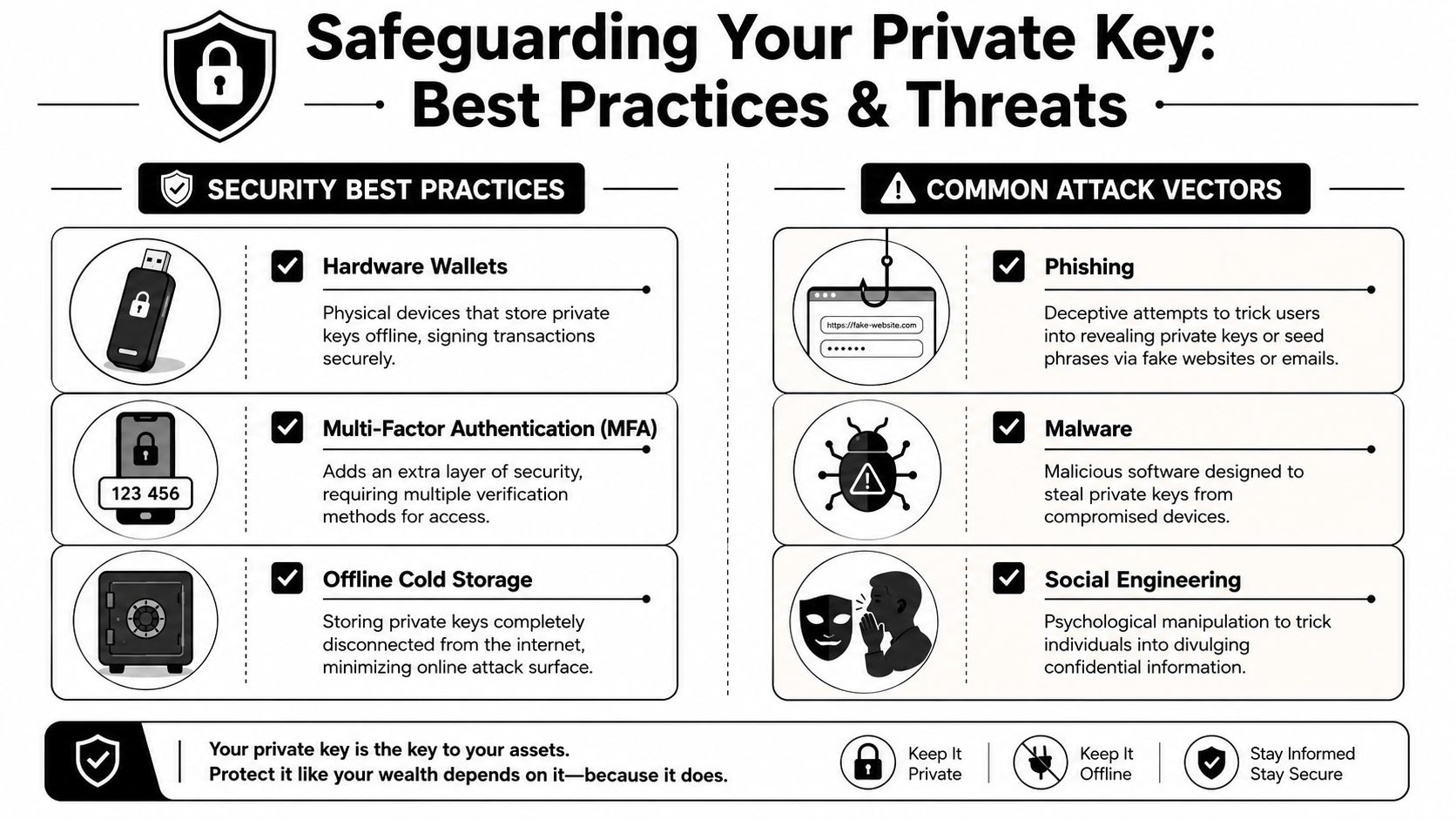
A private key can be mathematically strong and still get stolen in a single bad click. That is the part many beginners miss. Security is not just about the size of the secret, it also depends on where you store it, which device handles it, and whether you can spot a fake prompt before you approve it. A 256-bit private key is extremely hard to brute-force, but phishing pages, malware, and fake support channels remain real ways to lose control. Crypto.com's private key glossary
What actually protects keys
The best protection keeps the secret away from normal internet use. Hardware wallets help because they keep signing secrets offline and confirm transactions on the device itself. Offline cold storage pushes that separation further by keeping the key away from everyday browsing, email, and chat apps. These choices matter because they reduce the number of places an attacker can reach.
For people who hold their own assets, “not your keys, not your coin” captures the trade-off clearly. Real control means real responsibility. You need physical backups, careful device hygiene, and a habit of checking every transaction before you approve it. A wallet only protects you when you know what you are signing.
How attackers go after keys
Attackers usually do not try to break the private key itself. They work around it. Phishing pages imitate wallet logins, fake browser pop-ups ask for recovery details, malware watches clipboard activity, and social engineering pressures people into sharing secrets with someone who claims to be support. These tricks work because people are easier to mislead than cryptography is to crack.
The pattern is usually the same. The attacker creates urgency, asks for one quick action, and pushes you outside your normal routine. Once the secret is entered or copied, the wallet cannot reverse that mistake.
A practical ranking of risk
- Phishing: the most common trap, because it copies real wallet screens and steals credentials through urgency.
- Malware: especially risky on a device used for both browsing and signing.
- Social Engineering: effective because it uses trust, fear, or fake authority.
- Weak storage habits: screenshots, shared notes, and cloud backups can turn a secret into an easy target.
Practical rule: if a site, app, or person asks for your seed phrase or private key, stop immediately.
The safest approach is simple. Keep the secret offline whenever you can, limit the number of devices and people that can see it, and verify every signing request before it leaves your wallet.
Recovery Options and Key Management Strategies
A lot of crypto education stops at “keep your key safe,” but real users need to know what happens when things go wrong. A wallet can be lost, a device can fail, a recovery phrase can be misplaced, or a key can be exposed. Crypto wallets often treat the secret as an irreversible control point, while enterprise systems handle similar secrets with rotation, access restrictions, and recovery controls built around hardware security modules and multi-party approval. Ledger Academy's private key overview
Recovery in self-custody
In self-custody, recovery usually means restoring from the seed phrase. That's convenient, but it also means the backup is the vault itself. If the phrase is copied by someone else, they don't need your device, password, or customer support desk. They already have the wallet.
That creates a hard trade-off. More backups improve recoverability, but more copies increase exposure. A paper backup stored badly can be just as risky as a digital one left in an unprotected cloud folder. The safest version is the one you can retrieve without putting the phrase into a routine internet-connected workflow.
What enterprise systems do differently
Institutional environments rarely rely on a single human holding a single secret. They use controls like hardware security modules, role-based permissions, and multi-party processes so one exposed credential doesn't automatically equal total loss. That doesn't mean crypto users should copy enterprise architecture exactly. It does mean the industry has already shown that key management can be designed with recovery in mind.
For high-value setups, the key question is not whether a key can ever be replaced. It's whether the system around the key can be changed without creating a bigger hole. That's where rotation, policy enforcement, and segregation of duties start to matter.
The decision users actually face
Most retail users must choose between simplicity and resilience. A single seed phrase is easy to back up, but it also concentrates risk. A more complex setup can reduce single points of failure, but it may be too hard to maintain correctly. The right answer depends on how much value is at stake, how technical the user is, and whether the setup is meant for everyday spending or long-term storage.
Practical rule: if you can't explain your backup plan to another trusted person in one minute, it's probably too complicated for your current setup.
Recovery planning should happen before the problem, not during it. Once a key is compromised or misplaced, the options narrow fast. That's why the best strategy is a backup process you can rehearse, document, and check without exposing the secret itself.
Practical Wallet Examples for Beginners and Intermediate Users
A beginner usually learns private keys through one of two experiences, a wallet setup flow or a recovery prompt. In MetaMask, the user first sees a seed phrase backup warning, not the raw private key, because the app wants to make recovery possible without forcing people to handle the underlying secret directly. In Ledger Live, the hardware device keeps the signing action separate from everyday browser activity, which is exactly the kind of separation that helps users avoid accidental exposure. Coiner Blog's beginner wallet guide
What a safe first setup looks like
A beginner should focus on three things. First, confirm the backup phrase is written down correctly. Second, store it away from screenshots, cloud notes, and shared devices. Third, test the recovery process only in a controlled way that doesn't expose the phrase to another app or person.
That sounds simple, but it's where a lot of mistakes happen. People save a recovery phrase in a photo album because it feels convenient. They later forget that phone backups, gallery sync, and shared accounts can broaden access. The best habit is boring but effective, keep the phrase offline and treat it like the wallet itself.
How an intermediate user thinks differently
Once someone starts moving assets across Ethereum, Layer 2 networks, or DeFi apps, the questions change. It's no longer just “where do I store the secret.” It becomes “which wallet is signing this action, and do I recognize the contract I'm approving?” That matters because smart contracts can request permissions that survive beyond one transaction.
Intermediate users also tend to manage more than one wallet. A hot wallet might handle small daily actions, while a colder setup holds long-term assets. That split reduces pressure on a single private key and helps make recovery decisions cleaner.
A simple compromise drill
A useful habit is to rehearse what happens if one wallet device is lost. Can you restore the wallet from the seed phrase? Can you verify the restored address before sending funds back into it? Do you know which assets sit in a hot wallet versus a more protected one? Those questions are practical, not theoretical.
The goal isn't perfection. It's reducing the chance that one mistake turns into a full loss. When people understand which credential does what, they stop treating wallet security like guesswork and start treating it like a process.
Conclusion
A private key is the secret that proves control. In cryptography, it's the hidden half of an asymmetric pair used to sign or decrypt data. In blockchain, it's the secret that authorizes spending and manages wallet control. That dual meaning causes confusion, but once you separate the key from the seed phrase, public key, and address, the picture gets much clearer.
The most important lesson is that the secret itself is the asset. A private key should never be shared, and a seed phrase deserves the same level of care because it can recreate that control. Good security isn't about memorizing jargon. It's about understanding what grants access, what only identifies you, and what can safely be made public.
If you're self-custodying crypto, review your storage, backup, and recovery habits today. Check where your seed phrase lives, whether your signing device is isolated enough, and whether your plan still makes sense if one wallet is lost or compromised. Strong key management isn't optional, it's the foundation that keeps control in your hands.
A CTA for Coiner Blog.