
Dogecoin vs Bitcoin: Which Crypto Fits Your Strategy
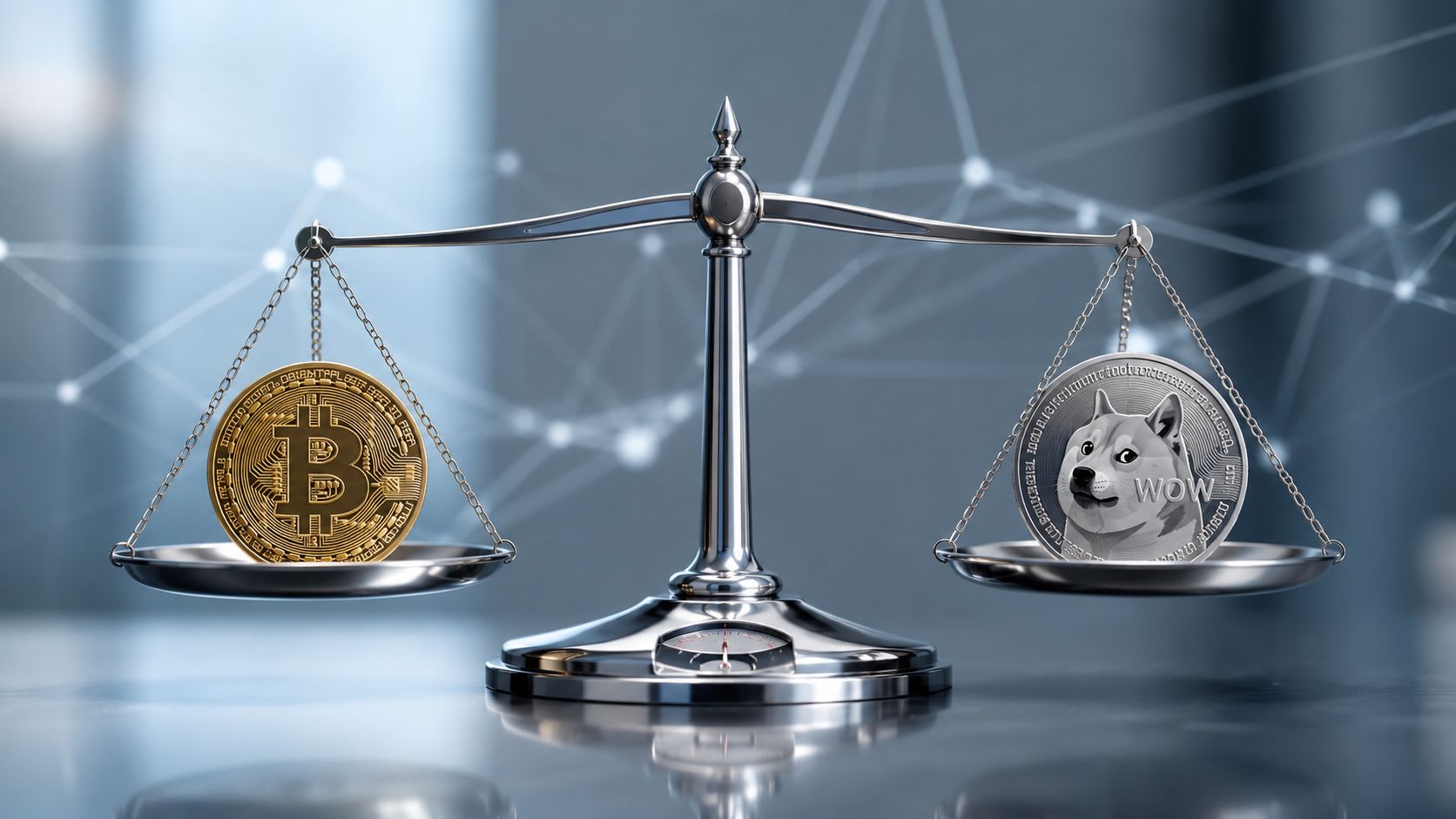
The popular advice on Dogecoin vs Bitcoin usually starts with the wrong question: which coin will rise more? That framing turns two radically different networks into competing lottery tickets. A more useful question for a retail investor in 2026 is: what financial job do you need the asset to perform?
Bitcoin is generally treated as a scarce macro asset, with a monetary policy built around predictable issuance and settlement security. Dogecoin is a faster, inflationary payment network whose market behavior is far more sensitive to sentiment and speculative flows. Neither description makes one universally superior. It tells you that the decision depends on whether you need a reserve-style benchmark, a high-beta trading instrument, or a practical network for smaller transfers.
| Metric | Bitcoin | Dogecoin |
|---|---|---|
| Launch | January 2009 | December 2013 |
| Monetary supply | Hard cap of 21 million BTC | No hard cap, perpetual issuance |
| New issuance | Block rewards halve every 210,000 blocks | 10,000 DOGE per block |
| Target block time | Roughly 10 minutes | Roughly 1 minute |
| Consensus and mining algorithm | Proof-of-Work, SHA-256 | Proof-of-Work, Scrypt |
| Commonly reported base-layer throughput | About 7 TPS | About 30 to 33 TPS |
| Typical confirmation experience | Roughly 10 to 60 minutes | Roughly 1 to 2 minutes |
| Strongest strategic fit | Scarcity, settlement, macro exposure | Fast transfers, sentiment-driven trading, tipping |
These differences shape liquidity, volatility, payment utility, and portfolio construction. Price is an outcome of those structures, not a substitute for understanding them.
Table of Contents
- Why This Comparison Is About More Than Price
- Origin Stories and Design Philosophies
- Supply Models and Tokenomics Compared
- Technical Architecture and Network Performance
- Real-World Payment Use Cases and Adoption
- Market Behavior and Investment Characteristics
- Security and Decentralization Trade-Offs
- Making Your Decision Based on Use Case
Why This Comparison Is About More Than Price
Price alone obscures the different jobs these networks can perform. Bitcoin's fixed supply and slower settlement profile support its role as a benchmark scarce asset. Dogecoin's expanding supply and quicker block production fit smaller, lower-stakes transfers more naturally, while exposing its market value to shifts in speculative interest.
The distinction also appears in the participants each asset attracts. Bitcoin can draw capital from investors seeking a long-term reserve narrative or exposure to a scarce digital commodity. Dogecoin tends to attract short-term flows when traders rotate into meme-oriented altcoins. The two assets can rise together while producing very different risk and execution outcomes.
The market microstructure question
A trading instrument has more dimensions than its quoted price. Liquidity, order-book depth, turnover, volatility, and the type of participants trading it all influence how easily a position can be opened or closed. Dogecoin remains highly liquid relative to its size. Historical market data has reported roughly $267.35 million in 24-hour volume near a price of $0.06982, while other market trackers have placed DOGE around $0.07 and shown substantial annualized turnover patterns.
That activity can reduce execution friction for traders, but it does not make DOGE a conservative asset. High turnover may indicate active speculation rather than durable transactional demand. Dogecoin can outperform Bitcoin during brief rotations into meme-oriented altcoins, then decline more sharply when that flow reverses.
For a retail investor, the practical question is whether the position is meant to preserve exposure to a macro monetary thesis or capture a higher-beta sentiment cycle. Bitcoin's market structure better suits the first objective. Dogecoin's liquidity and faster settlement make it more compatible with speculative trading and smaller transfers, but its inflationary issuance and sentiment sensitivity weaken its case as a reserve asset.
Practical rule: Choose the asset whose market behavior matches your thesis, not the asset with the more entertaining community.
Bitcoin is the deeper macro reserve asset in this comparison. Dogecoin is better understood as speculative beta with payment utility, not a cheaper version of Bitcoin. A lower unit price says nothing about relative upside or intrinsic value. Evaluate liquidity, expected holding period, settlement needs, and the source of demand instead.
Origin Stories and Design Philosophies
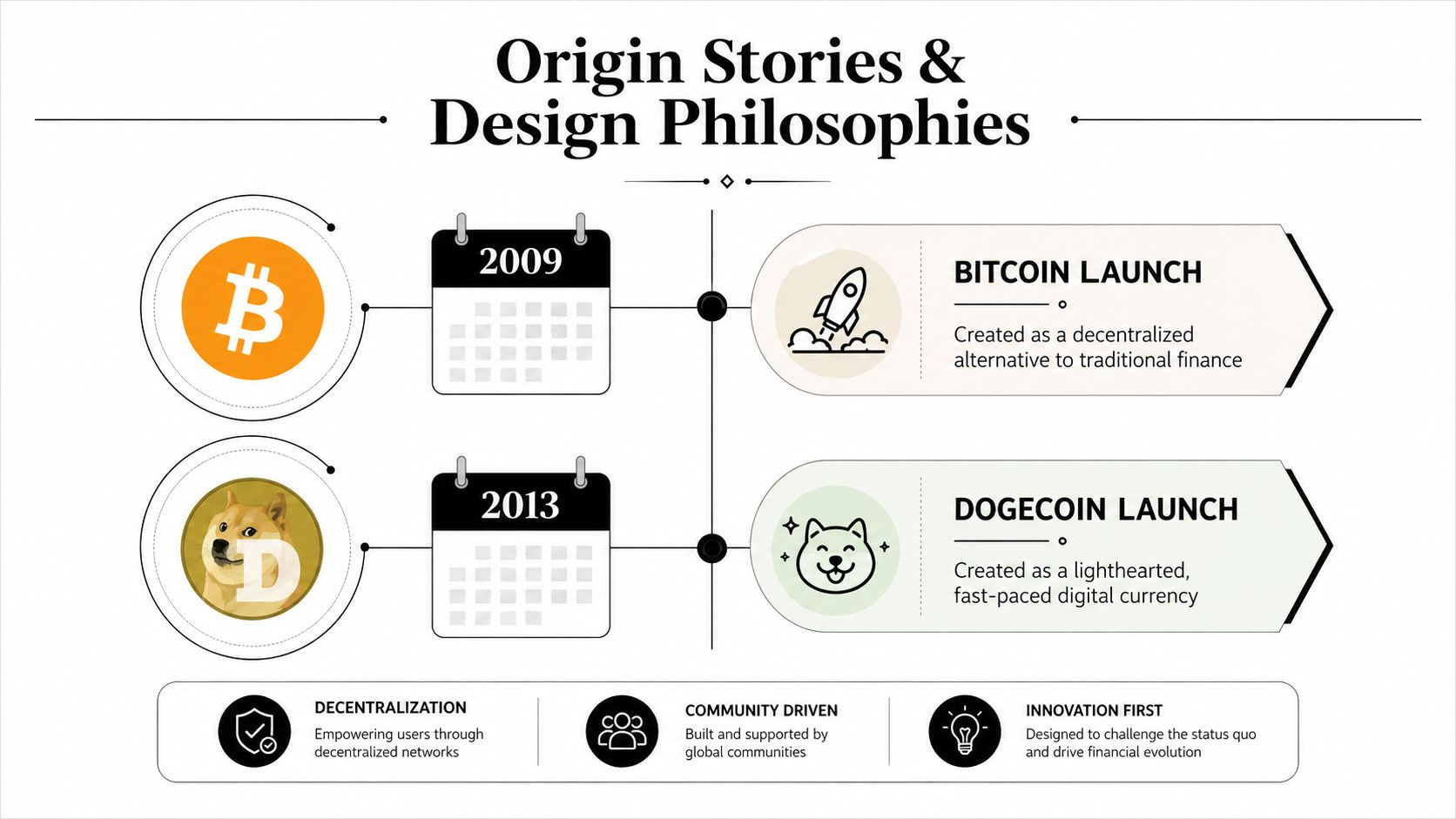
Bitcoin launched in January 2009, establishing a decentralized monetary network built around scarcity, censorship resistance, and security. Dogecoin launched in December 2013 as a lighter, more accessible cryptocurrency associated with internet culture and community participation. The contrast in origins helps explain why their systems emphasize different priorities today.
Bitcoin's design philosophy treats monetary predictability as central. Its protocol limits supply to 21 million BTC, and its issuance schedule is governed by block rewards that decline through halvings. Readers who want the historical context can review the Bitcoin Genesis Block analysis, which places the network's first block within its broader monetary and technical story.
Dogecoin began with a more playful identity, but its network became a functioning proof-of-work payment system. That evolution created a tension between cultural accessibility and monetary discipline. Dogecoin's design makes transfers quicker and keeps the currency usable for repeated small transactions, but it doesn't pursue the same terminal scarcity that defines Bitcoin.
Philosophy becomes protocol
Bitcoin prioritizes a conservative settlement model. Its longer block interval gives the network more time to organize competing blocks, while its monetary rules make supply changes difficult to introduce through ordinary policy decisions. Dogecoin takes a different route, favoring faster block production and ongoing issuance.
That doesn't mean Dogecoin lacks a purpose. Its community-oriented identity supports use cases such as tipping, donations, and casual peer-to-peer transfers. The important point is that purpose and monetary design reinforce each other. Bitcoin's identity supports holding and settlement. Dogecoin's identity supports circulation and participation.
Neither network is an unfinished version of the other. Bitcoin isn't trying to become a meme-based retail currency, and Dogecoin isn't structured to replicate Bitcoin's scarcity. Comparing them effectively requires respecting those original choices instead of judging both against one standard.
Supply Models and Tokenomics Compared
The sharpest difference in this comparison is monetary policy. Bitcoin has a 21 million BTC hard cap, while Dogecoin's supply expands indefinitely after its original cap was removed in February 2014. Bitcoin therefore offers a scarcity-based tokenomics model. Dogecoin offers predictable but perpetual issuance.
Bitcoin's block rewards halve every 210,000 blocks, approximately every four years at its roughly 10-minute block target, as explained in this Bitcoin halving guide. Each halving reduces the flow of newly created BTC, making the issuance schedule structurally disinflationary over time.
Dogecoin issues 10,000 DOGE per block and targets a one-minute block time. That produces roughly 5 billion new DOGE each year, according to the Bitcoin and Dogecoin monetary design comparison. The supply therefore keeps expanding instead of approaching a fixed terminal limit.
Bitcoin vs Dogecoin Supply Comparison
| Metric | Bitcoin | Dogecoin |
|---|---|---|
| Maximum supply | 21 million BTC | No hard cap |
| Issuance model | Block rewards decline through halvings | 10,000 DOGE created per block |
| Halving schedule | Every 210,000 blocks, roughly every four years | No comparable halving schedule |
| Annual new issuance | Declines over time | Roughly 5 billion DOGE |
| Monetary character | Fixed and structurally disinflationary | Perpetual and inflationary |
The practical implication isn't that Dogecoin's supply growth automatically makes it worthless. A currency can remain useful while issuing new units. The issue is valuation logic. Bitcoin holders can build a thesis around programmed scarcity. Dogecoin holders need a stronger case based on transaction demand, liquidity, community activity, or speculative demand absorbing ongoing issuance.
Dogecoin's history illustrates that scarcity isn't the only driver of market value. By mid-2015, the 100 billionth DOGE had been mined, and in May 2021 its market capitalization briefly exceeded $80 billion, as documented in Dogecoin's historical overview. Those milestones show that expanding supply can coexist with intense market demand, but they don't convert Dogecoin into a scarce asset.
Technical Architecture and Network Performance
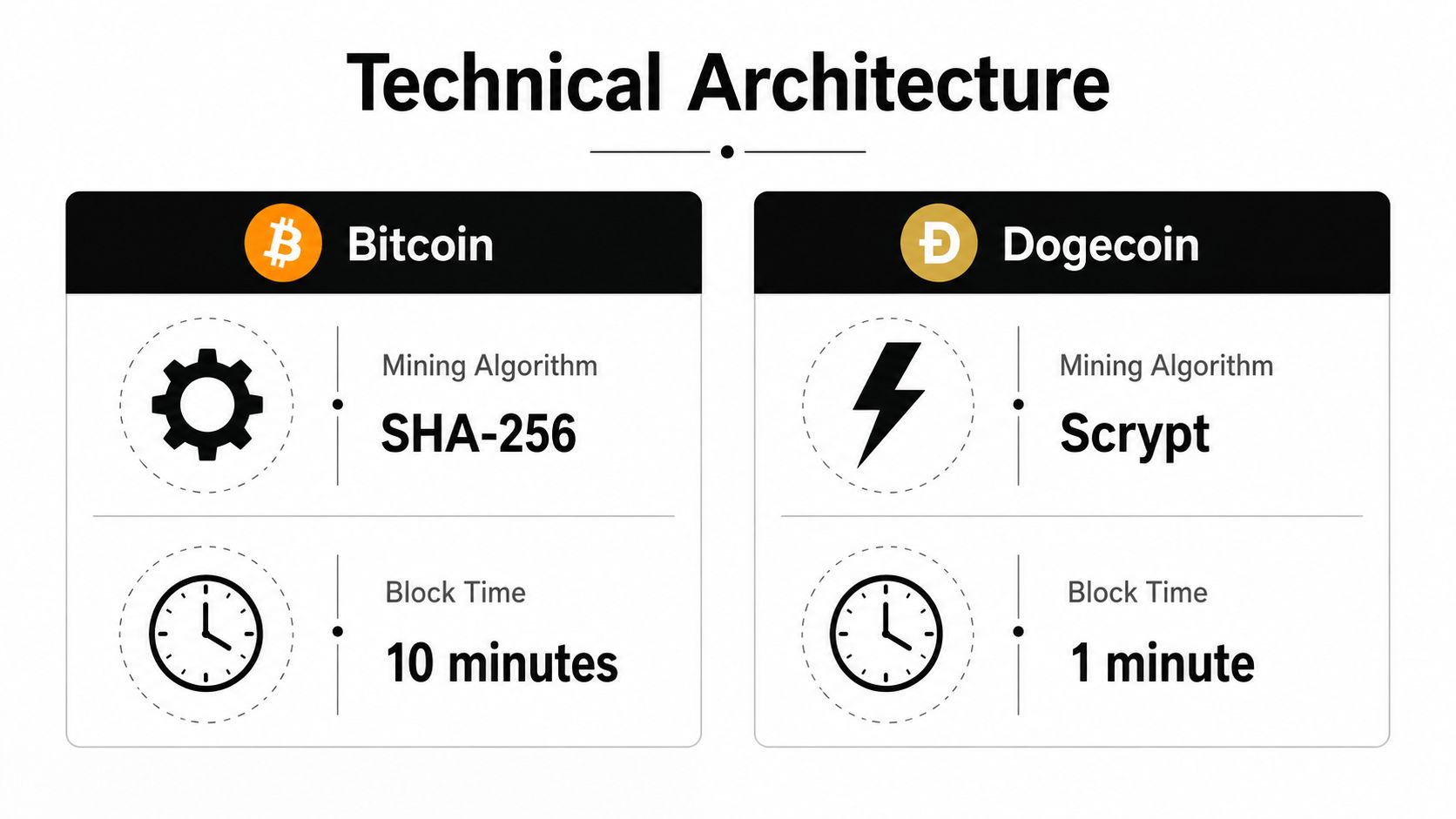
Bitcoin and Dogecoin share proof-of-work foundations, but they use different mining algorithms and operating targets. Bitcoin uses SHA-256, targets blocks roughly every 10 minutes, and retargets mining difficulty every 2,016 blocks. Dogecoin uses Scrypt, targets blocks every 1 minute, and adjusts difficulty every block through Digishield, according to Dogecoin's mining documentation.
Those settings create a clear performance contrast. Technical comparisons report Bitcoin at about 7 transactions per second and Dogecoin at roughly 30 to 33 TPS. They also report average confirmation experiences of approximately 10 to 60 minutes for Bitcoin and 1 to 2 minutes for Dogecoin, as summarized by OKX's Dogecoin transaction-speed analysis.
Speed is not the same as finality
Dogecoin's one-minute target gives it an obvious advantage for small, time-sensitive transfers. A user sending a modest payment or a social tip may value quick visible confirmation more than the strongest possible settlement process.
Bitcoin's slower base layer serves a different purpose. Its network is optimized for secure settlement rather than retail-speed payment flow. Users moving significant value may accept longer confirmation times because they care more about security assumptions and monetary credibility than immediate checkout speed.
The distinction also appears in miner economics. Dogecoin's block reward is 10,000 DOGE, while transaction fees typically contribute less than 1% of miner income, making fees less central to miner revenue than they are on Bitcoin, according to the Dogecoin mining reference above. That difference affects how each network's security budget relates to issuance and fee demand.
The video below provides a visual explanation of the protocol contrast and transaction mechanics.
Real-World Payment Use Cases and Adoption
“Payments” describes several different markets, and Bitcoin and Dogecoin don't need to serve all of them equally well. Bitcoin's slower base-layer settlement is more compatible with high-value transfers, cross-border settlement, and treasury narratives. Dogecoin's faster confirmation profile is more compatible with social tipping, casual transfers, and low-stakes retail payments.
That doesn't establish a universal adoption ranking. It creates a use-case fit. A business settling a large transaction may prioritize monetary credibility and settlement assurance. A user sending a small tip may prioritize speed, simplicity, and a community familiar with DOGE.
Why payment acceptance isn't enough
A merchant listing an asset doesn't prove that customers use it frequently. Payment processors, exchange liquidity, wallet support, accounting practices, and local regulation all influence whether nominal acceptance becomes regular economic activity. Recent market evidence indicates that Dogecoin's relevance remains tied mainly to price action and liquidity rather than clear proof of broad merchant adoption, according to DOGE to BTC exchange-rate history.
Bitcoin faces a different practical limitation. Its base layer isn't designed to compete with every retail payment rail on speed. Layer 2 networks can change the user experience, but they introduce additional infrastructure and operational considerations. A reader evaluating Bitcoin payments should therefore distinguish between direct on-chain settlement and activity routed through Layer 2 systems.
Dogecoin has a simpler argument for direct small transfers, but faster settlement doesn't solve every adoption barrier. Users still need wallets, exchanges, willing recipients, and reliable payment interfaces. The network can be technically suitable for tipping without becoming a dominant merchant currency.
For readers assessing financial service access around digital assets, a broader overview of crypto-friendly banks to watch in 2026 provides useful context. The central conclusion remains practical: Bitcoin fits higher-value settlement narratives, while Dogecoin fits lower-stakes circulation and social use cases more naturally.
Market Behavior and Investment Characteristics
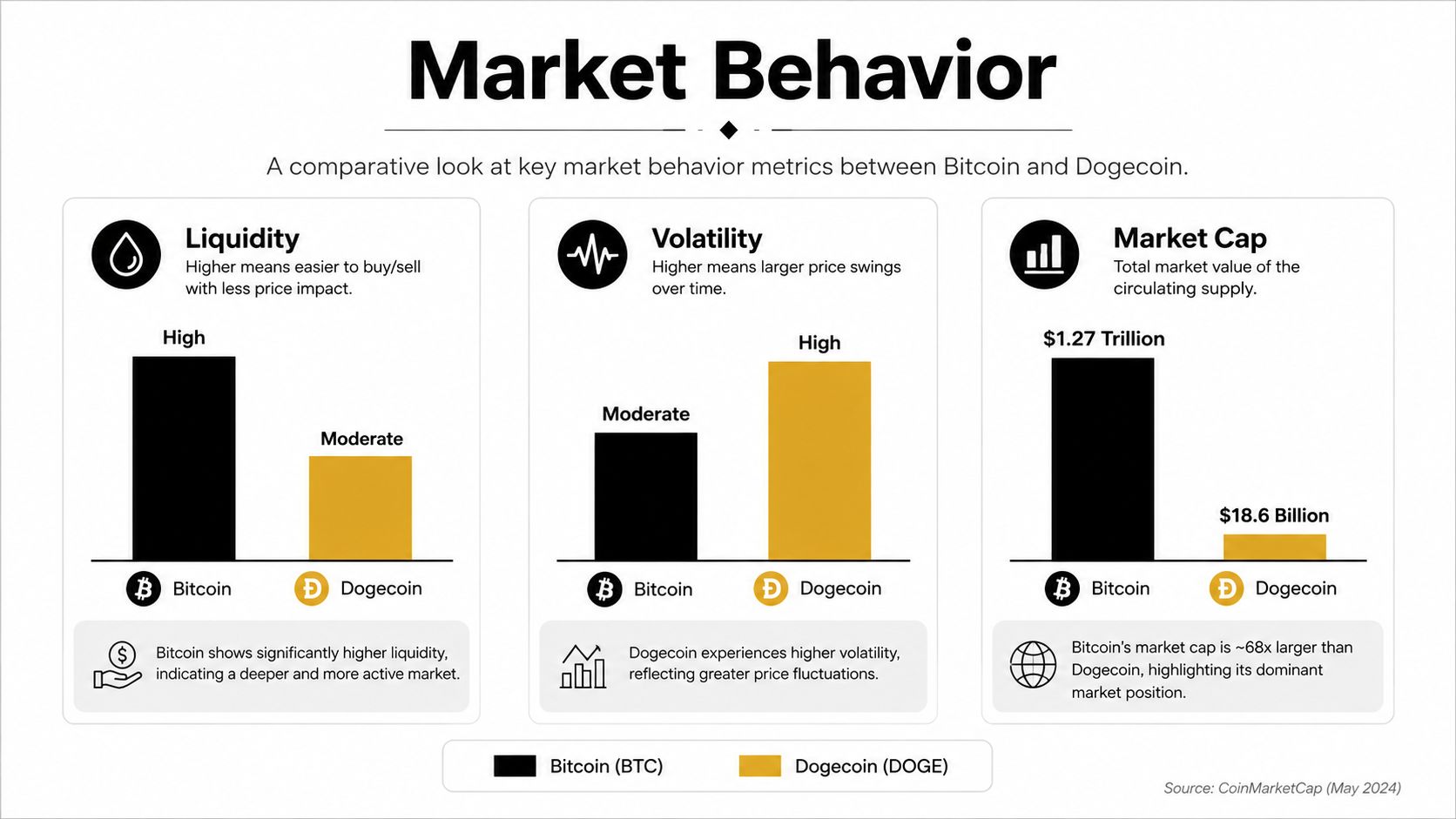
Bitcoin and Dogecoin occupy different positions in market structure. Bitcoin is treated as a scarce macro asset, drawing longer-horizon holders and capital tied to monetary, settlement, and reserve-asset narratives. Dogecoin behaves more like a sentiment-driven, high-beta trade. Its strongest advances often depend on speculative attention rotating toward meme-based assets.
Liquidity and volatility need to be read together. Dogecoin can show substantial turnover for an asset of its size, which may reduce execution friction for active traders. The same turnover also reflects a market more exposed to short-term positioning, retail enthusiasm, and shifts in attention. Liquidity supports entry and exit. It does not establish durable demand.
Reading the two assets as instruments
Bitcoin remains volatile, despite its stronger macro role. Its investment case is more closely associated with scarcity, settlement, and reserve-asset expectations than with short-lived social momentum.
Dogecoin may suit active traders seeking exposure to rapid changes in retail sentiment. Its fundamental anchor is less stable. Ongoing issuance means buyers are not relying on a fixed terminal supply, while continued relevance depends more heavily on community attention and speculative participation.
| Trading question | Bitcoin | Dogecoin |
|---|---|---|
| Core market narrative | Scarce macro reserve asset | Sentiment-driven speculative beta |
| Liquidity interpretation | Deeper benchmark liquidity | High turnover relative to size |
| Main catalyst type | Macro, monetary, settlement narratives | Meme-driven flows and retail sentiment |
| Key analytical risk | Treating scarcity as guaranteed appreciation | Treating liquidity as proof of durable value |
The practical distinction is use-case fit. Bitcoin's market behavior aligns more closely with a macro reserve-asset thesis, while Dogecoin offers higher sensitivity to sentiment and speculative flows. Neither role guarantees returns, and trading activity alone cannot validate either thesis.
A similar discipline applies when comparing payment infrastructure. Investors may examine providers through operational differences rather than brand popularity, as shown in this partial-match comparison of Braintree and Stripe. Liquidity tells you how actively an asset trades. It does not tell you why demand will persist.
Security and Decentralization Trade-Offs
Security begins with consensus design, but it doesn't end with an algorithm name. Bitcoin uses SHA-256 proof-of-work, while Dogecoin uses Scrypt proof-of-work. Network size, mining economics, hash-rate distribution, and the incentives available to miners all influence how expensive and practical attacks become.
Bitcoin's large security budget and deep economic importance support its position as the stronger settlement benchmark. Attackers would need to overcome substantial mining and market incentives, and any attempt to disrupt the network would face consequences beyond a single transaction. That doesn't make Bitcoin invulnerable. It means the cost and implications of attacking it are unusually significant.
Dogecoin has a smaller security environment and a different mining structure. Its merged-mining relationship with Litecoin gives miners a way to support both networks through compatible Scrypt work. That arrangement can strengthen available security, but it also means readers should understand that Dogecoin's security profile isn't identical to Bitcoin's independent SHA-256 ecosystem.
A practical security checklist
Identify the settlement value. For high-value transfers, prioritize the network whose security and settlement reputation best match the amount at risk.
Separate network risk from custody risk. A secure blockchain doesn't protect funds held through a compromised exchange, careless wallet setup, or lost recovery credentials.
Examine miner incentives. Dogecoin's ongoing block issuance and comparatively minor fee contribution create a security model that relies heavily on block rewards. Bitcoin's eventual fee-market questions are different, especially as issuance declines through halvings.
Consider confirmation depth. A quick first confirmation isn't automatically equivalent to final settlement confidence. The right threshold depends on transaction value and the recipient's tolerance for settlement risk.
Security principle: Fast confirmation improves convenience. It doesn't remove the need to evaluate consensus resilience, custody, and transaction value together.
Decentralization also has several meanings. It can refer to miners, node operators, developers, exchanges, or ownership. A serious comparison should avoid reducing the term to a slogan. Bitcoin and Dogecoin distribute trust differently because they target different combinations of speed, issuance, and settlement assurance.
Making Your Decision Based on Use Case
A rational decision starts with the job the asset must perform. If the job is long-term scarcity exposure or a macro reserve thesis, Bitcoin's 21 million BTC cap and declining issuance provide the clearer structural fit. If the job is rapid, low-stakes transfer activity or participation in sentiment-led trading, Dogecoin's faster blocks and active liquidity may be more relevant.
Neither network offers a universal solution. Bitcoin isn't automatically appropriate for every payment, and Dogecoin's speed doesn't compensate for every monetary or market risk. Investors should also consider whether their actual objective requires a cryptocurrency at all, rather than assuming that one of these two assets must belong in a portfolio.
Match the instrument to the scenario
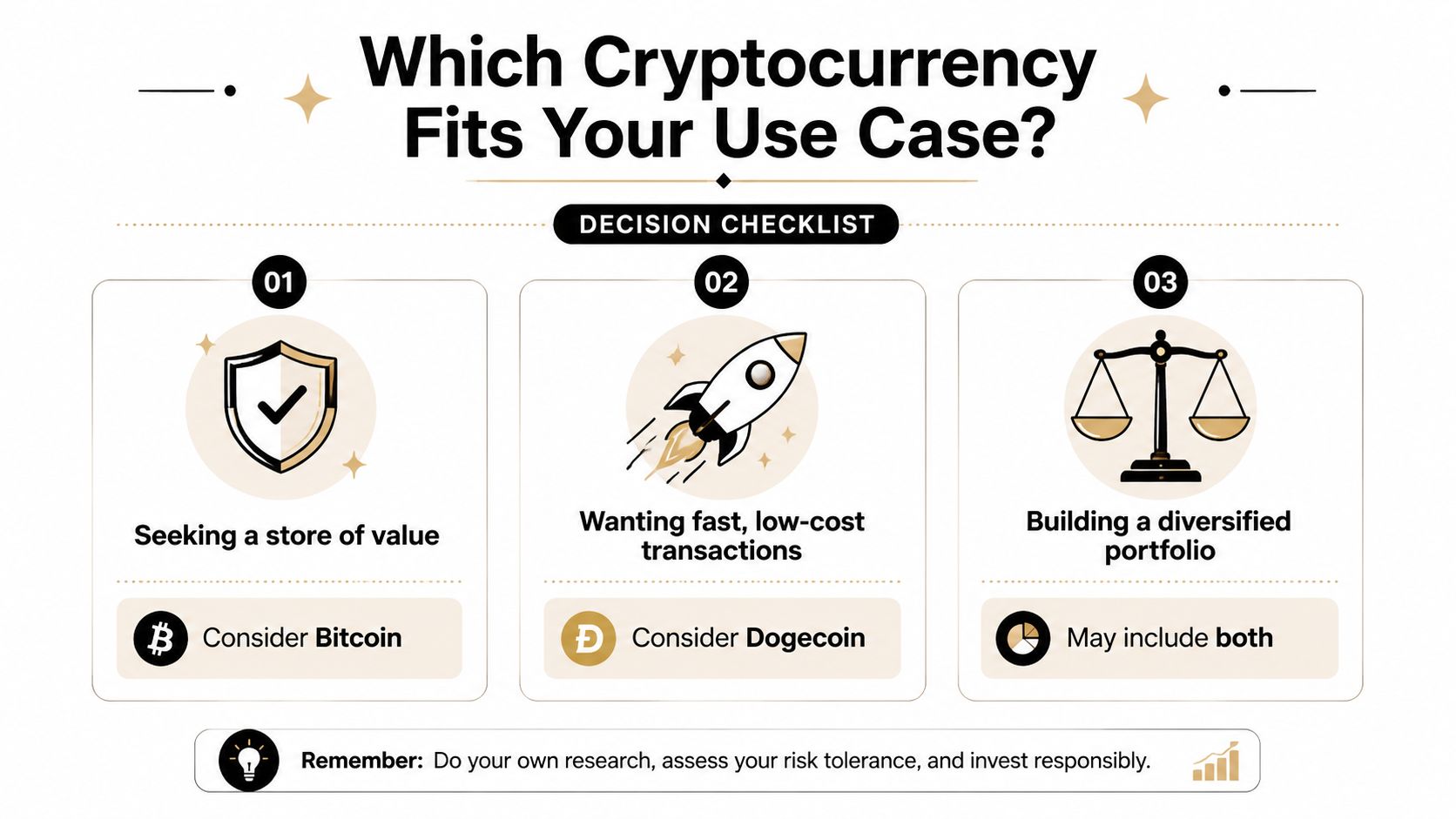
Store-of-value thesis: Bitcoin fits more naturally because its consensus rules impose a hard supply ceiling and reduce issuance through scheduled halvings.
High-value settlement: Bitcoin's slower base-layer design is more consistent with a security-first settlement role than with instant retail checkout.
Small transfers and tipping: Dogecoin is the more natural candidate when quick confirmations and community circulation matter more than scarcity.
Speculative trading: Dogecoin may provide higher sensitivity to meme-driven rotations, but that sensitivity cuts both ways. High liquidity can support execution without making the underlying thesis durable.
Diversification: Holding both can express two different views, Bitcoin as scarce macro exposure and Dogecoin as a more sentiment-sensitive payment and trading asset. That isn't automatically safer. It may combine distinct risks.
Before allocating capital, ask what would invalidate your thesis. For Bitcoin, is the thesis based on scarcity, settlement, or macro adoption? For Dogecoin, are you relying on payment activity, liquidity, community demand, or a future sentiment wave? If you can't answer those questions, the trade is probably being driven by price alone.
The most defensible conclusion is not that Bitcoin wins or Dogecoin wins. Bitcoin is the stronger fit for scarcity and settlement. Dogecoin is the stronger fit for fast, low-stakes transfers and sentiment-driven beta. Your time horizon, risk tolerance, custody setup, and intended use should determine which distinction matters most.
Coiner Blog publishes practical cryptocurrency analysis on Bitcoin, Dogecoin, Ethereum, Web3, DeFi, tokenomics, Layer 2 networks, and emerging blockchain applications. Visit Coiner Blog for balanced guides and market-focused insights that can help you evaluate digital assets beyond price charts.