
Cross Chain Bridges: Architecture, Risks & Best Practices

Cross-chain bridges became one of crypto's defining infrastructure stories because they solved a real problem and exposed an equally real weakness. Chainalysis estimated that about $2 billion was stolen across 13 bridge hacks in 2022, with bridge-related theft representing 69% of all funds stolen in crypto-related hacks that year. The Ronin Bridge, Wormhole, and Nomad incidents accounted for about $624 million, $326 million, and $190 million, respectively. (Chainalysis bridge-hack summary)
That history shouldn't lead users to dismiss interoperability. Bitcoin, Ethereum, Layer 2 networks, DeFi applications, games, and tokenized real-world assets all operate across separate environments. The more important question is what a bridge trusts, how it verifies events, and what happens when that verification fails.
Table of Contents
- Why Cross Chain Bridges Became Crypto's Biggest Security Challenge
- How Cross Chain Bridges Actually Move Assets
- Understanding Bridge Trust Models and Verification Methods
- Major Bridge Hacks and What They Revealed
- Practical Risk Mitigation for Bridge Users and Projects
- The Current State of Bridge Infrastructure and Market Scale
- Where Bridge Technology Is Heading Next
Why Cross Chain Bridges Became Crypto's Biggest Security Challenge
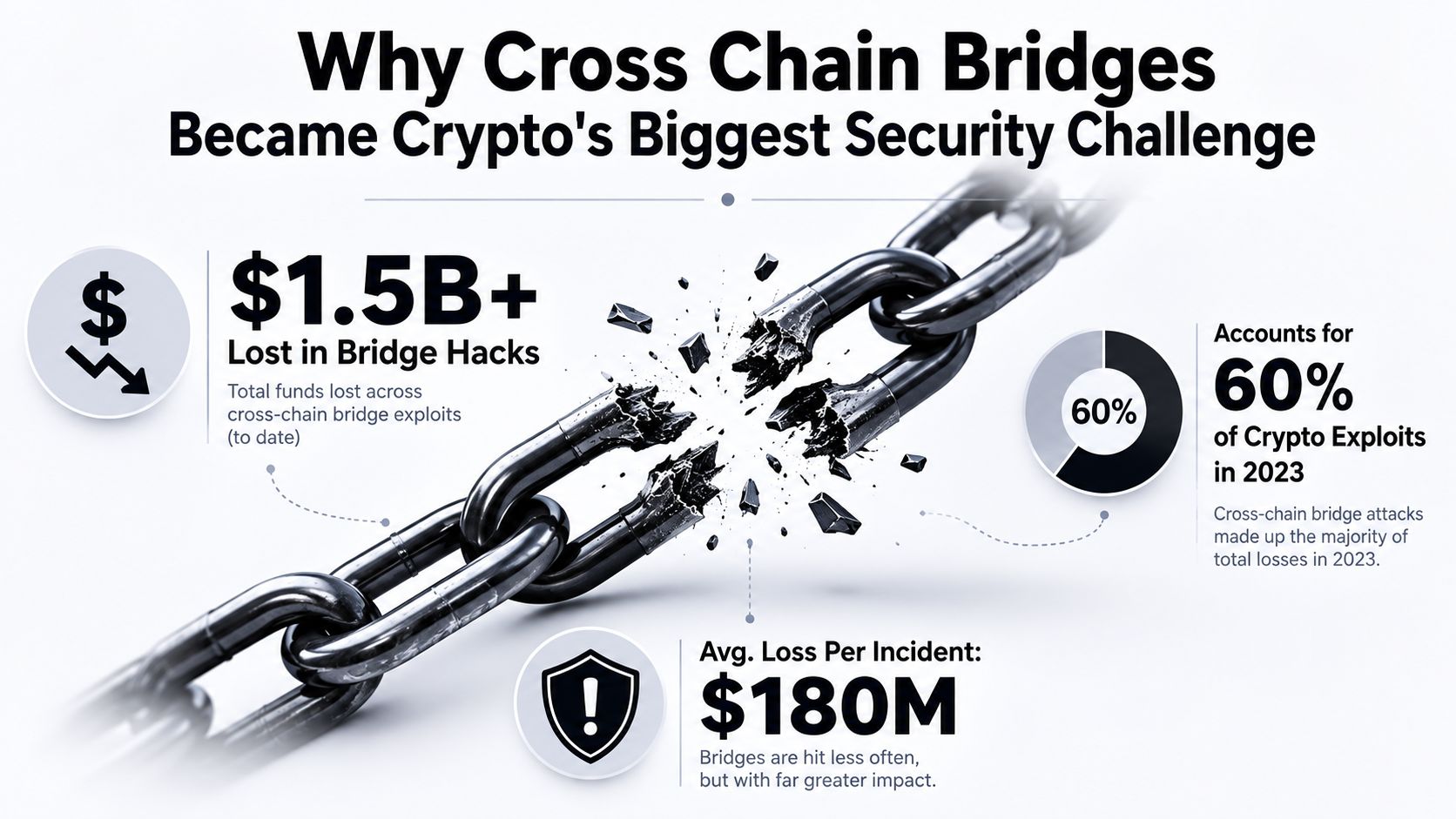
A bridge connects blockchains that don't share a native state or consensus process. Ethereum can't automatically know that a token was locked on another network, and a Bitcoin transaction can't directly trigger a smart contract on an Ethereum Layer 2. Bridges add the messaging and verification machinery that makes those actions possible.
That machinery creates a paradox. Bridges are essential plumbing for a multi-chain ecosystem, but they also concentrate valuable assets and powerful permissions in one system. A successful exploit may not affect one wallet or one application. It can create unbacked wrapped assets, release collateral without a matching deposit, or compromise liquidity relied on by multiple protocols.
The loss pattern matters more than the headline
The biggest incidents clustered early in 2022. Ronin lost about $624 million, Wormhole lost about $326 million, and Nomad lost about $190 million. Those events showed how a limited number of bridge failures could produce outsized losses because bridge contracts often controlled large reserves or issued representations of valuable assets. (Interchain Foundation interoperability report)
A systematic study of bridge security identified 12 potential attack vectors and grouped historical incidents into 10 exploit types. That classification points to a central lesson: the danger usually comes from architectural trust assumptions and verification design, not only from an isolated coding mistake. (Systematic bridge-security study)
Core principle: A bridge isn't secure because its front end looks polished or because its token has a recognizable brand. Its security depends on who can authorize a message and how the destination chain checks that message.
Users who understand that distinction can evaluate bridges more intelligently. They can ask whether a bridge depends on an external signer committee, an oracle network, a light client, or cryptographic proofs. That trust model matters more than a simple comparison of fees or total value locked.
How Cross Chain Bridges Actually Move Assets
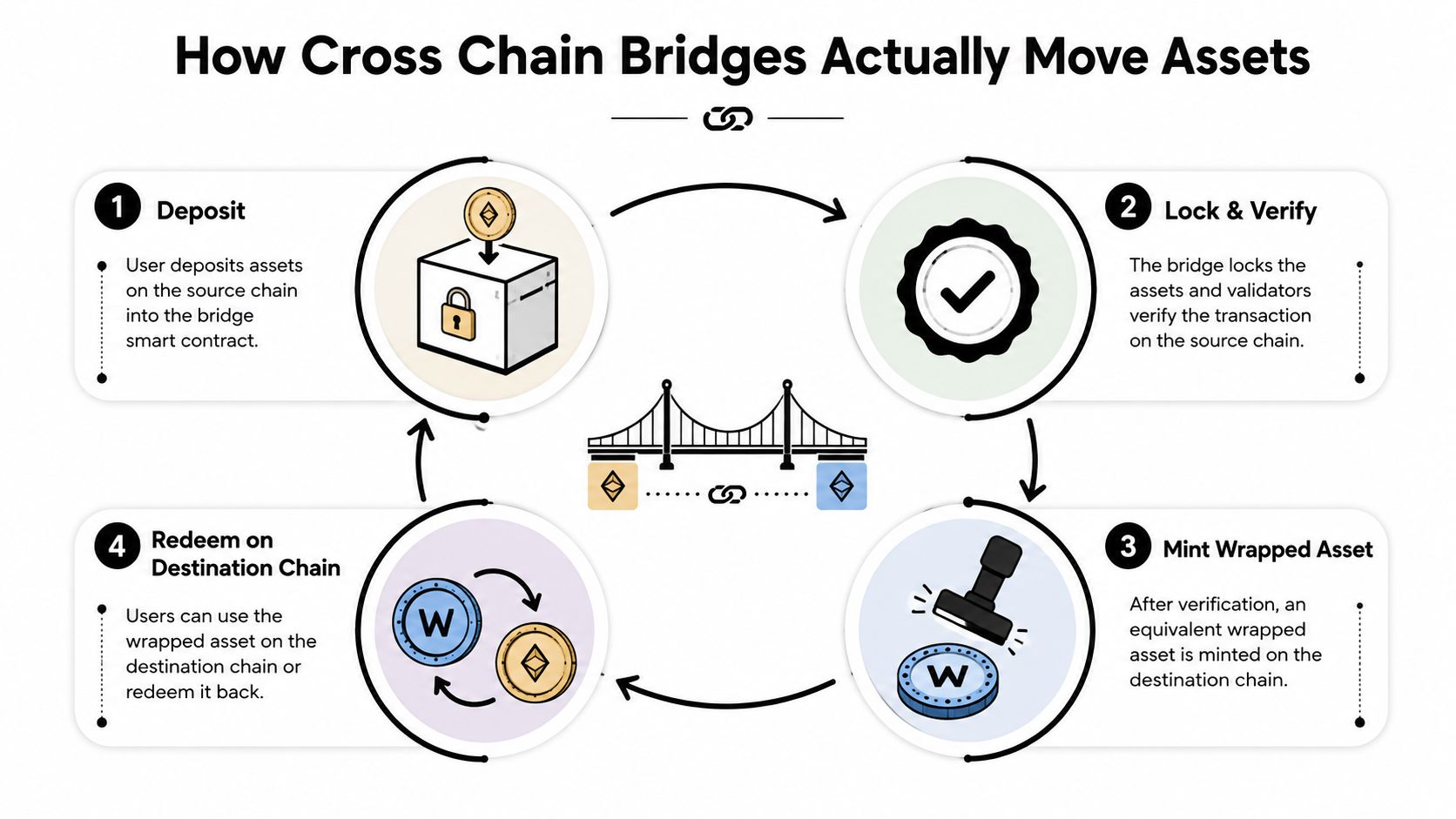
A bridge usually doesn't move the original token from one blockchain to another. Instead, it coordinates two actions: one chain locks or destroys an asset, and another chain releases or creates a corresponding representation.
Think of a currency exchange booth. You hand over dollars, the booth holds them in its reserve, and it gives you euros. The euros aren't the same physical notes, but the booth's reserve is supposed to support the exchange. A bridge follows a similar logic, except smart contracts, validators, relayers, or custodians coordinate the process.
Lock and mint
In a lock-and-mint design, you deposit the original asset into a contract on the source chain. A verification system observes that deposit and sends a message to the destination chain. The destination contract then mints a wrapped version of the asset.
To return, you send the wrapped token back to the bridge contract. The contract burns that representation, and the original asset is released on the source chain. This pattern is described in the cross-chain bridge mechanics glossary.
The important dependency is the proof of the original lock. If validators or relayers falsely report that a deposit occurred, the destination contract may mint assets that aren't backed by anything.
Burn and mint
A burn-and-mint bridge destroys a token on the source chain and creates an equivalent representation on the destination chain. The system doesn't keep the original token locked in the same way, but it still needs reliable proof that the burn happened.
The accounting rule remains simple: the destination-side issuance must correspond to a real source-side state change. If the verification layer accepts a false burn, the bridge can create unbacked supply.
Liquidity pools
A liquidity-pool bridge uses pools of assets on multiple chains. You deposit one asset into a pool on the source network, and the bridge pays you from a pool on the destination network. Liquidity providers later rebalance the pools or receive fees for supplying capital.
This model can feel more like an exchange than a minting system, but it still introduces dependencies. Users must consider pool liquidity, pricing, rebalancing, smart contract permissions, and the operators or validators responsible for cross-chain messages.
For a broader explanation of asset movement between networks, see this guide to cross-chain swaps. The practical takeaway is straightforward: identify whether a bridge locks and mints, burns and mints, or routes liquidity. Then identify who verifies the event that allows the next step.
Understanding Bridge Trust Models and Verification Methods
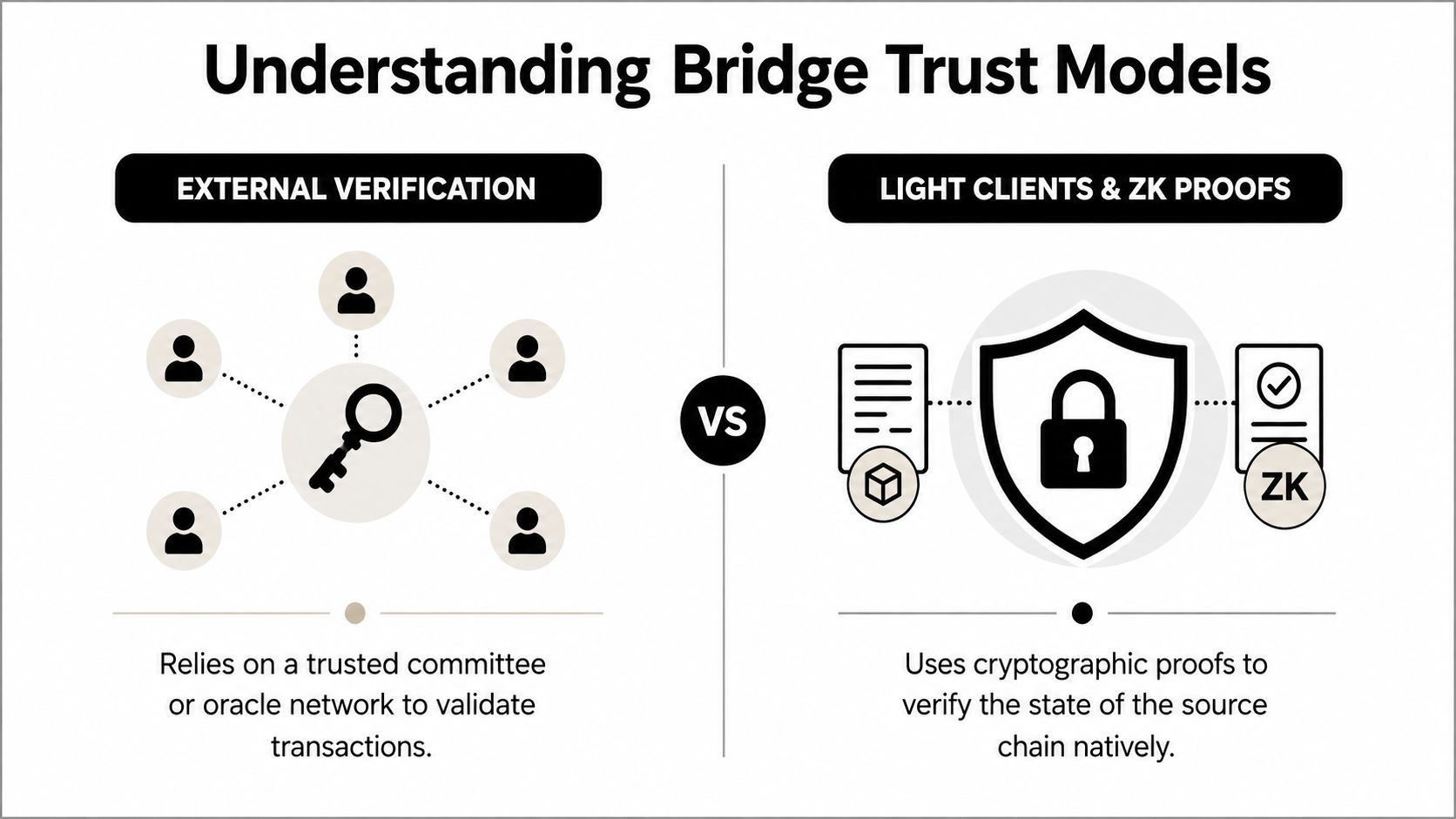
The most useful way to compare bridges is to classify their verification model. A bridge may advertise decentralization, but the decisive question is whether the destination chain verifies source-chain state itself or accepts a claim from an outside group.
A 2023 study organized bridges around external, local, optimistic, and native verification, alongside lock-and-mint, burn-and-release, and liquidity-pool transfer patterns. (Bridge taxonomy study)
External verification
External verification relies on actors outside the destination chain's own consensus rules. Those actors may include a multisignature committee, validator set, oracle network, bonded relayers, or a decentralized verifier network.
This model can be practical because it works across very different chains. A committee watches the source chain, signs an attestation, and the destination contract executes when the required threshold is met. A bonded design may require signers to stake collateral that can be penalized after dishonest behavior.
The weakness is the trust boundary. An attacker may target private keys, corrupt signer coordination, exploit an oracle, compromise a relayer's infrastructure, or exploit a threshold that is too low. Even a large validator set can provide weaker security than it appears if a small subset controls message approval.
Optimistic verification changes the timing rather than eliminating trust. A message may be accepted unless someone challenges it during a dispute period. That creates a monitoring requirement, because the system depends on an honest watcher noticing a false message and responding before final execution.
Native verification
Native verification uses the destination chain to check source-chain state directly. Light clients reproduce enough of another chain's consensus verification to confirm that a transaction or state transition is genuine. Zero-knowledge proofs can compress evidence that a source-chain computation or consensus condition was satisfied, allowing a destination contract to verify the proof without trusting a committee in the same way.
This approach can reduce external trust, but it isn't automatically simple or risk-free. Different consensus systems are difficult to verify inside another chain, proof systems require careful circuit design, and implementation errors can still undermine safety.
A practical comparison
| Model | Primary trust assumption | Typical failure exposure |
|---|---|---|
| External committee | Signers report honestly and protect keys | Key compromise, collusion, weak quorum |
| Oracle or relay network | Off-chain infrastructure observes source state accurately | Manipulated data, unavailable nodes, operator compromise |
| Optimistic verification | Honest watchers challenge false messages | Missed disputes, inadequate response time |
| Light client | Destination contract correctly verifies source consensus | Verification bugs, implementation complexity |
| Zero-knowledge proof | Proof generation and verification logic is correct | Circuit errors, invalid assumptions, operational failure |
Practical rule: The more external trust a bridge needs, the larger its attack surface and vulnerability window tend to become.
Native verification isn't a guarantee of safety, and external verification isn't automatically unusable. The right evaluation asks what can authorize a transfer, how many independent parties must agree, whether users can exit during a failure, and whether the protocol monitors cross-chain accounting rather than isolated transactions.
Major Bridge Hacks and What They Revealed
Bridge incidents are most useful as lessons about trust models, not as a leaderboard of losses. Across these cases, attackers found a gap between what the destination chain accepted and what had happened on the source chain.
| Bridge Name | Date | Loss Amount | Attack Vector |
|---|---|---|---|
| ChainSwap | July 10, 2021 | $8 million | The first reported bridge attack, according to a later review |
| Ronin Bridge | 2022 | About $624 million | Compromise of validator trust and signing authority |
| Wormhole | 2022 | About $326 million | Verification bypass involving a forged or improperly accepted message |
| Nomad | 2022 | About $190 million | Message verification failure that allowed unauthorized withdrawals |
| Verus-Ethereum Bridge | May 2026 | About $11.5 million | Bridge exploit |
| Transit Finance | May 2026 | $1.88 million | Bridge exploit |
The ChainSwap incident, reported as the first bridge attack on July 10, 2021, cost $8 million. A later review described it as an early warning that cross-chain infrastructure was already a security target. (Bridge-security review)
Ronin showed the danger of external verification based on validator signing authority. Attackers compromised enough of that authority to approve a large release of funds. Wormhole exposed a different failure: its verification path accepted an unauthorized message, so the destination chain treated an invalid claim as legitimate.
Nomad demonstrated how a message-verification flaw can turn a bridge contract into an open withdrawal mechanism. Once users saw that the contract accepted invalid state, the same weakness could be used repeatedly. The distinction matters: Ronin centered on compromised signers, while Wormhole and Nomad centered on how the destination chain checked messages.
A quantitative review mapped 18 notable bridge hacks to losses exceeding $2.9 billion. The same review also recorded more than 81,000 cross-chain transactions totaling over $4.2 billion in token transfers and noted that attackers had stolen over $3.2 billion from cross-chain bridges since June 2021. (Quantitative interoperability security review)
More recently, in May 2026, the pattern repeated: attackers stole $328.6 million across eight incidents in May 2026 alone, including the Verus-Ethereum and Transit Finance losses listed above. (May 2026 bridge-exploit report)
The central lesson is to evaluate what authorizes a transfer. External committees require protection against key compromise and collusion. Native verification reduces reliance on those signers, but its message checks and proof logic must still be correct. In every model, projects need accurate cross-chain accounting of deposits, burns, locks, and releases.
Practical Risk Mitigation for Bridge Users and Projects
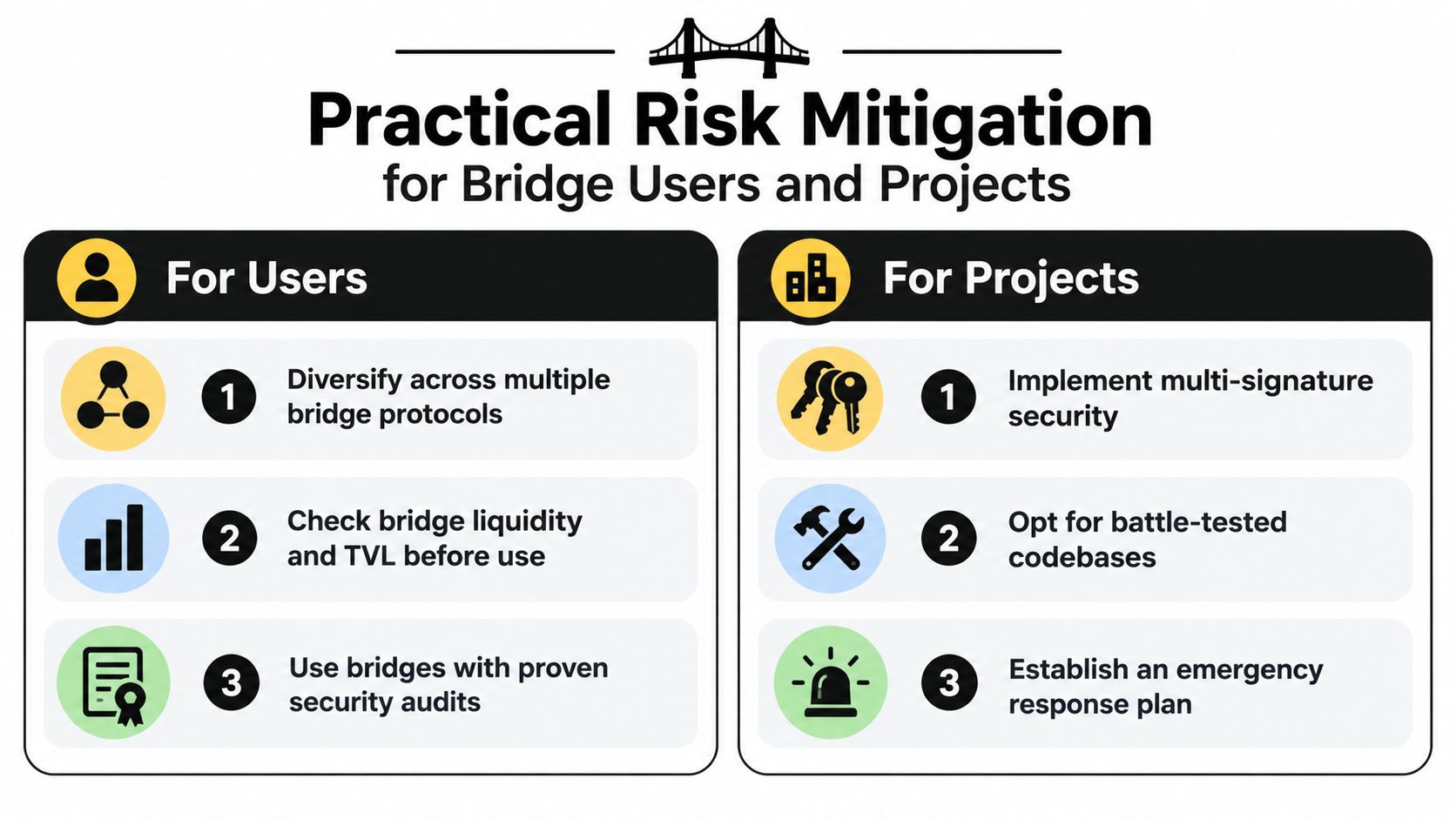
No bridge transfer is risk-free, but users can reduce unnecessary exposure by treating the bridge as a financial and technical dependency rather than a simple transport button.
What users should check
- Identify the trust model: Find out whether the bridge uses an external committee, optimistic verification, a light client, or zero-knowledge proofs. Look for the quorum and the parties that can authorize releases.
- Start small: Send a small test transaction before transferring a meaningful balance. Confirm the destination asset, recipient address, finality requirements, and redemption process.
- Review liquidity: A liquidity-pool bridge may show a successful transaction while leaving you dependent on destination-side liquidity. Check whether the pool can support the withdrawal you need.
- Read audit scope: An audit can cover smart contracts without covering validator keys, relayers, RPC infrastructure, governance, or emergency controls. Treat an audit as one input, not a complete security verdict.
- Understand delays: Challenge windows, confirmations, and withdrawal queues can affect when you receive funds. A bridge that doesn't offer instant finality may be safer in one respect but less convenient during volatile markets.
Diversifying across bridge protocols can limit the amount exposed to one implementation, but it also creates more operational complexity. Record the source chain, destination chain, token contract, and transaction identifier for every transfer.
For a broader framework covering position sizing, custody, and operational discipline, use this resource on mastering crypto risk management.
What projects should build
Project teams need controls that assume a bridge can fail. Rate limits can restrict the amount released during a defined period, while circuit breakers can pause minting, burning, or withdrawals when monitoring detects abnormal behavior.
Teams should also monitor cross-chain invariants. A release on one chain should correspond to a matching lock or burn on the source chain. Monitoring only destination transactions may miss a forged message that looks valid in isolation.
A multi-bridge strategy can reduce dependence on one provider, but it introduces reconciliation and governance problems. Each route needs clear rules for supply accounting, pause authority, incident communication, and recovery. Emergency response plans should name the people who can act and the contracts they can pause.
Security is not only about preventing the first invalid message. It is also about limiting how much that message can release and how quickly defenders can stop the next one.
The Current State of Bridge Infrastructure and Market Scale
By late 2024, interoperability had become infrastructure rather than a niche experiment. Across 43 interoperability protocols, total value locked exceeded $8 billion as of October 2024, and the leading cross-chain routes processed substantial volume. Ethereum accounted for 38.9% of cross-chain inflows and 47.9% of outflows, so activity remained concentrated around the largest smart-contract ecosystem.
That scale broadens the blast radius of a bridge failure. Bridges now carry DeFi liquidity, gaming assets, Layer 2 activity, and tokenized representations that other protocols may accept as collateral. A broken message or redemption assumption can therefore affect lending markets, decentralized exchanges, treasuries, and real-world asset platforms, not only users making the original transfer.
Ethereum's role also creates a distinction that TVL alone cannot show. A route connected to Ethereum may still depend on an external committee, relayers, or a multisignature system rather than Ethereum's own consensus. The meaningful safety question is which chain verifies the source event, and whether that verification is native or supplied by another trust layer.
Teams building blockchain products must address legal and governance questions alongside contract design. A practical guide for WA blockchain startups from By Design Law Firm & Legal Consultancy, PLLC covers corporate governance and compliance concerns that code does not resolve.
Layer labels can also obscure important differences. Ethereum mainnet, Layer 2 networks, and application-specific chains may use different finality, messaging, and withdrawal assumptions. This overview of Layer 1, Layer 2, and Layer 3 networks offers useful context before comparing bridge routes.
The market is becoming more infrastructure-like. Greater adoption does not remove trust assumptions. It gives those assumptions more capital and more dependent applications, making the verification model the clearest lens for judging bridge safety.
Where Bridge Technology Is Heading Next
The strongest direction in interoperability is not just faster bridging. It is trust minimization.
Light clients and zero-knowledge proofs aim to let destination chains verify source-chain state with less reliance on external signers. Intent-based systems and chain abstraction may hide routing complexity from users, while wallets and applications determine how to execute a transfer across networks. Those designs can improve the experience, but a simpler interface doesn't automatically mean fewer trust assumptions.
The difficult engineering work remains underneath. Developers must verify consensus correctly, secure proof systems, manage liquidity, handle failed execution, and preserve clear accounting across chains. A polished wallet flow can still depend on an opaque solver, relayer, or committee.
The useful question for every bridge is therefore unchanged: who is allowed to say that the source-chain event happened, and what independent evidence does the destination chain check? Users who answer that question can assess Bitcoin gateways, Ethereum bridges, Layer 2 routes, DeFi integrations, and future tokenization systems without relying on branding alone.
Coiner Blog offers practical cryptocurrency education and analysis across Bitcoin, Ethereum, DeFi, Web3, Layer 2 networks, NFTs, crypto gaming, AI and crypto, and real-world asset tokenization. Visit Coiner Blog to explore clear guides that connect blockchain opportunities with the security and risk questions that matter before you move funds.