
NFT Market Trends 2026: A Data-Driven Analyst Guide
The loudest NFT headline in the market is also the most misleading. The sector doesn't look like 2021 anymore, but that doesn't mean it disappeared. One major forecast values the global NFT market at USD 16.02 billion in 2025, rising to USD 18.71 billion in 2026 and USD 102.59 billion by 2034, a projected 23.7% CAGR according to Fortune Business Insights' NFT market outlook.
That single data point changes the frame. NFT market trends are no longer best understood as a meme cycle driven by speculative profile pictures. They're better understood as a maturing digital ownership stack, where liquidity, infrastructure, gaming, compliance, and user experience determine which segments survive.
That matters for anyone still watching Web3 through a boom-and-bust lens. If you only track headlines, NFTs look like a casualty of the last cycle. If you track structure, they look more like a market going through the same painful filtering process that shaped DeFi, smart contracts, and Layer 2 adoption. The speculative excess has faded. The useful rails are getting stronger.
Bear markets often do that. They strip away narrative hype and expose what people truly use, which is why NFT investors should think more like operators navigating a cryptocurrency bear market than trend chasers.
Table of Contents
- Beyond the Hype Decoding Real NFT Market Trends of 2026
- The Analyst's Toolkit Key Metrics Defining NFT Market Health
- Where the Value Is A Deep Dive into Core NFT Segments
- The Engines of Growth Tech and Infrastructure Trends Powering What's Next
- Navigating the Future Market Signals, Forecasts, and Critical Risks
- Actionable Takeaways for Creators and Investors
- Frequently Asked Questions on NFT Market Trends
Beyond the Hype Decoding Real NFT Market Trends of 2026
The cleanest way to read nft market trends in 2026 is to stop treating NFTs as one category. The market now splits into very different businesses: gaming assets, art, memberships, token-gated communities, phygital products, and digital identity. They share token standards and marketplaces, but they don't share the same demand drivers.
That distinction matters because the post-2021 correction changed buyer behavior. Speculative flipping dominated the previous cycle. The current phase is more selective. Users increasingly care about what an NFT does, what ecosystem it belongs to, and whether the underlying smart contracts fit into a broader Web3 product.
NFTs didn't vanish. Speculation stopped masking weak products.
A second shift is easy to miss if you only follow price charts. Maturity in this market doesn't mean every collection wins. It means capital, attention, and usage are concentrating in fewer places with better liquidity, clearer tokenomics, stronger communities, and lower-friction infrastructure.
That's why the right question isn't “Are NFTs back?” The better question is “Which NFT models still generate repeat behavior?” In 2026, that's where the signal sits.
The Analyst's Toolkit Key Metrics Defining NFT Market Health
Professional NFT analysis starts by rejecting a common mistake. Price alone tells you very little.
A collection can post a rising floor price while liquidity thins out, wash trading grows, and real users leave. Another can look quiet on social media while accumulating durable utility through gaming loops, memberships, or broader protocol integrations.

Volume without context can mislead
Trading volume is the first thing many market participants check. It matters, but only when paired with user participation and marketplace depth. If volume spikes while a small set of wallets repeatedly trade the same assets, you may be looking at inorganic activity rather than genuine demand.
Unique active wallets are the closest NFT equivalent to daily active users in traditional tech. They don't tell you everything, but they help distinguish a living network from a price chart with no community behind it.
Floor price is useful as a sentiment marker. It shows the lowest listed price, not the price where healthy two-way markets exist. In thin collections, floor can be manipulated or become irrelevant if holders don't transact.
Average sale price adds another layer. When average sale price diverges sharply from floor, it often signals that buyers only want a narrow trait band, premium pieces, or scarce utility-linked items.
For traders trying to understand market depth, crypto market structure concepts like slippage and execution still matter. NFT buyers often underestimate how important liquidity really is, which is why broader thinking about the liquidity of cryptocurrency markets helps when judging NFT exits.
How to read quality, not just activity
The strongest NFT dashboards combine on-chain and qualitative signals:
- Holder distribution: A broader holder base usually suggests healthier ownership than heavy concentration in a few wallets.
- Repeat usage: Look for token-gated access, game functionality, event redemption, or recurring utility. These behaviors matter more than hype cycles.
- Marketplace quality: Collections with consistent listings and actual sales are easier to evaluate than ones defined by stale asks.
- Community behavior: Ignore vanity metrics. Watch whether holders show up for product releases, governance, or ecosystem participation.
A simple working framework helps:
| Metric | What it tells you | Common trap |
|---|---|---|
| Trading volume | Attention and turnover | Mistaking churn for conviction |
| Unique active wallets | Breadth of participation | Assuming every wallet is organic |
| Floor price | Fast sentiment snapshot | Treating it like fair value |
| Average sale price | Where buyers actually clear | Ignoring trait concentration |
| Utility usage | Product-market fit | Overvaluing promised features |
Later in the cycle, this matters even more:
Practical rule: If you can't explain why users return after mint day, you're not analyzing a market. You're analyzing a launch event.
Where the Value Is A Deep Dive into Core NFT Segments
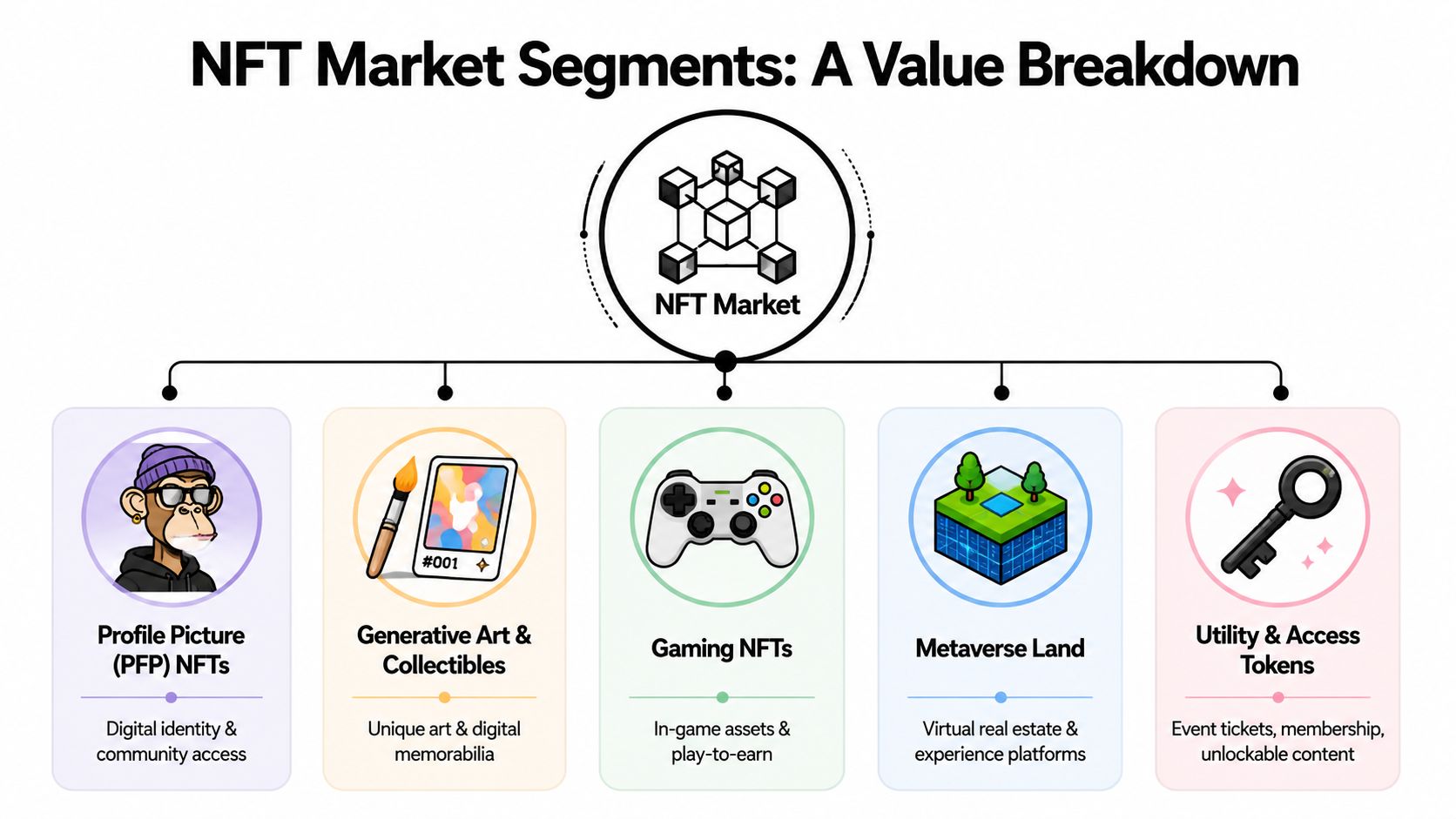
The phrase “NFT market” hides major differences in user behavior. Some segments function like collectibles. Others behave more like gaming infrastructure, branded access rails, or digital licensing layers. Lumping them together leads to bad forecasts.
A useful starting point is segment-level transaction gravity. In 2025, gaming NFTs accounted for 38% of total transaction volume, while Ethereum powered nearly 62% of all NFT transactions, and OpenSea maintained more than 2.4 million monthly active users in Q2 2025 according to this 2025 NFT marketplace and blockchain summary. That combination tells you where network effects sit: in ecosystems with liquidity and in products with repeat interaction.
Gaming is the clearest utility segment
Gaming has become the strongest proof that NFTs can support more than ownership theater. In-game assets, skins, characters, and progression items create recurring user actions. That's critical because recurring actions are what sustain marketplaces.
Gaming NFTs work best when the token is subordinate to gameplay. If the asset improves progression, identity, portability, or player retention, it has a reason to exist beyond resale. If it exists only to speculate on “future game adoption,” it usually stalls.
This is why GameFi remains central to nft market trends. It connects digital ownership to mechanics users already understand.
PFPs and community still matter, but only selectively
Profile picture collections aren't dead. They've just become far more demanding as products.
The strongest PFP brands now function like social identity layers mixed with IP franchises, events, token-gated communities, and merch ecosystems. That's a very different model from the low-effort copycat wave of the earlier cycle. Community still matters, but the market increasingly asks whether the collection can convert attention into durable utility.
If you want a clean example of how NFT branding evolved, collections adjacent to the Mutant Ape Yacht Club ecosystem show why community assets can still matter when they tie into broader identity and culture. But the bar is much higher now. A Discord server alone isn't a moat.
Art, metaverse land, and utility NFTs need different lenses
Digital art still has a place, especially where provenance, artist reputation, and curation are strong. But art NFTs should be analyzed more like cultural assets than growth startups. Scarcity matters. So does collector quality.
Metaverse land remains one of the more misunderstood categories. Land only has value if people want to build, gather, or transact there. Without user demand, virtual parcels become idle inventory.
Utility NFTs are the category that may matter most strategically, even if they look less glamorous. They include:
- Membership NFTs: Access to private communities, content, or experiences.
- Event and redemption NFTs: Tickets, claim mechanics, phygital drops, and brand activations.
- Identity-linked NFTs: Tokens that verify participation, loyalty, or digital reputation.
- RWA-adjacent structures: Ownership wrappers that connect blockchain records with off-chain rights.
Strong segments don't just store value. They generate reasons to come back.
The big takeaway is simple. Investors shouldn't ask whether NFTs as a whole are attractive. They should ask which segment has the clearest user loop, the best infrastructure support, and the deepest liquidity in its chosen chain and marketplace.
The Engines of Growth Tech and Infrastructure Trends Powering What's Next
The next leg of NFT adoption won't come from louder marketing. It will come from better rails.
One forecast projects the NFT market will reach USD 330.0 billion by 2034, with growth driven by layer-2 blockchain scalability, metaverse integration, and institutional adoption according to Intel Market Research's NFT market forecast. That's the most important technology lens in the market right now because it explains why some NFT use cases are becoming viable only now.

Layer 2 changes the unit economics
Layer 2 matters because it changes what creators and users can afford to do. Cheap, fast transactions make higher-frequency NFT interactions practical. That's especially important for gaming, loyalty systems, and dynamic assets that need repeated updates.
When gas is expensive, only high-value collectibles clear efficiently. When costs fall, entirely different categories become possible. Suddenly smart contracts can support frequent in-game actions, lower-cost minting, and more experimentation around access, rewards, and digital identity.
Web3 infrastructure is changing the landscape. The future of NFTs is tied to broader cryptographic and scaling progress, not just marketplace front ends, which is why following the future of cryptography gives a clearer edge than tracking social sentiment alone.
AI, RWAs, and institutional rails are expanding the category
AI is already reshaping digital creation. In NFTs, that doesn't just mean AI-generated art. It also points toward dynamic assets, programmable media, evolving identity objects, and new licensing models for creators. The most important question isn't whether AI can create images. It's whether blockchain can track ownership, provenance, permissions, and monetization in a useful way.
Real-world asset tokenization also matters, though not every tokenized object should be treated as an NFT thesis. The strongest overlap appears where uniqueness, provenance, redemption, or rights management matters more than simple fungibility. Luxury goods, ticketing, authenticated collectibles, and phygital products fit this model better than generic asset wrappers.
Institutional adoption adds another layer. Large participants won't enter the category through chaotic user flows, uncertain compliance, or fragmented chain support. They need predictable settlement, better UX, and marketplaces that can support operational controls.
Three infrastructure themes stand out:
- Scalability: Lower transaction friction expands viable product design.
- Interoperability: Multi-chain support broadens distribution and reduces ecosystem lock-in.
- Compliance readiness: Institutions need onboarding, reporting, and risk controls before they participate meaningfully.
Infrastructure is where speculative markets become usable markets.
That's the key shift in nft market trends. The category is becoming less dependent on headline sales and more dependent on whether the underlying stack can support mainstream-grade products.
Navigating the Future Market Signals, Forecasts, and Critical Risks
The healthiest way to approach 2026 is with selective optimism. There's enough evidence to argue that NFTs are maturing. There isn't enough evidence to justify indiscriminate exposure.
A useful market signal comes from collection quality. By 2026, the ecosystem shows fewer active collections but higher-quality usage, with value concentrating in a top tier such as CryptoPunks, BAYC, and Pudgy Penguins, while repeatable behaviors like gaming and token-gated access prove more sustainable than pure hype, according to BYDFi's 2026 NFT utility and market guide.
Why quality concentration is a bullish and bearish signal at once
This concentration is bullish because it suggests the market is learning. Capital is no longer spread evenly across every collection with decent branding. Buyers increasingly reward communities with persistent relevance, recognizable IP, or actual utility.
It's also bearish for weak projects because market tolerance has collapsed. Collections without product follow-through now struggle to maintain even basic secondary activity. In practical terms, that means the next winners probably won't be the loudest mints. They'll be the ones with strong execution, transparent teams, and sustainable user loops.
That's why broad “NFT comeback” narratives can mislead. The category may grow while a large share of projects still underperform or disappear.
The risks that still matter
NFTs still carry the full risk profile of crypto plus their own category-specific hazards.
- Smart contract risk: A compelling concept can still fail because of flawed code, upgrade issues, or poor treasury controls.
- Regulatory uncertainty: Rules around digital ownership, securities treatment, consumer protection, and marketplace compliance are still evolving.
- Liquidity risk: Many NFTs are harder to exit than buyers assume, especially outside blue-chip collections.
- Platform dependence: Marketplaces, wallets, and front ends shape discoverability and access. If a platform changes policy or loses traction, collections can suffer.
- Narrative whiplash: Social sentiment in crypto still turns faster than fundamentals.
For investors looking further out, disciplined scenario thinking matters more than bold predictions. High-conviction positioning in Web3 should include a plan for failure, not just a thesis for upside. That mindset is often missing in retail commentary around crypto predictions for 2025, but it's essential for NFT exposure.
A simple rule helps. Treat community quality, utility design, and chain-marketplace fit as prerequisites. Treat upside as optional.
Actionable Takeaways for Creators and Investors
NFT growth now depends less on surface-level hype and more on the rails underneath it. Industry commentary increasingly points to lower fees through multi-chain support, better user experience, and compliance-ready marketplaces as the essential conditions for sustainable scaling, as discussed in this NFT market development overview.

For investors
If you're allocating capital, focus on selection discipline.
- Prioritize utility: Ask what the NFT enables, powers, verifies, or improves.
- Check chain fit: A project should live where its users already are, whether that means Ethereum, an L2 environment, or a gaming-first ecosystem.
- Study user behavior: Repeat interaction matters more than launch excitement.
- Assess liquidity realistically: If exits depend on one marketplace, one influencer wave, or one narrow buyer base, risk is high.
- Review team execution: In Web3, roadmap credibility and smart contract quality matter as much as branding.
A practical investor checklist looks like this:
| What to evaluate | Why it matters |
|---|---|
| Utility design | Filters out purely narrative collectibles |
| Marketplace support | Improves discoverability and resale options |
| Community quality | Signals whether users stay after mint |
| Technical stack | Affects cost, speed, and product viability |
| Compliance posture | Important for longevity and institutional pathways |
For creators
Creators need to think like product builders, not just artists launching collections.
- Design for repeat use: Build access, progression, perks, or redemption into the NFT.
- Choose infrastructure carefully: Layer 2, multi-chain support, and wallet UX directly affect adoption.
- Use AI thoughtfully: AI can expand creative output and personalization, but provenance and rights need clarity.
- Plan post-mint operations: Community management, updates, licensing, and platform support shape whether the collection survives.
- Reduce friction: Mainstream users won't tolerate complicated onboarding forever.
The best NFT launch in 2026 won't feel like a launch. It will feel like a product people already know how to use.
That's the operating mindset for the current cycle.
Frequently Asked Questions on NFT Market Trends
Are NFTs still worth paying attention to in 2026
Yes, but only if you stop thinking of them as a single speculative bucket. The strongest nft market trends are tied to utility, gaming, digital identity, memberships, and better infrastructure. Weak collections can still fail even if the broader category grows.
Which blockchain matters most for NFTs right now
Ethereum remains the reference ecosystem for liquidity, blue-chip collections, and marketplace depth in the data cited earlier. But the better question is chain fit. Some projects need Ethereum's network effects. Others benefit more from lower-cost environments or Layer 2 execution.
How do I spot a weak NFT project early
Look for missing product logic. If the pitch depends on hype, vague partnerships, or future promises with no clear utility, caution is warranted. Thin community engagement, low real usage, and unclear smart contract design are also warning signs.
Are gaming NFTs the best segment to watch
They're one of the strongest segments because they create repeat interaction and fit naturally with digital ownership. But not every blockchain game deserves attention. Focus on whether the NFT improves gameplay or exists as monetization garnish.
What's the biggest risk for retail buyers
Liquidity. Many buyers focus on entry price and ignore exit conditions. If a collection has weak secondary demand, getting out can be difficult even if the floor price appears stable.
How should creators think about launching now
Creators should treat NFTs as product infrastructure. The collection should do something useful, live on a suitable chain, and reduce onboarding friction. Compliance, support, and long-term experience design matter more now than pure art reveal mechanics.
FAQ Quick Answers
| Question | Short Answer |
|---|---|
| Are NFTs dead? | No. The market looks smaller in hype terms but more selective in real usage. |
| What segment looks strongest? | Gaming and utility-linked NFTs stand out because they create repeat behavior. |
| Is Ethereum still important? | Yes, especially for liquidity and established ecosystem depth. |
| Do PFPs still matter? | Yes, but mostly where they function as brands or access layers. |
| What should investors avoid? | Projects with weak utility, thin liquidity, and no execution credibility. |
| What should creators focus on? | Usability, chain fit, long-term utility, and lower-friction onboarding. |
Coiner Blog is building exactly the kind of practical crypto resource readers need right now: grounded analysis, plain-English guides, and smart coverage of NFTs, Web3, DeFi, crypto gaming, Layer 2, AI integration, and blockchain innovation. If you want more clear-eyed breakdowns like this, follow Coiner Blog for upcoming articles and market insights.