
What Is Pepe? the Frog Meme and Billion-Dollar Crypto

Pepe refers to two different things that now collide in public discussion: Pepe the Frog, a character created by Matt Furie in 2005 in Boy's Club, and PEPE, an ERC-20 token on Ethereum with 18 decimals and the contract address 0x6982508145454ce325ddbe47a25d4ec3d2311933. They share a name and theme, but they aren't officially the same thing, and that distinction matters if you care about culture, legality, reputation, or investment risk.
A trader sees PEPE on a watchlist and thinks meme coin. A journalist sees Pepe and thinks internet culture wars. Both are right, and that clash is exactly why this topic matters now.
Most explainers stop too early. They either tell the meme story without explaining the token, or they describe the token without confronting the baggage of the meme. That leaves readers with the wrong mental model. Pepe is one of the clearest examples of how internet symbols migrate into financial markets, then pick up new risks that have nothing to do with smart contracts alone.
Table of Contents
- What Is Pepe and Why It Matters in 2026
- From Webcomic to Global Meme The Origin Story of Pepe
- What Is the PEPE Cryptocurrency Token
- PEPE Tokenomics and Market Dynamics
- The Risks and Controversies Surrounding PEPE
- How to Research and Safely Interact with Meme Coins
What Is Pepe and Why It Matters in 2026
If you're asking what is Pepe, the right answer depends on whether you're asking a culture historian or a crypto trader. The historian will tell you Pepe is an internet character whose meaning changed repeatedly as different online communities adopted it. The trader will tell you PEPE is a highly speculative Ethereum token whose price is driven mostly by sentiment and liquidity.
Both answers are incomplete on their own.
In crypto, PEPE functions as a case study in how branding can do the work that utility normally does. In internet culture, Pepe shows how an image can mutate across platforms and politics until the original creator loses control of the public meaning. Put those together and you get a rare hybrid object: part meme, part market instrument, part reputational stress test.
Why this matters beyond one token
A lot of Web3 assets want to be evaluated like infrastructure. They talk about smart contracts, DeFi integrations, Layer 2 expansion, or long-term ecosystem growth. PEPE doesn't fit neatly into that frame. Its importance comes from something older and messier than protocol design: shared online attention.
That makes Pepe useful even if you never buy the token.
- For investors: It shows what happens when market value concentrates around cultural familiarity instead of cash flow or network utility.
- For builders: It proves that brand recognition can matter more than product depth in certain corners of crypto.
- For creators: It raises hard questions about copyright, platform moderation, and association risk.
- For readers tracking meme-coin cycles: coverage of meme coin news and market narratives helps explain why symbols can move capital so quickly.
Practical rule: If you can't separate the meme from the token, you can't evaluate either one correctly.
The deeper lesson is that PEPE isn't just a coin. It's a compressed expression of how internet culture, speculation, and identity now interact in public markets.
From Webcomic to Global Meme The Origin Story of Pepe
Pepe's history starts with a small webcomic and ends in a place its creator never designed for: global politics, platform moderation disputes, and later, a speculative crypto market built around the image. That sequence matters. Anyone trying to understand PEPE the token first needs the older history of Pepe the Frog, because the token inherited recognition and controversy at the same time.
Pepe began as a comic character, not a financial brand
Matt Furie created Pepe the Frog in 2005 for Boy's Club, a laid-back webcomic built around stoner humor and absurd conversations. The phrase “feels good, man” helped make the character memetic, but the original setting was apolitical and informal. That baseline is easy to miss now because the internet encountered Pepe largely through cropped panels, reposts, and edits rather than through Furie's comic itself, as summarized in Wikipedia's history of Pepe the Frog.
That loss of context is a recurring pattern in internet culture. A character leaves its source material, gets detached from authorial control, and becomes raw material for collective reuse. Readers who want a better grounding in how digital objects spread and mutate can start with these blockchain and internet-native systems basics, because both memes and tokens depend on network effects, replication, and shared recognition.
This timeline helps show the cultural mutation.

The meme spread because it was emotionally flexible
By the late 2000s and early 2010s, Pepe had moved across message boards and social platforms into a wide library of reaction images. The format worked because it could express contradictory moods without losing recognizability. Sad Pepe, smug Pepe, tired Pepe, ironic Pepe, and triumphant Pepe all still read as the same character. Very few meme templates retain that much identity while absorbing that many emotional uses.
That adaptability made Pepe more than a single joke. It became a reusable visual shorthand. In practice, that gave online communities a low-friction way to signal mood, belonging, and subcultural fluency.
Political co-option changed what the image signaled
The reputational break came when extremist and explicitly political communities began reusing Pepe in racist, antisemitic, and nationalist contexts. By the middle of the 2010s, the image no longer circulated only as a general reaction meme. It also carried visible association risk.
Chatham House traces that shift through the politicized use of Pepe in the 2014 to 2015 period, the symbol's amplification during the 2016 U.S. election cycle, and its later reuse in very different political settings such as the Hong Kong protests. The point is not that Pepe has one permanent ideology. The point is that its meaning became unstable, contested, and highly dependent on context, as examined in Chatham House's analysis of Pepe's evolution.
That instability is the part many crypto summaries skip.
A frog in a comic, a meme on social platforms, and a token on Ethereum are three different things. They influence one another, but they are not interchangeable. Treating them as the same object creates analytical errors and legal confusion. Furie created the character. Internet users transformed the meme. Token traders speculate on a separate financial instrument that borrows the symbol's cultural charge.
Pepe is a case study in symbolic drift. The image kept its outline while its social meaning changed with each community that reused it.
For anyone researching PEPE the asset, this origin story is not background trivia. It explains why the token arrived with built-in attention, built-in ambiguity, and built-in reputational risk. That combination helped the brand travel fast, but it also means any discussion of PEPE that ignores copyright, extremist associations, and context collapse is incomplete.
What Is the PEPE Cryptocurrency Token
By the time PEPE appeared on Ethereum, the symbol already carried years of cultural baggage. The token did not create that attention. It inherited it, then converted it into a tradable asset.
That distinction matters. PEPE is not Pepe the Frog the character, and it is not the meme in all its internet contexts. It is a crypto token that borrows a recognizable image and the attention attached to it. On a legal, ethical, and market level, that separation is the starting point for understanding what buyers are getting.
PEPE is an ERC-20 token, not a claim on a project
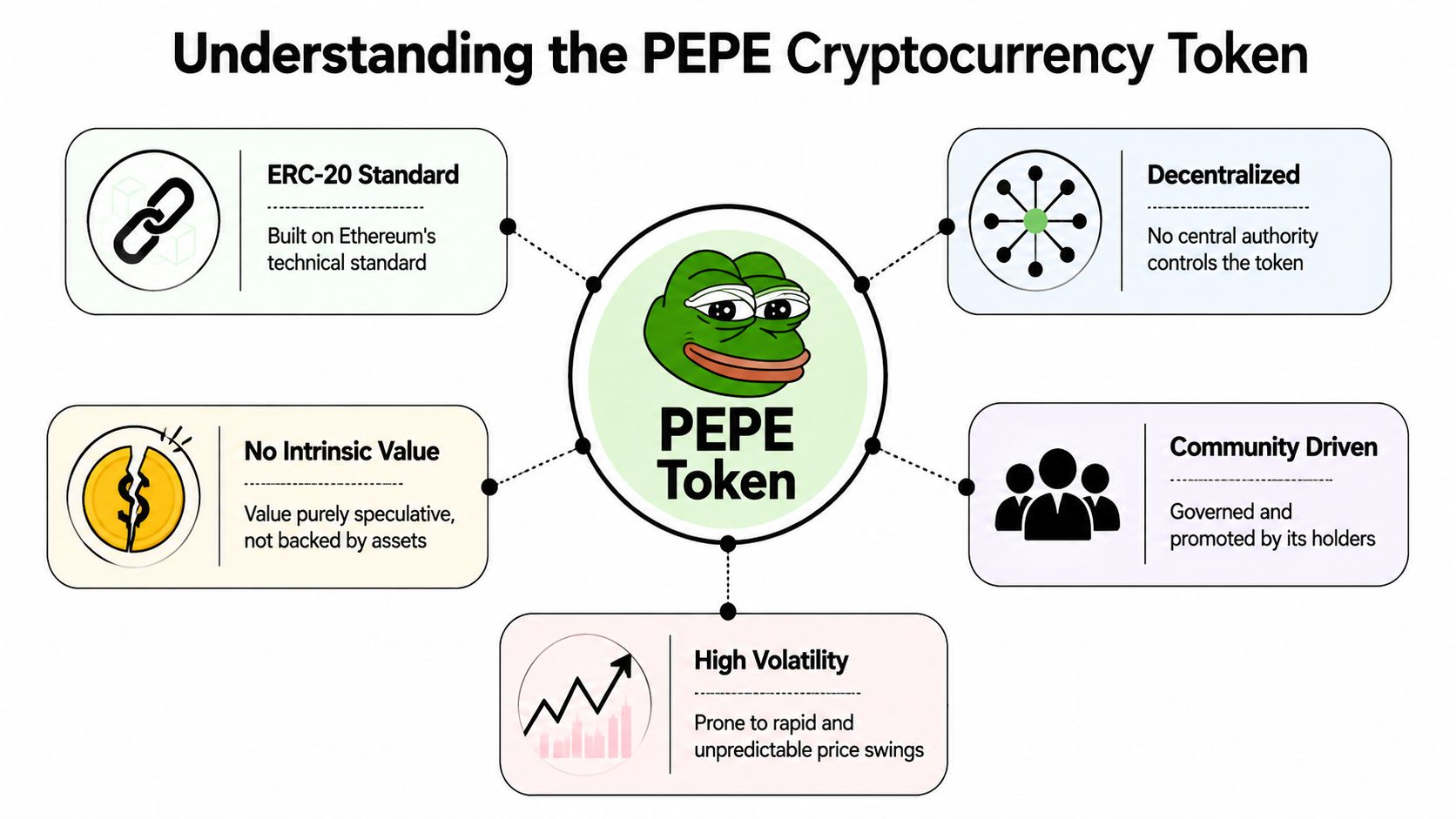
PEPE is an ERC-20 token on Ethereum with 18 decimals and the contract address 0x6982508145454ce325ddbe47a25d4ec3d2311933. Cube Exchange's overview also lists its enormous fixed supply, which is part of the branding and trading psychology around the asset rather than evidence of underlying utility, as described in its PEPE explainer.
Using the ERC-20 standard gives PEPE broad compatibility with Ethereum wallets, decentralized exchanges, and other common trading tools. For readers who want a refresher on that infrastructure, Coiner Blog's guide to blockchain technology basics covers the mechanics behind tokens like this.
What that structure does, and does not, mean
An ERC-20 token can represent many different things: governance rights, access to a protocol, claims on fees, or pure speculation. PEPE sits firmly in the last category. Its Ethereum base makes it easy to hold and trade, but it does not turn the token into productive infrastructure.
That is the point many casual summaries blur. Technical compatibility is not the same as economic purpose.
PEPE does not give holders ownership in a company, rights to protocol revenue, or a built-in yield mechanism. The asset's market value comes primarily from exchange liquidity, social attention, and traders' expectations that future demand will exceed current demand. In practice, that makes PEPE closer to a financialized internet symbol than to a token tied to software usage.
This short video gives a market-facing explanation of how PEPE is typically framed in crypto conversations.
A precise description helps avoid category errors:
- PEPE is not equity. Holding it does not confer ownership in a business.
- PEPE is not yield-bearing by default. The token itself does not generate cash flow.
- PEPE is not a base-layer asset. Its role is not to secure Ethereum or operate core network infrastructure.
- PEPE is a meme coin. Its pricing depends heavily on attention, sentiment, and speculative trading.
That last point is the definition. PEPE is a liquid, highly speculative token built on Ethereum and branded around a meme with a complicated public history. Anyone evaluating it as an asset should separate the token's market mechanics from the meme's cultural notoriety, because the overlap creates attention, and attention is what the market trades.
PEPE Tokenomics and Market Dynamics
PEPE's tokenomics are simple enough to fit on one screen. The consequences are not simple at all.
The tokenomics are simple, and that simplicity matters
CoinGecko describes PEPE as a community-driven meme token with no transaction taxes, locked liquidity, and an immutable smart contract, while also listing a circulating supply of 420 trillion PEPE and a 24-hour trading volume above $1.7 billion on active days in its PEPE market page. Those details matter because they tell you how the token is designed to trade.
No transaction taxes reduce friction for entry and exit. Locked liquidity can reassure traders that a key liquidity pool constraint isn't as easily changed. An immutable smart contract limits the ability to alter token behavior later. None of that creates intrinsic value, but it does shape trader confidence.
PEPE trades like attention, not like software infrastructure
A utility token in DeFi often has a story tied to function. It may help pay fees, govern a protocol, or access some onchain service. PEPE doesn't need that story to attract participation. It runs on a different mechanism: visibility.
When social attention rises, meme coins can attract volume quickly because the thesis is easy to understand. Traders don't need to model protocol revenue or Layer 2 throughput. They need to believe more people will care tomorrow than care today.
That's why PEPE can move sharply without protocol-level news. Exchange listings, viral posts, broader crypto optimism, and meme-coin rotation can all matter more than technical development. In that sense, PEPE behaves less like Web3 infrastructure and more like a sentiment instrument that happens to settle on Ethereum.
The simpler the token story, the faster it can spread. The faster it spreads, the more reflexive the market can become.
That reflexivity cuts both ways. High liquidity can make entry easy, but it also creates the illusion that exit will always be easy. In stressed conditions, traders all discover the same thing at once: liquidity is a market condition, not a permanent guarantee.
PEPE Token Key Metrics
| Metric | Detail |
|---|---|
| Token standard | ERC-20 on Ethereum |
| Decimals | 18 |
| Contract address | 0x6982508145454ce325ddbe47a25d4ec3d2311933 |
| Max total supply | 420,689,899,653,542.539491331875576506 PEPE |
| Circulating supply | 420 trillion PEPE |
| Transaction taxes | No transaction taxes |
| Liquidity status | Locked liquidity |
| Smart contract status | Immutable smart contract |
| Market behavior | Primarily speculative and sentiment-led |
| Trading activity | 24-hour volume can exceed $1.7 billion |
If you want to understand why those mechanics matter in execution, this guide on the liquidity of cryptocurrency markets gives the right lens. For PEPE, liquidity isn't just a convenience feature. It's the main engine that lets hype convert into tradable price action.
One more analytical point often gets missed. PEPE's enormous supply isn't just a meme-friendly number. It also helps create the psychological appeal of buying “a lot” of tokens for relatively small amounts of capital. That can make the asset feel cheap even when that intuition is economically meaningless.
The Risks and Controversies Surrounding PEPE
Most meme-coin writeups mention risk as a disclaimer. With PEPE, risk is the subject.
Financial risk is the obvious one
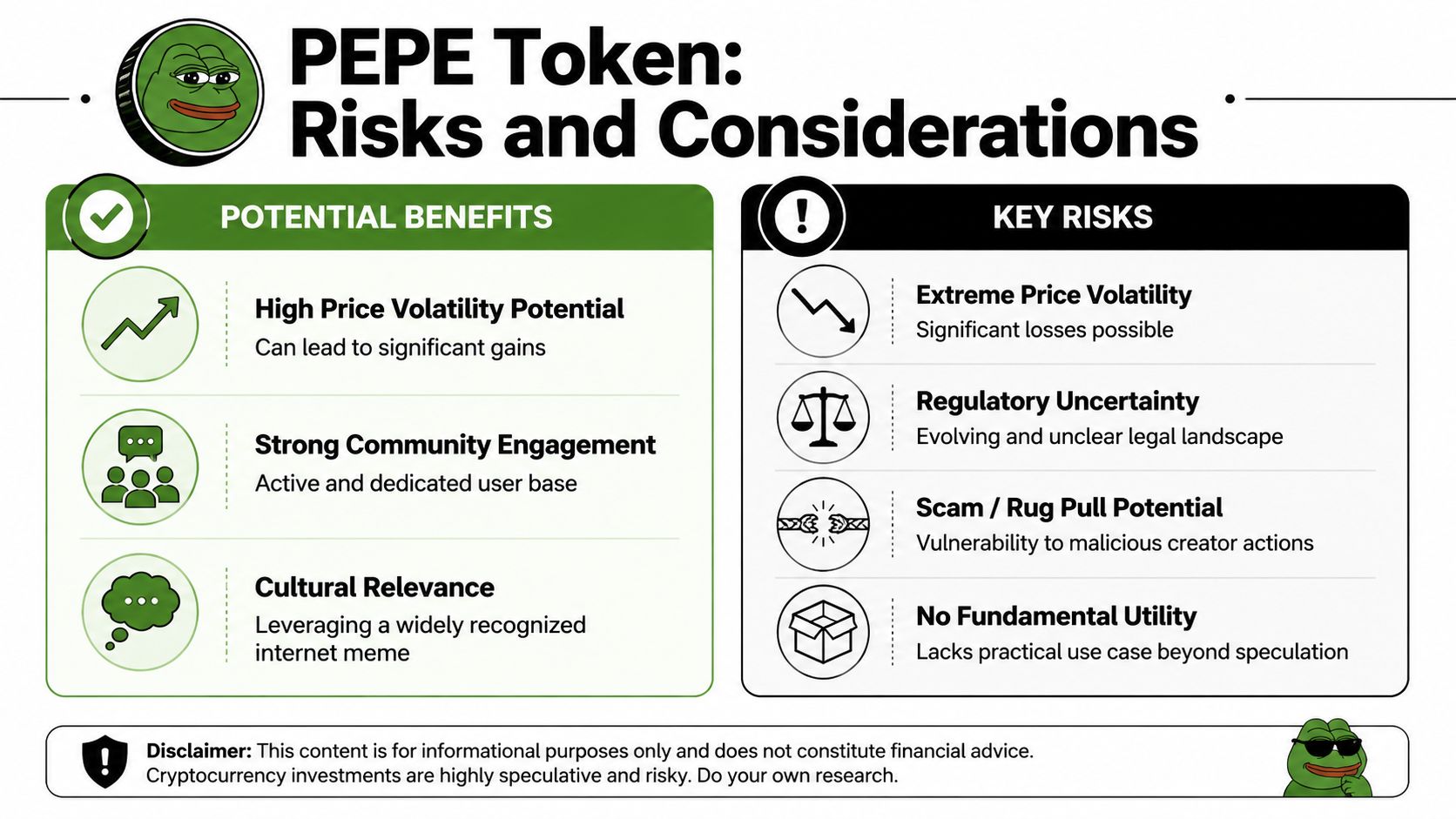
PEPE is a meme coin with no utility beyond trading and collectability. That alone should define your expectations. You're not buying a claim on protocol cash flow, and you're not buying access to a necessary blockchain service.
The practical consequence is brutal but simple. Price can rise very far on attention, and it can fall hard when that attention rotates elsewhere. There is no fundamental floor in the usual sense because there is no productive base layer of demand holding the thesis together.
This is why meme coins often confuse newcomers. They can look liquid, social, and unstoppable during a strong cycle. Then sentiment changes and the same features that helped the asset climb accelerate the drawdown.
Reputational risk is the underrated one
Bitstamp's explainer highlights a concern many buyers have but most token pages avoid: PEPE's branding is derived from the Pepe meme's history, which creates legal and reputational risk questions. This doesn't mean buying PEPE automatically endorses extremist uses of Pepe the Frog. It does mean the token inherits a symbol with a public history that some platforms, advertisers, creators, and counterparties may view cautiously.
That distinction matters in practical terms.
- A trader may see PEPE as just another speculative asset.
- A content platform may evaluate the imagery differently.
- A brand partner may avoid association entirely.
- A creator or influencer may face context collapse when audiences interpret the symbol through politics instead of crypto.
Owning a token and endorsing a symbol aren't always the same thing. Public audiences may not care about that distinction.
That's the hidden cost many explainers skip. Reputational exposure doesn't show up in a wallet, but it can still affect whether someone is comfortable holding, discussing, or promoting the asset.
Operational and platform risk still apply
Even when a token has an immutable contract and active markets, buyers still face ordinary crypto hazards.
- Execution risk: Slippage, rushed entries, and thin order-book conditions can punish traders who assume every market is deep.
- Platform risk: Exchange access, listing status, and moderation rules can shape who can trade or promote the asset.
- Scam spillover: The meme-coin sector attracts copycats, fake contract addresses, impersonators, and opportunistic launches that rely on confusion.
If you're interacting with this segment at all, basic anti-fraud discipline matters. Coiner Blog's overview of how to avoid crypto scams is a practical companion to any meme-coin research process.
PEPE isn't unusual because it's risky. It's unusual because its risks include finance, symbolism, and online identity all at once.
How to Research and Safely Interact with Meme Coins
Most losses in meme coins don't come from misunderstanding a complex protocol. They come from failing to ask simple questions before clicking buy.
A practical research workflow
Newton's PEPE explainer makes an important point: retail buyers need clearer guidance on downside scenarios, concentration risk, and liquidity risk. That's exactly the right frame. Researching meme coins isn't about pretending they have hidden fundamentals. It's about checking whether the structure makes the speculation survivable.

Use a workflow like this:
Verify the contract first. For PEPE, confirm the token address matches the known contract before you interact with any market. Fake tokens often rely on name confusion rather than technical sophistication.
Check market data on established trackers. CoinGecko is useful for trading pairs, circulating supply context, and liquidity visibility. You're not looking for certainty. You're looking for obvious mismatches between hype and tradability.
Review holder concentration on a blockchain explorer. A meme coin can look healthy until you discover a small number of wallets hold a large share of supply. Concentration doesn't guarantee disaster, but it sharply changes exit risk.
Understand where you're trading. On Ethereum, swaps often route through decentralized exchanges such as Uniswap. Make sure the pair you use is the intended one, and inspect the token details before approving any transaction.
Separate your wallet behavior. Use a dedicated non-custodial wallet for higher-risk speculation. Don't mix experimental meme-coin activity with wallets that hold your core assets, NFTs, or long-term DeFi positions.
How to think about downside before you buy
The best meme-coin question isn't “How high can it go?” It's “What happens if I need to exit during a bad week?”
That mindset changes behavior immediately.
- Size small on purpose. Meme coins shouldn't force emotional decisions.
- Assume volatility is normal. If a sudden move would make you panic, your position is too large.
- Plan your invalidation point before entry. If the only thesis is “people are talking about it,” then silence is part of the risk.
- Treat liquidity as conditional. High volume today doesn't promise clean execution tomorrow.
Buy only what you can explain without using the phrase “it's going viral.”
For beginners, a resource on how to invest in cryptocurrency for beginners can help frame position sizing, wallet setup, and exchange hygiene before you touch meme coins at all.
One final analytical point. Trends like AI plus crypto, tokenized real-world assets, Layer 2 growth, and DeFi expansion may dominate serious Web3 development, but meme coins still absorb attention because they are easy to understand and easy to narrate. That doesn't make them equal to productive crypto sectors. It makes them highly efficient at converting culture into speculation.
PEPE is the cleanest example of that process. As a meme, it shows how online symbols evolve beyond author control. As a token, it shows how markets assign value to recognition, controversy, and liquidity. If you understand both halves, you won't confuse cultural relevance with investment quality.
Coiner Blog publishes factual guides and analysis for readers trying to understand crypto markets without ignoring risk. If you want more articles on meme coins, blockchain basics, DeFi, NFTs, and broader Web3 trends, you can browse Coiner Blog.