
What Is a Smart Contract? the Ultimate 2026 Guide
A smart contract is a self-executing digital agreement stored on a blockchain that follows coded rules and carries out terms automatically without a middleman. The market around smart contracts was valued at USD 2.69 billion in 2025 and is projected to grow from USD 3.39 billion in 2026 to USD 16.31 billion by 2034, which is one reason so many people are asking what a smart contract is right now.
If you're crypto-curious, you've probably run into the term while reading about Ethereum, DeFi, NFTs, Web3, or tokenization. It can sound abstract at first, but the core idea is simple. A smart contract is like a digital vending machine for assets and services. If the required input arrives and the conditions are met, the programmed outcome happens.
That simplicity is exactly why smart contracts matter. They sit underneath lending apps, token swaps, digital collectibles, DAOs, and a growing list of blockchain products. But once you move beyond the beginner analogy, the full story gets more interesting. Smart contracts aren't just convenient automation. They're also rigid, public, hard to change, and sometimes legally messy when code and written agreements don't line up.
Table of Contents
- What Is a Smart Contract? An Unbreakable Digital Promise
- How Smart Contracts Execute on the Blockchain
- Real-World Use Cases Dominating Web3 in 2026
- A Simple Smart Contract Code Example
- Navigating the Risks Security and Gas Fees
- The Legal Quandary Code vs Contract Law
- The Future of Smart Contracts and Automated Trust
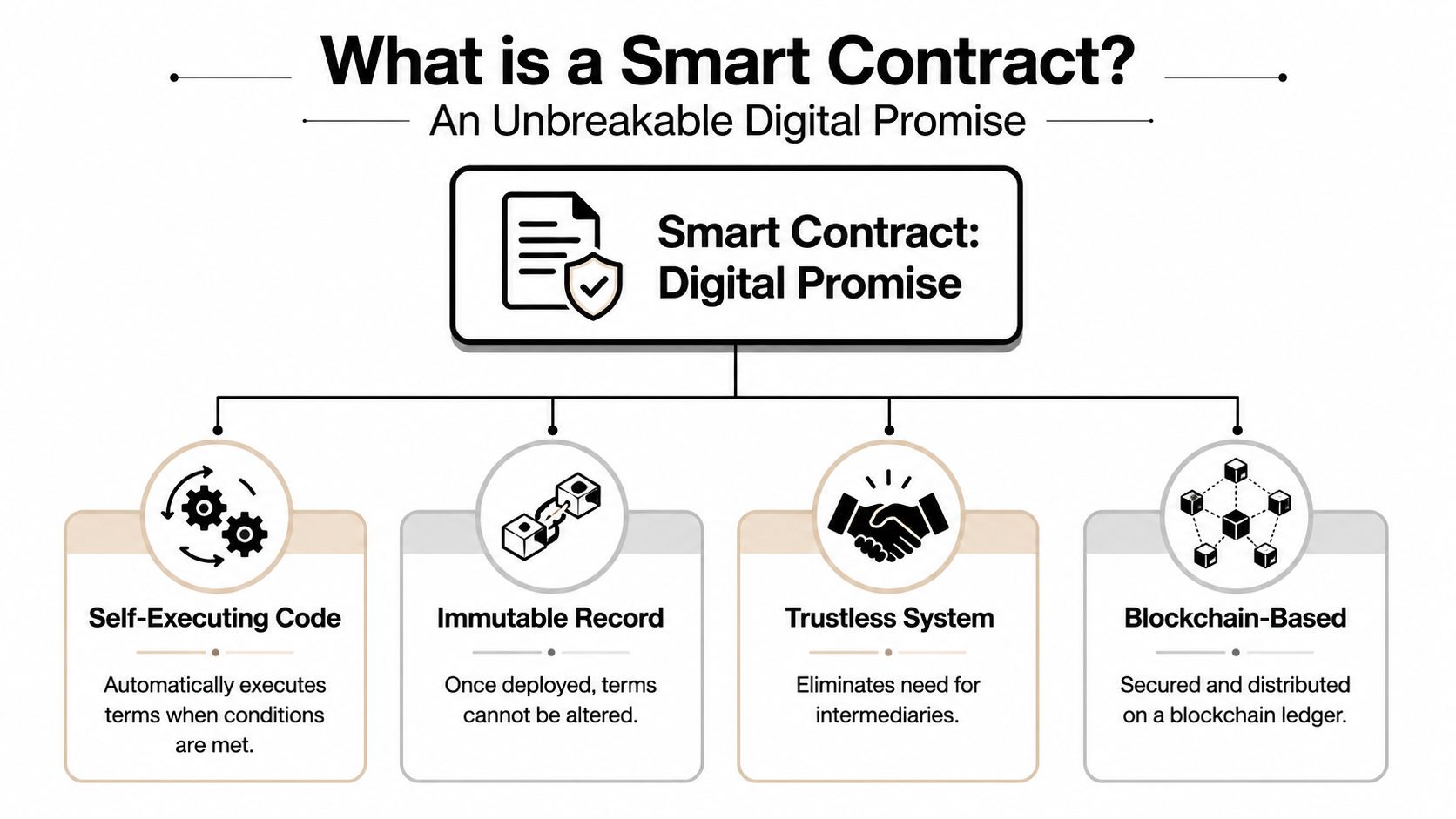
What Is a Smart Contract? An Unbreakable Digital Promise
You're buying a digital asset from someone you don't know. In a normal setup, you might rely on a marketplace, escrow service, payment processor, or legal agreement to keep both sides honest. A smart contract tries to replace part of that trust layer with code.
The old vending machine analogy still works as a starting point. You insert the right amount, press the right button, and the machine releases the product. No clerk has to approve the sale. A smart contract does something similar with blockchain transactions. If the preset conditions are met, it executes the programmed action.
From idea to blockchain reality
The phrase itself is older than Bitcoin. The term smart contract was first coined by computer scientist and legal theorist Nick Szabo in 1996, before blockchain networks existed. He later defined smart contracts as "computerised transaction protocols that execute terms of a contract" and described them as digital promises designed to automate agreement execution without an intermediary, as outlined in this history of smart contracts.
That historical detail matters because it clears up a common confusion. Smart contracts are not just "contracts on Ethereum." They are a broader idea about automated enforcement. Blockchain gave that idea a durable home by making the code transparent, shared, and difficult to alter after deployment.
If you're still getting oriented in the broader ecosystem, it helps to read smart contracts as one of the core building blocks of Web3 technology, alongside wallets, tokens, decentralized apps, and on-chain identity.
The four traits that matter most
A useful mental model is to focus on four properties:
- Self-executing logic: The contract runs when the required condition is met.
- Shared visibility: Network participants can inspect what the code is meant to do.
- Immutability after deployment: The live contract is typically not something you casually edit.
- Reduced reliance on intermediaries: The system enforces the rule set itself.
Practical rule: A smart contract isn't smart in the human sense. It's precise. It only does what the code allows.
That's why "what is a smart contract" has both a simple and a serious answer. The simple answer is automated code on a blockchain. The serious answer is a new way to coordinate value, ownership, and rules in digital systems without handing control to a central operator.
How Smart Contracts Execute on the Blockchain
At runtime, a smart contract behaves less like a PDF and more like a tiny application. Someone sends a transaction. The blockchain checks it. The contract code runs. Then the network records the result.
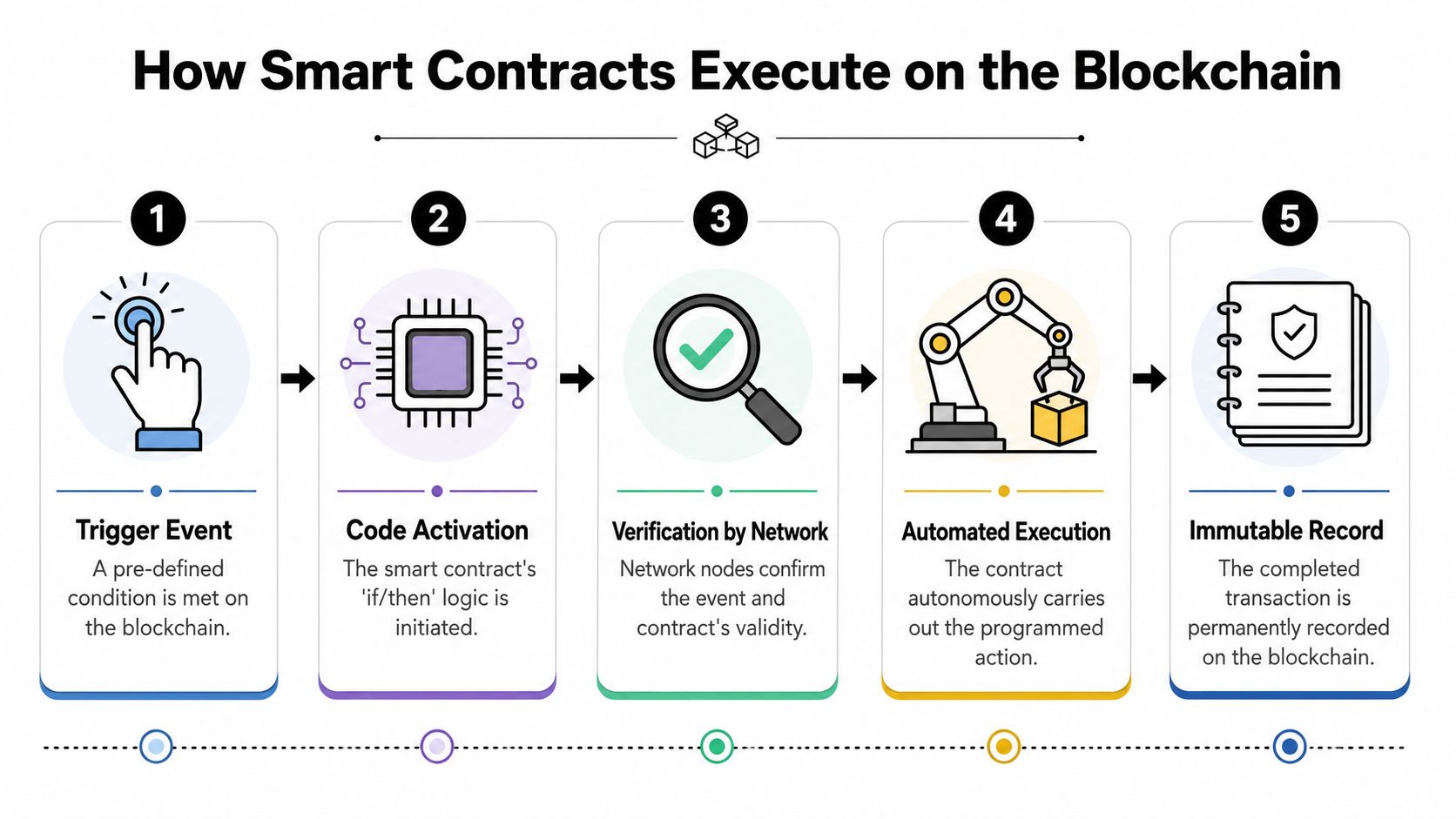
The core mechanic is basic. Smart contracts execute through if/then logic. If a condition is satisfied, then the code performs an action. That action might release collateral, swap tokens, mint an NFT, update a ledger entry, or reject the transaction if the inputs don't qualify.
The if-then engine
A clean way to picture the flow is this:
- A trigger happens: A wallet sends funds, calls a function, or submits data.
- The contract checks conditions: Has payment arrived? Is the sender authorized? Is the deadline valid?
- The network verifies execution: Nodes confirm the transaction and process the logic.
- The contract acts: It transfers assets, updates state, or blocks the action.
- The result is recorded: The blockchain stores the output as part of its permanent history.
When deployed, smart contracts become tamper-proof and immutable programs that execute solely on if/then logic, run without human oversight, and can't be altered post-deployment. The example often used is simple and powerful: if a loan is repaid, then release collateral, as described in this overview of real-world smart contract use cases.
A smart contract doesn't "decide" whether a situation feels fair. It checks conditions and follows instructions.
For users trading on decentralized exchanges or chasing arbitrage, one adjacent concept is MEV, which shows how transaction ordering can affect outcomes around smart contract execution.
Ethereum, the EVM, and other chains
Ethereum remains the chain commonly associated with smart contracts, partly because it became the dominant programmable blockchain. As of October 24, 2022, the total number of smart contracts deployed on Ethereum exceeded 4,658 million, according to the European Blockchain Observatory and Forum smart contracts report.
The execution environment behind much of that ecosystem is the Ethereum Virtual Machine, or EVM. You can think of it as a shared global computer that processes contract logic consistently across nodes. Other chains use different designs. Solana and Cardano don't mirror Ethereum exactly, but they pursue the same end goal: trusted automation through code on a distributed ledger.
Real-World Use Cases Dominating Web3 in 2026
Smart contracts stopped being a theory years ago. Today, they power some of the most active corners of crypto, from DeFi protocols to NFT collections and blockchain games.

DeFi, NFTs, and GameFi in practice
Start with DeFi. When you deposit tokens into a lending protocol, a smart contract can hold collateral, calculate what you're allowed to borrow, and release funds if the inputs satisfy the rules. No bank officer approves the loan. The application logic lives on-chain.
Then there are NFTs. A smart contract can mint a token, assign ownership, and define how transfers work. In practice, that means digital art, membership access, collectible items, and ticketing systems can all rely on programmable ownership rather than a private database.
GameFi pushes that idea further. In blockchain games, smart contracts can track in-game assets, reward distribution, marketplace transactions, and player-owned inventories. That changes the feel of digital ownership because items can exist independently of a single game studio's internal server logic.
If you want to see how governance layers connect to this world, DAOs are another major use case where smart contracts enforce voting rules, treasury movements, and proposal execution.
Supply chains and real-world coordination
One of the most practical examples sits outside crypto-native speculation. In supply chain management, smart contracts can digitally track and verify every step of a product's journey, including a coffee bean moving from farm to consumer, by recording immutable data on origin, transportation conditions, and quality checks at each stage, as explained in this article on smart contract uses in supply chains.
That matters because supply chains often break down at handoff points. One party updates one system. Another updates a spreadsheet. A third party relies on delayed reporting. Smart contracts can reduce those information gaps when the right data reaches the chain.
A few categories where this gets interesting fast:
- Asset exchange: Token swaps, stablecoin transfers, and escrow-like settlement.
- Digital ownership: NFTs, token-gated access, creator royalties written into logic.
- Operational workflows: Logistics triggers, compliance checks, automated notifications.
- Community governance: Treasury disbursements and proposal execution.
A short visual walkthrough helps make those examples more concrete.
A Simple Smart Contract Code Example
A lot of beginners assume smart contracts must look mysterious. They don't. Under the hood, a basic contract can be surprisingly readable, especially in Solidity, the language most closely associated with Ethereum.
A tiny Solidity contract
Here's a minimal example that stores and returns a message:
// SPDX-License-Identifier: MIT
pragma solidity ^0.8.0;

contract SimpleMessage {
    string public message;

    constructor(string memory initialMessage) {
        message = initialMessage;
    }

    function updateMessage(string memory newMessage) public {
        message = newMessage;
    }
}
Even if you don't code, the structure is approachable.
- The contract name:
SimpleMessageis the on-chain program. - The stored variable:
messagekeeps a text value. - The constructor: It sets the first message at deployment.
- The function:
updateMessage()changes the stored value later.
That example isn't financially interesting, but it shows the core truth. A smart contract is just code until it's deployed. Once it's live on a blockchain, other users and applications can interact with it according to its rules.
Read smart contract code the same way you'd read product terms. The important question is not whether it looks technical. The important question is what powers it gives, to whom, and under what conditions.
What deployment actually means
Deployment means taking code, compiling it into bytecode the blockchain can run, and sending a transaction to publish it on-chain. That transaction usually requires a gas fee because the network is doing computational work and storing state.
After deployment, the contract gets an address. Wallets, decentralized apps, bots, and other contracts can call its functions. That's when a text file turns into a live piece of infrastructure.
Developers building decentralized apps often connect front ends, wallets, and contract logic through broader Web3 application development workflows. The contract is only one layer. The user experience, wallet prompts, indexing, and security checks matter just as much.
Navigating the Risks Security and Gas Fees
The upside of smart contracts is automation. The downside is that automation can execute bad code with total discipline.
If you interact with DeFi, staking protocols, bridges, or token launchpads, two questions matter more than almost anything else. First, can the contract fail or be exploited? Second, why does every action cost money?
Where users get hurt
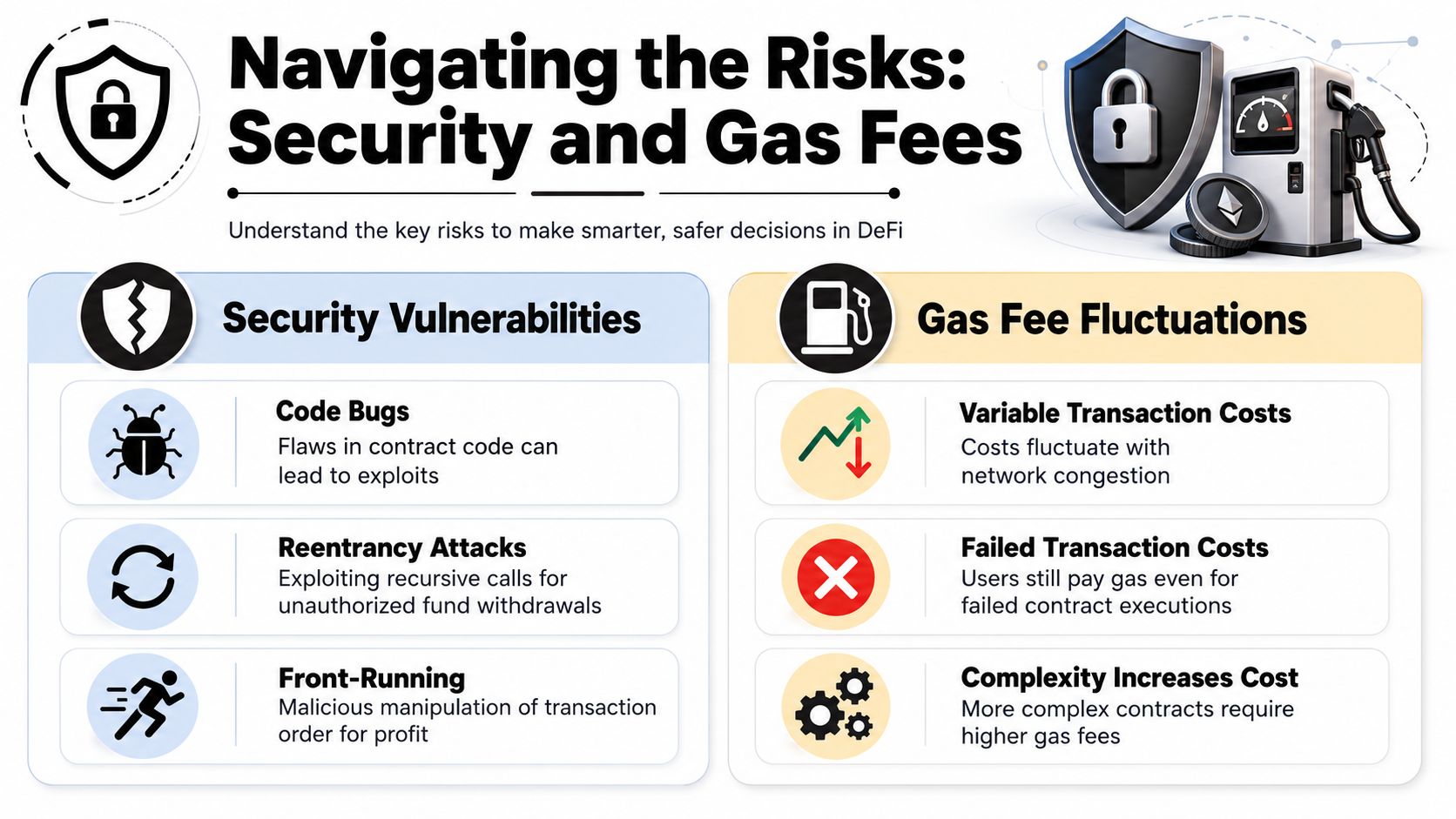
Security risk starts with code quality. A flawed contract can expose funds, lock assets permanently, or let attackers manipulate execution paths. One well-known pattern is a reentrancy attack, where repeated calls exploit a contract before its internal state updates properly.
Other danger zones show up often:
- Code bugs: Simple logic mistakes can create expensive failures.
- Front-running exposure: Traders can exploit transaction ordering in public mempools.
- Admin key risk: Some protocols claim decentralization while retaining powerful controls.
- Unaudited deployments: Fresh contracts can look polished and still hide serious flaws.
A helpful mindset comes from basic security discipline. Before using a new protocol, think in terms of threat surface, privilege, failure modes, and recovery options. If you want a structured framework for that process, this guide to information security risk assessment is a solid reference because the principles map well to smart contract risk analysis.
Red flag: If you don't understand who can upgrade a contract, pause before depositing funds.
Why gas fees exist
Gas fees confuse newcomers because they feel like random tolls. They aren't random. They are the cost of asking a blockchain network to process computation and record state changes.
A simple token transfer may be straightforward. A more complex smart contract interaction can involve more storage updates, more logic, and more verification work. That usually means higher cost. Congestion also matters. When many users compete for block space, fees can rise.
A few practical habits help:
| Situation | Better move |
|---|---|
| You're testing a new protocol | Start with a small transaction |
| The network feels crowded | Wait and compare fee conditions |
| A contract looks complex | Expect higher execution cost |
| You need cheaper transactions | Explore Layer 2 options |
Layer 2 networks matter here because they aim to preserve blockchain security while making smart contract usage faster and cheaper. That's one of the reasons Layer 2 scaling has become such a central part of the Web3 conversation, especially for DeFi and consumer-facing apps.
For readers tracking the long arc of security design, privacy tech, and cryptographic trust systems, the future of cryptography is closely tied to how safely smart contracts will evolve.
The Legal Quandary Code vs Contract Law
Many people hear "code is law" and assume the legal side is solved. It isn't.
A smart contract can execute perfectly at the technical level and still create a dispute in practical scenarios. The problem appears when the blockchain code and the human-readable agreement are supposed to represent the same deal, but they don't.
When code and paperwork disagree
When a smart contract's code differs from a parallel legal agreement, such as after a coding error, the situation becomes uncomfortable: no clear global standard dictates which prevails, and no government agency currently certifies that code accurately mirrors written terms, according to this discussion of the smart contract versus written contract paradox.
That gap creates a real liability problem.
If the contract sends funds one way and the signed agreement says something else, who absorbs the loss? The developer? The company? The counterparty? A court may eventually weigh in, but the blockchain transaction may already be final.
Smart contracts are great at execution. They are much weaker at interpretation, ambiguity, and exceptions.
For teams handling complex agreements, especially in finance or procurement, tools for pre-deployment review are becoming more important. Something like AI-powered legal analysis can help compare legal language and structured terms before they become code, which is far safer than discovering a mismatch after funds move.
Why this matters for tokenized assets
This legal gray area becomes more serious when smart contracts touch real-world assets. Tokenized real estate, private credit, invoices, securities, and membership rights all depend on a clean relationship between on-chain logic and off-chain legal enforcement.
That is why I see legal alignment as one of the biggest bottlenecks for mainstream adoption. The code can automate transfer. It can't, by itself, resolve every dispute over intent, fraud, mistake, or regulatory obligation.
The Future of Smart Contracts and Automated Trust
A few years from now, booking a freight shipment, collecting royalties, or settling part of a trade may feel as ordinary as using online banking today. The difference is that more of the trust layer will sit in software that checks conditions, moves assets, and records the result on-chain.
That future is taking shape in a more complicated way than early crypto narratives suggested. Smart contracts are not becoming universally intelligent agreements. They are becoming better execution engines inside larger systems that also include legal documents, off-chain data, identity checks, and human oversight.
Two technologies are pushing that shift.
Layer 2 networks make smart contracts cheaper and faster to use, which matters because automated trust only works at scale if people can afford to interact with it. A contract that is reliable but too expensive to call is like a toll road priced so high that nobody drives on it.
AI tools are starting to help on the development and review side. They can compare contract logic against product requirements, flag unusual code paths, and help auditors spot patterns that deserve a closer look. That does not remove the need for expert review. It makes the review process sharper, especially as contracts become more modular and interconnected.
The next wave also looks more serious because it is tied to real assets and business workflows. Precedence Research's smart contracts market outlook projects strong growth through the next decade, which fits what many builders are betting on: more tokenized assets, more automated settlement, and more demand for systems that reduce manual reconciliation.
The hard part is not writing code that says "if X happens, do Y." The hard part is building systems that still behave sensibly when data is wrong, users make mistakes, markets get stressed, or the legal agreement behind the transaction is disputed.
That is why the future of smart contracts is really the future of automated trust with guardrails.
The strongest projects will treat smart contracts less like magical replacements for institutions and more like high-speed rule engines. They work well for clear, repeatable actions. They still need surrounding protections for upgrades, dispute handling, oracle failures, access control, and legal enforceability.
My view is simple. The winners will be the teams that combine fast execution with careful design. In practice, that means cheaper Layer 2 deployment, better security review, tighter links between code and legal intent, and selective use of AI where it improves verification instead of pretending to replace judgment.
If that model matures, smart contracts will not just automate transactions. They will automate narrower, better-defined forms of trust, which is far more useful than the old promise of replacing every contract with code.
If you want more clear-eyed crypto explainers, practical blockchain analysis, and grounded coverage of Web3, DeFi, tokenomics, NFTs, Layer 2s, and emerging infrastructure, follow Coiner Blog. It's a strong place to keep learning without getting lost in hype.
2 Comments