
Zero Knowledge Proofs the Crypto Tech Changing Everything
You're probably dealing with this question already, even if you haven't framed it in cryptography terms.
You need to prove something online, but you don't want to hand over everything. Maybe it's your age for a platform, your residency for a DeFi protocol, or your identity for compliance. In traditional systems, proving one fact usually means exposing a full bundle of personal data. That's clumsy, risky, and increasingly out of step with how Web3 is evolving.
That's why zero knowledge proofs matter right now. They let someone prove a claim is true without revealing the secret behind it. In crypto, that idea has moved far beyond academic novelty. It now sits close to the center of Layer 2 scaling, privacy-preserving smart contracts, decentralized identity, and the next generation of institutional DeFi.
If you've seen people treat zero knowledge proofs like mathematical magic, this guide takes a different approach. The math is elegant, but the essence is engineering. Which systems are practical. Which ones carry hidden trust assumptions. Where privacy holds up. And where implementation mistakes can break the promise.
Table of Contents
- Why Everyone in Crypto Is Talking About ZKPs
- What Are Zero Knowledge Proofs Really
- SNARKs vs STARKs vs Bulletproofs A Practical Comparison
- How Zero Knowledge Proofs Power Web3 Today
- The Hidden Risks and Limitations of ZKPs
- The Future From Verifiable AI to Tokenized Assets
- How to Get Involved with Zero Knowledge Proofs
Why Everyone in Crypto Is Talking About ZKPs
A simple real-world example explains the appeal better than most whitepapers.
You walk up to a venue and need to prove you're old enough to enter. The venue doesn't need your home address, full legal name, license number, or exact birthdate. It only needs one answer. Are you above the required age or not? Traditional identity checks reveal too much. Zero knowledge proofs aim to fix that.
That same problem shows up all over crypto. A user wants to prove they meet a compliance rule without exposing their wallet history. A trader wants to confirm a transaction is valid without leaking strategy. A Layer 2 network wants to prove a large batch of Ethereum transactions was processed correctly without forcing every validator to recompute the whole batch.
This is why ZKPs have gone from niche cryptography to a major Web3 conversation. They sit at the intersection of privacy, scalability, and verifiability. Those are three things every serious blockchain ecosystem needs more of.
For newer readers, it helps to place ZKPs in the broader Web3 stack. If you want a refresher on how decentralized apps, identities, and ownership fit together, this overview of Web3 technology basics gives useful context.
Why the timing matters
Crypto has matured enough that raw transparency is no longer enough on its own.
Retail users want better privacy. Developers want faster execution. Institutions want to use public blockchains without exposing proprietary data. DeFi protocols want compliance paths that don't destroy user confidentiality. AI agents and automated smart contracts also need ways to prove correct behavior without publishing every internal input.
Zero knowledge proofs matter because they replace “trust me” with “verify this,” while limiting what gets exposed in the process.
That combination is rare. Most systems give you transparency by sacrificing privacy, or privacy by sacrificing auditability. ZKPs try to hold both at once. That's why they've become one of the most important technologies in blockchain infrastructure, tokenization, and Layer 2 design.
What Are Zero Knowledge Proofs Really
At the most basic level, zero knowledge proofs let a prover convince a verifier that a statement is true without revealing the secret information that makes it true.
That sounds abstract until you anchor it to a story.
The core idea in plain language
The classic analogy is Ali Baba's Cave. There's a cave with two paths, left and right, connected by a locked door inside. The prover claims they know the secret word that opens the door. The verifier wants proof, but doesn't want to learn the word itself.
The prover walks into the cave and chooses a path. The verifier waits outside, then calls out which side the prover must return from. If the prover really knows the secret, they can open the door and come back from either side. If they don't, they can only guess. Repeat this enough times and the verifier becomes convinced the prover knows the secret, without ever hearing the secret word.
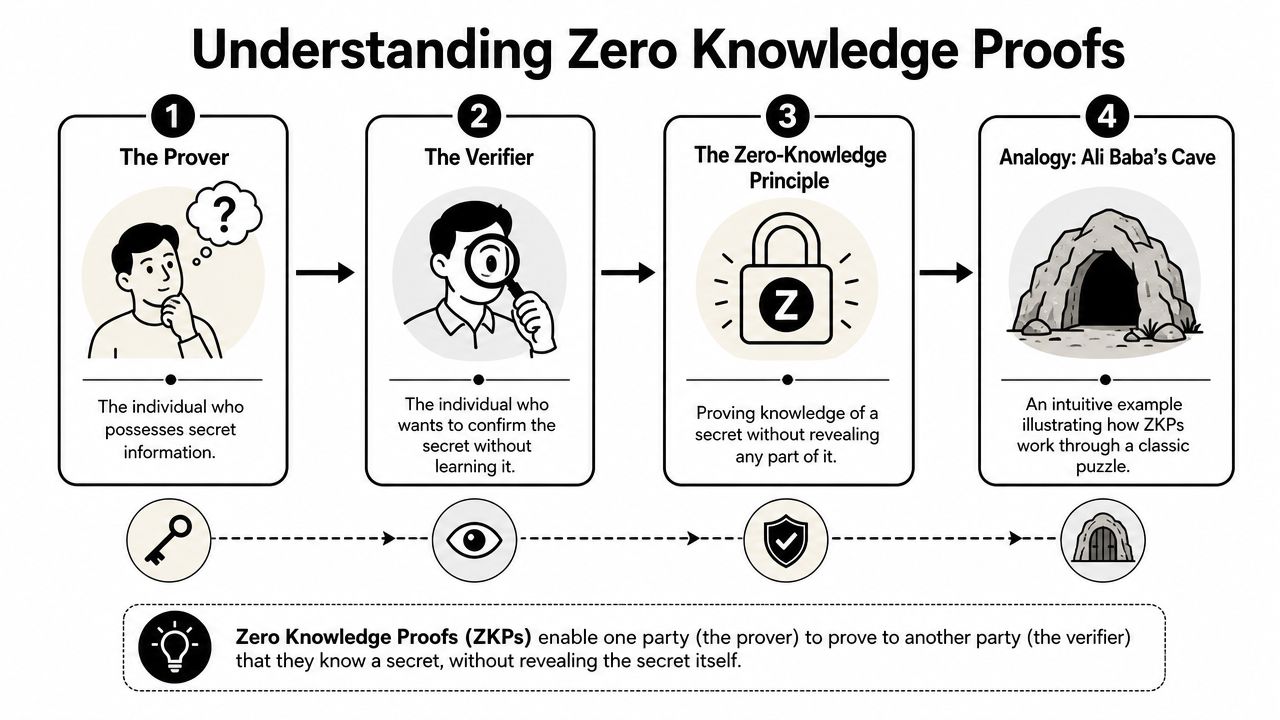
That's the intuition. You prove possession of knowledge, not the knowledge itself.
A blockchain version works the same way in spirit. Instead of proving you know a cave password, you might prove that:
- A transaction is valid without revealing transaction details
- You meet a KYC rule without exposing the underlying documents
- A smart contract executed correctly without replaying every internal computation
If you want a deeper privacy-oriented walkthrough after this article, Ciphar's complete guide to ZKE in 2026 is a useful companion piece.
For readers who want to connect this to the broader mechanics of distributed ledgers, this primer on blockchain technology basics helps bridge the gap.
The three rules every real ZKP must satisfy
A lot of crypto content treats ZKPs like a vibe. They're not. A valid zero-knowledge proof system has to satisfy three strict properties. As explained in Circularise's breakdown of zero-knowledge proofs explained in three examples, those properties are Completeness, Soundness, and the Zero-Knowledge property itself.
Here's what that means in plain English:
- Completeness means an honest prover can convince the verifier when the statement is true. If the user has the right secret, the proof should work.
- Soundness means a dishonest prover shouldn't be able to fool the verifier when the statement is false. If the claim is fake, the system should reject it.
- Zero-Knowledge means the verifier learns nothing beyond the fact that the statement is valid. The proof confirms truth, but it doesn't spill the secret.
Why this matters for blockchain
These properties sound theoretical, but they shape real design choices in crypto.
Completeness is why a wallet or rollup can rely on a proof to confirm proper execution. Soundness is why attackers shouldn't be able to forge legitimacy out of nowhere. Zero-knowledge is why users can protect sensitive information while still participating in public networks like Ethereum.
Practical rule: If a project says it uses ZK tech, ask what is being proven, what is being hidden, and what assumptions still remain.
That last part matters because a protocol can use zero-knowledge components and still leak data elsewhere through poor implementation, bad randomness, or unsafe surrounding infrastructure. The proof system may be sound on paper while the product remains fragile in practice.
That gap between theory and deployment is where most of the confusion starts, and where most of the serious risks live.
SNARKs vs STARKs vs Bulletproofs A Practical Comparison
Once you move past the basic idea, the next question is practical. Which kind of zero knowledge proof are we talking about?
Not all ZKP systems behave the same way. Some prioritize tiny proof sizes. Some avoid trusted setup. Some are more suitable for confidential transactions, while others are better for verifiable computation or scalable smart contracts.
Why these categories matter
Three names come up constantly in crypto infrastructure:
- ZK-SNARKs
- ZK-STARKs
- Bulletproofs
They all aim to prove statements efficiently without revealing private inputs, but the engineering trade-offs differ.
A useful way to think about them is this:
- SNARKs often win on compactness and fast verification.
- STARKs are attractive when teams want to avoid trusted setup.
- Bulletproofs are often discussed for confidential transactions and range proofs.
That matters for product design. A privacy coin, an Ethereum Layer 2, and a GameFi app don't all need the same thing. If a proof is too large, too slow, or too expensive to generate, the product may work in demos and struggle in production.
Before choosing a proof system, developers also need to understand the execution environment. This overview of how smart contracts work is useful background for why verification cost and data footprint matter so much onchain.
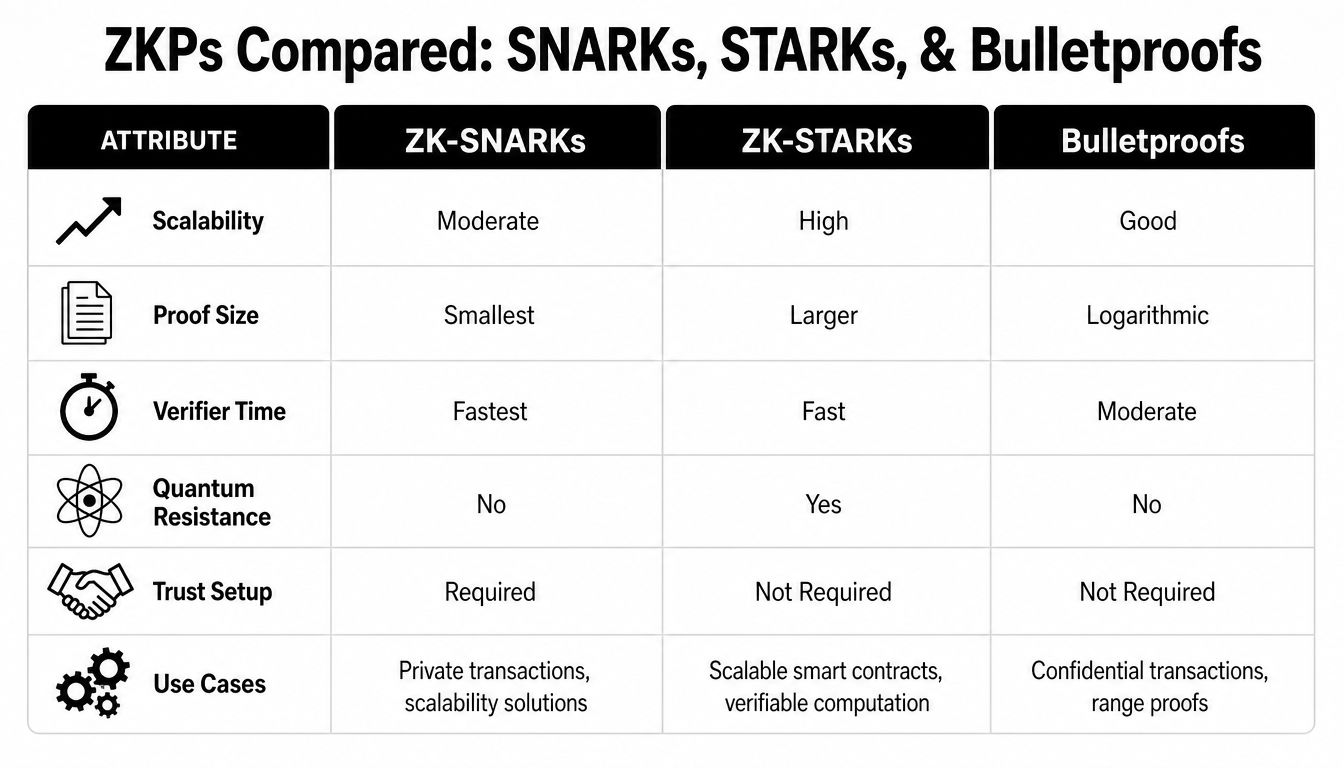
ZKP technology comparison SNARKs vs STARKs vs Bulletproofs
| Attribute | ZK-SNARKs | ZK-STARKs | Bulletproofs |
|---|---|---|---|
| Scalability | Moderate | High | Good |
| Proof size | Smallest | Larger | Logarithmic |
| Verifier time | Fastest | Fast | Moderate |
| Quantum resistance | No | Yes | No |
| Trust setup | Required | Not required | Not required |
| Use cases | Private transactions, scalability solutions | Scalable smart contracts, verifiable computation | Confidential transactions, range proofs |
The biggest conceptual split is trusted setup.
Many SNARK systems require a special initialization ceremony. If that process is compromised and secret material from it is exposed, the system can inherit serious trust issues. STARKs were designed in part to avoid that dependency. According to a 2025 arXiv survey of ZKP frameworks, zk-STARKs avoid trusted setup but require significantly larger proof sizes and higher memory overhead than zk-SNARKs. That's a meaningful trade-off, especially for apps that care about onchain footprint, NFT minting constraints, or timing-sensitive play-to-earn systems.
How to think about the trade-offs
For most readers, the useful question isn't “Which is best?” It's “Best for what?”
ZK-SNARKs
SNARKs are often favored when every byte matters. Small proofs are attractive on public blockchains because data storage and verification efficiency are constant pressures.
They're a natural fit for:
- Privacy-focused transactions
- Rollup verification pipelines
- Applications where verifier speed is a priority
The catch is the trusted setup issue. If you're evaluating a SNARK-based project, you should ask how the setup was performed, who participated, and what assumptions users are being asked to accept.
ZK-STARKs
STARKs appeal to teams that want stronger transparency around setup assumptions.
They often make sense for:
- Large-scale computation proofs
- Rollups that prioritize transparent cryptographic assumptions
- Systems designed with long-term security conservatism in mind
The downside is heavier proofs and more memory overhead. Those costs don't always show up in marketing copy, but they matter for real deployment.
Bulletproofs
Bulletproofs sit in a different part of the design space. They're commonly associated with confidential transactions and range proofs rather than the same rollup-centric narrative that dominates SNARK and STARK discussions.
They can be attractive when teams want no trusted setup and have use cases aligned with transaction privacy. They're not a universal replacement for the other two families.
When you hear “SNARK vs STARK,” don't treat it like a tribal argument. It's an engineering decision shaped by proof size, setup assumptions, memory use, latency, and the kind of application being built.
That's the practical lens most crypto explainers skip. The cryptography matters, but deployment constraints decide what ships.
How Zero Knowledge Proofs Power Web3 Today
The easiest way to understand zero knowledge proofs is to see where they already show up in live crypto systems.
They aren't just a research topic anymore. They're active infrastructure for privacy, identity, DeFi, and scaling.
A major turning point came in 2016, when Zcash launched as the first major cryptocurrency using zk-SNARKs for transaction privacy. By 2023, ZKP adoption had expanded into digital identity, securing over 1 billion digital identity verifications globally, while projects such as Aleo and Polygon zkEVM were processing over 5 million confidential transactions daily according to Chainlink's overview of zero-knowledge proof adoption and applications.
Privacy coins and confidential transactions
Zcash is still the clearest early example of what made people pay attention.
Public blockchains are transparent by default. That's useful for auditability, but it creates obvious privacy problems. Wallet balances, transfer patterns, and network relationships can become visible to anyone willing to analyze the chain. ZKPs changed that by making it possible to validate transactions without exposing all the underlying details.
That's the breakthrough privacy coins introduced to the market. Instead of choosing between “fully public” and “not verifiable,” they demonstrated a middle path. You can keep a ledger trustworthy while limiting what outsiders learn from it.
For investors, this matters because privacy isn't just a niche ideological concern. It affects institutions, treasuries, funds, and businesses that can't publish every operational detail to competitors.
Layer 2 scaling and ZK rollups
The second major use case is Ethereum scaling.
A ZK rollup bundles many transactions together, processes them offchain, then posts a proof back to the base chain showing the batch was computed correctly. Ethereum doesn't need to rerun every transaction one by one. It checks the proof.
That design has obvious implications:
- Lower congestion pressure on the base layer
- More efficient execution for users and apps
- A cleaner path for scaling smart contracts and DeFi
This is one reason zero knowledge proofs became central to the Layer 2 conversation. They aren't just about privacy. They're also about reducing the amount of computation the main chain has to verify directly.
The trend also connects with identity-heavy apps and regulated finance. QuickNode notes that zero-knowledge proofs are being applied to verify transactions in DeFi and blockchain networks by letting institutions confirm customer identities and transaction accuracy without disclosing sensitive data, supporting compliance while preserving privacy.
Decentralized identity and selective disclosure
Identity is one of the cleanest non-trading examples of ZKP value.
A good digital identity system shouldn't force users to overshare. If a platform needs to know whether you're above a certain age, in an allowed jurisdiction, or holding a valid credential, it shouldn't need your full identity file. ZKPs enable selective disclosure. You reveal the minimum fact required, not the whole record.
For those following the rise of wallets, credentials, and compliance-friendly onboarding, zero knowledge proofs become highly practical. They help turn identity from a surveillance tool into a verification layer.
For readers exploring that area further, this guide to blockchain identity verification is a good next read.
A strong decentralized identity system doesn't ask for your entire life story. It asks for the smallest provable fact needed to authorize an action.
That approach becomes even more important as tokenized assets, DAO access controls, and institutional onboarding mature.
Private DeFi and institutional use
ZKPs also address one of DeFi's biggest limitations for serious capital.
Traditional decentralized finance is transparent by design. That's part of the appeal, but it's also a barrier. Institutions often can't expose trading positions, treasury movement, counterparties, or compliance workflows on a public ledger. Zero knowledge proofs make it possible to verify correctness without publishing the underlying strategy.
That opens doors for:
- Confidential smart contracts
- Compliance-aware trading systems
- Treasury management with less public leakage
- Permissioned access layers on public infrastructure
Here's a concise explainer worth watching before you dig further into the architecture:
The broader takeaway is that zero knowledge proofs are helping public blockchains support more serious economic activity. Not by hiding everything, but by letting systems reveal only what they need to reveal.
That distinction is why they've become such a critical bridge between open networks and real-world adoption.
The Hidden Risks and Limitations of ZKPs
A lot of ZKP content stops at the magical part. That's a mistake.
Zero knowledge proofs can be mathematically elegant and still dangerous in deployment. The hard problems often sit outside the headline description of the protocol. They show up in setup ceremonies, implementation shortcuts, randomness failures, side-channel leaks, and the economics of proof generation.
Trusted setup is a real trust problem
Many zk-SNARK systems depend on a trusted setup.
This is usually described as a ceremony that creates public parameters for the proof system. In theory, if the secret remnants from that ceremony are destroyed properly, everything is fine. If they aren't, the system can inherit a toxic trust assumption that ordinary users may never notice.
NIST's Privacy-Enhancing Cryptography work on ZK proof research and protocol use highlights that zero knowledge proofs are used to establish correct behavior in privacy-preserving protocols, while public guidance on practical mitigation for setup-related failures remains limited. That gap matters. Many beginner guides explain what a SNARK does, but not what can go wrong if the setup process is mishandled.
Prover extraction and side-channel leaks
There's another uncomfortable issue. The phrase “zero-knowledge” can make readers think these systems are automatically leak-proof.
They aren't.
Implementation mistakes can create openings where private witness data becomes recoverable or inferable. That's where prover extraction enters the conversation. In qualitative terms, it refers to scenarios where an attacker can reverse-engineer sensitive information from public proofs or surrounding system behavior.
Recent industry reporting described in the earlier comparison source found that 73% of ZKP-based blockchain projects in 2024 to 2025 experienced prover extraction vulnerabilities. That number should reset the way people talk about these systems. “Mathematically strong” does not mean “safe in production by default.”
Security in ZK systems doesn't end with the proof. It extends to randomness generation, hardware behavior, memory handling, libraries, circuits, and every surrounding layer.
That's also why side-channel attacks matter. If a prover leaks information through timing, memory access, or poor randomness, the protocol may preserve its formal definition while the implementation still spills secrets.
Computation costs are easy to underestimate
Another blind spot is cost.
A lot of public discussion focuses on gas fees and ignores where the heavier work often happens. Proof generation can be much more computationally expensive than verification. That matters for rollups, wallets, mobile apps, GameFi systems, and any environment where latency or hardware limits are real product constraints.
In practice, this means teams can't evaluate zero knowledge proofs on elegance alone. They need to ask:
- Who generates the proof
- How expensive that generation is
- Whether the latency fits the user experience
- What hardware assumptions the system makes
- How much complexity developers are introducing
For users and investors, the practical lesson is simple. Don't assume every project with “ZK” in the branding has solved privacy, security, and scalability at once. Some have solved one piece and postponed the hard parts.
The Future From Verifiable AI to Tokenized Assets
The story of zero knowledge proofs starts in theory, but their next chapter is about infrastructure.
The concept emerged from theoretical computer science in 1985, when Shafi Goldwasser, Silvio Micali, and Charles Rackoff formally introduced it. By the 2010s, the field had shifted toward practical systems, with zk-SNARKs becoming the first widely implemented variant and enabling privacy-preserving blockchain applications such as Zcash by 2016, as summarized in Wikipedia's history of the zero-knowledge proof.
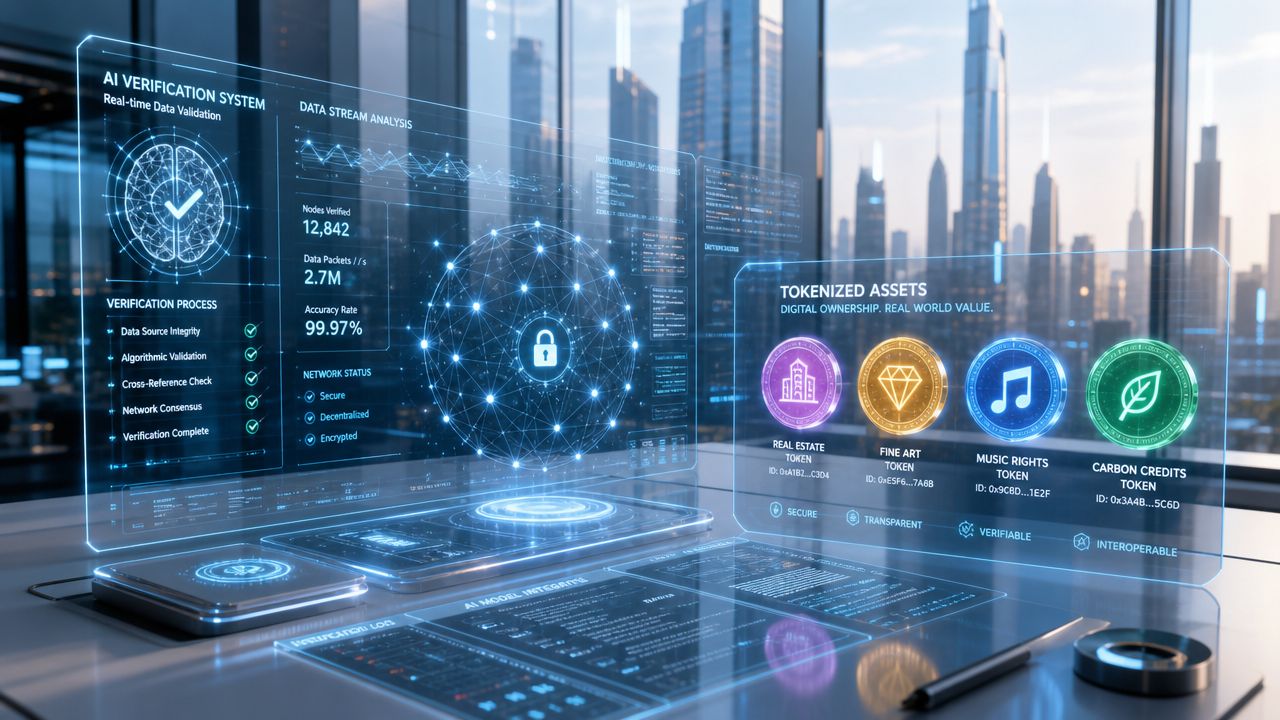
From 1985 theory to a privacy layer for Web3
That arc matters because it shows how unusual this technology is. Very few cryptographic ideas travel from deep theory to live blockchain infrastructure with this much relevance across markets.
Today, zero knowledge proofs are becoming a candidate privacy layer for Web3 itself. They can support open networks without forcing every participant to expose every internal detail. That's useful for DeFi, governance, identity, enterprise adoption, tokenomics design, and cross-chain systems.
Verifiable AI without exposing the model
One of the most interesting frontiers is AI plus crypto.
As AI agents become more active in onchain environments, systems will need ways to verify claims about model behavior, outputs, or compliance without publishing proprietary models and private training data. That's exactly the kind of selective verification ZK systems are good at in principle.
An AI company, for example, could aim to prove that a model produced an output under defined rules without disclosing the model weights. An onchain AI agent could prove it followed a governance or execution policy without exposing every internal decision path.
That future won't be solved by cryptography alone. Governance matters just as much. For readers thinking about autonomous systems and control frameworks, Averta's piece on critical AI agent governance strategies is a strong companion read.
The next trust battle on the internet may not be “Is this AI powerful?” It may be “Can this AI prove what it did without exposing everything behind it?”
RWAs compliance and onchain privacy
The other major frontier is tokenized real-world assets.
RWAs bring traditional finance problems onto public blockchains. Ownership, jurisdiction, accreditation, and compliance all need verification. But asset holders often can't publish sensitive personal or commercial information on an open ledger.
Zero knowledge proofs fit that gap well. They can support workflows where users prove they meet a rule without revealing every underlying document. That could become useful in tokenized funds, private credit, real estate access controls, and regulated transfer restrictions.
If this direction keeps maturing, the long-term role of ZKPs may be bigger than “privacy tech.” They may become a standard method for proving compliance, execution, and legitimacy across digital assets.
For a broader look at where these ideas intersect with security and protocol design, this article on the future of cryptography is worth reading next.
How to Get Involved with Zero Knowledge Proofs
If you've made it this far, the key point is clear. Zero knowledge proofs aren't just a clever crypto primitive. They're becoming core infrastructure for privacy, scaling, identity, and verifiable computation.
The right way to get involved depends on what kind of reader you are.
If you're a developer
Start by learning the workflow, not just the definition.
Look at how teams design circuits, generate proofs, and verify them inside blockchain systems. Focus on practical tooling such as Circom and Cairo, then study how rollups and privacy protocols use them in production. Pay attention to setup assumptions, latency, memory overhead, and the places where secret data can leak outside the proof layer.
A good developer path looks like this:
- Learn the model first: Understand prover, verifier, witness, circuit, and verification flow.
- Study real deployments: Look at Zcash, Polygon zkEVM, Aleo, and StarkNet style architectures.
- Treat security as implementation work: Audit randomness, setup assumptions, and hardware behavior.
If you're an investor or active user
Don't evaluate a ZK project on branding alone.
Ask sharper questions. Is the protocol using SNARKs, STARKs, or another system? Does it rely on trusted setup? What's the user benefit. Lower fees, better privacy, compliance-friendly identity, or confidential DeFi? And just as important, what are the hidden operational risks?
Useful projects to watch are the ones building real products around scaling, identity, private computation, and tokenized assets, not just attaching “ZK” to token narratives.
What to watch next
Three areas stand out for the next wave of adoption:
- Layer 2 ecosystems that use zero knowledge proofs for scalable smart contracts
- Identity and compliance tooling that enables selective disclosure
- AI and RWA infrastructure where proving correctness without exposing data becomes a competitive advantage
The big takeaway is simple. Crypto needs systems that are open enough to verify, private enough to use, and efficient enough to scale. Zero knowledge proofs are one of the few technologies that can plausibly support all three, if teams handle the engineering with care.
Coiner Blog tracks the technologies shaping crypto before they become mainstream talking points. If you want more analysis on zero knowledge proofs, Layer 2 infrastructure, DeFi, AI-blockchain convergence, NFTs, and tokenized assets, explore the latest insights on Coiner Blog.
1 Comment