
Account Abstraction Wallets: The Future of Web3 in 2026

You're probably using a crypto wallet that still feels like early-internet software. You copy long addresses, double-check networks, keep a seed phrase in a drawer, and make sure there's ETH in the wallet before you can do anything on Ethereum. One wrong click can mean a failed transaction, a wasted fee, or a moment of real panic.
That friction matters more than most investors realize. Wallet experience is the front door to Web3, DeFi, Layer 2 apps, tokenized assets, and on-chain gaming. If the wallet is clunky, adoption slows. If the wallet becomes flexible, secure, and easier to recover, the whole market opens up to a much wider audience.
That's why account abstraction wallets have become one of the most important shifts in crypto product design. They change the wallet from a rigid key holder into a programmable user account. For everyday users, the “so what” is simple. You may be able to recover access without a seed phrase, pay for activity with tokens like USDC instead of only ETH, and bundle multi-step actions into something that feels closer to one tap than a mini engineering project.
Table of Contents
- Why Your Crypto Wallet Is About to Get a Major Upgrade
- What Is Account Abstraction Really
- How EIP-4337 Unlocks Account Abstraction on Ethereum
- Practical Benefits for Everyday Users
- Leading Account Abstraction Wallets to Watch in 2026
- How to Get Started with an AA Wallet
- The Future of Web3 Powered by Account Abstraction
Why Your Crypto Wallet Is About to Get a Major Upgrade
Jake buys a token on a DEX, then wants to stake it on a DeFi app. First he signs in. Then he approves the token. Then he confirms the swap. Then he waits. Then he signs again to stake. Somewhere in the middle, he realizes he's low on ETH, even though he holds plenty of stablecoins. That's a normal crypto experience today, and it's still a bad one.
The pain gets sharper when security enters the picture. Traditional wallets put enormous responsibility on one thing: the private key or seed phrase. Lose it, and access may be gone for good. Protect it poorly, and a scammer can drain the wallet. The philosophy behind not your keys, not your coin is still essential, but self-custody doesn't have to mean accepting outdated usability.
Many users started their search for better options by comparing wallet models, including top open-source crypto options that prioritize transparency and control. That's a good instinct. But transparency alone doesn't solve the core UX problem. The wallet itself needs to become smarter.
The next wallet upgrade isn't about prettier interfaces. It's about changing what a wallet can do on your behalf.
That's where account abstraction enters. Instead of forcing every user into the same rigid transaction flow, it lets wallets act more like software products with rules, permissions, and recovery options. You stop thinking of a wallet as a metal key and start thinking of it as a secure app account built for Web3.
For investors, that shift matters because wallets are where retail adoption either stalls or accelerates. Better wallet design can make DeFi, NFT platforms, GameFi, and tokenized real-world assets more approachable. A breakthrough at the wallet layer often ripples upward into every app category built on top of it.
What Is Account Abstraction Really
From a simple key to a smart account
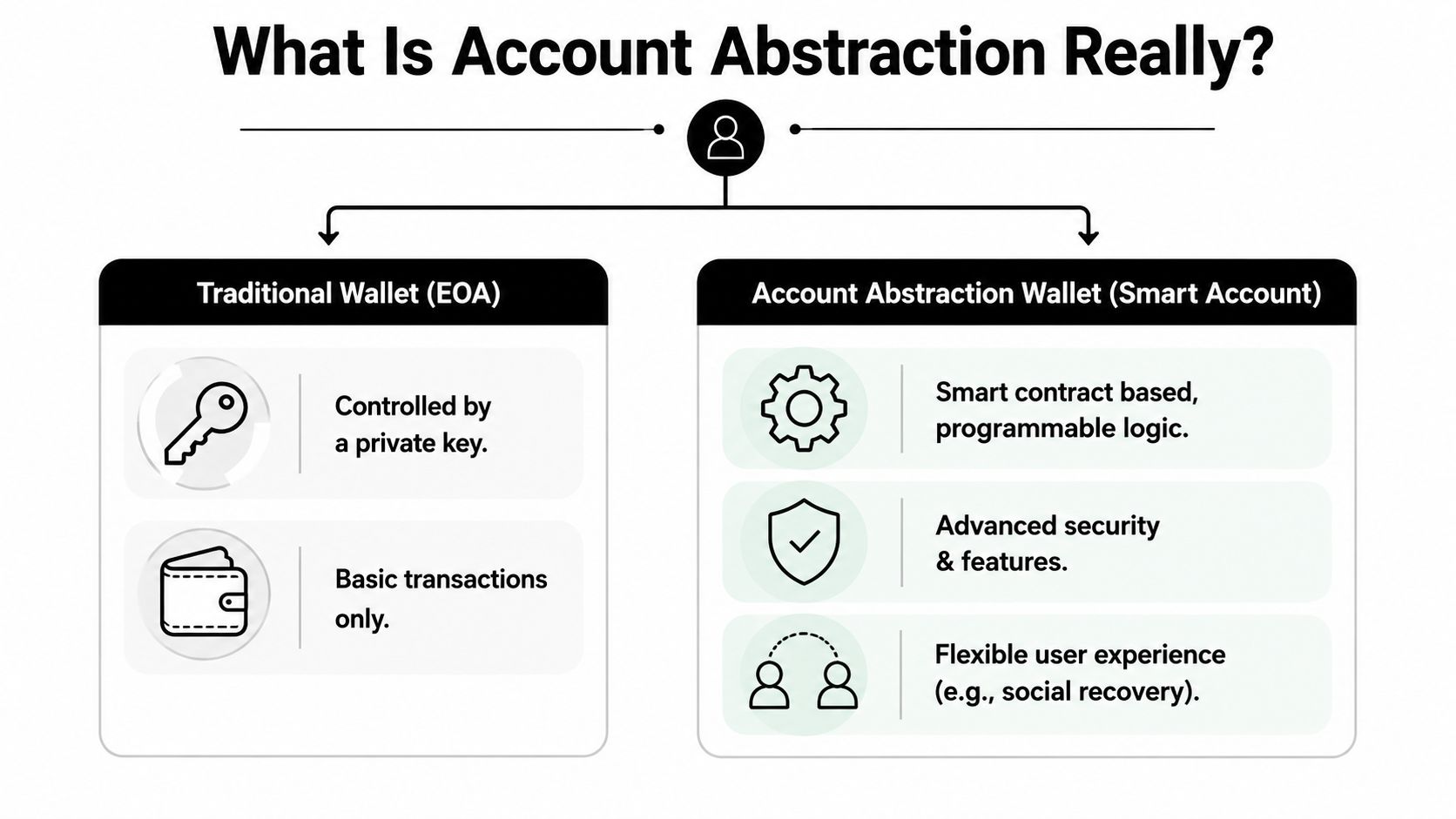
A traditional Ethereum wallet is usually an Externally Owned Account, or EOA. An EOA is controlled by one thing: a private key. If the key is available, the wallet works. If the key is lost or stolen, the account becomes a problem very quickly.
Account abstraction changes that model. Instead of treating the wallet as a bare account controlled only by a signature, it turns the wallet into a smart contract-based account with logic built in. Ethereum's own documentation on account types explains this split between EOAs and contract accounts, and that difference is the foundation of the whole idea.
Here is the simplest comparison:
| Wallet type | Analogy | What it means |
|---|---|---|
| Traditional wallet | A simple house key | One key opens one door. Very little flexibility. |
| Account abstraction wallet | A smart lock | You can set access rules, recovery options, spending limits, and permissions. |
The smart lock comparison matters because it highlights the fundamental shift. A normal wallet asks, “Did the correct key sign this transaction?” An account abstraction wallet can ask better questions, such as, “Is this transaction under the daily limit?”, “Did the user approve it with a passkey?”, or “Can a recovery group help restore access?”
If you want a quick refresher on the logic behind that behavior, it helps to review how smart contracts work on Ethereum. That programmable layer is what lets a wallet behave more like software and less like a fragile key ring.
The Practical Benefits of Programmability
The “so what” is simple. If the wallet is programmable, the user experience can improve in ways that standard wallets cannot match.
That means features people already understand from modern apps can finally show up in crypto wallets too:
- Social recovery: You can assign trusted guardians to help restore access if a device is lost.
- Alternative login methods: Wallets can support passkeys, biometrics, or other approval rules instead of relying on a single secret phrase alone.
- Gas sponsorship: An app or service can cover network fees for the user.
- Batch transactions: Several actions can be grouped into one approval, which makes DeFi flows less clumsy.
- Token-based gas payments: In many setups, users can pay fees with tokens like USDC instead of keeping ETH on hand for every action.
For users, that can mean something very practical. You may no longer have to treat one seed phrase like the only copy of a vault key. You may be able to recover access, set safety rails, and approve transactions in a more familiar way. You may also be able to make a DeFi trade without first buying ETH just to pay gas.
For investors, that shift is significant. Better wallet design reduces friction at the exact point where many new users quit. If onboarding gets easier, DeFi apps, consumer crypto products, gaming, and tokenized asset platforms all have a better chance of keeping users long enough to build real revenue.
There is also a standards layer behind this progress. ERC-4337 gives developers a way to build smart accounts on Ethereum without changing the base protocol. The terms around it can sound technical at first, but the business takeaway is straightforward: Ethereum found a practical path to smarter wallets now, and that makes the wallet layer more investable than it was a few years ago.
How EIP-4337 Unlocks Account Abstraction on Ethereum
Understanding the EIP-4337 process
A new user opens a DeFi app, swaps one token for another, signs once, and the trade goes through without first topping up ETH for gas. To the user, it feels normal. Under the hood, EIP-4337 is what makes that experience possible on Ethereum without changing Ethereum's core consensus rules.
That design choice matters. Instead of waiting for a base-layer protocol change, developers got a practical framework for building smart accounts at the application layer. The result is faster product iteration and a clearer path from wallet research to real user growth.
EIP-4337 introduces a different transaction flow. Rather than sending a traditional transaction directly from an externally owned account, the wallet creates a UserOperation. You can read the formal Ethereum explanation in the ERC-4337 overview from the Ethereum Foundation.
Here are the three parts that matter most:
- UserOperation: the user's signed instruction set. It says what should happen and under what rules.
- Bundler: a service that collects these operations and submits them to the network.
- EntryPoint contract: the shared on-chain contract that verifies and executes the operation through the smart account.
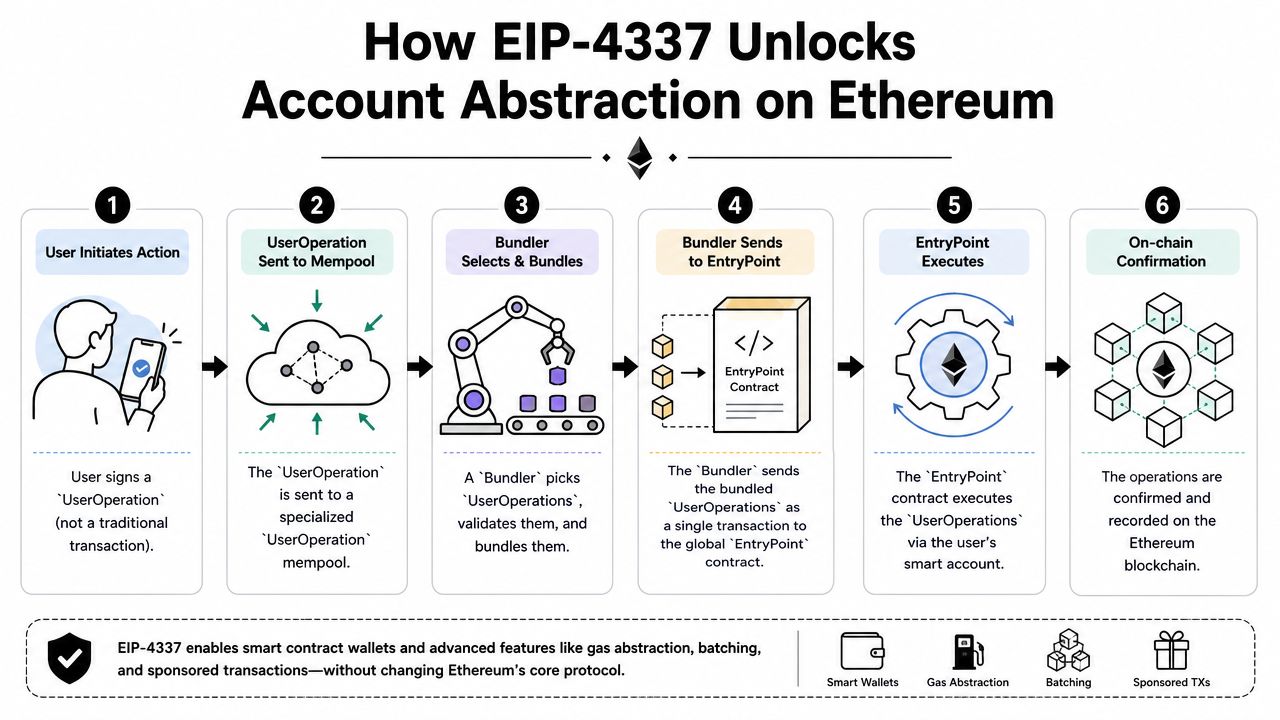
The easiest way to follow the flow is to compare it to a shipping system. A UserOperation is the shipping request. The bundler works like a logistics company that groups many packages efficiently. The EntryPoint is the processing hub that checks whether each package meets the rules before sending it onward.
A simplified flow looks like this:
- The wallet signs a UserOperation that expresses the user's intent.
- A bundler collects that operation and submits it on-chain.
- The EntryPoint validates and executes it through the smart account.
That may sound like extra machinery, but the extra layer is exactly what gives smart wallets their flexibility. The wallet can follow custom verification rules, recovery logic, spending limits, or sponsored fee arrangements while still settling on Ethereum.
For users, the important takeaway is simple. EIP-4337 turns wallets from single-key containers into programmable accounts. That is the technical shift behind more forgiving ownership. It is how you get closer to practical outcomes like recovering access after losing a device, or paying for a DeFi action with a token balance instead of treating ETH as a permanent toll ticket.
For investors, this is a wallet infrastructure story with clear business consequences. Better transaction design reduces failure points at the moment users try to do something valuable. If fewer users get stuck on gas setup, signature friction, or brittle key management, more of them reach the point where swaps, deposits, subscriptions, gaming purchases, and on-chain investing become repeat behavior.
It also fits Ethereum's broader direction. Since the network's move to staking, more innovation has shifted toward modular improvements in wallets, Layer 2s, and app design. For context on that foundation, Ethereum's proof-of-stake transition helps explain why the wallet layer has become a more active area for product and investment attention.
EIP-4337 matters because it changes what a wallet can be. Instead of asking users to adapt to blockchain plumbing, it lets wallet software adapt to users.
Practical Benefits for Everyday Users
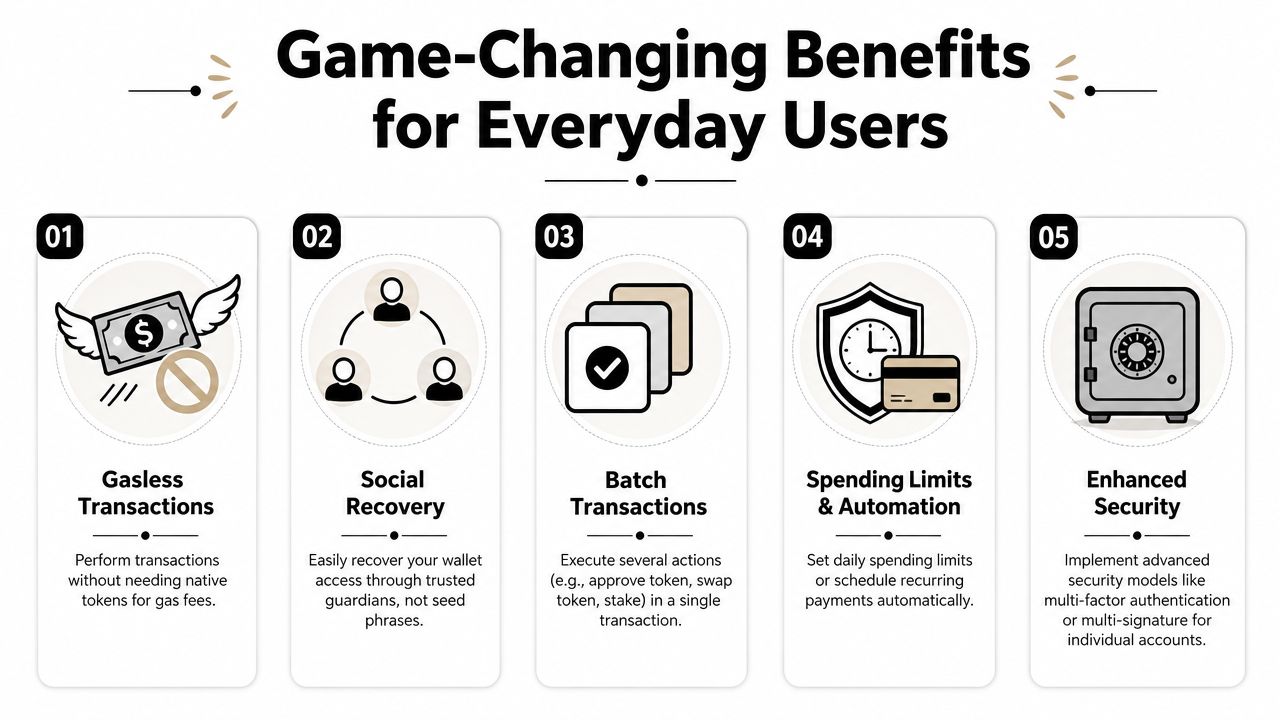
A good way to judge account abstraction is to ignore the acronym for a moment and ask a simple question. What gets better for the person using the wallet?
The answer is practical, not theoretical. Account abstraction makes wallets behave less like fragile key vaults and more like financial apps people already know how to use. That shift matters because adoption rarely stalls on ideology. It stalls when a user gets locked out, cannot pay a network fee, or gives up after signing the same action three times.
Social recovery instead of permanent loss
In a traditional wallet, one lost seed phrase can end the story. The system does not care whether the owner is legitimate, careful, or easy to verify. It checks for the right key and nothing else.
Account abstraction changes that design. A wallet can be set up with recovery rules, including trusted guardians or backup devices, so access can be restored without handing control to a centralized company. The Ethereum.org explanation of smart accounts and recovery options gives a useful overview of why programmable accounts can support these user-defined safeguards.
That is the true "never lose your wallet again" angle investors should pay attention to. It does not mean recovery becomes effortless or risk-free. It means the wallet can reflect how people manage valuable accounts in daily life, with fallback methods and checks that fit the user.
Here is the practical difference:
| Scenario | Traditional wallet | Account abstraction wallet |
|---|---|---|
| Lost primary access | Often catastrophic | Recovery rules can be built into the wallet |
| Backup model | Seed phrase only | Guardians, devices, and custom policies |
| User experience | Brittle and stressful | More forgiving and easier to manage |
Recovery design also works best alongside better security habits. A separate guide on how to avoid common crypto scams and phishing traps fits naturally here, because a smarter wallet reduces mistakes, but it does not replace caution.
Gas sponsorship and token-based fee payments
At this point, the user experience starts to feel much more normal.
A new user might hold USDC and still be blocked from making a trade because the wallet requires a small amount of ETH for gas. To anyone outside crypto, that feels absurd. It is like having money in your checking account but being told you first need a different coin just to press "send."
EIP-4337 allows a paymaster to cover gas on a user's behalf, and it also supports designs where fees are handled in ERC-20 tokens rather than only native ETH. The official EIP-4337 specification describes the paymaster role that makes those sponsored transaction models possible.
For users, the benefit is immediate. A DeFi app can onboard someone without forcing a separate ETH top-up step first. For investors, the implication is broader. Every removed setup step improves the odds that a wallet user becomes an active on-chain customer instead of a stalled signup.
That matters even more in consumer apps, gaming, and tokenized asset platforms, where native gas token friction can crush conversion before the product has a chance to prove its value.
Batch transactions that cut the clutter
DeFi often turns one intention into several approvals and confirmations. Swap a token, deposit it, then stake the position. The user experiences that as repeated friction, even when the underlying goal is simple.
Account abstraction can group multiple actions into one coordinated operation. The Stackup overview of batch transactions with ERC-4337 accounts explains how smart accounts can package steps that would otherwise require separate user signatures and transaction flow.
A simple comparison makes the point:
- Old flow: Approve, wait, confirm, wait, deposit, wait, stake.
- AA wallet flow: Set the goal once, then let the wallet execute the approved sequence.
This saves more than clicks. It reduces uncertainty. Users are less likely to wonder whether they missed a step, signed the wrong prompt, or abandoned the process halfway through.
That is the larger pattern across account abstraction. Each improvement looks small in isolation. Better recovery. More flexible fee payment. Fewer transaction prompts. Put together, they make self-custody easier to keep, easier to fund, and easier to use. For the market, that is how wallet infrastructure starts turning technical progress into repeat user behavior.
Leading Account Abstraction Wallets to Watch in 2026

Argent for mobile-first simplicity
Argent has long stood out by focusing on the wallet experience rather than only the wallet engine. Its appeal is straightforward: make self-custody feel less intimidating. That emphasis makes Argent one of the clearest examples of how account abstraction can serve normal users instead of only crypto power users.
The product is often associated with social recovery, smoother onboarding, and a more app-like interface. For a new entrant to Web3, that matters. A wallet that feels familiar lowers the chance that the user abandons the process before ever reaching a DeFi protocol or NFT marketplace.
Safe for serious security and shared control
Safe, formerly Gnosis Safe, occupies a different part of the market. It's the standard many DAOs, teams, and high-value crypto users already recognize for multi-signature treasury management and shared approvals.
That makes Safe important in the account abstraction conversation because it shows the model isn't only about beginner convenience. It's also about structured control, role-based permissions, and stronger operational security. For capital pools, investment groups, and active on-chain organizations, those features matter as much as smooth onboarding.
Some wallets win by reducing friction. Others win by making control safer and more deliberate. The strongest ecosystem has room for both.
Biconomy and Zerion for the infrastructure layer
Not every winner in this trend will be a wallet brand. Some of the value will accrue to infrastructure providers that help apps integrate account abstraction features directly into their products.
Biconomy is often discussed in that context because it provides tooling and infrastructure around smart account functionality. Zerion, meanwhile, represents the portfolio and wallet experience side of Web3, where better account design can blend investing, asset tracking, and on-chain actions into one interface.
For investors, that's a useful lens. The account abstraction thesis isn't limited to wallet apps. It reaches SDK providers, developer tooling, DeFi front ends, Layer 2 ecosystems, consumer finance experiences, and eventually AI-driven transaction agents operating within tightly defined permissions.
How to Get Started with an AA Wallet
A simple 3-step path for first-time users
If you want to try an account abstraction wallet, keep the first move simple.
- Pick a wallet with a clear consumer experience. Argent is a common starting point because it's designed for ease of use. If you're still comparing options more broadly, this guide to best crypto wallets for beginners helps frame the tradeoffs.
- Create your account and learn the recovery model. Don't rush this part. Read how the wallet handles guardians, device recovery, or passkey-based access before moving funds.
- Test with a small on-chain action. Swap a token, bridge to a Layer 2, or interact with a basic dApp so you can feel the difference in approvals, gas handling, and transaction flow.
A common mistake is treating an AA wallet like a normal wallet with a nicer design. It's better to treat it like a new account model with different powers and different responsibilities.
Resources for developers
Developers should start with the ERC-4337 documentation itself, then review ecosystem tooling from providers building around smart accounts, bundlers, and paymaster flows. Alchemy's educational materials are a useful on-ramp. Biconomy's SDK resources are also worth reviewing if you want to embed AA features into a dApp rather than build wallet infrastructure from scratch.
GitHub is the next stop. Look for repositories tied to smart account SDKs, bundler implementations, and account standards used in production. The most productive way to learn this stack is to follow one complete flow from wallet creation to sponsored transaction execution, then inspect where validation, batching, and account permissions sit in the architecture.
The Future of Web3 Powered by Account Abstraction
Account abstraction looks like wallet tech, but its impact is much broader. It changes how users enter Web3, how DeFi apps design transaction flows, and how developers think about identity, permissions, and automation.
In DeFi, smart accounts make complex strategies easier to package into cleaner user actions. In GameFi and metaverse products, they can reduce the constant interruption of fee management and repetitive approvals. In tokenization, they can make digital asset ownership feel closer to modern financial apps than to raw blockchain tooling.
The AI angle is especially interesting. AI agents managing on-chain actions sound risky when wallets are built around all-or-nothing private key control. They sound far more realistic when the wallet supports limited permissions, spending policies, and programmable execution rules. That could become one of the most important bridges between AI and crypto over the next wave of product design.
Layer 2 networks strengthen the case. Lower fees and faster user experiences make advanced wallet logic more practical, especially for consumer applications. That creates a reinforcing cycle: better wallets make Layer 2 apps easier to use, and better Layer 2 environments make smart wallet features cheaper to deliver.
Investors tracking where this goes next should combine technical understanding with broad ecosystem awareness. Good digital asset market analysis can help frame where wallet innovation intersects with DeFi, AI-linked crypto tools, and real-world asset tokenization.
Account abstraction wallets won't fix every problem in crypto. They do solve one of the oldest and most damaging ones. Web3 has asked users to behave like system administrators for too long. Smart accounts move the experience closer to what mainstream users will accept.
If you want more clear, practical breakdowns on crypto wallets, Ethereum, DeFi, NFTs, blockchain trends, and where Web3 is heading next, explore Coiner Blog. It's a strong destination for readers who want smarter analysis without the hype.