
What Are ERC20 Tokens? Your 2026 Guide
An ERC-20 token is a standard blueprint for creating interchangeable tokens on the Ethereum blockchain, and there are over 1.4 million ERC-20 tokens deployed on Ethereum today. If you've ever opened MetaMask, seen a token balance, and wondered what you own, the short answer is this: you're looking at a smart contract that follows a shared set of rules so wallets, exchanges, and DeFi apps can all understand it.
That shared rulebook is why one token can plug into a wallet, a decentralized exchange, a lending app, and a portfolio tracker without every developer building a custom integration from scratch. It's one of the quiet design decisions that made Ethereum useful far beyond sending ETH.
Beginners usually get stuck on two points. First, ERC-20 tokens are minted, not mined like Bitcoin. Second, they don't sit in your wallet as little digital files. Your wallet reads a balance that lives inside a smart contract's ledger. Once those two ideas click, a lot of Web3 starts to make more sense.
Table of Contents
- The Blueprint That Revolutionized Ethereum
- How ERC-20 Tokens Actually Function
- Popular Examples and Real World Use Cases
- ERC-20 vs ERC-721 and ERC-1155
- How to Safely Interact with ERC-20 Tokens
- The Future of ERC-20 and Tokenization
- Frequently Asked Questions About ERC-20
The Blueprint That Revolutionized Ethereum
Why Ethereum needed a common token language
Before ERC-20, launching a token on Ethereum was akin to selling electronics when every phone used a different charger. A wallet might understand one token, an exchange might support another, and a decentralized app would need custom code for each asset it wanted to handle.
ERC-20 fixed that by acting as a universal slot. If a token follows the standard, wallets and apps know how to talk to it. That's why developers often describe standards as the rules of the road for smart contracts. They reduce guesswork, lower integration friction, and make assets portable across an ecosystem.
For investors, this matters because standardization makes markets deeper and more accessible. For builders, it means less time reinventing token plumbing and more time designing actual products.
Practical rule: A token standard isn't just a technical detail. It's what lets one asset move across wallets, exchanges, dashboards, and DeFi protocols without breaking compatibility.
From GitHub proposal to the backbone of Web3
The ERC-20 token standard was formally proposed by developer Fabian Vogelsteller in November 2015 as the 20th Ethereum Request for Comments on Ethereum's GitHub, then officially approved and implemented in 2017, according to CoinCodex's overview of Ethereum ERC-20 tokens. That proposal standardized fungible token creation on Ethereum and introduced a unified API for smart contracts.
In plain language, that API gave token contracts a shared way to do a few essential things: move tokens between accounts, check balances, inspect supply, and let third parties spend tokens with permission. Because of that common interface, tokens such as MKR, UNI, AAVE, and USD Coin (USDC) could work across wallets and decentralized applications without each app building a one-off integration.
That sounds simple, but the effect was huge. ERC-20 helped fuel the ICO era, then became core infrastructure for DeFi, Web3 apps, and tokenized assets more broadly. If you've read about stablecoins, governance tokens, or even the broader idea of crypto tokenization and what it means for ownership, you've already been looking at the world ERC-20 helped create.
How ERC-20 Tokens Actually Function
The six functions every ERC-20 must support
At the code level, ERC-20 isn't magic. It's an agreement about what functions a token contract must expose so every wallet and app can use the same commands.
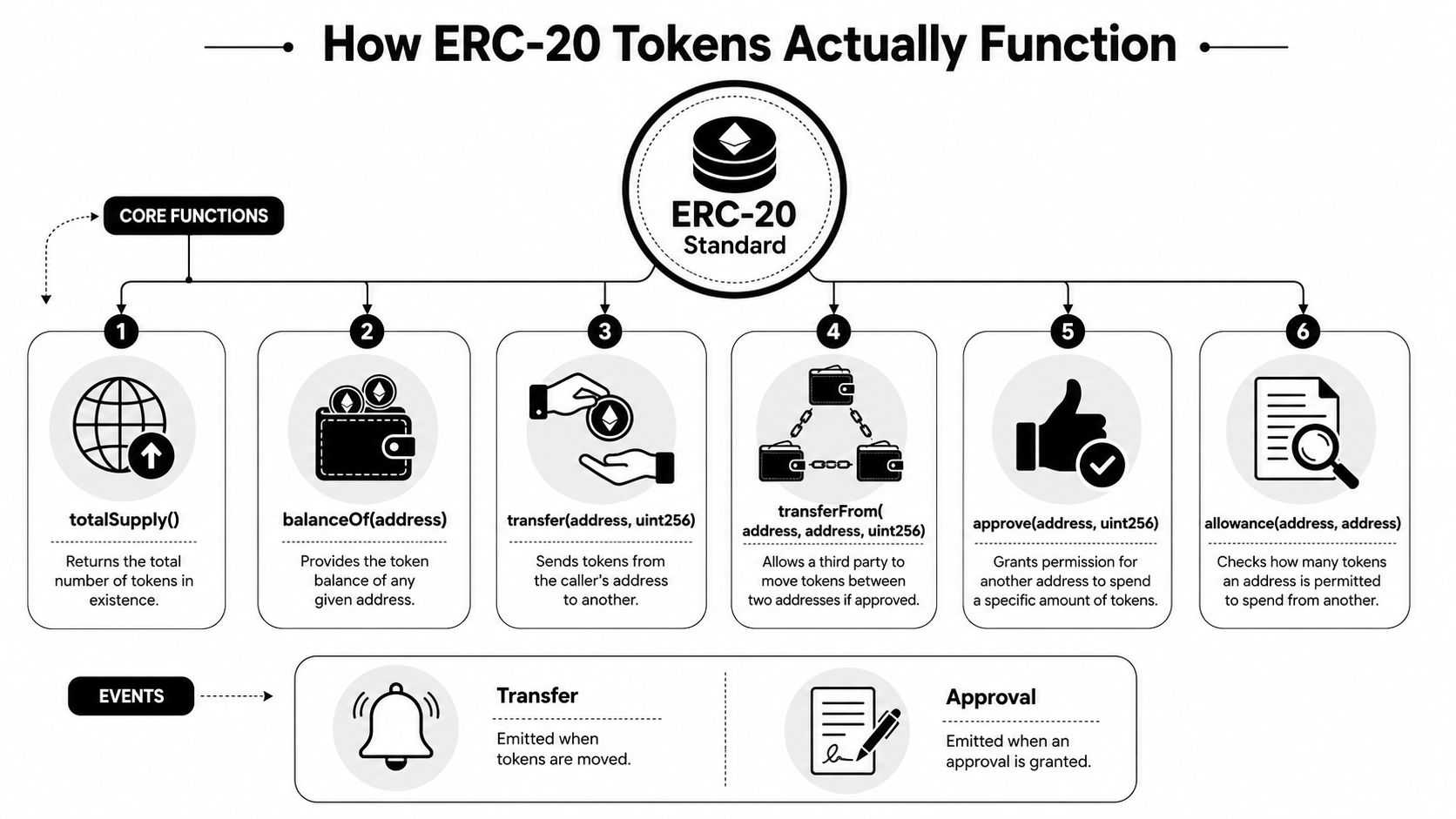
According to Ethereum.org's ERC-20 documentation, every compliant ERC-20 token must implement six mandatory functions: totalSupply(), balanceOf(), transfer(), transferFrom(), approve(), and allowance(). Those functions standardize supply tracking, balance lookups, direct token transfers, delegated spending, and spending limits.
A good analogy is a basic banking interface:
- totalSupply() checks how many units exist in total.
- balanceOf() asks, “How much does this address have?”
- transfer() sends tokens directly to someone else.
- approve() gives a third party permission to spend up to a set amount.
- allowance() checks how much permission remains.
- transferFrom() lets the approved third party move tokens within that allowance.
This is why DeFi works at all. An automated market maker, lending protocol, or staking app can interact with different ERC-20 assets through the same predictable interface. If you want a softer entry into the mechanics behind that, this primer on what a smart contract is and how it works helps connect the token layer to the code layer.
Why approve and transferFrom confuse so many people
The most misunderstood part is the approve plus transferFrom pattern. People often think a decentralized app “takes” tokens from a wallet directly. That's not what happens.
When you approve a dApp, you're telling the token contract that a specific address may spend up to a certain amount on your behalf. Later, the dApp calls transferFrom() to move some or all of that approved amount. It's closer to authorizing a payment processor than handing over your private keys.
That model powers common DeFi actions. Swapping on a DEX, depositing into a lending market, or moving assets into a yield strategy usually begins with an approval. If you want to see how this logic shows up in practice, Yield Seeker has a useful piece on how smart contracts automate stablecoin yield, which makes the approval flow easier to visualize in a real DeFi context.
Approvals don't move tokens by themselves. They create permission. The movement happens only when a contract later uses that permission.
Beyond the six functions, compliant ERC-20 contracts also emit two required events: Transfer and Approval, as explained in Eco's overview of the ERC-20 standard. These events let wallets, explorers, and analytics tools watch token movements and approval changes in real time without constantly polling contract storage.
Where your tokens really live
This is the mental model beginners need most. You don't hold ERC-20 tokens as files inside MetaMask, Rabby, Ledger Live, or another wallet app. The smart contract keeps the ledger. Your wallet just reads the contract's balance mapping for your address and displays the result.
So when you “send” an ERC-20 token, the network isn't moving a coin-shaped object from one digital pocket to another. The contract updates two entries in its internal accounting. One balance goes down, another goes up, and the Transfer event tells outside apps what changed.
That difference matters because it explains gas costs, approvals, and many security failures. If the contract is flawed, paused, or exploited, your wallet display doesn't protect you. The wallet is a viewer and signer. The contract is where the token logic lives.
Popular Examples and Real World Use Cases
A lot of readers asking what are ERC20 tokens aren't really asking about code. They're asking where these things show up in the wild, and why anyone uses them.
Stablecoins as on-chain dollars
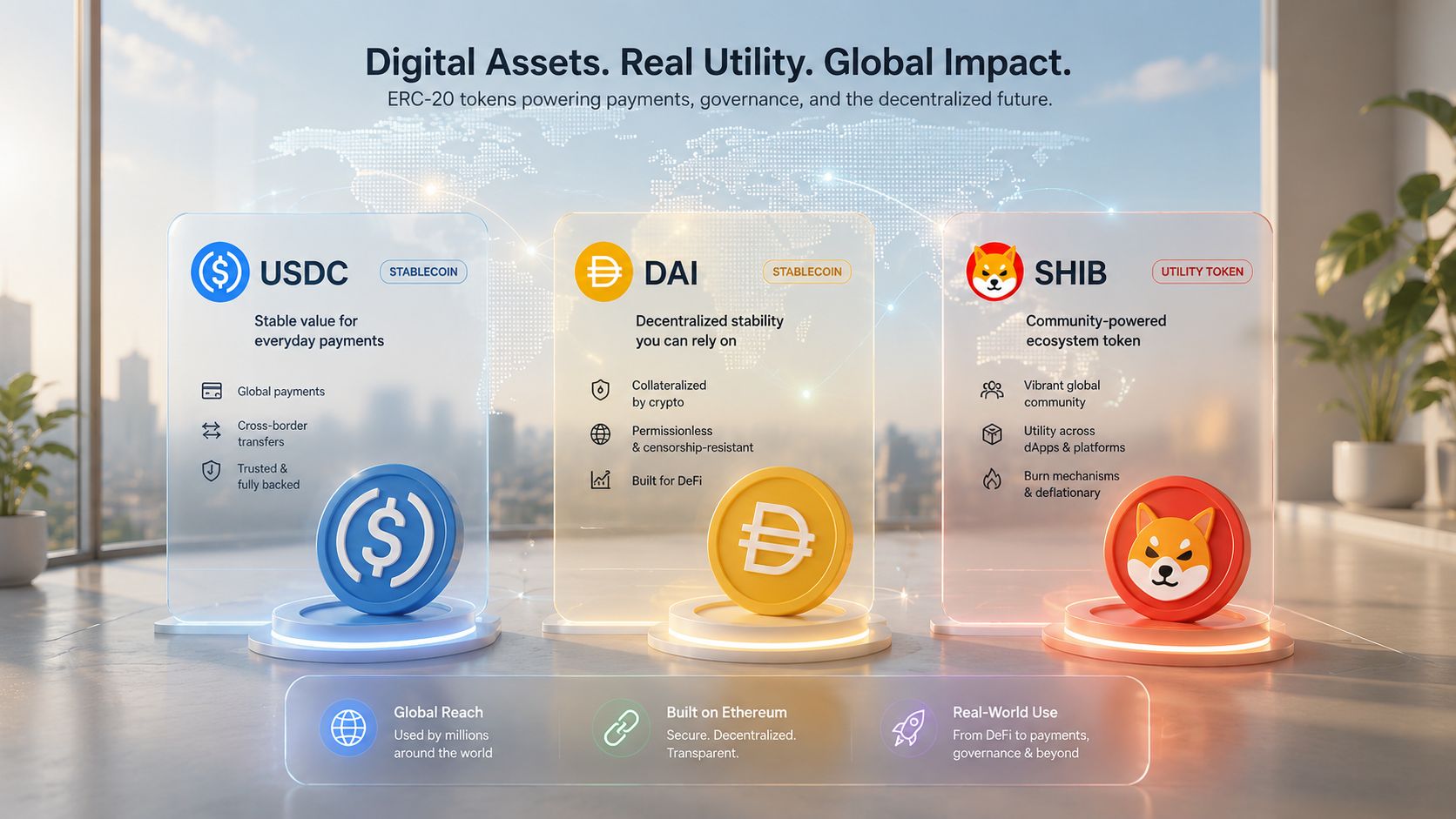
USDC is one of the clearest examples. In practice, many traders and DeFi users treat stablecoins as their working cash balance on Ethereum. They use them to move between exchanges, park funds between trades, supply liquidity, or hold dollar-like exposure without exiting to a bank.
That role makes stablecoins the bridge between traditional finance and Web3 activity. They're often the asset people borrow, lend, swap into, or use as collateral. In volatile markets, they also become a defensive tool.
Governance tokens in DeFi
UNI and AAVE represent a different category. These are commonly called governance tokens because they can give holders a say in protocol decisions, such as treasury use, parameter changes, or feature rollouts.
Owning one of these tokens isn't the same as owning equity in a company. It's closer to holding voting chips inside an on-chain system. For active DeFi users, that can matter because token governance shapes the rules of the platforms they rely on.
A governance token also reflects a broader idea in Web3. Users aren't always just customers. In some protocols, they can also become participants in decision-making.
Utility tokens that power services
Some ERC-20 tokens exist mainly to power a service rather than track dollars or governance rights. A common example in crypto is the utility token model, where the asset is tied to access, incentives, payments, or coordination within a network.
That's why people often call ERC-20 assets programmable money. The same standard can represent a stable asset, a voting tool, a rewards token, or the fuel for a decentralized service. AI and crypto projects, GameFi economies, and tokenized real-world systems often build on this exact flexibility.
This short explainer gives a visual walkthrough of how token standards fit into the broader Ethereum ecosystem:
The important question isn't just “Is this an ERC-20?” It's “What job does this token do inside its system?”
ERC-20 vs ERC-721 and ERC-1155
The fastest way to clear up token confusion is to compare standards by what kind of asset they describe.
Fungible means interchangeable
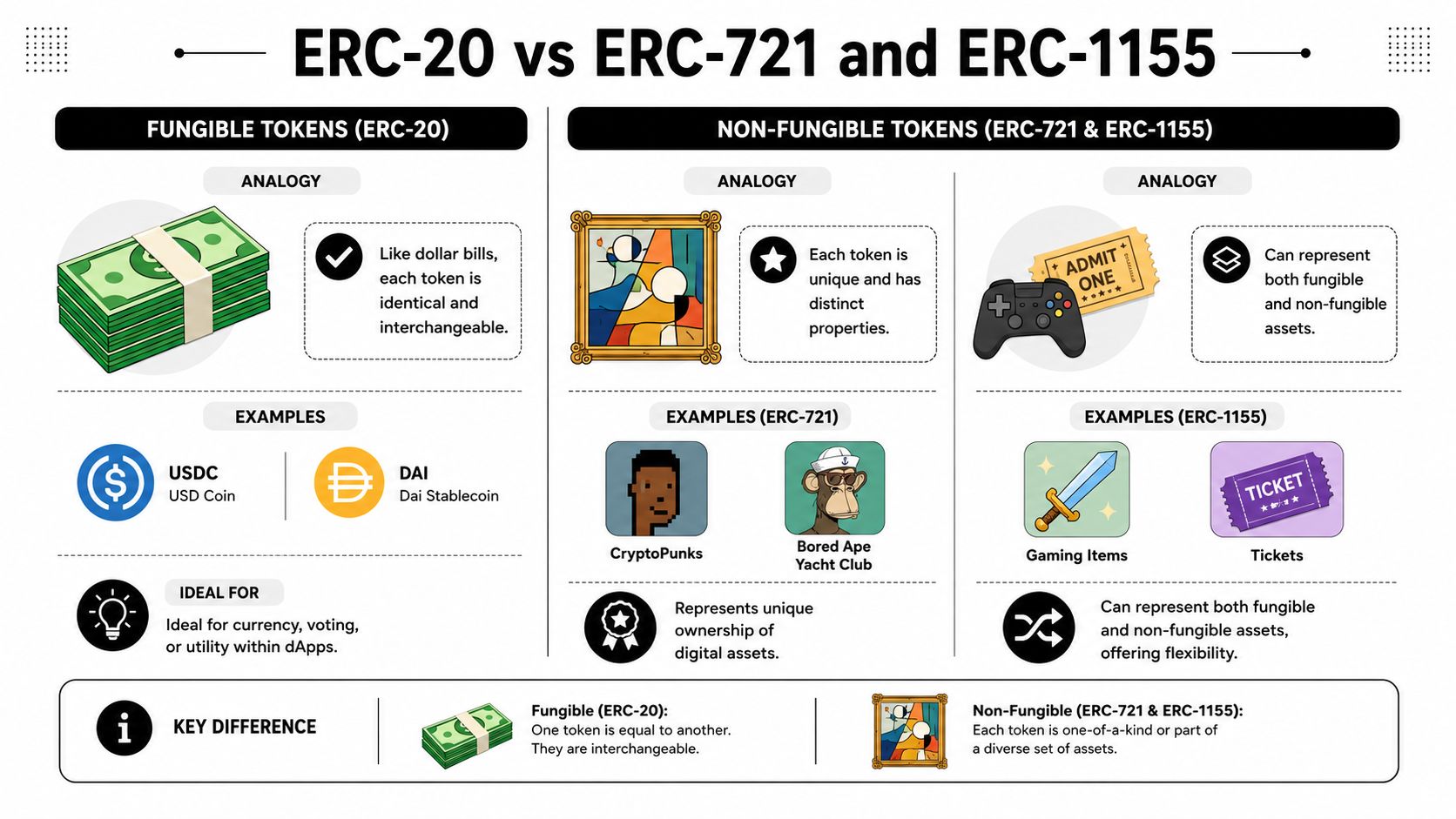
ERC-20 tokens are fungible. One unit is meant to be equivalent to another unit of the same token, just like one dollar bill is interchangeable with another dollar bill.
That makes ERC-20 ideal for assets used as money-like units, accounting units, voting units, rewards, or protocol balances. DeFi needs this property because liquidity pools, lending markets, and trading pairs all depend on interchangeable units that software can treat the same way.
Here's the clean comparison:
| Standard | Asset type | Mental model | Common uses |
|---|---|---|---|
| ERC-20 | Fungible | Dollar bills | Stablecoins, governance, utility tokens |
| ERC-721 | Non-fungible | Unique artwork or a one-off ticket | NFTs, collectibles, identity-like assets |
| ERC-1155 | Mixed model | A book of coupons with different item types | Gaming items, tickets, mixed asset systems |
When unique assets need different standards
ERC-721 is for unique assets. Each token has its own identity, so one isn't interchangeable with another. That's why ERC-721 fits digital art, collectible avatars, and certain ownership records better than ERC-20.
ERC-1155 sits in the middle. It can represent both fungible and non-fungible assets under one contract, which makes it attractive in gaming and ticketing systems. A game might use it for stackable potions, rare swords, and event passes without deploying a separate contract for every item type.
The practical takeaway is simple. If you're building a money-like system, DeFi protocol, stablecoin, or governance layer, ERC-20 is usually the right fit. If you're representing uniqueness, provenance, or item-specific traits, another standard makes more sense.
How to Safely Interact with ERC-20 Tokens
ERC-20 made token creation easy. It also made it easy for anyone to deploy junk, scams, and unsafe contracts. That's the tradeoff of an open system.
According to Nerochain's ERC-20 market analysis, there are over 1.4 million ERC-20 tokens deployed on Ethereum. The same analysis says a review of nearly 100,000 ERC-20 tokens found that only 1 out of every 5 (20%) launched tokens met basic security requirements for holders, meaning nearly 80% failed essential checks. It also notes that among that secure 20%, the majority die within the first hour of launch due to weak holder participation and low transaction activity.
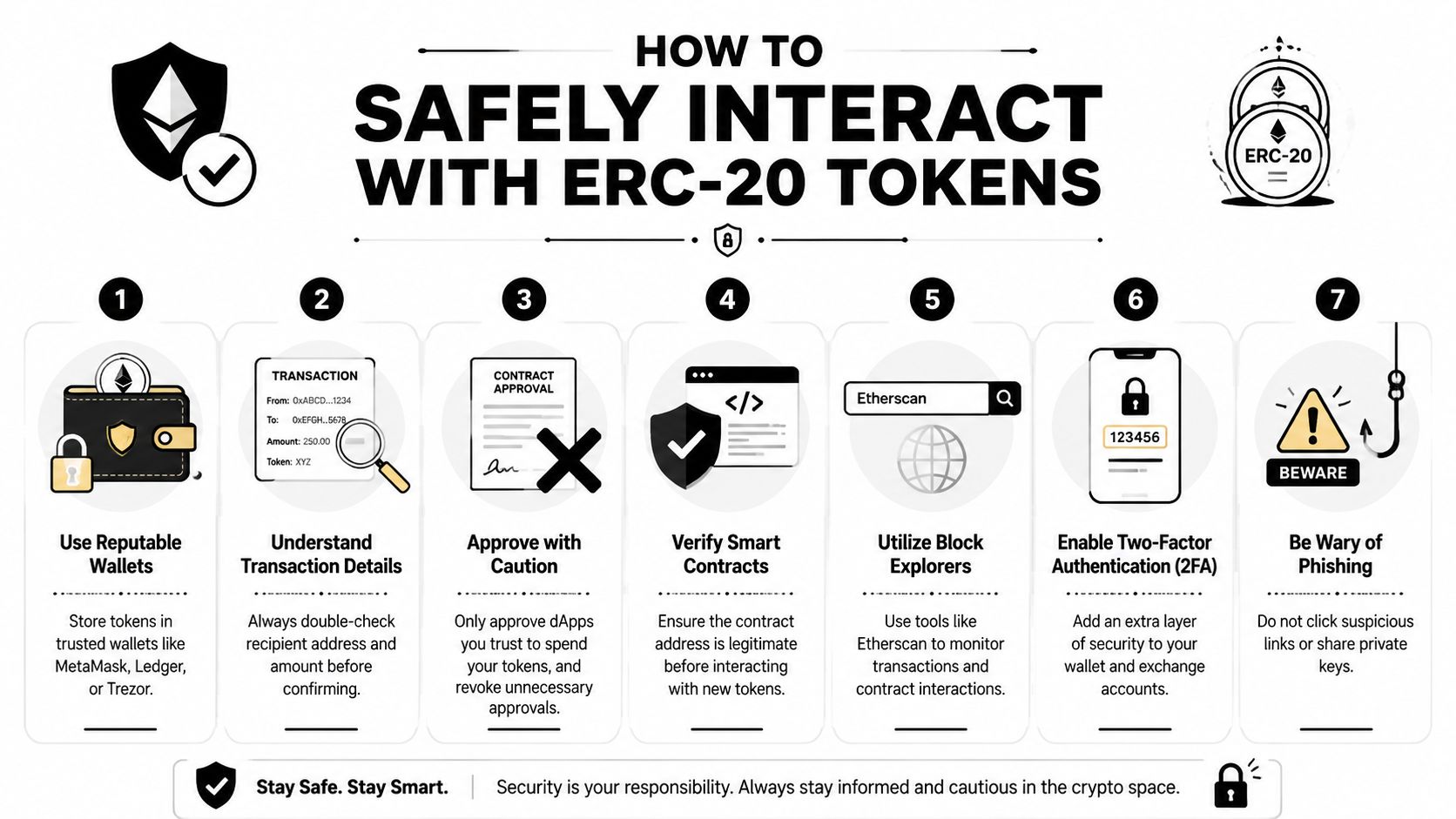
Basic wallet habits that prevent expensive mistakes
The first line of defense is still boring operational discipline.
- Use established wallets: MetaMask, Rabby, Ledger, and Trezor are widely used because large communities pressure them to improve security and UX.
- Check the contract address: Don't trust a token name or logo. Scam tokens often mimic popular brands.
- Read the transaction prompt: Look for what you're signing, not what you think you clicked.
- Keep custody clear: If your assets sit on an exchange, you're depending on that platform's controls and solvency. The old principle still matters, and why “not your keys, not your coin” keeps coming up in crypto is worth understanding in full.
If you trade across apps, a wallet basics refresher helps. Polycool's essential guide for prediction market traders is framed around prediction markets, but the wallet custody concepts apply just as well to ERC-20 usage in DeFi.
Approvals are useful and dangerous
The biggest hidden risk in normal ERC-20 usage is the approval system discussed earlier. Unlimited or forgotten approvals can turn a routine interaction into a future problem if the approved contract is later compromised or behaves maliciously.
A good working habit is to treat approvals like open tabs on your bank account.
- Approve only what you need: If an app allows a custom limit, consider using it.
- Revoke stale permissions: After you're done with a protocol you no longer use, remove access.
- Separate wallets by purpose: Many experienced users keep one wallet for long-term holdings and another for active DeFi experimentation.
If a dApp asks for token spending rights, you're not just clicking a button. You're changing who the token contract is willing to trust on your behalf.
How to inspect a token before touching it
Before swapping or depositing a token, check a block explorer such as Etherscan. You want to confirm the contract address, recent transfers, holder activity, and whether the token you see in a wallet or social post matches the actual deployed contract.
A few red flags should slow you down:
- Unclear origin: No reliable project page, no clear team context, no transparent purpose.
- Strange prompts: Approval requests that don't match the action you intended.
- Lookalike branding: Slightly altered ticker symbols or copied logos.
- Rush tactics: Pressure to act instantly because a token is “about to explode.”
You won't eliminate risk in Web3. You can reduce avoidable mistakes by assuming every new token interaction deserves verification.
The Future of ERC-20 and Tokenization
ERC-20 still matters because it solved a basic but durable problem: how to make digital assets interoperable across a large ecosystem of wallets, apps, and markets. That design keeps paying dividends as Ethereum expands.
Layer 2 networks extend the standard
Layer 2 networks such as Arbitrum and Optimism matter here because they let developers and users keep the familiar Ethereum token model while reducing some of the cost and congestion pain of mainnet. The standard remains recognizable, while the user experience often becomes more practical for trading, gaming, and smaller-value interactions.
That's one reason ERC-20 keeps showing up in new corners of Web3. Builders don't have to abandon the standard to experiment with faster or cheaper environments.
Tokenization moves beyond crypto-native assets
The next frontier is broader tokenization. Real-world asset projects often use token standards to represent claims, shares, or exposure to things outside crypto-native markets. That could include forms of credit, funds, or property-linked structures, depending on the legal design.
The bigger point is that ERC-20 isn't only about speculative altcoins. It's a framework for digital units that software can move, track, and combine. That's relevant to DeFi, on-chain treasuries, AI-linked payment rails, and parts of finance that are becoming more programmable.
As this grows, security literacy becomes more important, not less. A useful companion topic is understanding scammer tactics like phishing, because many crypto losses still begin with ordinary social engineering rather than exotic blockchain bugs.
Frequently Asked Questions About ERC-20
Are ERC-20 tokens mined like Bitcoin
No. ERC-20 tokens are minted, not mined.
According to OpenZeppelin's ERC-20 documentation, ERC-20 tokens are fungible assets stored within smart contracts rather than user accounts, and the contract maintains the balance ledger. Unlike Bitcoin or other mineable cryptocurrencies, ERC-20 tokens cannot be mined. They are minted when a smart contract is deployed, usually with a predefined total supply, and are often distributed through ICOs or Token Generation Events.
That difference matters for tokenomics. With Bitcoin, issuance comes from mining rules. With an ERC-20 token, supply depends on how the contract was written and whether the design allows additional minting later.
Why do ERC-20 transfers require ETH
Because the transfer runs on Ethereum.
Even if you're sending USDC or another ERC-20 token, the transaction still consumes Ethereum network resources. The gas fee is paid in ETH, not in the token being transferred. That's why people sometimes hold a stablecoin balance but still can't move it until they add a little ETH to the wallet.
This also ties ERC-20 usability to Ethereum's network conditions. When the chain gets busy, token transfers can become more expensive.
Are all Ethereum tokens ERC-20
No. ERC-20 is the main standard for fungible tokens, but Ethereum supports other standards too.
ERC-721 is widely used for unique NFTs. ERC-1155 supports mixed asset types, especially in gaming and ticketing. There are also many other Ethereum standards for narrower use cases. So when someone says “Ethereum token,” the next question should be, “Which standard?”
If you want more clear, practical breakdowns like this, Coiner Blog publishes beginner-friendly and investor-aware guides on Ethereum, DeFi, tokenomics, NFTs, GameFi, and the fast-moving edges of Web3.