
What Does EIP Mean? a 2026 Guide to Ethereum Proposals

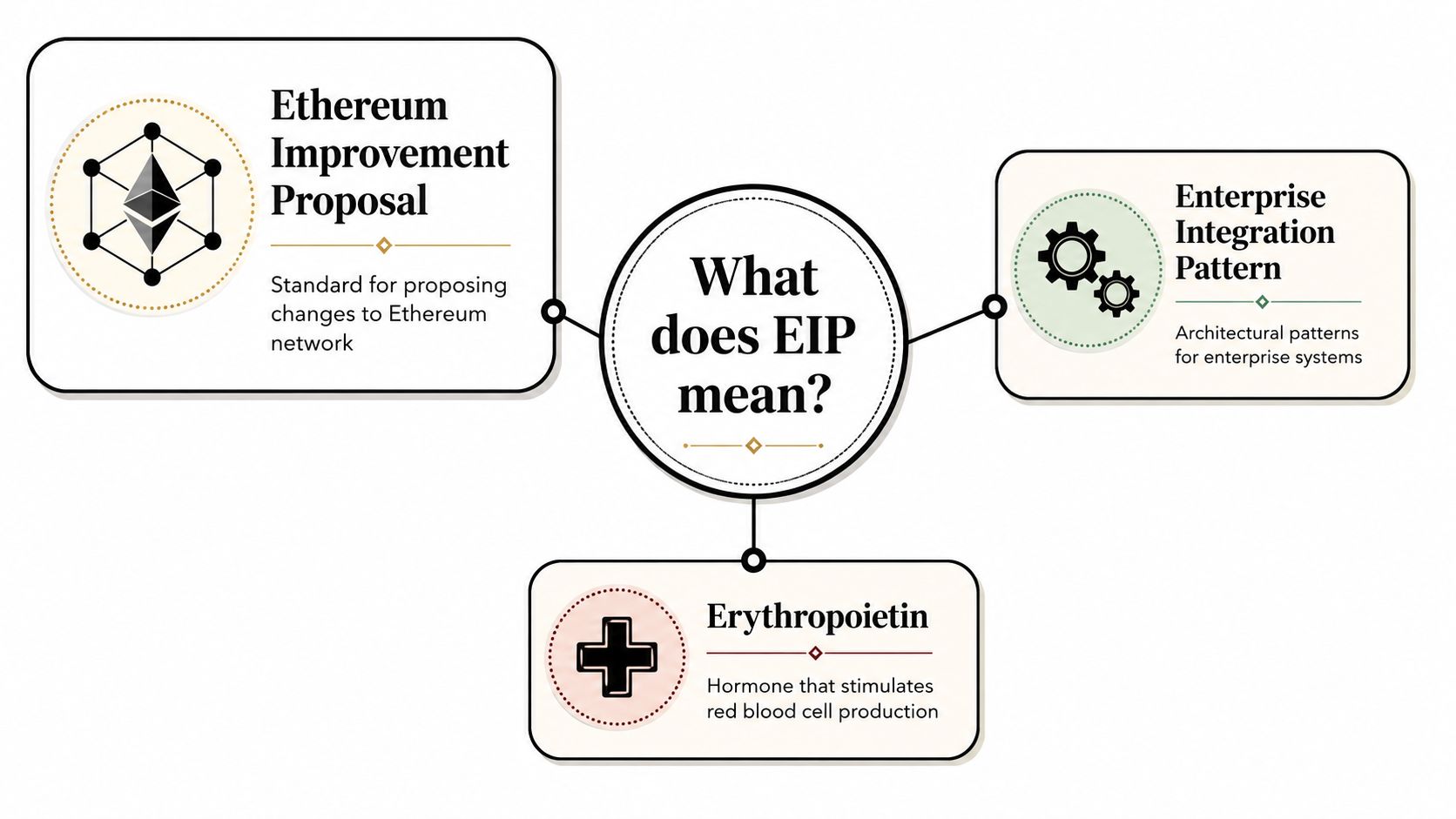
In crypto, EIP stands for Ethereum Improvement Proposal, a formal document and process for proposing changes to Ethereum's protocol, standards, and client APIs, introduced in October 2015. In computing, EIP can also mean the 32-bit Extended Instruction Pointer, so context decides which meaning applies.
What does EIP mean when you see it in a wallet guide, a token discussion, or a developer thread? The short answer is that the acronym is simple, but the consequences can be very different depending on whether the topic is Ethereum governance, low-level CPU behavior, or another field entirely.
Table of Contents
- Understanding What EIP Means Across Different Contexts
- How the Ethereum Improvement Proposal Process Works
- Types of EIPs and the Difference Between EIP and ERC
- Notable EIPs That Changed Ethereum and Crypto
- How to Read and Track EIPs That Matter to You
- Practical Implications for Users Developers and Investors
Understanding What EIP Means Across Different Contexts
In Ethereum, EIP most commonly means Ethereum Improvement Proposal. It is the formal way people propose changes to Ethereum's rules, standards, and technical interfaces. The format was introduced in October 2015, borrowing ideas from both Bitcoin Improvement Proposals and Python Enhancement Proposals. That matters because Ethereum does not depend on one company to decide upgrades, it uses open proposals that the community can review, debate, and adopt. The proposal document is structured, usually with an abstract, motivation, specification, rationale, and security considerations, so reviewers can examine the change before anyone ships it.
Why context changes the meaning
The same letters can mean very different things outside crypto. In computing, EIP also means Extended Instruction Pointer, the 32-bit register in x86 architecture that points to the next instruction a processor will execute. In that setting, EIP has nothing to do with governance. It relates to CPU control flow, debugging, and exploit analysis. The acronym can also appear in other fields, so the surrounding conversation usually tells you which definition applies.
A quick way to avoid confusion is to look at the surrounding nouns. Words like Ethereum, tokens, NFTs, wallets, clients, and protocol upgrades usually point to Ethereum Improvement Proposal. Words like registers, memory, assembly, and instruction flow point to the Extended Instruction Pointer meaning.
Practical rule: if the discussion is about blockchain rules or app standards, think Ethereum. If it is about machine code or crashes, think CPU architecture.
A good plain-language explainer should break down complex terminology without flattening the differences, and that matters here because the acronym looks familiar but points to unrelated systems. Once you spot that pattern, you can read a headline or forum post and tell whether the topic is network governance or low-level systems behavior. That first distinction saves a lot of confusion later.
How the Ethereum Improvement Proposal Process Works
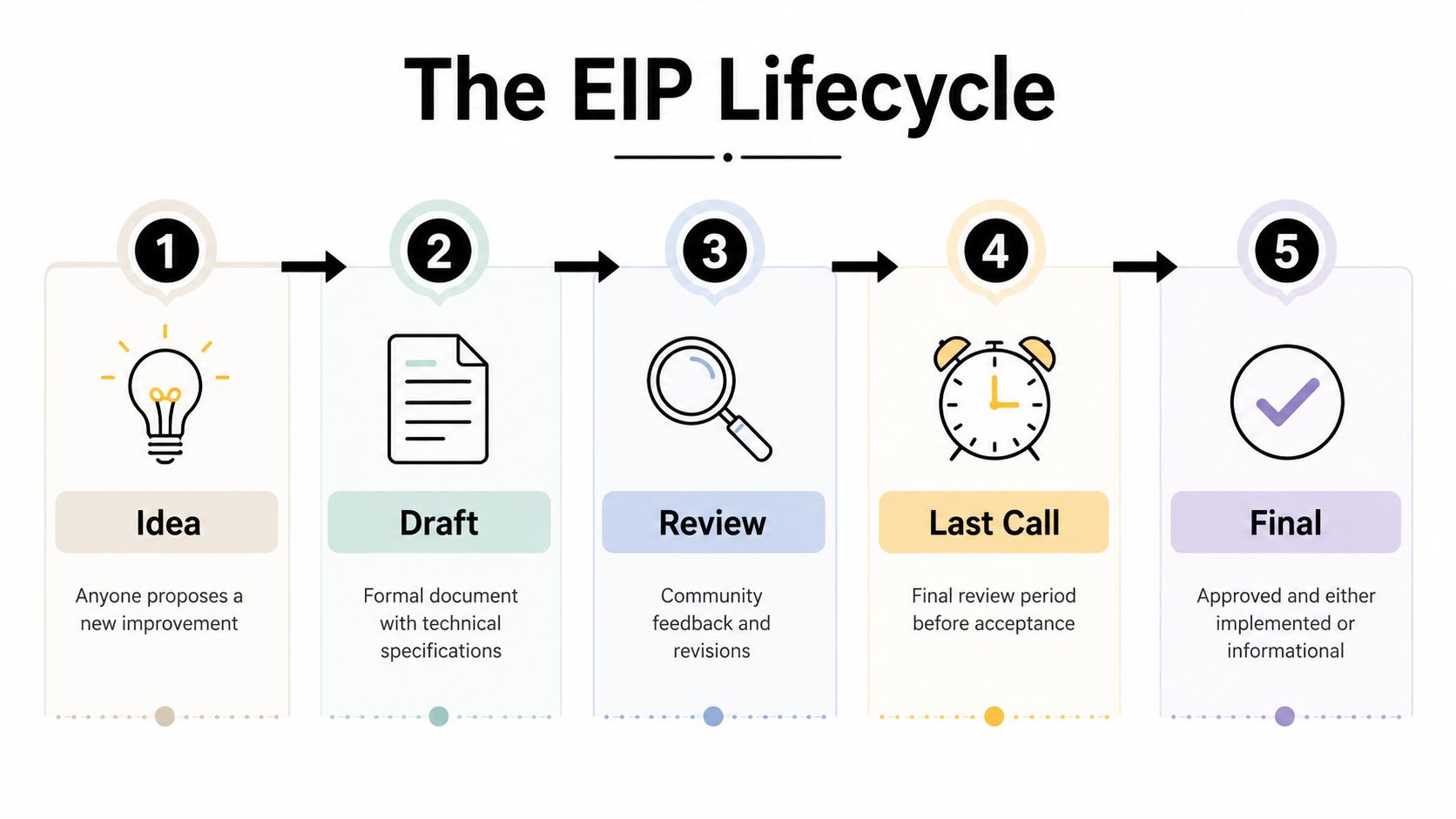
An EIP starts as an idea, but it only becomes meaningful if other people can review it in public. That is the core of Ethereum's governance style. Instead of relying on a closed committee, Ethereum routes technical change through a proposal process that lets developers argue over details before the network commits to anything. The result is slower than a top-down decision, but it is also more transparent.
From draft to final status
A typical proposal begins as a draft, where the authors write out the problem, the proposed change, and the technical specification. At that stage, the document is still a work in progress, and other contributors can challenge assumptions or suggest edits. The proposal then moves through review, where community feedback sharpens the design and exposes edge cases.
Why this matters: the review process is where bad assumptions get caught before they turn into network problems.
Later stages mark how close the idea is to adoption. A proposal can sit in review for a long time if the tradeoffs are unclear, or it can move faster if the change is narrow and the technical path is obvious. Some proposals affect only documentation or standards, while others influence how wallets, nodes, and applications behave. That is why an EIP's status matters as much as its title.
For readers who want to understand this kind of open technical scrutiny more broadly, peer review for innovation is a useful mental model. The exact details differ from Ethereum's process, but the underlying idea is similar, public feedback makes the result stronger.
Why some proposals take longer than others
An EIP can drag on when it touches compatibility, security, or user experience. Ethereum has a large ecosystem, so even a small design choice can have ripple effects across wallets, DeFi apps, Layer 2 networks, and infrastructure providers. If a proposal changes how transactions are priced or how smart contracts are interpreted, the community has to test not just whether it works, but whether the ecosystem can absorb it.
The process is also a record of compromise. A proposal may begin as a technical fix, then evolve into a narrower version that more people can support. That is normal in decentralized systems. The visible back-and-forth is not a sign of weakness, it is part of how Ethereum turns disagreement into implementable code.
Types of EIPs and the Difference Between EIP and ERC
Not every EIP changes Ethereum's core protocol. That is where many readers get tripped up, because the acronym covers several proposal types, not one narrow category. The cleanest way to think about it is that EIP is the umbrella term, and ERC is one important subset focused on application-layer standards.
The main EIP categories
Standards Track EIPs define changes that affect how Ethereum works or how software on top of Ethereum should behave. These can cover network rules, wallet behavior, client APIs, and smart-contract standards. They are the proposals most developers and users care about when they ask whether a change will affect fees, tooling, or app compatibility.
Meta proposals deal with the EIP process itself. They are about governance mechanics, not token behavior or gas costs. Informational proposals are different again, because they describe guidance or background without forcing a protocol change.
Read the title before you read the details. If the proposal is informational, it may educate you. If it is standards track, it may change what your software needs to support.
Where ERC fits
An ERC, or Ethereum Request for Comments, is a kind of standards-track EIP focused on application-level standards. That is why famous token formats and NFT formats live in this family. People often say “ERC” when they mean token standard, but technically those standards sit under the broader EIP framework.
That distinction matters for investors and users. A core protocol EIP can change how the chain itself behaves, while an ERC-style standard can change how wallets, apps, and smart contracts interact. If you have ever wondered why some tokens show up cleanly in a wallet while others require custom handling, that is the sort of practical difference this framework helps explain. For a deeper look at token standards, see this overview of ERC-20 tokens.
The simplest test is practical. If an EIP changes consensus, fee mechanics, or client behavior, it sits closer to infrastructure. If it defines how a token or NFT should behave across apps, it sits closer to the application layer. That is the difference between “network upgrade” and “shared standard.”
Notable EIPs That Changed Ethereum and Crypto
Some EIPs are easy to ignore until they land in your wallet or dashboard. Then they become impossible to miss. The biggest ones did not just improve developer ergonomics, they changed how people used Ethereum day to day, from transaction pricing to token creation to NFT support.
EIP 1559 changed fee mechanics
EIP-1559 is one of the best-known examples because it altered how transaction fees are handled. Before it, users relied more heavily on a simple auction-style fee market. After it, Ethereum introduced a base-fee mechanism that made fee behavior easier to reason about, while also adding a burn mechanism for part of the fee. That change affected users, builders, and ETH supply dynamics in a very visible way.
For retail investors, the practical point is not the theory. It is that fee design affects user experience, and user experience affects how much friction people feel when they send transactions or use apps. The protocol detail matters because Ethereum is not just a token, it is a network for activity.
EIP 20 and EIP 721 shaped the application layer
EIP-20 is the standard people usually associate with fungible tokens, and it became the foundation for a large share of the Ethereum token economy. Once wallets and apps agreed on a shared token interface, developers could build around common assumptions instead of custom code for each asset. That was a major step for DeFi and wallet compatibility. For background on how token standards fit into Ethereum's broader direction, this Ethereum proof-of-stake explainer is a useful companion read because many modern standards and upgrade decisions sit inside the same evolving ecosystem.
EIP-721 did something similar for NFTs. By defining a standard for non-fungible assets, it made it easier for marketplaces, wallets, and games to recognize unique digital items consistently. That helped NFT apps spread across the ecosystem, because creators and developers no longer had to invent a fresh ownership model every time.
Why these proposals mattered in practice
These proposals mattered because they reduced fragmentation. Developers got a common language for tokens and collectibles, wallets got predictable interfaces, and users got fewer surprises when moving assets around. In Ethereum terms, that is not abstract design work, it is product infrastructure.
The same pattern shows up across crypto more broadly. Bitcoin has its own governance culture, but Ethereum's proposal process is a reminder that standards can shape markets by shaping software. When a standard becomes widely adopted, it defines what most apps can do without custom integration.
How to Read and Track EIPs That Matter to You
You do not need to read every EIP. You do need a fast filter for the ones that might affect your wallet, your token, or the apps you use. The easiest approach is to treat each proposal like a product change request, then ask whether it changes behavior you rely on today.
Start with status and scope
The first thing to check is the proposal's status. If it is draft or review, the idea is still fluid. If it is final, you can expect the technical shape to be settled, though implementation still matters across clients, wallets, and apps. The second thing to check is scope. A change to core protocol behavior is very different from a change to documentation or standards guidance.
The structure of an EIP usually helps here. The abstract tells you the goal, the motivation tells you why anyone proposed it, the specification tells you what changes, and the security considerations tell you where the sharp edges are. If you only have time for a few sections, those are the ones that often matter most.
Useful habit: read the motivation first, then the security section, then the specification. That order makes the tradeoffs easier to follow.
Match the proposal to your use case
A retail investor should care most about whether a proposal could affect fees, wallet support, or network reliability. A dApp builder should pay closer attention to client APIs, standards changes, and backward compatibility. A token issuer should watch for standards that influence how assets display or transfer across wallets and marketplaces.
One practical way to judge relevance is to ask three questions.
- Does this change something my wallet or app already depends on? If yes, watch it closely.
- Does it need ecosystem coordination? If yes, adoption may take time even after finalization.
- Does it alter how users experience the chain? If yes, expect real-world impact, not just technical discussion.
For wallet-related standards and user-facing changes, account abstraction wallet design is a good adjacent topic, because it shows how proposal-level changes can reshape the user experience without changing the fact that the chain still needs broad adoption.
The most important mindset is simple. An EIP is not important because it sounds technical. It is important when it changes what software has to do, what users see, or what assumptions developers can safely make.
Practical Implications for Users Developers and Investors
For users, an EIP can show up as lower friction, a different fee pattern, or a wallet that suddenly supports a new standard cleanly. For developers, it can create a new shared interface that removes a lot of custom work. For investors, it can be a signal that Ethereum is evolving in a direction that may change usage patterns, tooling demand, and ecosystem priorities.
The key risk is compatibility. A proposal can look elegant on paper and still create pain if wallets, dApps, or infrastructure providers are slow to adopt it. That is why decentralized governance is both a strength and a constraint. Ethereum can evolve without a central gatekeeper, but it also needs many independent teams to move in roughly the same direction.
If you are deciding whether an EIP matters to you, focus on the software you use. If you send transactions often, watch fee-related changes. If you build on Ethereum, watch standards and API changes. If you hold assets across wallets and apps, watch for anything that affects token recognition, signing, or transfer behavior.
The better question is rarely “What does EIP mean?” The better question is “Which EIP changes my experience, and how soon?” That shift turns a vague acronym into a practical checklist.
Coiner Blog covers Ethereum, Web3, DeFi, Layer 2 networks, tokenomics, NFTs, and the technical changes that shape how crypto works. If you want more plain-language guides that connect governance ideas like EIPs to real wallet, token, and dApp decisions, visit Coiner Blog and keep exploring with us.