
SEC vs Ripple Updates: A Complete 2026 Case Brief
The surprising part of the Ripple case is that it didn't end the SEC's crypto debate, it made the debate more precise. By the time the lawsuit closed in August 2025, the court had already separated token status from transaction type, left Ripple with a $125,035,150 penalty and a permanent injunction, and still failed to settle the bigger question of how the SEC should police digital assets going forward. That's why sec vs ripple updates still matter, even after the docket is closed, the doctrine is not.
Table of Contents
- Why the SEC vs Ripple Case Still Matters in 2026
- Timeline of the SEC vs Ripple Lawsuit
- The 2023 Split Ruling and the Howey Test
- SEC Arguments vs Ripple Arguments Compared
- The $125 Million Penalty and the 2025 Closure
- What the Ruling Means for Crypto Projects
- Is Ripple a True Precedent or Just a Settlement
- Practical Takeaways for XRP Holders and Builders
Why the SEC vs Ripple Case Still Matters in 2026
The case began in December 2020, when the SEC alleged Ripple Labs and two executives raised more than $1.3 billion through unregistered XRP sales. It ended years later with a split result, but the market still treats it as a live reference point because the opinion didn't say “XRP is always safe.” It said something narrower, and more useful for lawyers, that the legal outcome turns on how the token was sold rather than on a blanket label for the asset itself. For a plain-English summary of how SEC probes work more broadly, the Kons Law SEC investigation guide is a useful starting point.
The reason the case still shows up in compliance conversations is simple. It gave exchanges, issuers, and desks a framework that doesn't collapse every transfer into the same legal bucket. That matters in crypto because tokens move through very different channels, retail exchanges, institutional placements, OTC flows, compensation grants, and ecosystem distributions. Ripple forced regulators and market participants to look at those channels separately instead of assuming one rule fits all.
Why the precedent keeps resurfacing
The lawsuit also matters because the SEC hasn't spoken with one voice about what Ripple means. Judge Analisa Torres's opinion became a reference point in later enforcement debates, but even inside the agency there's disagreement about whether it should be read as a narrow fact pattern or a broader warning. That's why searches for SEC vs Ripple updates are really searches for the next stage of U.S. crypto regulation, not just a recap of one company's litigation history.
The strongest lesson from Ripple is not that a token is permanently blessed or permanently tainted. It's that distribution design can change the legal outcome.
The case also landed at a moment when the SEC's posture toward crypto was shifting. That makes Ripple more than a finished lawsuit. It's now part of the evidence set that lawyers use to argue whether the agency is building a durable theory or moving case by case, one enforcement action at a time.
Timeline of the SEC vs Ripple Lawsuit
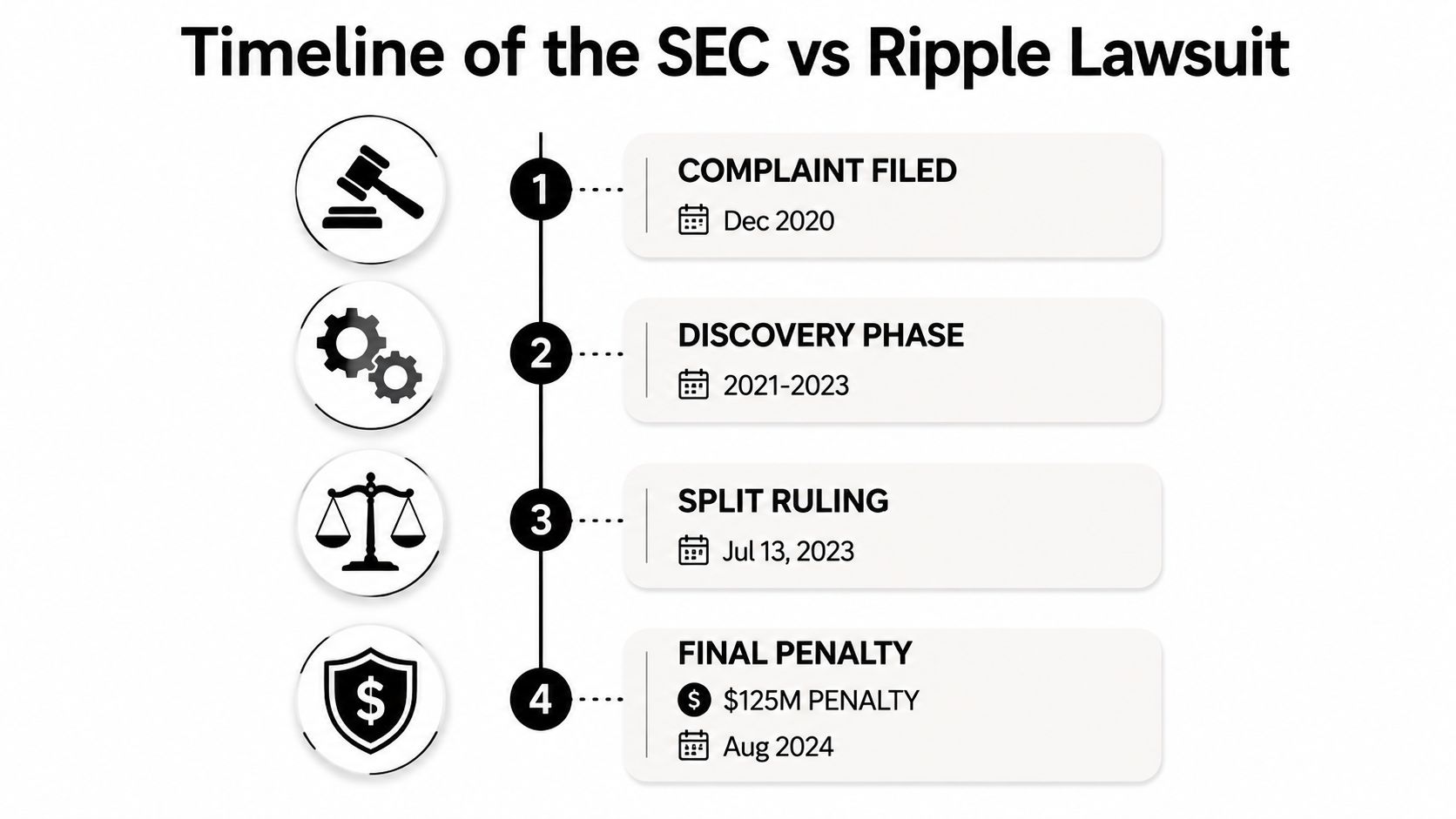
The Ripple case is easier to understand when you put the milestones in order. The SEC filed its civil action in December 2020, alleging Ripple Labs and two executives had raised more than $1.3 billion through unregistered XRP sales. That filing immediately turned XRP into a test case for how the SEC would treat large, liquid tokens that trade like commodities in practice but can still be sold like securities in some contexts.
By July 13, 2023, Judge Analisa Torres had issued the opinion that changed the tone of the entire market. Her ruling split the transactions into categories, and that split, not the headline, became the legal story. Retail exchange trading was treated differently from Ripple's direct institutional fundraising, which meant the case was no longer about whether XRP had one fixed legal identity.
The litigation then moved from legal theory to remedies. In August 2024, the district court imposed a $125,035,150 civil penalty and a permanent injunction barring Ripple from future Section 5 violations. The court also rejected the SEC's disgorgement request because the agency hadn't proven investor harm to the court's satisfaction. That outcome told the market something important, legal exposure remained real, but the SEC hadn't won the broadest remedy it wanted.
How the final phase unfolded
A later procedural fight in May 2025 showed the case still wasn't administratively neat. Judge Torres rejected a joint request for an indicative ruling that would have vacated the final judgment, saying that procedural path was improper. In other words, the parties couldn't bargain the judgment away by agreement.
The final step came in August 2025, when Reuters reported that both sides withdrew their appeals and the SEC ended the lawsuit, leaving the $125 million fine in place. That closure matters because it removed the uncertainty around whether the case would be reopened on appeal, but it didn't erase the opinion or its compliance lessons.
The milestone map in one view
| Milestone | What happened | Why it mattered |
|---|---|---|
| Dec 2020 | SEC filed the complaint alleging more than $1.3 billion in unregistered XRP sales | Turned Ripple into the flagship SEC crypto enforcement case |
| Jul 13, 2023 | Split ruling on XRP sales | Separated token status from transaction type |
| Aug 2024 | $125,035,150 penalty and permanent injunction | Locked in the monetary and compliance consequences |
| May 2025 | Joint indicative-ruling request denied | Showed the judgment couldn't be casually unwound |
| Aug 2025 | Appeals withdrawn, case closed | Ended the five-year enforcement fight |
The 2023 Split Ruling and the Howey Test
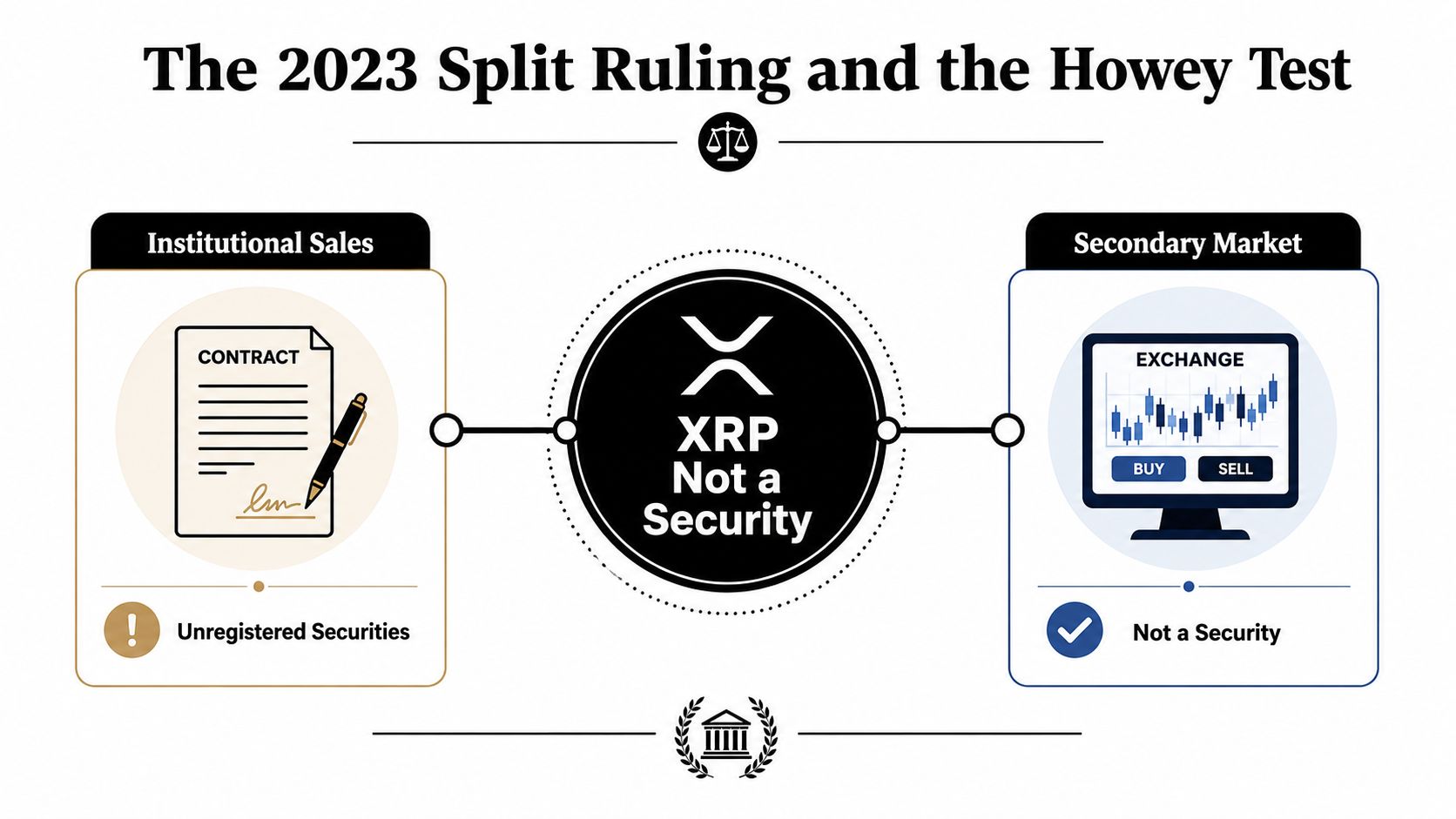
Judge Torres's July 13, 2023 ruling sits at the center of the case because it drew a line the SEC did not want. XRP itself was not a security in public exchange trades, while Ripple's direct institutional sales did satisfy the Howey test. That split matters because it rejects the idea that a token's legal status can be decided in the abstract, without looking at how it was sold.
How Howey works in plain English
The Howey test asks whether a transaction looks like an investment contract, which usually means money was put into a common enterprise with an expectation of profit from someone else's efforts. The phrase sounds technical until it is applied to crypto. A token can circulate as a market asset in one setting and function as a fundraising tool in another, and Howey forces a court to decide which transaction it is examining.
That is why Ripple became such an important case for lawyers and compliance teams. The court did not say every XRP transfer had the same legal character. It said the distribution channel matters, which makes the ruling useful for exchanges, OTC desks, and issuers that sell the same asset through different routes.
Why exchange sales and institutional sales split apart
Programmatic or secondary-market XRP sales on exchanges were treated differently from Ripple's direct institutional placements. In the court's reasoning, the exchange buyer was not entering the same direct fundraising relationship that existed in the institutional setting. The institutional buyer was closer to Ripple's capital raise, while the retail exchange buyer was one step removed.
Practical rule: if a token reaches the market through multiple channels, each channel needs its own legal analysis. One sales method can create securities risk even when another does not.
Ripple's response to that ruling was predictable and loud. After the decision, Garlinghouse declares victory on crypto, but the legal meaning of the opinion was narrower than the celebration suggested. The court did not bless XRP as a token. It separated transaction types, which is a harder and more limited precedent than a full industry win.
That is the non-obvious consequence of the opinion. It gives issuers no universal pass, and it gives the SEC no universal victory. It splits the analysis at the transaction level, which is more useful than a slogan and more uncomfortable than a clean verdict. As SEC crypto posture has shifted in 2025, that narrowness matters. The precedent still helps projects argue that distribution design matters, but it does less work than XRP maximalists claim once the agency starts framing later enforcement disputes around different facts.
The practical takeaway is blunt. Legal risk in crypto is distribution-specific, not token-wide. That is why XRP's exchange trading and Ripple's institutional fundraising landed on opposite sides of the same opinion, and why the case still shapes how compliance teams think about token launches, brokered placements, and secondary-market liquidity.
SEC Arguments vs Ripple Arguments Compared
The case is clearest when the two legal theories sit side by side. The SEC argued that Ripple's XRP program was an unregistered securities offering in substance, not just in form. Ripple pushed back by saying XRP functioned as a digital asset, that the SEC had not given fair notice, and that post-sale trading context mattered.
| Claim | SEC Position | Ripple Position | Court Outcome |
|---|---|---|---|
| XRP sales | Ripple raised more than $1.3 billion through unregistered XRP sales | XRP should not be treated as a security across the board | The court rejected a token-wide rule |
| Investor expectation | Every XRP sale reflected an investment contract | Secondary-market buyers were not buying in a direct fundraising deal | Retail exchange trades were not securities transactions |
| Institutional fundraising | Direct sales were securities offerings | The token's status should not change by buyer class | Direct institutional sales were treated as securities transactions |
| Fair notice | Existing securities law gave enough warning | Ripple said it lacked fair notice | Ripple did not win that defense |
| Remedies | SEC sought disgorgement and penalties | Ripple opposed broader remedies | The court imposed $125,035,150 and rejected disgorgement for insufficient proof of investor harm |
Ripple's stronger argument was not that XRP was magically outside securities law. It was that the law needed to track the actual transaction. That's a narrower claim, but it held up better in part because the court was willing to treat secondary-market trades differently from direct capital raising.
The SEC's best argument was remedial, not rhetorical. The agency secured a permanent injunction and a large civil penalty in the end, which means Ripple didn't escape consequences even after winning key liability issues. What the SEC did not get was the broad disgorgement theory it wanted.
That distinction matters for every crypto team watching these updates. A partial legal win can still leave real enforcement pain on the table. A partial loss for the SEC can still produce a meaningful compliance precedent.
The $125 Million Penalty and the 2025 Closure
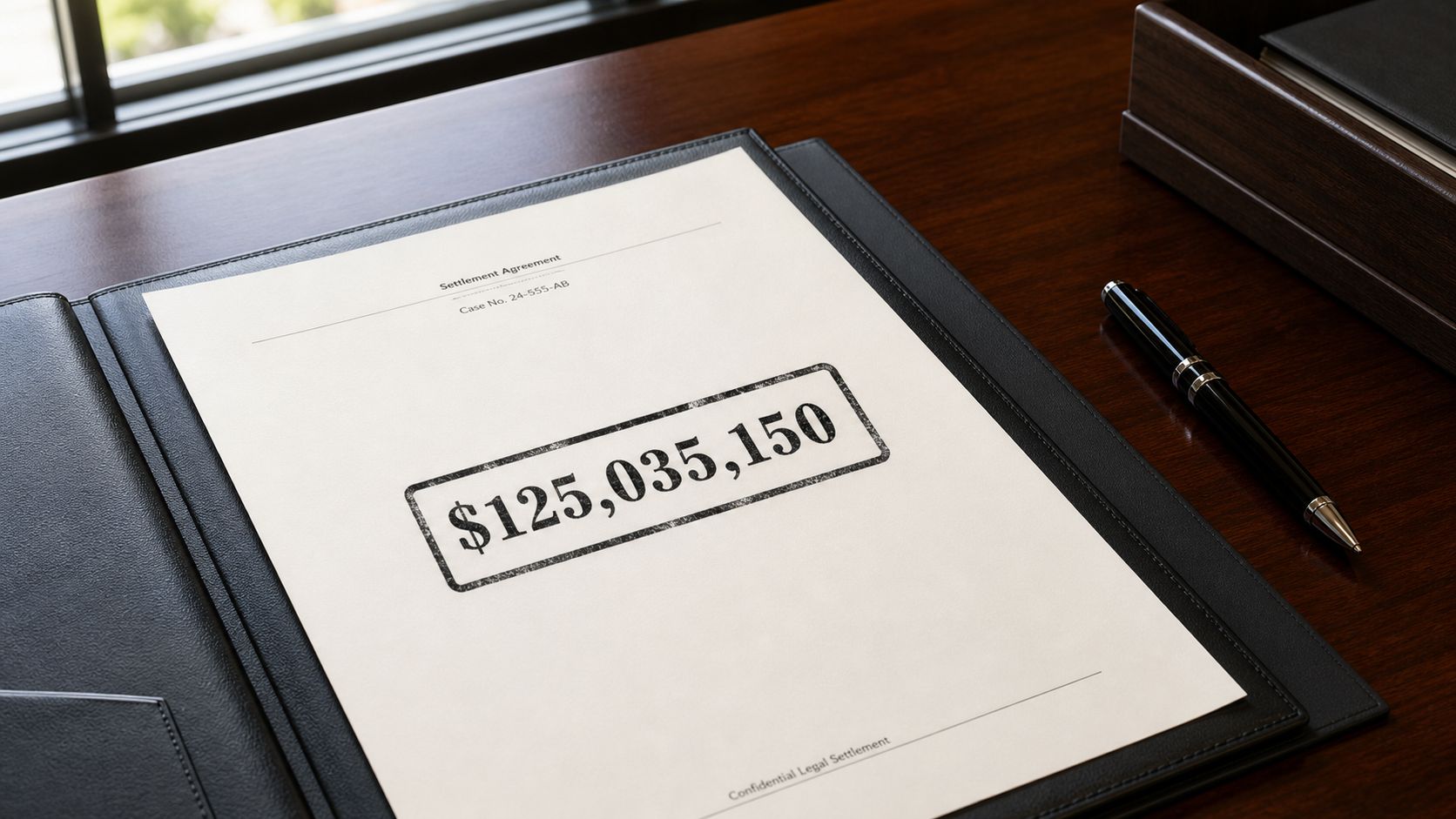
The financial endgame arrived in August 2024, when the district court imposed a $125,035,150 civil penalty and a permanent injunction barring Ripple from future violations of Section 5 of the Securities Act. That part is easy to overlook because the 2023 opinion got the headlines, but the remedy is what stayed attached to the company.
What the court refused to grant
The court also rejected the SEC's disgorgement request, citing insufficient proof of investor harm. That matters because disgorgement is more than a technical remedy, it's a sign of how aggressively the SEC wants to frame wrongdoing. The court's refusal set a boundary on what the agency could recover from Ripple on this record.
The procedural fight didn't stop there. In May 2025, Judge Torres rejected a joint request for an indicative ruling that would have vacated the final judgment, saying the proposed path was improper. That was a strong signal that even when both sides want to move on, the court still controls whether the judgment can be altered.
Why the internal SEC split matters
Commissioner Crenshaw's May 2025 statement criticizing the settlement showed the agency wasn't unified about what Ripple meant. That internal dissent is useful because it undercuts the easy narrative that the SEC had reached a neat institutional consensus. It hadn't. Some people inside the agency treated the outcome as too forgiving, while others clearly saw value in closing the case.
Reuters later reported in August 2025 that the SEC ended the lawsuit after both sides withdrew their appeals, leaving the $125 million fine in place. So the legal endpoint is real, but it's not a clean absolution.
The case closed, but the message did not become simple. Ripple paid a large penalty, kept a permanent injunction, and still left the market arguing about what the precedent actually covers.
For readers tracking SEC vs Ripple updates, that's the key fact pattern. The lawsuit is over, the monetary consequence is locked in, and the broader doctrinal fight is still alive in agency statements and later enforcement choices.
What the Ruling Means for Crypto Projects
The Ripple ruling is most useful when teams turn it into a checklist rather than a slogan. Exchanges learned that secondary-market XRP trading was treated differently from Ripple's fundraising. OTC desks learned they can't assume a token's market reputation protects every bilateral sale. Issuers learned that direct sales to funds, strategic buyers, or other institutional counterparties can still draw securities scrutiny even if retail exchange trading later looks cleaner.
The compliance filters that matter
A project should ask who is buying, how they are buying, and what the offering materials imply. If the sale looks like capital formation, legal risk rises. If the transaction is an open-market trade with no direct issuer fundraising relationship, the analysis changes, but it doesn't disappear.
The court's refusal to grant disgorgement for lack of proven investor harm is also a practical limit on enforcement remedies. It doesn't make risky conduct safe. It does show that the SEC still has to prove its case on remedies, not just on theory.
For a broader look at how disclosure and enforcement issues intersect with stablecoin and token design, the internal guide on stablecoin regulation is a helpful companion. The same basic lesson applies, structure matters more than slogans.
Builder's rule: if the token is the same but the sales path changes, the legal analysis can change with it.
That's why XRP holders, exchanges, and project teams should separate trading status from fundraising status. One can be relatively settled while the other stays exposed. The Ripple case makes that split impossible to ignore.
Is Ripple a True Precedent or Just a Settlement
Ripple is best read as durable guidance on transaction analysis, not a final answer on whether a token is a security. That matters because the SEC's later crypto task-force thinking points in the same direction, a digital asset may separate from an investment contract once the original issuer's promises are no longer outstanding and later holders lack enforceable rights. That is a much narrower and more conditional theory than the loudest pro- or anti-Ripple takes usually admit.
Why the precedent may be shrinking in practice
Commissioner Crenshaw's public criticism in May 2025 shows the agency itself didn't treat the outcome as settled doctrine. At the same time, later 2025 reporting noted the SEC had backed away from several crypto actions, which looks more like an enforcement reset than a clean statutory answer. If that pattern continues, Ripple will matter less as a universal rule and more as a litigation template.
That doesn't make the opinion weak. It makes it specific. Courts often rely on fact patterns that are too narrow to answer every future case, and Ripple fits that mold. The ruling's strongest legacy is the transaction-level lens, not a declaration that one token is forever safe.
The smart reading is blunt. Ripple tells future courts to ask what was sold, to whom, and under what expectations. It does not tell them that every token ages into safety just because it has been on the market for a while. For readers trying to understand smart contracts, that same distinction between code, context, and legal relationship is exactly why crypto law stays tricky.
If you want a single sentence answer, this is it. Ripple looks like a real precedent for channel-specific analysis, and a limited settlement-style endpoint for everything else.
Practical Takeaways for XRP Holders and Builders
If you're holding XRP on a retail exchange, the 2023 ruling gave you meaningful clarity on secondary-market trading, but not a blanket immunity for every crypto asset. If you're building on XRP rails, the legal picture is far cleaner than it was in 2020. If you're running issuer-style institutional sales, the risk remains much higher because that's where Ripple lost. For broader risk framing, the guide on mastering crypto risk management is worth a look, and if you want market context, the CoinStats Ripple price page is a practical reference point.
Coiner Blog covers crypto law, blockchain trends, DeFi, Web3, and the market issues that affect how projects launch and how holders judge risk. If you want more grounded analysis like this, visit Coiner Blog and keep following the cases that shape crypto's next regulatory phase.