
Bittensor Price Prediction: 2026 Outlook and Forecast

TAO climbed from about $30.40 on May 14, 2023, to $767.68 on April 11, 2024, a peak-to-trough increase of more than 2,400%, with its market capitalization expanding into the multi-billion-dollar range during 2024, according to CoinMarketCap's Bittensor market data. That history makes a conventional chart-based Bittensor price prediction unreliable. TAO isn't only an AI-linked crypto asset responding to Bitcoin liquidity, Ethereum activity, or broader Web3 sentiment. It's also a flow-allocated base currency whose future value depends on how the network directs emissions across competing subnets.
The practical question, then, isn't whether TAO can revisit a previous high. It's whether subnet demand, staking, miner activity, institutional access, and token supply can convert new issuance into productive network growth. The analysis below treats every forecast as a scenario, not a promise, and combines market structure with Bittensor's protocol-level economics.
Table of Contents
- Why Bittensor Price Predictions Are Harder Than Most
- How Bittensor's Subnet Economics Actually Drive TAO
- TAO Supply Mechanics, Release Schedule, and Dilution Risk
- Bullish Catalysts Versus Governance and Concentration Risks
- A Transparent Framework for Building TAO Price Forecasts
- TAO Price Scenarios Across Short, Medium, and Long Terms
- Common Mistakes in TAO Forecasts and Risk Management Essentials
Why Bittensor Price Predictions Are Harder Than Most
TAO's close prices moved from about $217.20 on September 2 to $254.07 on August 27 in late August and early September 2026, while market capitalization ranged roughly from $2.08 billion to $2.44 billion, according to CoinMarketCap's historical Bittensor data. The useful insight is not another measure of volatility. It is that a chart does not show whether those moves came from demand for subnet exposure, changes in emission allocation, or broader crypto flows.
A forecasting model also faces sharp regime changes and uncertain circulating-supply assumptions. Historical prices establish context, but they do not identify whether the next move will reflect renewed AI interest, Bitcoin risk appetite, subnet demand, or selling from newly issued tokens.
Forecasting principle: TAO's past rally demonstrates its capacity for repricing. It does not establish that the same return profile will repeat.
A different asset structure
Many Layer 1 networks can be modeled mainly through block rewards, staking participation, and demand for the native chain. Bittensor adds a subnet allocation layer. Emissions move through specialized markets, and their distribution can change as subnet prices, demand, validator behavior, and miner incentives change.
TAO therefore functions more like a shared monetary resource for a network of specialized markets than a passive Layer 1 token. A subnet focused on AI inference, storage, data, or another service can attract capital and rewards, while a weaker subnet can lose influence. Valuation reflects total network activity and the concentration of that activity across subnets.
For readers studying how price discovery works in crypto markets, the distinction is direct. TAO's market price forms through buyers and sellers, while protocol flows influence how much supply reaches the market and where capital is directed. Demand affects subnet economics, subnet economics influence emission allocation, and that allocation can shape future demand.
The result is a flow-allocated base currency. A bullish case requires subnet demand to absorb emissions and turn them into productive network activity. A base case assumes partial absorption, with market liquidity carrying part of the adjustment. A bearish case emerges when issuance reaches markets faster than staking, subnet participation, or service demand can absorb it.
The analytical lens
A credible Bittensor price prediction should test three areas:
- Market structure: Is TAO holding support, rejecting resistance, or moving with Bitcoin and Ethereum liquidity?
- Protocol flow: Are emissions being absorbed through staking, subnet participation, and productive demand, or becoming sell-side supply?
- Scenario probability: What conditions would make a bullish, base, or bearish outcome more likely?
This approach avoids false precision. It also points to the central investment question: TAO's price depends on the quality of capital allocation inside Bittensor, not merely on the strength of the AI narrative.
How Bittensor's Subnet Economics Actually Drive TAO
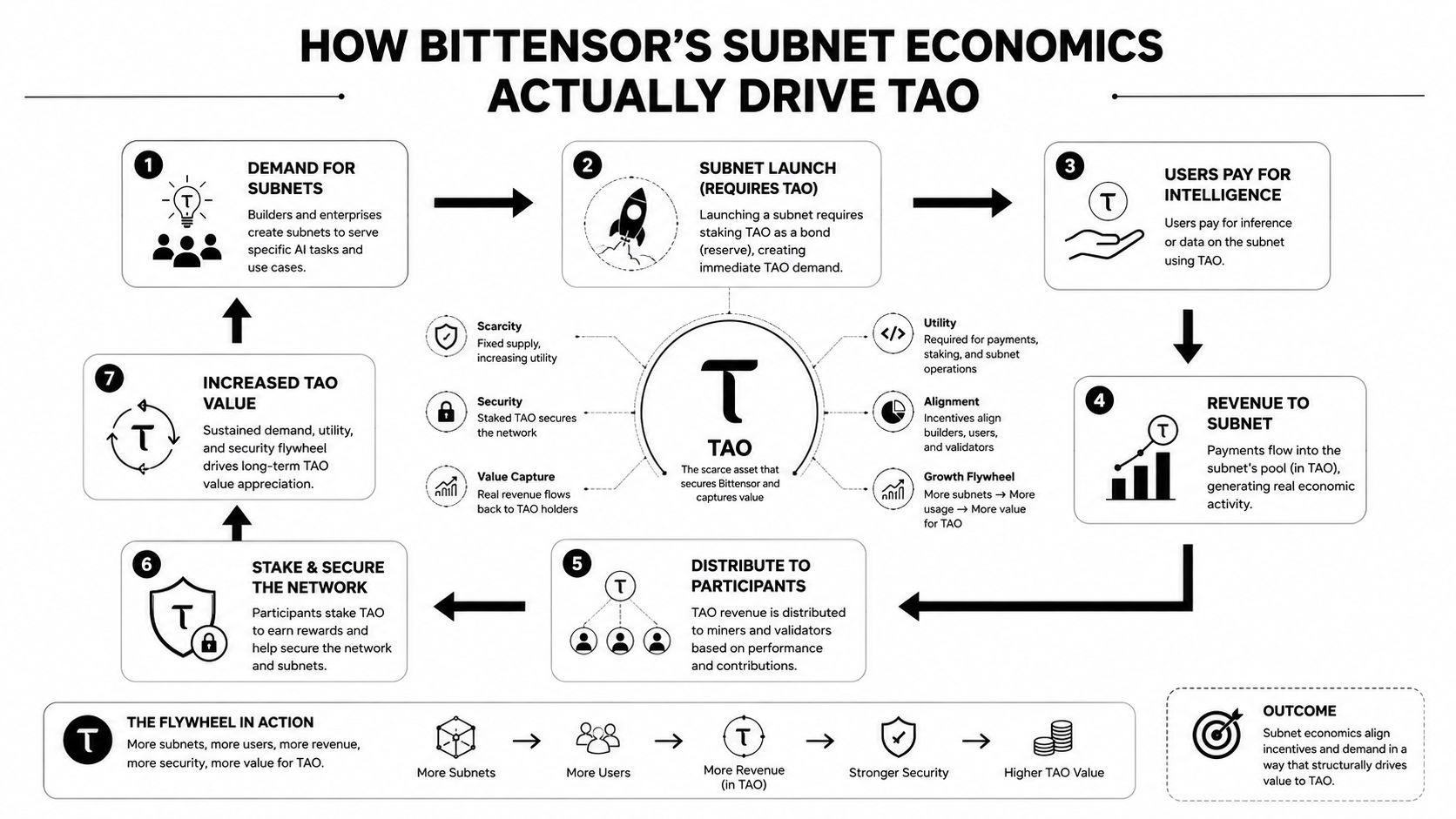
The simplest analogy is a shared payroll budget. Bittensor creates TAO emissions, then distributes that budget across specialized subnets where miners and validators compete to provide useful digital services. The network doesn't allocate every reward equally. It uses market signals and protocol rules to determine which subnets deserve a larger share.
Official Bittensor emission documentation states that the network has a base emission of 1 TAO per block, with issuance decaying toward the 21 million TAO cap and halving at issuance thresholds rather than at fixed calendar dates. That means the calendar alone doesn't tell an analyst how much economic pressure a subnet creates. The allocation of each emission matters just as much as the total amount.
From TAO stakes to subnet demand
Dynamic TAO changes the relationship between the base token and subnet-specific alpha tokens. Subnets can develop their own economic markets, while TAO remains the asset used to value stakes and coordinate capital. Validators and stakers effectively express preferences by directing capital toward subnet opportunities they consider more valuable.
The Bittensor subnet guide explains that a subnet's share of network emissions is tied to the exponential moving average of its price, with stakers voting through TAO. In plain terms, a subnet that attracts sustained demand can gain a larger portion of the network's payroll budget. A subnet that loses demand can see its share shrink.
This creates two opposing flows:
- Productive absorption: Users and participants acquire or stake TAO to gain exposure to strong subnets. That can reduce immediately available sell pressure when demand grows faster than issuance.
- Emission recycling: Weak subnet economics can release capital back into the market, especially when rewards aren't supported by durable demand for the underlying service.
The important point is that subnet price strength isn't automatically bullish. Analysts need to ask whether price movement reflects genuine demand, miner burn, staking conviction, or temporary speculation.
Why emission quality matters
Independent technical coverage of TAO emission mechanics describes a demand-sensitive gate in which weaker subnets can be pushed toward zero emissions, while stronger subnets capture a larger share. In a flow-based model, sufficiently negative net flows can result in zero emissions for a subnet.
That design can make issuance more efficient, but it also introduces concentration risk. If a small group of leading subnets captures most rewards, capital may rotate aggressively into those markets while weaker participants lose support. A bullish TAO forecast therefore requires more than rising subnet prices. It requires evidence that demand is broad enough, durable enough, and economically useful enough to absorb emissions.
The key monitoring set is subnet EMA price dispersion, miner-burn activity, staking behavior, and the percentage of emissions captured by leading subnets. These indicators tell investors whether TAO is funding useful network output or distributing inflation that the market must later sell.
TAO Supply Mechanics, Release Schedule, and Dilution Risk
Bittensor's supply story starts with a hard ceiling of 21,000,000 TAO, documented in Bittensor's historical supply data. Recent tokenomics snapshots place circulating supply at about 10.77 million TAO, or 51.3% of total supply. Another independent tracker reports a little over 11.3 million TAO, or roughly 53.84%, in circulation in early September 2026 through TAOstats tokenomics data. These figures come from different snapshots and methodologies. They do not change the maximum supply.
The remaining issuance creates a persistent absorption requirement. TAO's price can rise while supply expands, provided demand grows quickly enough to absorb new tokens without reducing the valuation assigned to each circulating unit.
Issuance is threshold-based
The network mints TAO per block, while the reward decays toward the cap. Halvings follow issuance thresholds rather than a fixed calendar rhythm. A precise annual schedule would therefore require assumptions about block production and the timing of each threshold.
| Halving Era | Block Reward (TAO) | Approx. Annual Emission | Cumulative Circulating Supply | Unissued Supply |
|---|---|---|---|---|
| Current issuance phase | 1 TAO base emission | Depends on block production and allocation | About 10.77M to 11.3M in recent snapshots | Roughly half of the cap remains outside circulation |
| Next issuance threshold | Reduced after the applicable threshold | Lower than the preceding phase | Higher than the current snapshot | Lower as new TAO enters circulation |
| Later threshold phases | Further reductions | Declines as the reward decays | Progressively approaches 21M | Progressively decreases toward zero |
The table remains deliberately assumption-aware. Verified information establishes the base emission and the cap, but does not establish a block frequency that would justify invented daily, monthly, or annual totals. Forecasts gain credibility from showing what is unknown, not from filling every gap with false precision.
Releases create identifiable supply events
The broader release curve extends well beyond the network's early years. Tokenomics.com's Bittensor release schedule projects releases from March 3, 2023, to March 3, 2067, across 529 events, with 21,000,000 TAO released in total under the schedule. It also projects an October 2026 release of 214,286 TAO, scheduled to equal 1% of total supply.
A scheduled release does not guarantee a selloff. Tokens may enter circulation and remain staked, move between wallets, or support subnet activity. Its market importance is anticipatory: traders can price in expected liquidity before the event, while the subsequent response indicates whether demand can absorb the additional supply.
Practical rule: Treat every release as a demand test, not an automatic bearish trigger.
For scenario analysis, the supply schedule should be connected to subnet economics. In a bull case, productive subnets attract enough capital to absorb new TAO. In a base case, issuance is matched by uneven demand and limits upside. In a bear case, releases reach the market faster than useful network activity develops, increasing dilution pressure.
Long-term forecasts must therefore model scarcity and dilution together. A fixed cap supports scarcity, but it does not protect TAO from underperformance if supply reaches the market faster than productive demand grows.
Bullish Catalysts Versus Governance and Concentration Risks
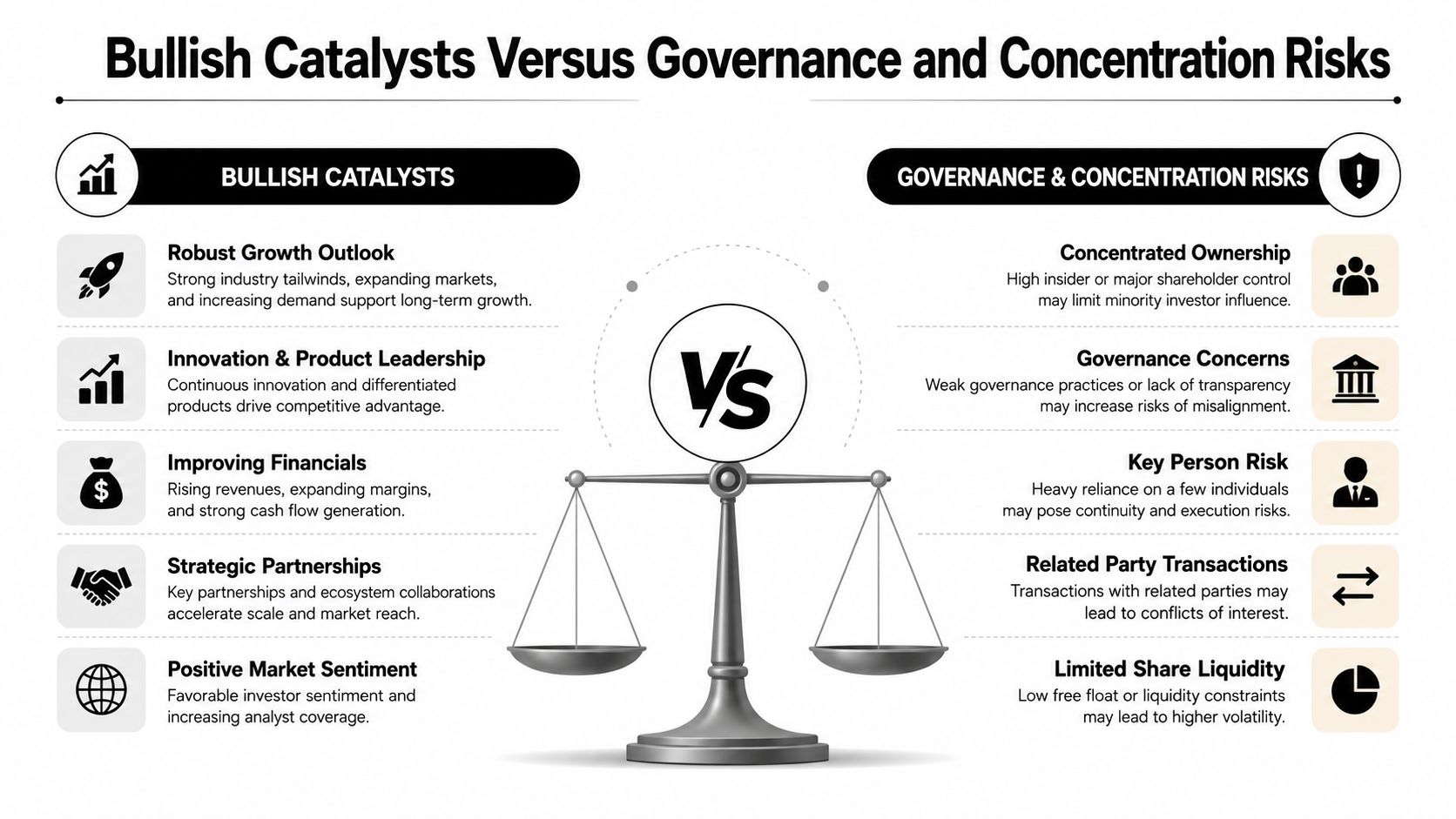
TAO's bullish case depends on capital flowing toward productive subnets, not on an AI narrative alone. Bittensor gives specialized networks a way to coordinate participants, validators a way to assess performance, and TAO a role as the base currency allocated across competing markets. That flow mechanism creates an investable question: can emissions move toward subnets that generate durable demand?
Market access has widened through several developments. CoinBird's Bittensor news coverage reports that Grayscale filed to convert its TAO trust into an ETF, Yuma launched an institutional fund for TAO exposure, and a canonical TAO token was bridged to Solana for broader DeFi access. These developments may improve liquidity and give institutional and cross-chain participants more ways to acquire or evaluate TAO. They do not, by themselves, prove that subnet demand will absorb emissions.
The bullish ledger
A constructive scenario requires several conditions to align:
- Institutional accessibility: An ETF conversion effort, an institutional fund, and Solana access can widen the channels through which capital reaches TAO.
- Subnet productivity: Subnets that attract sustained demand and turn emissions into useful AI coordination can support a higher valuation.
- Emission efficiency: Dynamic TAO can direct rewards toward subnets with stronger demand, potentially limiting dilution from weaker markets.
- AI market relevance: Demand for decentralized compute, inference, data, or other machine intelligence services would give the network a clearer use case.
The key variable is allocation efficiency. If TAO continues to fund subnets that users value, access-driven inflows can reinforce network activity. If capital arrives while demand remains shallow, the same inflows may support price temporarily without improving the underlying economics.
The risk ledger
Bittensor's allocation system also creates concentration risks. A small group of influential participants could affect emission parameters or subnet outcomes. Treasury concentration could add selling pressure faster than new demand develops. Validator hardware and operating costs may further limit participation by smaller operators, reducing the range of contributors who influence network decisions.
The clearest recent warning followed Covenant AI's exit from a major subnet. Coverage reported a 27% TAO drop, approximately $900 million erased from market value, and about $11 million in liquidations after the event, according to CoinBird's report. The episode illustrates how quickly a concentration or governance shock can outweigh positive adoption news.
Regulatory uncertainty around AI-linked utility tokens adds another risk when investors compare TAO with Bitcoin, Ethereum, DeFi assets, Layer 2 networks, and tokenized real-world assets. My view is that adoption catalysts offer meaningful upside, but the bull case remains fragile while ownership, governance influence, or subnet demand is concentrated. A durable re-rating requires wider access and resilient flow allocation.
A Transparent Framework for Building TAO Price Forecasts
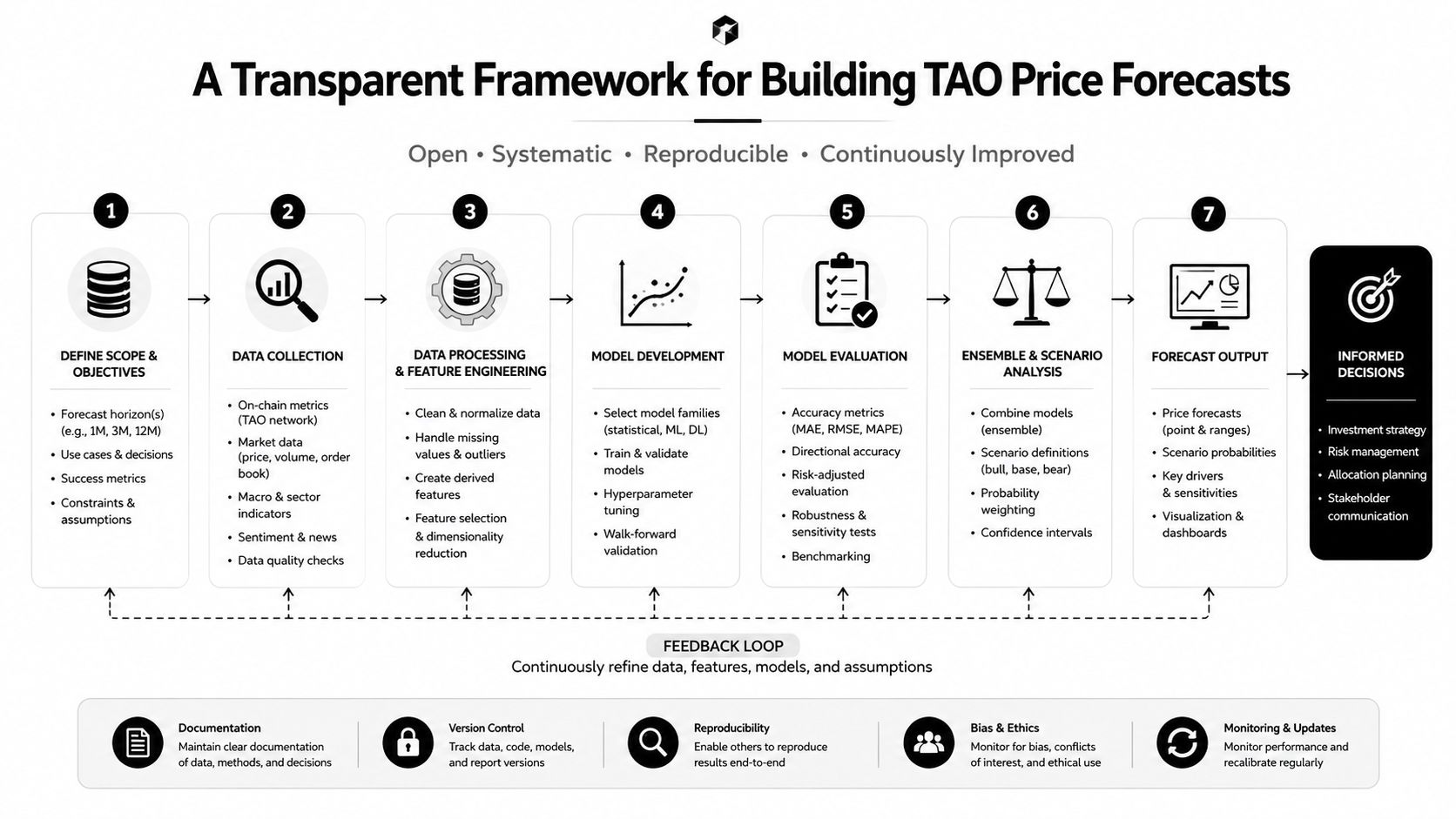
A useful forecast should be reproducible. Rather than starting with a target and searching for supporting evidence, analysts can begin with four inputs, assign each a role, and record what would invalidate the conclusion.
Four inputs for an auditable model
Technical structure provides the first boundary. Analysts can examine prior cycle highs, recent trading ranges, support and resistance, and the 200-week moving average. These levels don't predict value, but they show where market participants previously accepted or rejected prices.
On-chain flow data supplies the mechanism. Relevant observations include subnet emissions, staking participation, circulating-supply growth, miner-burn activity, and the share of rewards captured by leading subnets. The purpose is to determine whether new issuance is being absorbed by demand or returned to exchanges.
Valuation comparables create a market context. TAO can be compared qualitatively with AI-focused crypto assets, compute networks, DePIN projects, and other protocols whose valuations depend on network activity. A revenue multiple can be useful only when the underlying revenue definition is consistent and verifiable.
Scenario weighting prevents false certainty. Instead of one target, construct bull, base, and bear cases. Each case should specify the assumptions that change, such as subnet demand, staking participation, institutional access, emission efficiency, and the wider macro regime.
How to stress-test the result
A worked model should use ranges rather than fabricated precision. For example, the base case can assume stable staking, continued subnet expansion, and neutral valuation relative to comparable AI and DePIN assets. The bull case can increase the assumed rate of institutional participation and emission efficiency. The bear case can reduce subnet demand, increase effective sell pressure, and apply a lower market valuation.
The output isn't a guaranteed price. It's a conditional statement: if these operating and market assumptions hold, this range becomes more defensible. If staking weakens or emissions concentrate in low-demand markets, the base case should be revised downward. If subnet demand broadens and new access channels attract durable liquidity, the bull case becomes more plausible.
For comparison, readers can review Cronos crypto price prediction analysis to see why a token forecast should always disclose its assumptions, data window, and invalidation conditions.
The following video can add visual context for readers reviewing market structure and protocol mechanics:
My preferred weighting is qualitative rather than mechanically fixed: protocol flows deserve more weight than a short-term chart pattern, while macro liquidity can override both during severe risk-off conditions. The model becomes useful when readers can change one assumption and see why the conclusion changes.
TAO Price Scenarios Across Short, Medium, and Long Terms
The forecast separates three horizons and three outcomes rather than presenting unsupported point targets. Verified information supports market snapshots, supply mechanics, emissions, and historical volatility, but not a defensible dollar target for each future year. TAO therefore works better as a flow-allocated base currency: capital moves toward subnets, and the market reprices the token according to whether those emissions produce durable demand.
| Horizon | Bear Case | Base Case | Bull Case | Key Assumption |
|---|---|---|---|---|
| Rest of 2026 | Retest of recent lows or deeper weakness | Range-bound recovery with selective subnet leadership | Reclaim of higher resistance as access and demand improve | Macro conditions, October release absorption, and emission efficiency. A sustained break outside the $217.20-$254.07 range would weaken the base case |
| 2027 to 2028 cycle window | Persistent discount if subnet yields compress | Gradual appreciation as staking and subnet activity mature | Strong re-rating if institutional access combines with successful Dynamic TAO recalibration | Durable subnet demand and broader capital participation |
| 2030 horizon | Valuation remains constrained by dilution and governance concentration | Higher network value if productive emissions grow with demand | Substantial expansion if Bittensor becomes a major AI coordination layer | Network utility must outpace supply growth over multiple issuance phases |
For current reference points, CoinStats' Bittensor coin price and data can help readers monitor live market information, circulating supply, and market activity. These figures need checking at the time of analysis because crypto conditions change quickly.
Short-term conditions
The rest of 2026 is primarily a liquidity and event-risk question. TAO's late-August and early-September trading range shows how quickly participants can reprice the asset, while the October token release creates a visible test of market absorption. The bear case gains weight if buyers fail to absorb that supply or if a major subnet loses market confidence.
The base case requires stability, not euphoria. TAO would need to retain investor attention while leading subnets show that their emissions produce useful activity. A bullish move needs stronger evidence, including institutional access that becomes sustained liquidity and Dynamic TAO directing rewards toward productive markets.
The $217.20-$254.07 range provides a practical check on that view. A persistent move beyond it, especially without corresponding improvement in subnet activity or staking, would make a range-bound recovery harder to defend.
Medium-term conditions
The 2027 to 2028 window depends less on one announcement than on repeatable subnet economics. The base case assumes continued subnet expansion and stable staking participation, without treating every subnet as successful. The bull case requires institutional allocator inflows alongside a successful recalibration of emission flows. The bear case combines a risk-off crypto market with compressed subnet yields.
Entry zones should follow invalidation conditions rather than a preferred price. Falling staking, weaker demand for leading subnets, or repeated poor absorption of new supply would require a bullish thesis to be revised. Broader demand across useful subnets could support a re-rating before traditional chart signals appear.
Long-term conditions
By 2030, the decisive question is whether Bittensor's internal economy makes issuance productive. A capped supply does not guarantee scarcity value if the network cannot create durable demand for TAO exposure. Sustained demand for subnet participation, however, could make future emissions easier for the market to absorb.
Position sizing should reflect that uncertainty. A long-term thesis can withstand volatility, but it should not survive the disappearance of its core assumptions. Each scenario is a hypothesis that requires fresh data, especially on capital allocation, subnet output, and the market's response to new issuance.
Common Mistakes in TAO Forecasts and Risk Management Essentials
Automated prediction tools often reduce a complex protocol to a smooth price line. That output can appear precise while excluding the variables that shape TAO's value, including Dynamic TAO, subnet competition, emission gates, token releases, and governance concentration. A useful forecast must connect price scenarios to how TAO is allocated across subnets, not only to historical charts.
Errors that distort a TAO forecast
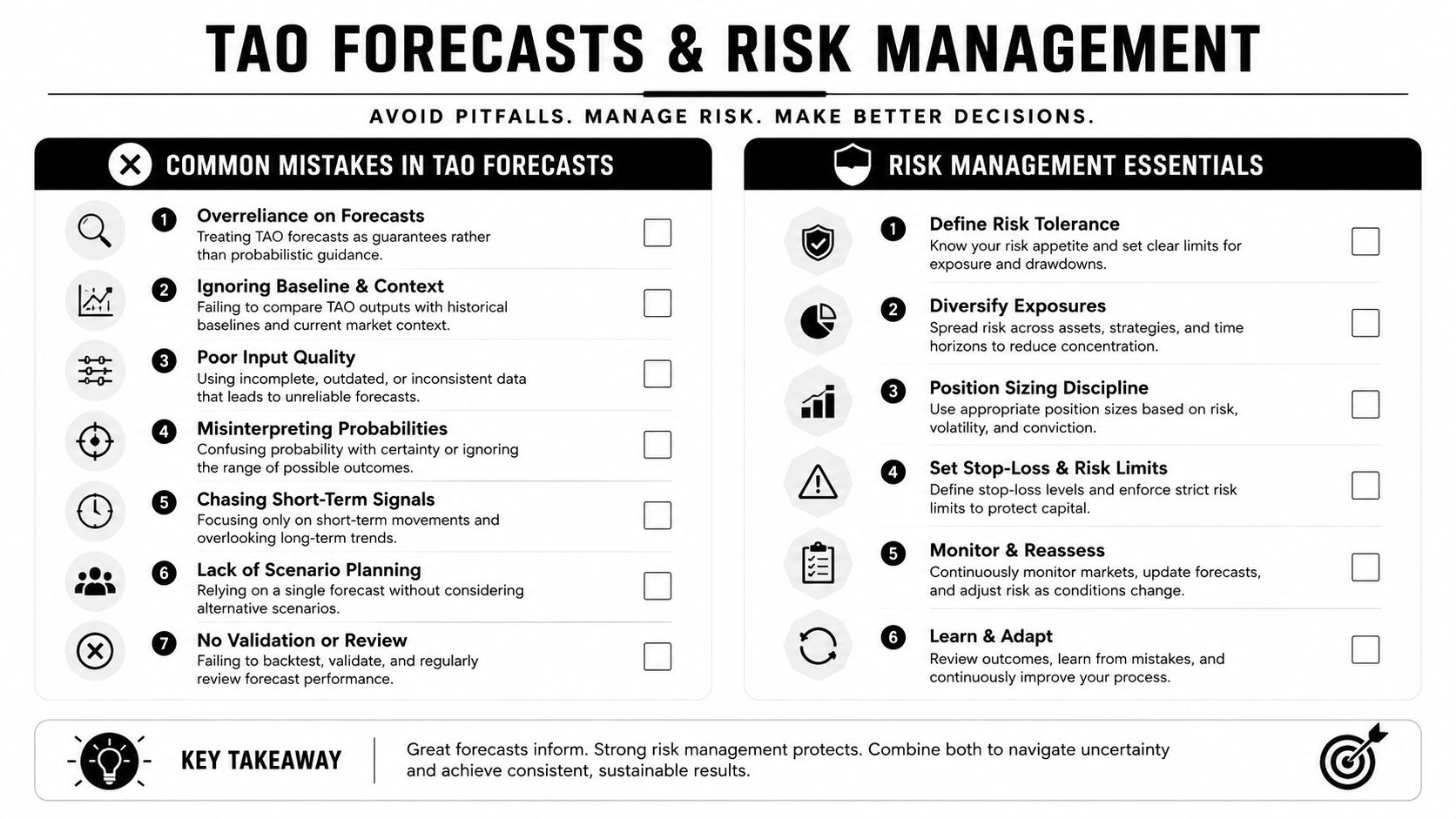
Extrapolating the 2023 to 2024 repricing as a normal growth rate ignores regime changes, changing liquidity, and the emission dynamics discussed earlier. A sharp historical move demonstrates volatility, but it does not establish a repeatable return schedule. The relevant question is whether future subnet demand can absorb newly emitted TAO at a similar pace.
Ignoring dilution creates an inflated view of per-token value. Analysts should distinguish circulating supply from the fully diluted supply represented by the 21 million TAO cap. Supply snapshots can differ, and future releases may affect liquidity, selling pressure, and market expectations.
Treating all emissions as equal misses Bittensor's central allocation mechanism. TAO directed toward strong, demand-supported subnets may produce a different market outcome from TAO emitted toward weak markets, where participants sell quickly. Emission flow is therefore a valuation input, not merely a supply statistic.
Following a single price call replaces analysis with authority. A forecast should state its assumptions, data sources, timeframe, scenario conditions, and invalidation level. Without those elements, a target is an opinion with no usable audit trail.
A practical risk checklist
- Size the position before entering: Use an amount that can tolerate substantial volatility without forcing an emotional exit.
- Define invalidation in advance: Tie the thesis to staking behavior, subnet demand, emission absorption, or protocol conditions instead of relying only on a round-number price.
- Track event risk: Review release schedules, Dynamic TAO parameter changes, governance decisions, and major subnet exits.
- Diversify thoughtfully: Compare TAO with other crypto AI, DePIN, Bitcoin, Ethereum, and Web3 exposures, while recognizing that crypto assets can still fall together.
- Rebalance after major changes: A network upgrade or emission redesign can alter the original thesis and requires a fresh review.
- Keep a forecast journal: Record assumptions, expected signals, actual outcomes, and the reason for each revision.
A stop-loss based on volatility measures such as ATR may suit active traders. Longer-term participants may prefer thesis-based exits tied to protocol deterioration. Neither approach removes risk. The choice should match the time horizon and the evidence supporting the position.
Risk rule: Every Bittensor price prediction, including this one, should be treated as a testable hypothesis rather than a guarantee.
Readers can use this crypto risk management guide as a companion checklist. TAO remains a volatile digital asset, and this analysis is not personalized financial advice. Investors should verify current market data, understand local regulations, and decide whether the protocol's risks fit their objectives.
Coiner Blog publishes practical analysis on Bittensor, AI and crypto, DeFi, Web3, tokenomics, and emerging blockchain networks, with attention to opportunity and risk. Visit Coiner Blog to follow future market explainers and document your own TAO thesis.