
Market Orders vs Limit Orders: A 2026 Guide
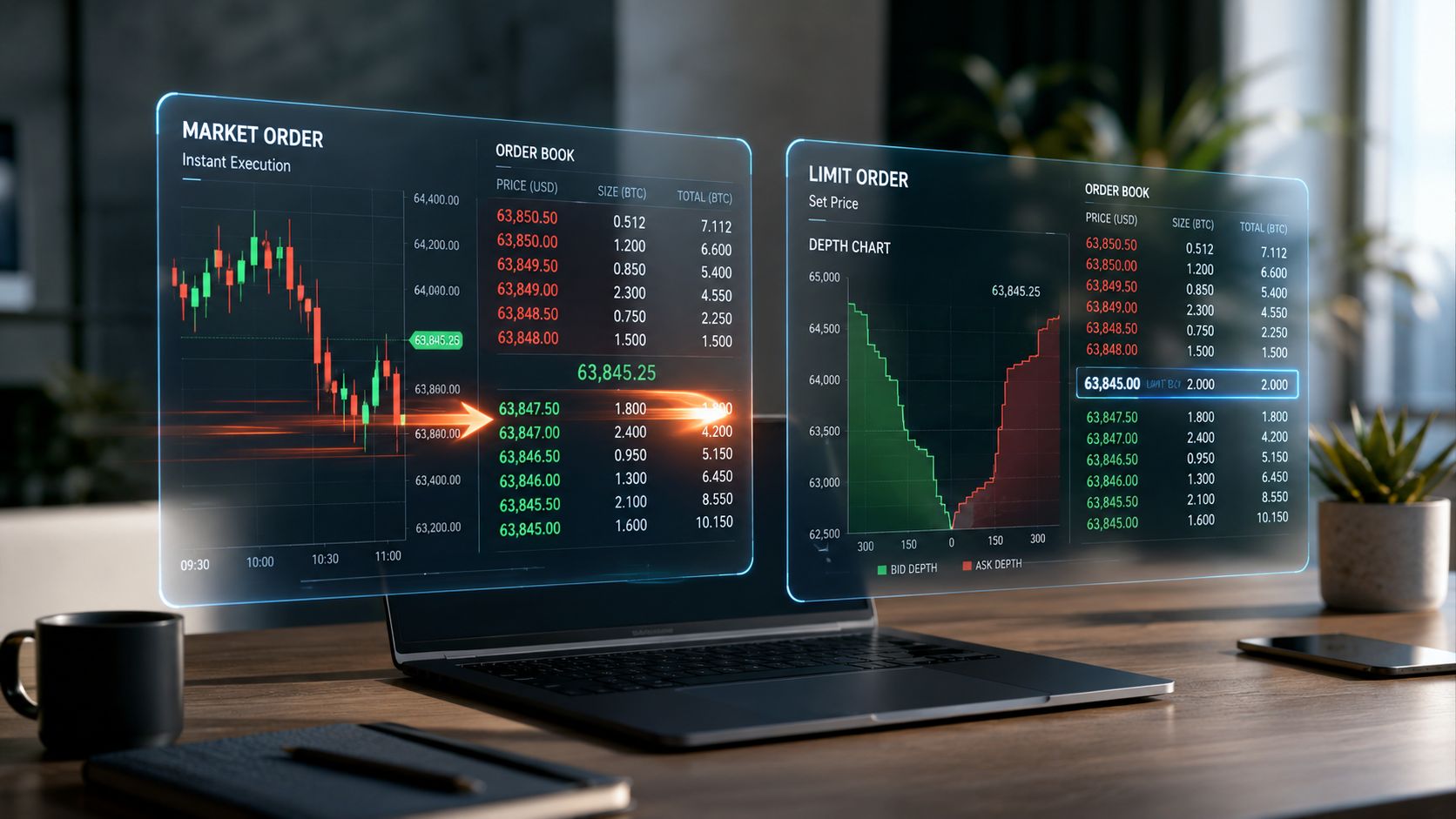
The popular advice is simple: use limit orders because market orders are expensive. That rule is easy to remember and often wrong, especially in crypto. A limit order can control your price and may qualify for maker pricing, but an order that never fills can cost more than a market order that gets you into a liquid trade immediately. A market order can also be the cheaper choice when an illiquid token is moving quickly and waiting means losing the setup entirely.
The useful question isn't “Which order type is safer?” It's what are you paying for execution certainty, price control, fees, and timing? This guide treats market orders vs limit orders as an execution decision tied to liquidity, volatility, position size, and urgency. For a broader foundation, the market microstructure guide is a useful companion.
Table of Contents
- Why the Limit Order Default Is Often Wrong
- How Market and Limit Orders Actually Work
- Cost Components Behind Each Order Type: Fees, Slippage, and Waiting
- Side by Side Execution and Fee Comparison
- Worked Scenarios in Real Crypto Conditions
- Where to Place Each Order on a Crypto Exchange
- Matching Order Type to Trader Profile
Why the Limit Order Default Is Often Wrong
“Always use a limit order” sounds disciplined, but it hides the cost of waiting. A limit order protects your maximum buy price or minimum sell price, yet it can leave you without a position while the market moves away. In a fast crypto breakout, that missed fill may matter more than the fee saved by avoiding a taker execution.
The better framework has four moving parts:
- Fill certainty: A market order is designed to execute immediately, while a non-marketable limit order waits for a compatible counterparty.
- Price control: A limit order won't pay above its buy limit or sell below its sell limit.
- Fee tier: Exchanges often distinguish maker and taker pricing, so the visible quote isn't the complete cost.
- Information decay: A resting order can become stale as new information changes the value of the asset or invalidates the setup.
The foundational academic view is more nuanced than the usual beginner slogan. In their 2005 Review of Financial Studies paper, Foucault, Kadan, and Kandel formalized the idea that patient traders tend to submit limit orders, while impatient traders tend to submit market orders. Their model connected the proportion of patient traders and order arrival rates with spread, trading frequency, resiliency, and limit-order execution time (Foucault, Kadan, and Kandel).
Practical rule: A limit order isn't automatically cheaper. Its real cost includes the possibility that you don't get the trade you planned.
That doesn't make market orders superior. It means order selection should follow the market's condition. A deep Bitcoin book with stable liquidity can make a market order efficient when immediate execution matters. A thin altcoin book can make an unprotected market order dangerous when the order is large relative to displayed liquidity.
Even the way traders consume educational content reflects this broader execution problem. If you're preparing a trading explainer or recording a walkthrough, a practical resource on how to change aspect ratio by ClipCreator.ai can help present order-book behavior clearly across different screens. The underlying lesson remains the same: don't turn an execution preference into a universal rule.
How Market and Limit Orders Actually Work
A market order says, “Execute now at the best available prices.” A limit order says, “Execute only at this price or better.” Charles Schwab's order-type overview captures the trade-off: market orders prioritize execution, while limit orders impose a price condition and may not fill.
How the order book handles a market order
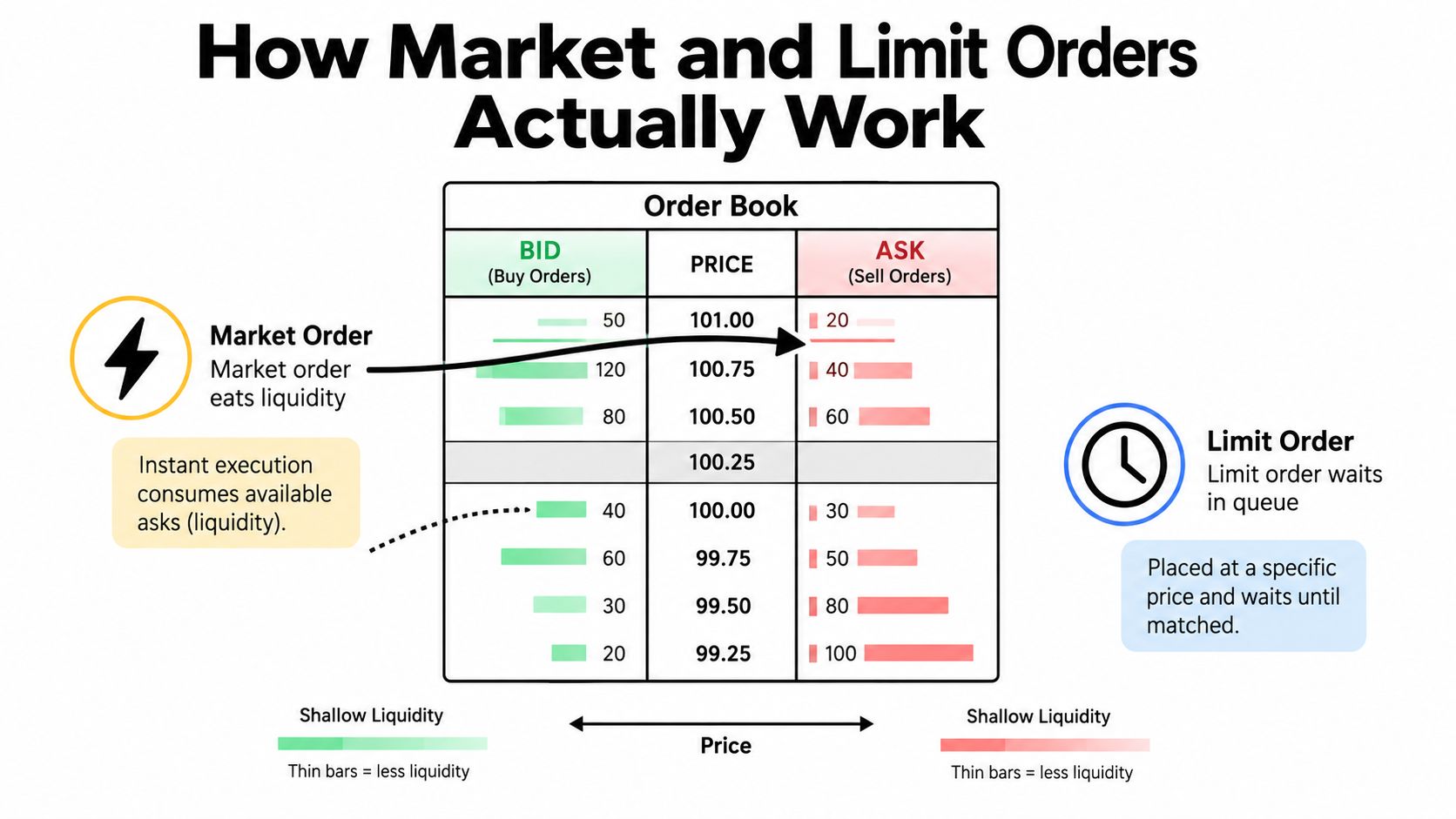
A crypto exchange records bids from buyers and asks from sellers. A market buy consumes the lowest available asks first. If the requested size exceeds the quantity at that level, the matching engine moves to the next ask and continues until the order is filled or available liquidity runs out. The mechanics follow directly from market-order trading on Coiner Blog.
That “best available price” is not a promise that the entire order fills at the first displayed quote. It means the engine accepts the best prices currently offered, potentially across several levels. In a shallow book, the final average price can differ materially from the quote shown when you clicked buy. The mechanics of market-order slippage in an order book show why order size relative to displayed liquidity matters.
A market sell works in reverse. It consumes the highest bids first. Execution is usually fast, but the final price remains uncertain until matching finishes. Market orders can therefore be cheaper than limits in a thin book when a failed fill would force a worse entry later, though the book must be checked before sending size.
How a limit order waits
For a buy, the limit price is the most you will pay. For a sell, it is the least you will accept. The Investor.gov explanation of order types confirms that buy limits execute at the limit price or lower, while sell limits execute at the limit price or higher.
If a buy limit sits below the current ask, it joins the bid side of the book. The exchange normally ranks orders by price, then by time at that price. A market sell may match against your resting bid. If sellers never reach it, the order stays open or expires under the exchange's settings.
A limit order can also execute immediately when set through the current opposite quote. The exchange may then fill it at available prices up to your limit. That provides a price ceiling or floor, but it does not automatically make the order passive or eligible for maker pricing. Check the exchange's post-only and fee rules rather than treating “limit” as a complete description of execution.
Cost Components Behind Each Order Type: Fees, Slippage, and Waiting
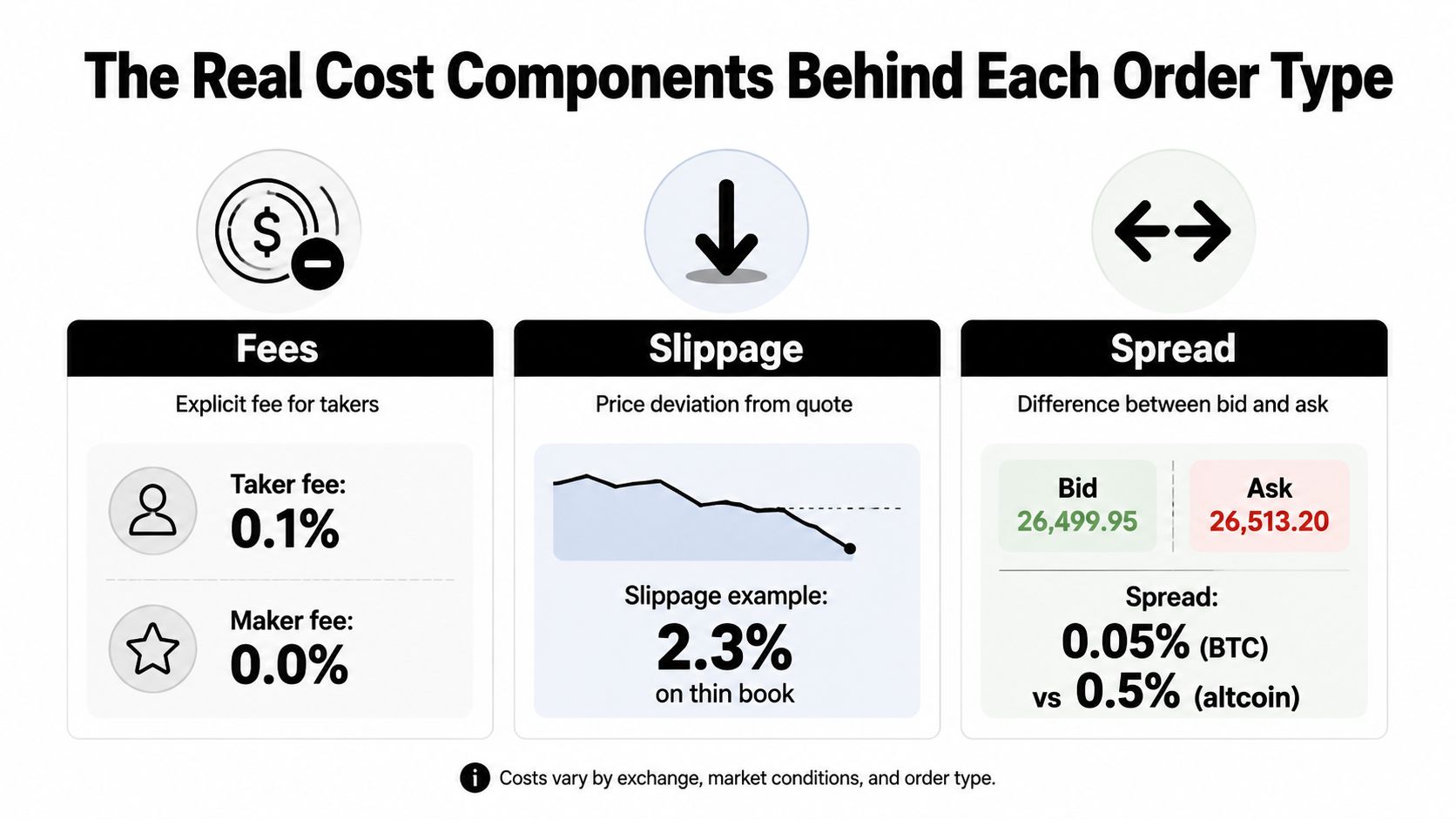
An order's cost has three layers: explicit fees, execution slippage, and the cost of waiting. Comparing fee schedules alone misses a low-fee limit order that never fills. Fear of market orders can also hide the value of completing a necessary trade, especially when delay would force a worse entry or exit.
Fees are visible, but not always decisive
A limit order may receive maker pricing when it adds liquidity to the book. A market order generally pays taker pricing because it removes existing liquidity. Rates vary by exchange, account tier, product, and region, so check the venue's schedule before estimating the trade cost.
A retail-investor study cited in the supplied research found that limit orders reduced trading costs by about 10 basis points, while about 65% of retail limit orders were fully filled (SMU Cox Today). The finding challenges the claim that limit orders “never fill,” but it does not guarantee comparable results for every token, venue, or market regime.
Slippage depends on depth and order size
A market order consumes liquidity already posted by other traders. With enough size near the quote, the average fill can remain close to the visible price. In a thin book, the order walks through several price levels.
Crypto traders should be especially careful with small-cap tokens, newly listed assets, and pairs that look active only because a few levels show limited size. The top-of-book quote matters less than the quantity available across every level the order will consume. Review how slippage affects trading costs before sending size into a shallow book.
A formal model estimated that the permanent price impact of a buy market order was about 3.9 times that of a comparable buy limit order (Rosu, information and limit-order markets). The multiplier is not universal across exchanges, but it shows why aggressive execution can leave a larger footprint than passive liquidity provision.
Waiting carries an opportunity cost
A limit order can save the spread and possibly reduce fees, yet the market may never return to its price. If the trade depends on entering before a catalyst, a missed fill belongs in the cost calculation. News, a Bitcoin move, a protocol exploit, or sudden liquidity withdrawal can also make the original price assumption less useful.
The practical comparison is fee plus slippage versus waiting cost plus execution uncertainty. In a thin crypto book, a market order can be cheaper when failed execution would force a worse trade later. In a stable, liquid market, the limit order's price control may justify waiting.
Side by Side Execution and Fee Comparison
The framework from the previous section is simple: compare fees and slippage with the cost of waiting. The execution choice still depends on what the trade must accomplish.
| Criterion | Market Order | Limit Order |
|---|---|---|
| Execution certainty | High under normal venue operation, because it takes available liquidity immediately | Conditional, because the market must reach the price and available liquidity must match |
| Price control | Low, the final price depends on the book while the order executes | High, a buy won't execute above its limit and a sell won't execute below it |
| Fee tier | Usually taker pricing because it removes liquidity | May receive maker pricing when it rests, but an immediately executable limit can be treated differently |
| Fill probability | Designed for an immediate fill, subject to available liquidity and venue conditions | Depends on price, queue position, volatility, and whether counterparties arrive |
| Best environment | Urgent execution in a sufficiently deep market, or an exit where delay is costly | Planned entries, patient exits, stable conditions, and situations where price control matters most |
| Main risk | Slippage and uncertain average execution price | Non-execution, stale pricing, and missed opportunity |
| Footprint | A comparable buy market order had roughly 3.9 times the estimated permanent price impact of a buy limit order in one formal model, as noted earlier | Usually supplies liquidity and can reduce aggressive market impact |
The table shows why “market equals bad” fails as a trading rule. Market orders provide schedule certainty, while limit orders provide maximum-price control. In a thin crypto book, the order with the lower fee can still be more expensive after slippage and a failed fill are included.
The decision depends on the benchmark
Suppose the benchmark is a planned execution schedule. Research on optimal liquidation under a VWAP benchmark describes market orders as useful for staying on schedule, though potentially costlier, while limit orders can save the spread but create schedule slippage (optimal liquidation under VWAP). The practical result is often a hybrid approach, with the order type changing as timing pressure and book conditions change.
A trader may place passive limits for the portion of an order that can wait, then use a smaller market order if the setup starts moving. That decision should be based on the displayed depth and the likely average fill, not just the best bid or ask. Review how slippage affects trading costs before sending size into a shallow book.
The key controls are the maximum acceptable slippage, the time available, and the portion of the position that must be executed. A market order can be the cheaper choice when delay would force a materially worse entry or exit. A limit order is the better tool when price control matters more than immediate completion.
Worked Scenarios in Real Crypto Conditions
A useful order-type decision starts with the market, not the button. The same instruction can be sensible for one Bitcoin pair and reckless for a thin altcoin pair.
Scenario one, the fast altcoin breakout
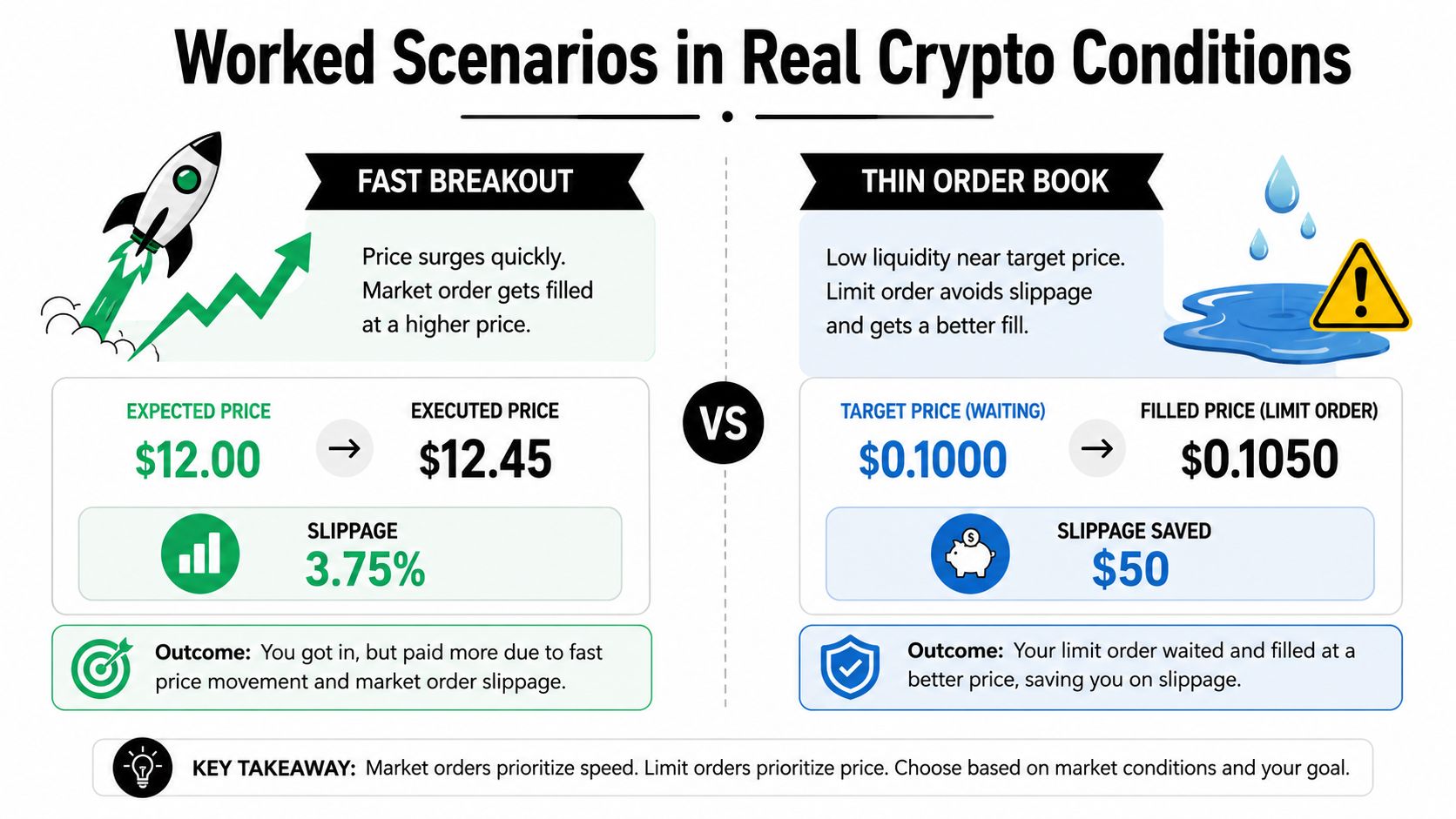
An altcoin trades around $12.00, and momentum accelerates after a catalyst. The book is thin, so a market buy fills at an average of $12.45, the exact scenario shown in the supplied execution visual. That represents 3.75% slippage, before any taker fee is added.
The market order looks expensive, and it may be. Yet a limit buy at $12.00 might never fill if sellers withdraw their offers and the market continues higher. A trader who needs exposure for a short-lived momentum setup has to compare the known slippage with the cost of missing the position entirely.
A disciplined response isn't to send an unlimited market order blindly. Reduce size, inspect the ask depth, consider a marketable limit with a maximum acceptable price, and abandon the trade if the book moves beyond the planned risk. The market order is justified only when the setup's time sensitivity outweighs the price uncertainty.
Scenario two, patient accumulation in a thinner book
Consider a token quoted near $0.1000 with insufficient depth for a larger immediate buy. The supplied scenario visual contrasts a limit execution at $0.1050 with waiting for the market to reach $0.1000, describing $50 saved on slippage. The point isn't that every limit order produces that saving. The point is that a resting order can avoid paying through the book when the trader has time and a firm price ceiling.
For steady Bitcoin accumulation, the book is typically more suitable for staged limit orders than a fast altcoin breakout. A trader can split the intended purchase across planned levels, monitor whether the orders receive fills, and use a small market order only when the schedule becomes more important than another price improvement.
The practical rule is simple: choose by liquidity depth and volatility regime, not by habit. A market order can be rational in a deep book when the position must be established. A limit order can be rational in a thin book when the trader would rather miss the entry than accept uncontrolled slippage.
Where to Place Each Order on a Crypto Exchange
Most centralized exchange spot interfaces place market and limit orders in the same trading panel. CoinEx is a useful representative example, but labels and controls vary, so verify the current interface before submitting an order.
Start with the order-type selector
Look for the Market and Limit tabs above the order form. The market tab usually asks for the amount of the asset, or the total value you want to spend. The limit tab normally adds a price field, because the exchange needs both your desired price and your quantity or total.
For a limit buy, enter the highest price you're willing to pay. For a limit sell, enter the lowest price you'll accept. Check whether the form displays quantity, total, or both, because switching the quote currency can change what the input represents.
Read the book before clicking
The order-book panel shows resting bids and asks. Compare your intended size with the visible quantity near the best prices. A market order that consumes only a small amount of a deep book may have limited price movement, while the same notional amount in a thin token can travel through several levels.
Use this placement checklist:
- Confirm the pair: Make sure you're trading the intended asset and quote currency.
- Confirm the tab: Check that Market or Limit matches your plan immediately before submission.
- Check the amount field: Verify whether you entered base-asset quantity or quote-currency total.
- Review the price: A limit order should show the intended price, not a stale number copied from another pair.
- Inspect the final preview: Confirm estimated cost, quantity, and any displayed fee.
- Check post-only status: Post-only generally cancels or rejects an order that would execute immediately, helping preserve passive intent, but exchange rules differ.
The common misclick is selecting Market while intending to set a price, then assuming the visible last-traded price will be the execution price. Another is entering a limit price in the wrong quote denomination. Slow down at the final confirmation screen, particularly during fast moves.
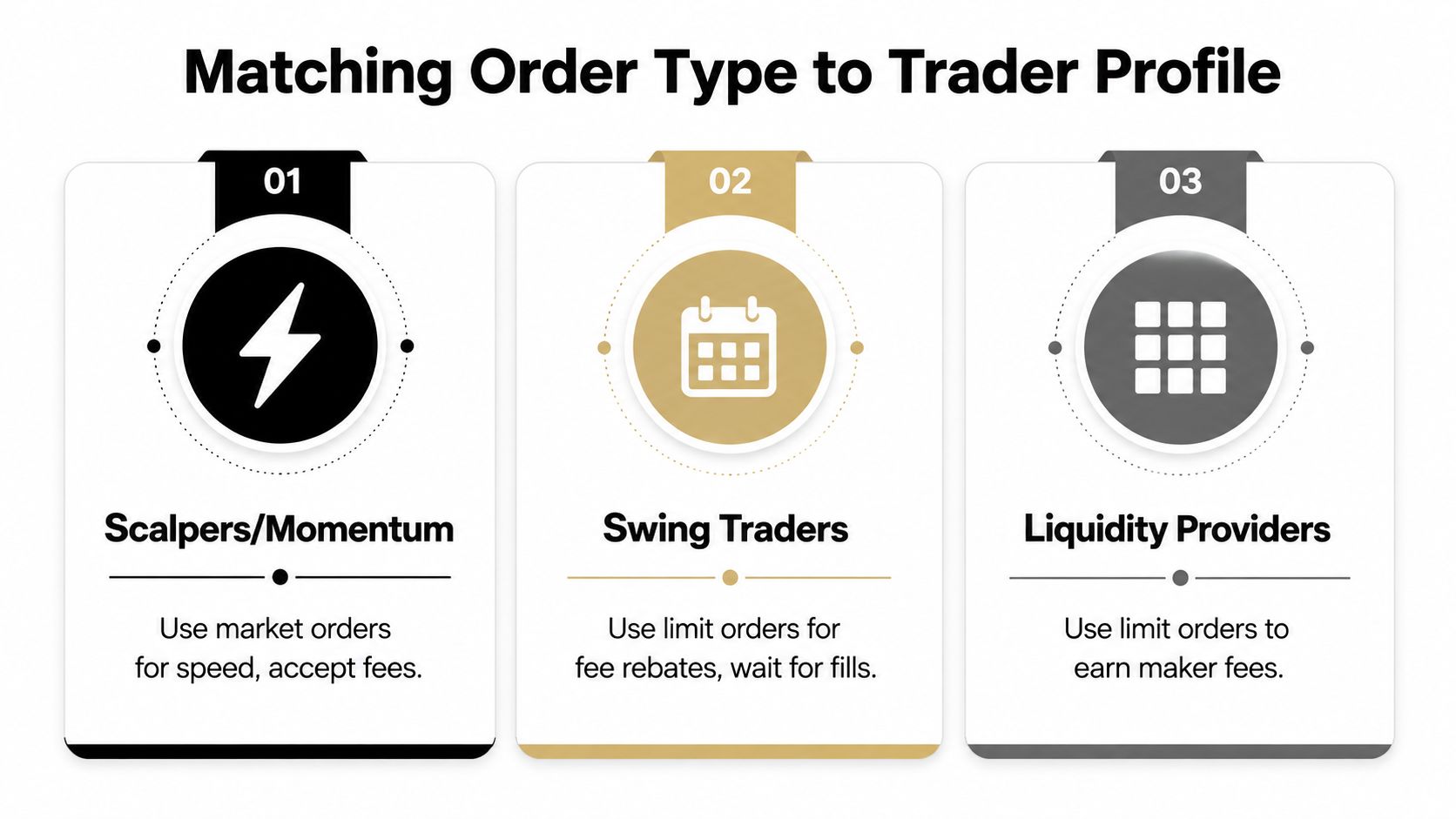
Matching Order Type to Trader Profile
The best default depends on the job your order must perform. A scalper needs execution before a short-lived edge disappears. A swing trader can usually define a level and wait. A dollar-cost averager cares more about repeatability and reducing the effect of any single entry than about catching the exact low.
Scalpers and momentum traders
Default: Use a market order, or a tightly constrained marketable limit, when immediate participation matters more than a precise entry.
These traders should accept that taker fees and slippage are part of the strategy's operating cost. The exception is a sudden deterioration in liquidity. If the ask side is disappearing or the spread widens sharply, reducing size or declining the trade is often better than forcing execution.
Swing traders
Default: Use limit orders at preplanned entry and exit levels when missing the trade is preferable to paying an unacceptable price.
A swing setup usually has more time for a counterparty to arrive. Still, don't leave a limit order unattended indefinitely. Cancel or revise it when the market's structure, thesis, or liquidity changes. A price target isn't a substitute for an active review of queue position and market conditions.
Dollar-cost averagers
Default: Split purchases across scheduled limit orders and occasional market orders, with the mix determined by the schedule and available liquidity.
Averaging doesn't remove execution risk. A limit-only plan can accumulate too slowly during a persistent advance, while a market-only plan can pay unnecessary spread and slippage. Use smaller scheduled orders, review fills, and keep the process consistent rather than trying to predict every short-term move.
Core takeaways:
- Market orders buy certainty of immediate participation, not a guaranteed price.
- Limit orders buy price control, not a guaranteed fill.
- Fees matter, but so do spread consumption, book depth, and missed execution.
- Liquidity and volatility should determine the order type.
- A hybrid route often fits better than a permanent preference for either button.
Coiner Blog offers practical guides and balanced analysis on Bitcoin, Ethereum, DeFi, Web3, Layer 2 networks, tokenomics, AI and crypto, and real-world asset tokenization. Visit Coiner Blog to keep building a more informed execution process, including how order books and trading tools shape crypto decisions.