
7 Best Seed Phrase Storage Methods Compared
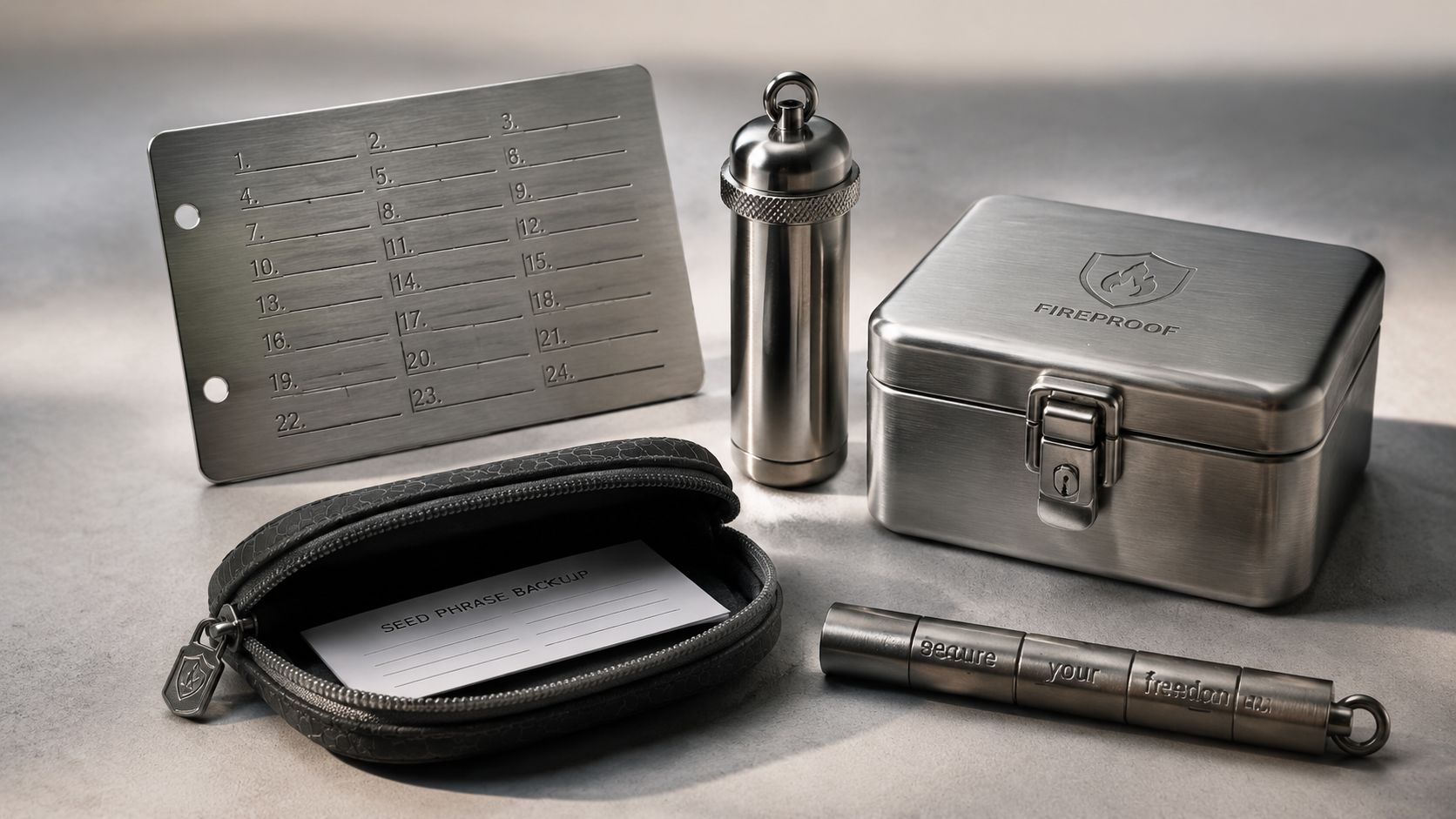
Writing a recovery phrase on paper is better than saving it in a phone, but paper alone isn't a complete long-term custody plan. It can burn, absorb water, fade, tear, or be found by someone who understands what it represents. The right best seed phrase storage method depends on your threat model, including fire, water, corrosion, theft, accidental loss, household access, and inheritance.
This comparison ranks seven products by material resilience, recovery compatibility, setup risk, privacy, and practical usability, not by price or brand popularity. BIP39, published in 2013, standardized how many wallets create and restore mnemonic backups. It uses a 2,048-word list and derives a 512-bit seed with PBKDF2-HMAC-SHA512 using exactly 2,048 iterations, which is why compatible wallets commonly use 12, 15, 18, 21, or 24 words. The BIP39 specification also explains why the first four letters can identify a word in the standard list, but that convention doesn't automatically apply to every recovery format.
A metal backup protects the medium, not the wallet setup. Generate the phrase on the hardware wallet, verify every word privately, and never photograph or upload it. For broader physical document protection, homeowners can also review this guide to document protection for homeowners Sydney.
Table of Contents
- 1. Billfodl
- 2. Cryptosteel Capsule and Cassette
- 3. Keystone Tablet Plus
- 4. NGRAVE GRAPHENE
- 5. Trezor Keep Metal
- 6. Blockstream Metal Plate
- 7. SEEDPLATE
- Top 7 Seed Phrase Storage Comparison
- Match the Backup to the Threat Model
1. Billfodl
Billfodl ranks first for readers who want a guided, familiar metal backup without adopting an unusual recovery format. Its cassette uses 316 marine-grade stainless steel, and its tile system records the first four letters of each BIP39 word. That makes the workflow easy to understand for compatible 12-word and 24-word wallets, while the enclosed design keeps the phrase less exposed than an open plate.
The product page describes resistance to shock, fire, and water, and offers a Multishard option for users who want a Shamir-style split backup. It also presents a 10-year warranty and 125% money-back guarantee language, but those commercial terms shouldn't be confused with a guarantee that a particular storage location will survive every disaster. The steel and enclosure address physical durability. They don't address theft, coercion, a copied phrase, or a compromised wallet during setup. Billfodl's product documentation provides the relevant product details.
Practical rule: A closed cassette is useful only if you periodically check that its locking mechanism and contents remain intact.
Why it suits first-time metal buyers
The labeled positions reduce assembly ambiguity, which matters because the ordered word list is the recovery secret. BIP39-compatible wallets generally recognize the first four letters, but users should confirm their wallet's documented recovery process before abbreviating anything. This guide to cold wallets provides useful context on why offline signing and offline recovery handling matter.
The trade-off is physical handling. Tiles can be fiddly to organize, especially when assembling a phrase in private and trying not to lose or mix spare characters. The screw and locking gate also create a maintenance point, so a periodic tamper inspection is sensible. Billfodl's mature design, clear slot layout, marine-grade steel, and optional split approach make it the strongest overall fit for beginners and long-term holders who value a conventional process over the smallest footprint.
2. Cryptosteel Capsule and Cassette
Cryptosteel earns second place because it gives users two distinct physical workflows without abandoning BIP39 compatibility. The Capsule stores letter tiles inside a steel tube, while the Cassette uses a slotted plate format. Both support the first-four-letters convention for BIP39 backups, so the core recovery logic remains familiar to users moving between compatible Bitcoin, Ethereum, and other cryptocurrency wallets.
That flexibility matters more than it first appears. A capsule can be easier to conceal and separate from ordinary household documents, while a cassette may be easier to inspect visually. Extra tiles, security seals, and multi-capsule configurations support redundancy and distributed custody, although every additional copy also creates another disclosure point. Cryptosteel's official site provides its format, accessory, documentation, and shipping information.
Mature documentation, slower assembly
Cryptosteel's extensive guides and durability material lower the risk of an avoidable setup mistake. That's valuable because a durable backup with one misplaced letter is still a failed backup. Users should write the words in their original order, confirm each entry against the wallet's supported word list, and keep unused tiles controlled during assembly.
The principal weakness is not the metal. It's operational complexity. Tile entry is slower than punching or engraving, and the range of kits can make selection confusing. Pricing also varies by configuration and promotion, so buyers should compare the exact format and included components rather than assuming every Cryptosteel package works the same way.
For experienced long-term holders, the multi-capsule approach can support geographically separated backups. For beginners, the Capsule or Cassette is best when the buyer is willing to follow the documentation carefully. It's less attractive for someone who wants a quick setup, a minimal toolset, or a backup that can be read instantly without rearranging or inspecting many small parts.
3. Keystone Tablet Plus
Keystone Tablet Plus places third because it addresses a specific weakness in many tile-based backups: tiles can shift when the plate deforms. Its 304 stainless steel construction is designed for water, fire, and corrosion resistance, while individual letter slots hold the tiles in place. The product supports 12-word, 18-word, and 24-word BIP39 phrases using the first-four-letters method. Keystone's official product page lists the included punch tool and security seals alongside the assembly design.
The anti-displacement design gives it a different custody profile from a loose-tile cassette. Heat can damage paper, and physical force can deform metal. A layout that constrains each character reduces one possible failure mode, although it doesn't make the backup invulnerable or eliminate the need to inspect the result.
A good balance for careful beginners
Keystone's step-by-step assembly is a practical advantage. The kit includes the tools needed to begin, and the format is compatible with many BIP39 wallets. That combination makes it easier for a first-time buyer to avoid improvising with household tools or an unsuitable marking method.
Still, setup takes patience. The screws and screwdriver add assembly time, and the inventory of letters can create a rare but frustrating constraint if a particular character runs out. Users should count and organize tiles before starting, then inspect every word and position before closing the tablet.
The Tablet Plus suits beginners who want guided assembly and holders who want a conventional BIP39 recovery format with a more constrained tile layout. It's less suitable for someone prioritizing the fastest setup or the least conspicuous possible backup. Its strongest argument is not a headline durability claim. It's the combination of recognizable recovery compatibility, included tools, and an effort to keep data in place during physical deformation.
4. NGRAVE GRAPHENE
NGRAVE GRAPHENE takes fourth because it changes the privacy model rather than placing the entire phrase on a stronger plate. Its two stainless-steel plates split and encode the recovery data, so one plate alone is described as indecipherable. That can reduce the consequences of a single discovered plate, provided the two components are stored and managed correctly.
The product is designed to pair with NGRAVE ZERO, but its split-plate approach is relevant to anyone evaluating alternatives to a single full backup. NGRAVE states resistance to temperatures up to 2,507°F, or 1,375°C, on its product page. That is a product claim about the design and materials, not a promise that every surrounding container, building, or storage location will remain usable in a fire. NGRAVE's GRAPHENE page also describes the punch pen, optional extra lower plate, and recovery design.
Stronger secrecy, heavier cognitive load
The split design is attractive for high-value custody because finding one plate shouldn't reveal the full recovery material. It can also support more deliberate separation between locations. But the same separation creates a recovery dependency. Owners must know where the components are, preserve the correct relationship between them, and understand the recovery procedure when the original wallet is unavailable.
That learning curve is the central drawback. Users accustomed to BIP39's first-four-letters convention won't be able to assume that the GRAPHENE workflow operates identically. The safer choice is to follow the manufacturer's documented restore procedure and test it before relying on the backup for substantial holdings.
GRAPHENE is best for security-conscious long-term holders and high-net-worth users who can manage a more complex system. It isn't the easiest first metal backup, and its premium positioning makes it harder to justify for a small or frequently accessed wallet. Its advantage appears when the threat model includes discovery of one physical component, not merely fire or water damage.
5. Trezor Keep Metal
Trezor Keep Metal ranks fifth, but it may be the most logical choice for an existing Trezor owner who wants first-party documentation and a backup aligned with the manufacturer's ecosystem. It uses AISI 304 stainless steel with a black surface treatment, a punch-in layout, a pre-marking pen, a punch tool, and tamper-evident seals. The holding box helps stabilize the plate while punching. Trezor's official Keep Metal page distinguishes the 20-word SLIP39 single-share version from the 24-word BIP39 version.
That distinction is important. A 20-word SLIP39 backup isn't interchangeable with a 24-word BIP39 phrase because both are written as words. Users must identify the standard used by the wallet before buying or marking the plate. A seed phrase is also not the same thing as an individual private key, so restoring the wrong format can lead to confusion even when every mark looks legible.
Best for ecosystem compatibility
Trezor's layout assistance and tamper-evident approach reduce setup uncertainty for users already following Trezor's recovery instructions. Punching also avoids the need to manage many loose tiles, and a permanent mark is straightforward to inspect once complete.
The plate is heavier than thinner steel or titanium alternatives, and it isn't positioned as the cheapest route to durable backup. Regional checkout presentation can also affect how the product appears to buyers. Those are usability and purchasing considerations, not security failures.
For Trezor users, the integration and official guidance carry real weight. For users with wallets from other manufacturers, the choice depends on whether the relevant recovery standard matches. Trezor Keep Metal makes the most sense when compatibility is confirmed first, the owner understands SLIP39 versus BIP39, and the backup will be stored separately from the signing device.
6. Blockstream Metal Plate
The strongest case for Blockstream Metal Plate is controlled, long-term custody, not broad beginner appeal. Its 316 marine-grade stainless steel construction, protective cover, and tile-based design suit users who want a finished BIP39 backup and already understand the Blockstream or Jade ecosystem. The official store listing describes its disaster-resistant construction and use of tiles recording the first four letters of each BIP39 word.
Stainless steel helps in moist or corrosive environments, but storage conditions still determine its lifespan. Chlorinated or saltwater exposure can cause pitting over time, so a dry, discreet location remains important. Material strength reduces some fire and corrosion concerns, yet it does not remove the need for sensible placement or periodic inspection.
Premium construction with tile-management risk
The assembly method follows BIP39's first-four-letters convention, which can make recovery compatible with wallets that use the same standard. The cover limits casual visibility during storage and handling. During setup, though, spare tiles must be controlled, and the owner needs a private workspace so an observer cannot reconstruct the phrase.
Tile systems also create an organizational failure point. Losing a spare character, misplacing a tile, or skipping verification can make an otherwise durable backup difficult to recover. A single-piece punch plate has fewer loose parts, while Blockstream's design offers a more polished presentation and covered storage.
The product's higher cost than simpler plates further narrows its audience. It fits Jade users and long-term holders who value durable construction, a conventional BIP39 workflow, and a protected tile layout. High-net-worth users may prefer it when assembly can be completed privately and duplicate backups are stored separately. Beginners should choose it only if they are comfortable identifying BIP39 words, checking the completed phrase, and maintaining the spare tiles.
Blockstream Metal Plate is a custody-focused choice for owners who prioritize corrosion resistance and a finished enclosure over the simplicity of punching one plate. Its recovery value depends on disciplined setup as much as on the steel itself.
7. SEEDPLATE
The SEEDPLATE prioritizes compact permanence over guided assembly, making it a different commitment for the owner. Designed for Coinkite and Coldcard users, its 2 millimeters thick plate comes in a 24-word format that holds a full BIP39 seed, alongside a Tiny 12 version for 12-word phrases. The owner marks each word with an automatic center punch, while the punch tool is sold separately. The official SEEDPLATE store also references third-party destruction testing through Lopp's testing index.
Understanding the distinction between holding your own keys and delegating custody is essential before choosing a permanent backup method. See this guide on not your keys, not your coin for background.
A single plate reduces the organizational risks of multi-piece tile systems. There are fewer components to track, no character inventory to maintain, and a smaller footprint that can support discreet storage. The trade-off is concentrated in the setup: the owner must create permanent, legible marks while avoiding damage and word-order errors.
Simple after setup, demanding during setup
Punching may be faster than loading tiles once the layout is familiar. It also creates a fixed physical record instead of movable characters. The separate tool purchase adds setup friction, and inexperienced users should practice on non-sensitive material before marking the phrase.
Legibility is the primary long-term concern. Scratches, poor storage, or careless handling can make the marks harder to interpret. After marking, inspect the plate privately and verify every word, position, and recovery standard. This seed phrase storage guide emphasizes preserving the exact ordered word list and checking words against the BIP39 list.
SEEDPLATE suits Bitcoin-focused users, compact-storage advocates, and experienced holders who want one plate for a full 24-word phrase. Its single-piece design limits lost-part risk and supports discreet custody, but it offers less guidance than a kit with an included tool. Beginners should choose it only if they can verify the layout carefully. For long-term or high-net-worth custody, separate duplicate backups and private setup matter more than the compact format alone.
Top 7 Seed Phrase Storage Comparison
| Product | 🔄 Implementation complexity | Resource requirements | ⭐📊 Expected outcomes | Ideal use cases | 💡⚡ Key advantages |
|---|---|---|---|---|---|
| Billfodl | Moderate, tile insertion into cassette; screw/lock closure | 316 SS tiles & cassette, basic tools for checks | ⭐ High durability (316 marine‑grade); fire/water/shock resistant | First metal backup users; home storage; Shamir/Multishard setups | Easy workflow; mature brand; Multishard option |
| Cryptosteel (Capsule / Cassette) | Moderate, tile insertion (tube or slotted plates); slower entry | Letter tiles/tube or cassette, optional seals/accessories | ⭐ High durability; proven resilience and documentation | Users wanting parts/accessories, global shipping, custom setups | Multiple form factors; extensive guidance and parts availability |
| Keystone Tablet Plus | Moderate, per‑letter slotting with screws; slightly longer assembly | 304 SS plate, letter tiles, punch tool, screwdriver & seals | ⭐ Good durability (304 SS); reduced tile shift under stress | Budget‑aware users seeking anti‑dislodgement design | Affordable; anti‑dislodging slots; clear assembly steps |
| NGRAVE GRAPHENE | Higher, split/encode workflow across two plates; learning curve | Two stainless plates, punch pen, optional extra lower plate | ⭐ Very high resilience; single plate indecipherable; extreme temp claims | Users prioritizing secrecy/high heat resistance; premium use | Split‑plate secrecy; premium build; strong physical protection |
| Trezor Keep Metal (20/24) | Moderate, punch‑in workflow requiring steady punching | AISI 304 punch plate, punch tool, pre‑marking pen, tamper seals | ⭐ High durability; tamper‑evident features; official docs | Trezor hardware users; those wanting first‑party accessory | Official integration; tamper seals; guided layout assistance |
| Blockstream Metal – Plate | Moderate, tile loading into plate with protective cover | 316 marine‑grade plate, character tiles, protective cover | ⭐ High durability; premium polished construction | Blockstream/Jade users; premium plate seekers | Marine‑grade steel; polished finish; simple loading |
| SEEDPLATE (Coinkite / Coldcard) | Low–Moderate, punch/mark with center punch; single plate workflow | 2 mm steel plate; requires separate automatic center punch | ⭐ High durability; compact; single plate holds full 24‑word seed | Cost‑conscious Bitcoin‑first users; concealed storage | Very cost‑effective; one plate stores full seed; reputable maker |
Match the Backup to the Threat Model
There isn't one universal winner in seed phrase storage because the storage medium solves only part of the custody problem. A steel plate can survive conditions that destroy paper, but it can still be stolen. A split design can reduce the damage caused by discovering one component, but it can also create recovery confusion. A tile system can guide a beginner through setup, while a punch plate can be more compact and permanent once the marking is complete.
Start with the event you're trying to survive. If fire, water, or ordinary physical deterioration is the primary concern, a stainless-steel system is a sensible improvement over paper. Material choice still matters. Current guidance on metal backups notes that stainless steel handles water exposure better than vulnerable materials but can pit in chlorinated or saltwater environments. Keep the backup away from predictable moisture and corrosive storage conditions rather than treating the metal label as a guarantee.
Choose by operating style
- Guided assembly: Billfodl, Cryptosteel, Keystone Tablet Plus, and Blockstream Metal Plate use tile-based workflows that can feel more approachable to beginners. The owner must still organize the tiles and verify the result.
- Compact permanence: SEEDPLATE and Trezor Keep Metal suit users who prefer punching a fixed record rather than arranging many loose characters.
- Single-component disclosure risk: A conventional full backup means anyone who finds it may control the wallet. NGRAVE GRAPHENE addresses that concern through a split-plate design, while Shamir secret sharing can divide secret material into shares and require a threshold for reconstruction. One implementation allows between 2 and 16 shares, with a chosen recovery threshold. The Shamir Backup app listing describes that model.
Before storing anything, confirm the wallet's recovery standard. BIP39 uses an exact ordered mnemonic list, while SLIP39 and manufacturer-specific systems may follow a different process. Where the wallet supports the convention, enter only the first four letters, inspect every mark or tile, and use the manufacturer's documented recovery procedure to test the backup. Never type the phrase into an internet-connected device, photograph it, or place it in cloud storage or a notes app. Independent wallet-security guidance reinforces the offline rule.
Store backups separately from the signing device, and consider physical separation when one location could be affected by the same fire, theft, or household event. Inheritance requires deliberate planning too. Guidance on long-term seed phrase management highlights annual reviews, offsite separation, and inheritance planning, but access instructions should explain the recovery process without exposing the phrase during routine access.
Beginners will usually benefit from a clearly labeled tile system and a successful restore test. Long-term holders may prefer a durable punch plate or a carefully managed multi-copy arrangement. High-net-worth users should consider whether a single full backup creates too much disclosure risk and whether a split or threshold design is manageable for their heirs and trusted custodians. The safest choice is the one you can assemble, verify, and recover correctly.
Coiner Blog publishes practical cryptocurrency guides and balanced analysis across Bitcoin, Ethereum, DeFi, Web3, Layer 2 networks, tokenomics, AI and crypto, and real-world asset tokenization. Visit Coiner Blog for clear explanations that help you evaluate wallet security, custody trade-offs, and the risks behind evolving digital-asset tools.