
What Is a Crypto Whale and Market Impact

A crypto whale is a market participant whose position can materially affect liquidity, price discovery, or sentiment. In Bitcoin, the commonly used benchmark is 1,000 BTC or more, while Santiment reported in 2026 that 2,044 whale wallets controlled 7.17 million BTC, about 35.82% of circulating supply.
That concentration changes how markets behave. A whale doesn't need to sell an entire position to move price. A relatively small transfer to an exchange can increase available sell-side supply, alter order-book conditions, and influence the decisions of traders who monitor on-chain activity. The label therefore describes market impact, not just personal wealth.
The most useful way to understand a crypto whale is operationally. Ask how much liquidity an asset has, how deep its exchange markets are, and what share of circulating supply a wallet controls. That framework works better than treating “whale” as a universal dollar category.
Table of Contents
- Defining the Crypto Whale Threshold
- The Evolution of Whale Ownership and Market Structure
- Why Whale Definitions Vary Across Different Assets
- Tracking Exchange Inflows and the Whale Ratio
- Real-World Scenarios of Whale Market Impact
- Common Misconceptions About Whale Manipulation
- Practical Risk Management for Retail Investors
Defining the Crypto Whale Threshold
A crypto whale is a holder large enough to influence the market in which they operate. The influence may appear through exchange deposits, withdrawals, large trades, liquidity changes, or shifts in investor sentiment. A wallet can qualify because its balance is enormous, but the more important question is whether its activity can affect other participants' ability to buy or sell at expected prices.
For Bitcoin, 1,000 BTC is a widely used industry threshold. Major analytics firms use that benchmark to distinguish whale-sized wallets from smaller holders, and Santiment's 2026 data counted 2,044 wallets at or above that level. Those wallets held 7.17 million BTC, equal to approximately 35.82% of Bitcoin's circulating supply, according to Santiment whale-holding data reported by CryptoRank.
That figure matters because the combined holdings exceeded one-third of circulating coins. It doesn't mean every whale is trading aggressively, or that all those wallets belong to one coordinated group. It does show why analysts watch large-holder movements closely when assessing liquidity and short-term market behavior.
A market convention, not a legal status
“Whale” isn't a formal legal classification. It's a practical label used by traders, analytics providers, and researchers. A 1,000 BTC wallet may be highly influential in one setting, yet its impact can differ depending on whether the coins sit in long-term custody, move between wallets, or reach an exchange with an active order book.
Bitcoin distribution tools may also use broader or narrower bands. For example, one tracker classifies the 1K to 10K BTC range as a whale band, while another uses 1,000 BTC or more as an alert threshold, as described by Newhedge's Bitcoin address distribution data. At current market prices, holdings at that level often represent tens of millions of dollars, but the value alone doesn't explain market impact. Liquidity is the deciding variable.
Practical rule: Treat the threshold as a screening tool. Treat exchange depth, transfer destination, and transaction intent as the evidence.
Readers who encounter the term through social platforms may also benefit from browsing social slang with Captapi, especially because crypto communities frequently use “whale” loosely. For the market mechanics behind the label, liquidity of cryptocurrency provides useful context on why a large balance matters only when it interacts with available market depth.
The Evolution of Whale Ownership and Market Structure
Whale ownership once evoked early adopters, miners, and private traders who accumulated Bitcoin before institutional participation became a major market feature. That picture is now incomplete. Large holders include public companies, spot ETFs and funds, and governments, each with different custody arrangements, mandates, and reasons for holding digital assets.
A 2026 Bitcoin ownership map estimated that fewer than 100 entities controlled about 4.2 million BTC, roughly 20% of the full 21 million BTC supply, according to KuCoin's analysis of Bitcoin ownership and market structure. The same analysis estimated that public companies held 1,264,579 BTC, or 6.0%, spot ETFs and funds held 1,214,016 BTC, or 5.8%, and governments held 649,954 BTC, or 3.1%.
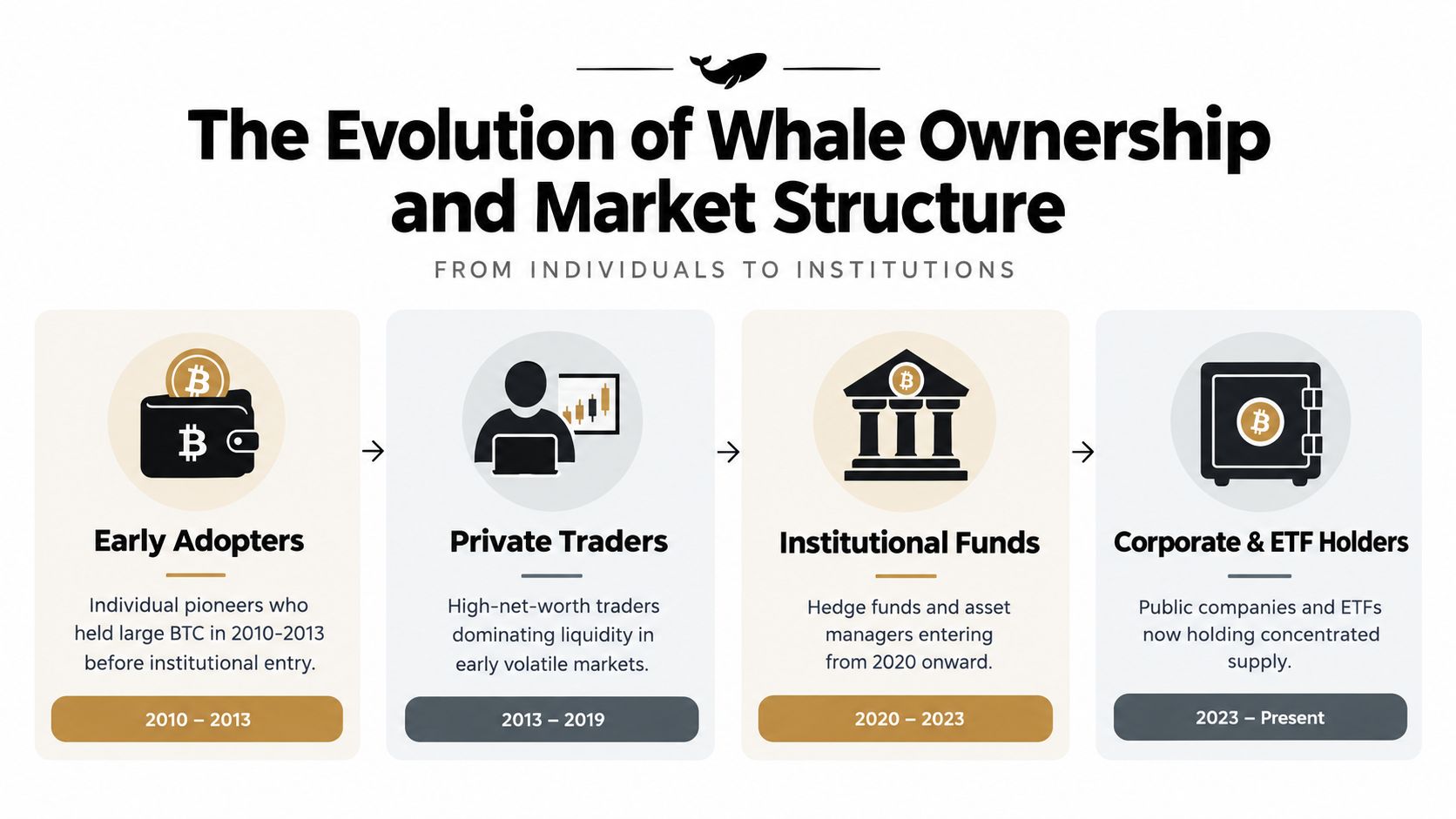
The holder category became institutional
These figures don't prove that institutions trade like private whales. A corporate treasury may follow a long-term allocation policy. An ETF may hold coins through a custodian, while the fund's investors buy and sell shares in a regulated market structure. A government wallet may be associated with reserves, seizures, or other state activity. The on-chain balance is visible, but the decision-making process behind it can differ substantially.
CryptoQuant's 2026 framing defines whales as wallets holding 1,000 to 10,000 BTC, excluding exchanges and mining pools to focus on investor behavior. That exclusion matters because exchange addresses can contain customer assets belonging to many unrelated holders. Counting an exchange wallet as one individual whale would distort the picture.
The broader lesson is that concentration and control aren't identical. A small number of entities may control substantial supply, yet much of that supply may remain inactive or move through intermediaries. Analysts therefore need to combine ownership maps with transfer patterns, custody information, and exchange flows.
Whale analysis has shifted from asking who the richest early adopters were to asking which types of entities control liquidity, and under what conditions they might release it.
That distinction belongs to market microstructure, where order-book depth, execution conditions, and participant behavior determine how ownership becomes price impact.
Why Whale Definitions Vary Across Different Assets
There's no universal balance that makes someone a whale across every cryptocurrency. The same position can be insignificant in a deep market and dominant in a thin one. That's why a useful definition must consider asset liquidity, exchange depth, circulating supply, and concentration together.
Bitcoin offers the clearest benchmark. Industry sources commonly use 1,000 BTC or more for a whale-sized wallet. Ethereum market-monitoring coverage has used 10,000 ETH as a comparable operational threshold, while smaller tokens are often assessed by the holder's share of circulating supply. For altcoins, analysts may look at ownership of 0.1%, or ranges such as 1% to 5%, because supply and liquidity vary sharply, as explained by Investopedia's Bitcoin whale overview.
Balance size versus market depth
Consider two trades with the same notional value. In Bitcoin, a transaction of that size may pass through multiple venues without exhausting visible bids or offers. In a niche DeFi token, the same transaction could consume a large part of the available order book, move the price sharply, and trigger automated responses from market makers or liquidation systems.
The wallet's percentage of supply also matters. A holder controlling a large share of a token can influence perceived scarcity, governance outcomes, staking participation, or investor confidence even if the wallet never sends funds to an exchange. In a protocol token, concentration may affect tokenomics and voting power as much as spot-market liquidity.
Reading whale alerts correctly
A whale alert usually identifies an address, a transfer size, or a destination. It doesn't automatically establish intent. The transfer might involve:
- Custody management: An institution moves assets between wallets controlled by the same provider.
- Liquidity preparation: A holder sends coins to an exchange, potentially preparing to sell or trade.
- Settlement: A transaction supports an OTC trade or another off-exchange arrangement.
- Protocol activity: Tokens move into staking, governance, lending, or liquidity contracts.
The practical question is not “Did a whale move coins?” It's “Did the movement change the amount of inventory available to the market?” A plain-language explanation of that principle appears in this guide to liquidity meaning for crypto traders.
A whale threshold tells you where to look. It doesn't tell you what the wallet will do next.
This relative framework applies across Bitcoin, Ethereum, Layer 2 tokens, DeFi assets, and tokenized real-world assets. The thinner the market, the more important supply concentration and venue depth become.
Tracking Exchange Inflows and the Whale Ratio
A 64% Exchange Whale Ratio, or 0.64, means large-holder deposits made up that share of Bitcoin exchange inflows by volume in the cited benchmark. The level was reported as the highest since 2015 in CoinMarketCap's report citing CryptoQuant. The figure measures potential exchange-side supply, not confirmed selling.
The threshold behind a whale deposit is relative to liquidity. A transfer that barely affects Bitcoin's order books can overwhelm a thin altcoin market, even if the smaller asset's dollar value is lower. Analysts should therefore compare wallet size with exchange depth, recent volume, and the amount normally available near the current price.
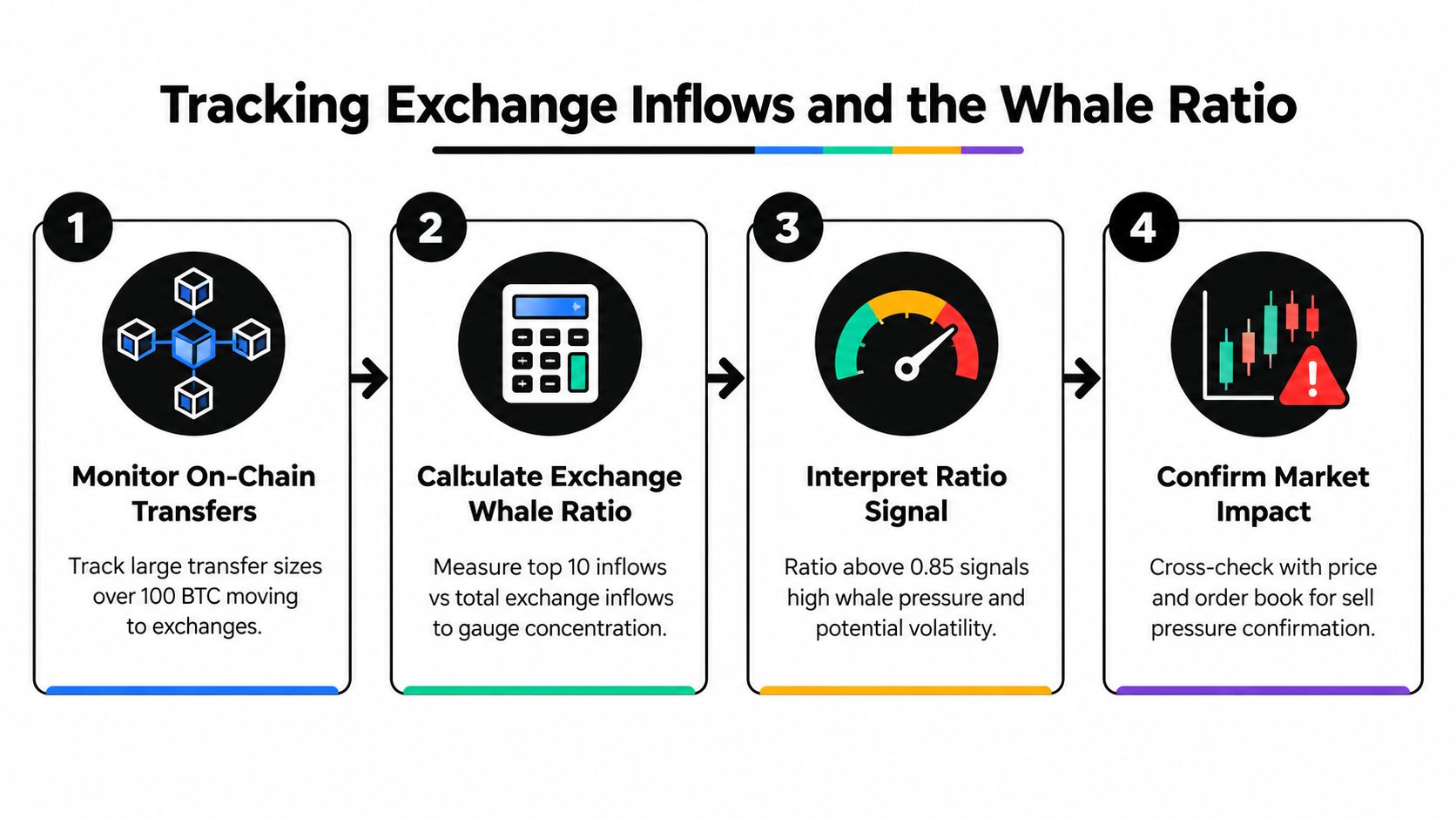
A practical reading process
Start with transfer size and destination. Identify whether the address sends funds to an exchange, a known custodian, a staking contract, or another private wallet. Transfers in the 100 to 1,000 BTC range were reported as representing 80% of inflows at certain points in the same CryptoQuant-referenced analysis. That observation is a historical condition, not a permanent definition of whale activity.
Then examine concentration. One large deposit may matter less than repeated transfers from several addresses controlled by related entities. A cluster of deposits can place more inventory near exchange liquidity at the same time, increasing potential sell-side pressure.
Compare flows with execution conditions. A rising ratio can accompany liquidation or profit-taking, but it does not prove that a sale occurred. Check price reaction, bid depth, funding conditions, and liquidation activity to distinguish a meaningful supply change from routine custody movement.
For broader monitoring, crypto market intelligence tools can combine on-chain transfers with order-book and derivatives data. ETF-related wallet activity also needs custody context. The ETF creation and redemption process explains why institutional asset movements may reflect share creation or redemption rather than a simple individual sell order.
Real-World Scenarios of Whale Market Impact
A large transfer doesn't automatically create a price crash. The result depends on the destination, execution method, timing, and amount of liquidity available at that moment.
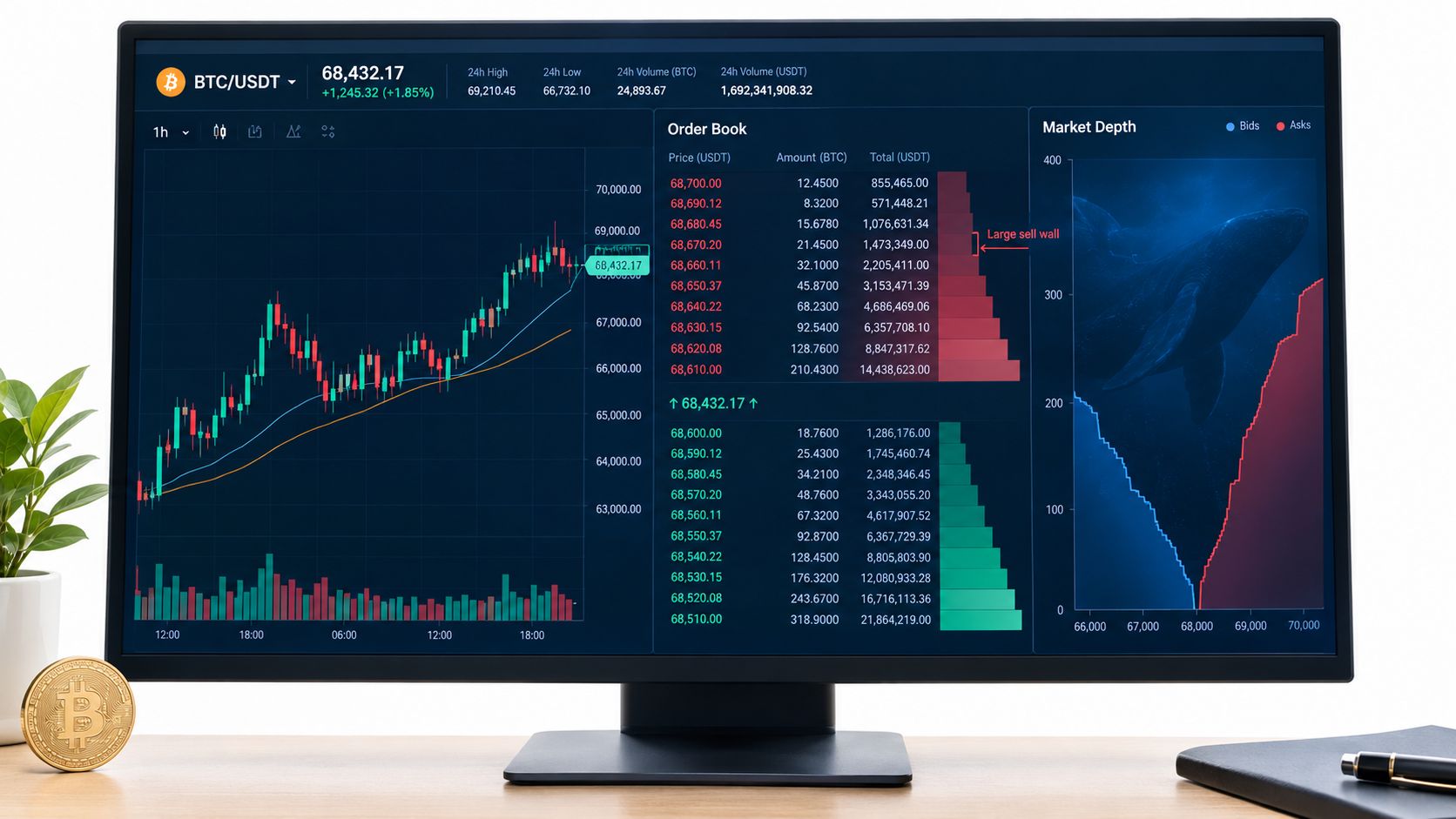
Scenario one, accumulation without a visible pump
Suppose a large holder buys from sellers through an OTC desk. The transaction may settle on-chain, but it doesn't necessarily consume visible exchange bids. Retail traders may see a wallet movement and assume a market purchase occurred, even though the trade could have been negotiated away from the public order book.
A different accumulation pattern appears when a whale places bids across several price levels. Those bids can absorb retail selling pressure while keeping the market from falling as quickly as it otherwise might. The effect may look uneventful on a chart because the whale's activity supports liquidity rather than removing it.
This is why an address movement should be classified before it's interpreted. A wallet transfer between cold-storage addresses, a custodian migration, and an exchange deposit can look similar on-chain while carrying different market implications.
The dashboard below illustrates the data retail traders should compare rather than relying on a single alert.
Scenario two, distribution into exchange liquidity
Distribution becomes more consequential when a large holder sends coins to an exchange and sells into available bids. If the order book lacks sufficient depth, the seller may need to accept progressively lower prices to complete the trade. Other traders may then react to the falling price, and positions can add forced selling.
That chain doesn't require malicious coordination. A whale may be rebalancing a treasury, meeting an obligation, reducing risk, or taking profit. The market impact can still be severe because the available liquidity was insufficient for the order size.
Scenario three, noise from internal transfers
Automated alert services often emphasize transaction size because it's easy to detect. They may not know whether both addresses belong to the same institution, exchange, or custodian. A wallet shuffle can therefore attract attention without changing the actual supply available to buyers and sellers.
The right unit of analysis isn't the transfer alone. It's the transfer's effect on accessible liquidity.
Experienced analysts combine address labels, exchange-flow data, order-book conditions, and subsequent price behavior. Retail investors should avoid treating a dramatic notification as proof of intent.
Common Misconceptions About Whale Manipulation
The most persistent mistake is equating large ownership with active manipulation. Concentration creates the capacity to influence a market, but capacity isn't evidence that a holder is spoofing orders, wash trading, coordinating a pump, or deliberately triggering liquidations.
A large wallet may belong to an exchange, ETF custodian, corporate treasury, government, or private investor. The balance can remain unchanged while the underlying owners trade indirectly through shares, derivatives, or managed accounts. On-chain visibility reveals movement, but it often doesn't reveal the full beneficial ownership or commercial purpose behind that movement.
Myth one, every large transfer is a sale
A transfer to an exchange can precede a sale, but it can also support custody operations, collateral management, or settlement. A transfer away from an exchange may reduce immediate visible supply, yet it doesn't guarantee that the holder has adopted a permanent long-term strategy.
The destination provides context, not certainty. Analysts should seek confirmation from exchange balances, trade execution, and price response before drawing conclusions.
Myth two, concentration proves coordination
High concentration can make a market vulnerable to a single holder's decisions. It doesn't demonstrate that large holders are working together. A few wallets may have unrelated objectives, different time horizons, and different custody providers.
A broader distribution report defines whales more conservatively as addresses holding at least 100 BTC and estimates that these addresses represent only 0.04% of all addresses while holding 61.7% of supply, according to Chainquery's distribution report. That estimate illustrates concentration, but it shouldn't be treated as proof of coordinated behavior.
Myth three, whale alerts are trading signals
An alert is an observation, not a forecast. Traders who buy or sell immediately after seeing one may become the liquidity that a larger participant needs. Social-media commentary can intensify that reaction, especially when users attach a confident narrative to an ambiguous transfer.
Glassnode's Supply per Whale metric demonstrates why balance methodology matters. It measures total BTC held by addresses with 100 to 10,000 BTC, divided by the number of addresses in that band, allowing analysts to track average large-holder balances rather than count the biggest wallets, as explained by Glassnode's Supply per Whale metric.
The disciplined approach is to separate three questions: who controls the address, where the assets moved, and whether accessible liquidity changed.
Practical Risk Management for Retail Investors
Whale data works best as a context indicator, not a standalone entry or exit command. Retail investors can't know every holder's intent, and on-chain signals often arrive before the market has fully processed their meaning. The goal is to manage exposure when liquidity conditions become less predictable.
Start with a simple monitoring routine:
- Check exchange inflows: Watch whether large transfers are moving toward venues where coins could become sell-side inventory.
- Review concentration: Use distribution metrics to identify assets where a small address group controls a meaningful share of supply.
- Compare multiple venues: A transfer to one exchange may matter differently from a broad movement across several markets.
- Check the order book: Look for changes in bid depth and spread conditions before assuming that a whale has created durable pressure.
- Separate custody from execution: Label known exchange, ETF, fund, and institutional addresses before reacting to their activity.
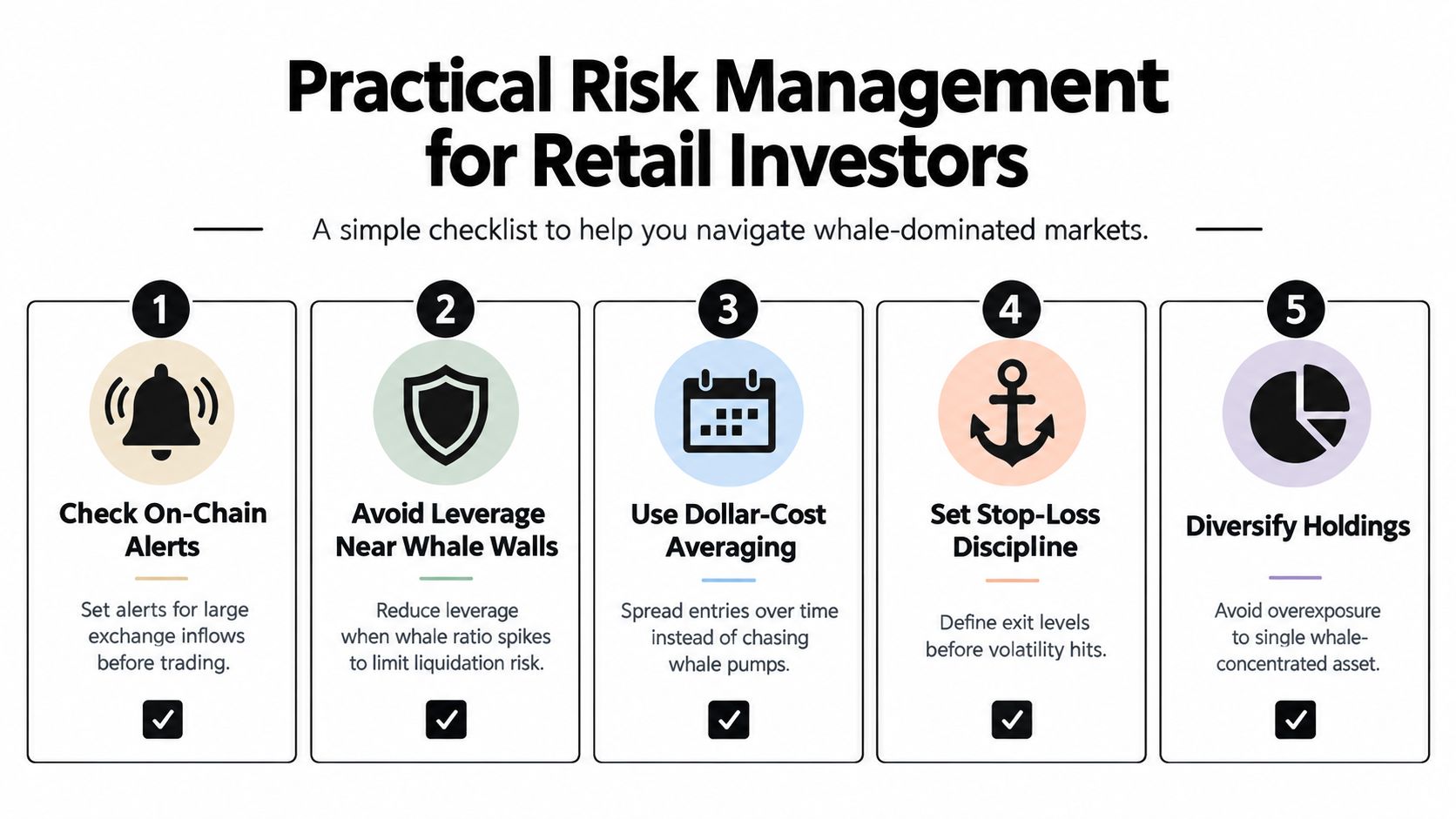
Adjust exposure before liquidity disappears
When whale deposits rise or large-holder activity becomes concentrated, reduce the chance that one order-book shock will determine your outcome. That can mean using smaller positions, avoiding excessive risk, spreading entries over time, and defining an exit level before volatility accelerates.
Dollar-cost averaging can reduce the pressure to time a single purchase, but it doesn't remove asset-specific risks. Diversification also needs judgment. Holding several highly correlated tokens may provide less protection than the number of positions suggests, particularly when the same market-wide liquidity event affects Bitcoin, Ethereum, Layer 2 assets, and DeFi tokens together.
Stop-loss orders require care as well. Thin liquidity can produce slippage or temporary price movements that trigger an exit before the market stabilizes. Position sizing remains the first line of defense because it limits how much one unexpected move can damage a portfolio.
Risk principle: Use whale metrics to decide how much uncertainty you can tolerate, not to pretend you know the next candle.
Review your assumptions whenever a whale alert appears. Confirm the destination, compare the flow with market depth, and look for evidence that execution followed the transfer. Avoid trading solely from anonymous social posts, and don't use borrowed funds you can't withstand during a liquidity shock. Crypto markets include Bitcoin, Ethereum, Web3 applications, DeFi protocols, smart-contract platforms, AI-linked projects, Layer 2 networks, and real-world asset tokens, but every asset still depends on its own supply concentration and trading depth.
Coiner Blog publishes practical cryptocurrency and blockchain analysis across Bitcoin, Ethereum, DeFi, Web3, tokenomics, Layer 2 networks, AI and crypto, NFTs, gaming, and real-world asset tokenization. Visit Coiner Blog to follow market-structure explainers and risk-focused guides that help you interpret whale activity without mistaking an alert for a prediction.