
What Is a Sidechain in Crypto and How Does It Work

A sidechain is a separate blockchain connected to a main chain by a two-way peg that lets assets move between them. The model was formalized in 2014, while a trustless proof-of-work sidechain construction arrived on October 30, 2018, addressing the problem of transferring assets without a central custodian.
But knowing the definition doesn't answer the question that matters most: what are you trusting when your funds leave Bitcoin or Ethereum? A sidechain can offer different transaction rules, faster processing, smart contracts, privacy features, or specialized applications. It can also introduce a separate validator set, bridge operators, withdrawal delays, and failure risks that the parent blockchain won't automatically absorb.
The useful mental model is simple. A sidechain borrows a connection to a major blockchain, not necessarily that blockchain's security. That distinction separates sidechains from many Layer 2 networks and should shape how users evaluate bridges, DeFi applications, tokenized assets, and Web3 infrastructure.
Table of Contents
- What a Sidechain Actually Is
- How Two-Way Pegs Move Assets Between Chains
- Sidechains vs Layer 2 vs Parachains
- Liquid and Other Real-World Sidechain Examples
- What Sidechains Unlock for Users and Developers
- The Security Trade-Off Most Explainers Skip
- Practical Tips Before You Bridge to a Sidechain
- The Core Idea to Remember
What a Sidechain Actually Is
A sidechain is an independent blockchain that runs alongside a parent blockchain and connects to it through a two-way peg. The peg allows assets to move from the parent chain to the sidechain and back, while the sidechain maintains its own consensus rules and transaction format. The academic definition of the model combines two parts, a cross-chain transfer protocol and a separate sidechain consensus protocol, as described in this academic treatment of sidechain design.
A physical analogy helps. Think of the parent chain as a major highway and the sidechain as a parallel service road. The service road has an on-ramp and an off-ramp, so vehicles can move between the two routes. But it doesn't use the highway's traffic signals, road inspectors, or maintenance budget. It has its own rules, operators, and safety arrangements.
That last point is more important than the road metaphor itself. A sidechain's validators or federation generally decide which transactions become final on that network. The parent chain doesn't automatically validate those transactions, reverse a fraudulent sidechain transfer, or provide the sidechain with its own hash power or staked capital. The IBM review of sidechain technologies describes sidechains as secondary blockchains connected through a two-way peg while using their own consensus rules.
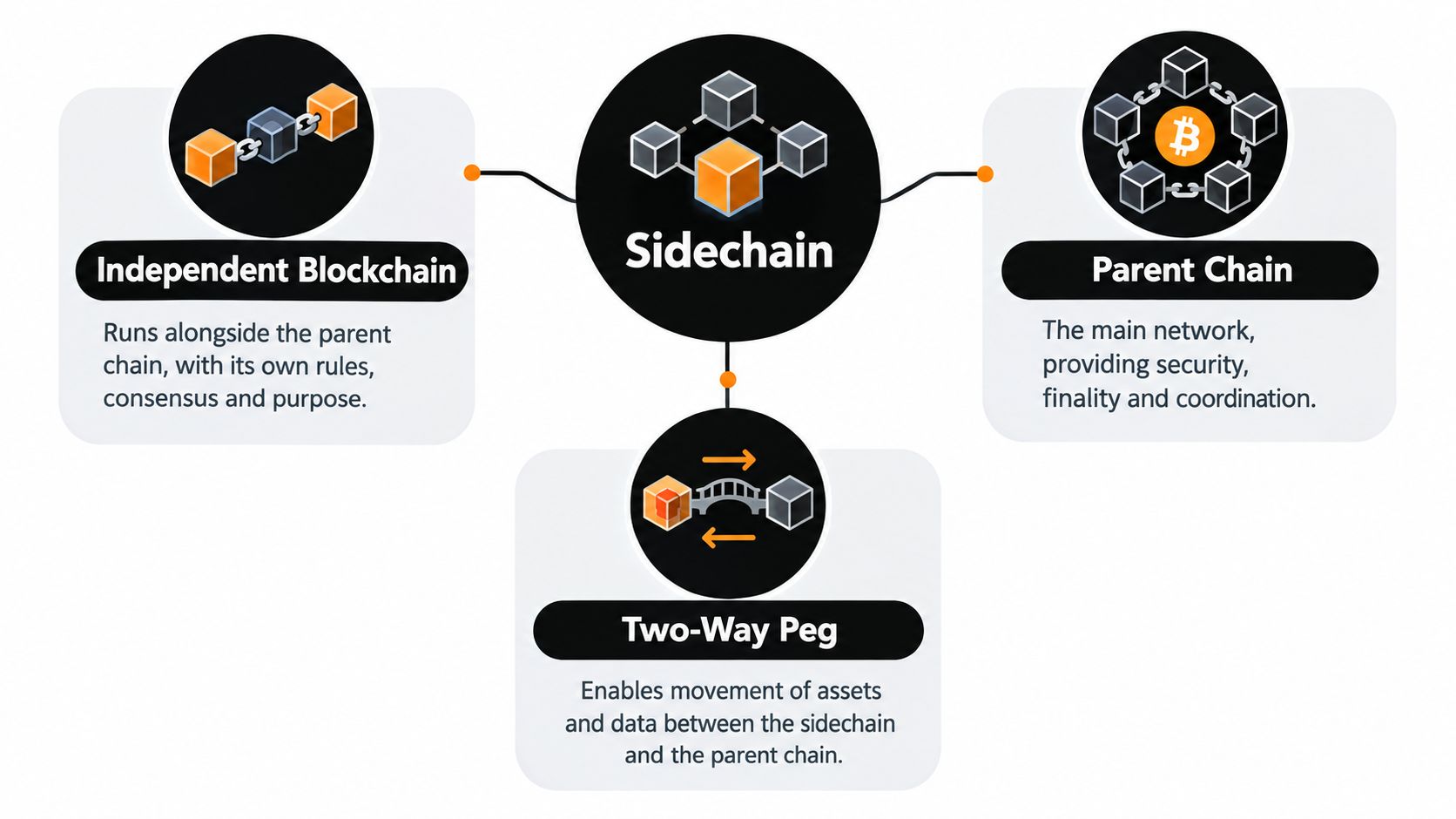
Independence creates flexibility
Developers can use that independence to introduce features that would be difficult or controversial on the parent chain. A sidechain might support smart contracts, a different virtual machine, new signature schemes, privacy-oriented transaction rules, or application-specific fee policies without changing the parent network's base consensus.
The cost is that every added capability comes with a security decision. Users need to ask who validates blocks, who controls the peg, how withdrawals work, and what happens if the sidechain stops producing blocks. A sidechain is a topology, not a safety rating. Two networks can both use the label while exposing users to very different operators and bridge assumptions.
How Two-Way Pegs Move Assets Between Chains
The easiest way to understand a two-way peg is to follow one asset through a complete transfer. Suppose you hold Bitcoin on the parent chain and want to use a Bitcoin-denominated asset on a sidechain.
The lock and mint sequence
First, you initiate the peg-in. Your Bitcoin is sent to a special output address or contract controlled by the peg mechanism. The funds become locked on the parent chain, meaning they can't also be spent normally on that network.
Second, the peg verifies the lock. Depending on the design, a federation, multisignature arrangement, custodial group, or automated verification system observes the parent-chain transaction. It then communicates enough evidence to the sidechain for the sidechain's rules to recognize the deposit.
Third, the sidechain issues the representation. An equivalent amount is minted or released to your address on the sidechain. The sidechain token represents the parent-chain asset, but it isn't the same on-chain object. Its usefulness depends on the peg continuing to honor the relationship.
The locking model traces back to the 2014 paper Enabling Blockchain Innovations with Pegged Sidechains, later treated as the first published sidechain proposal in the literature. The history and technical review of sidechains also connects the technology to later production deployments and scaling discussions.
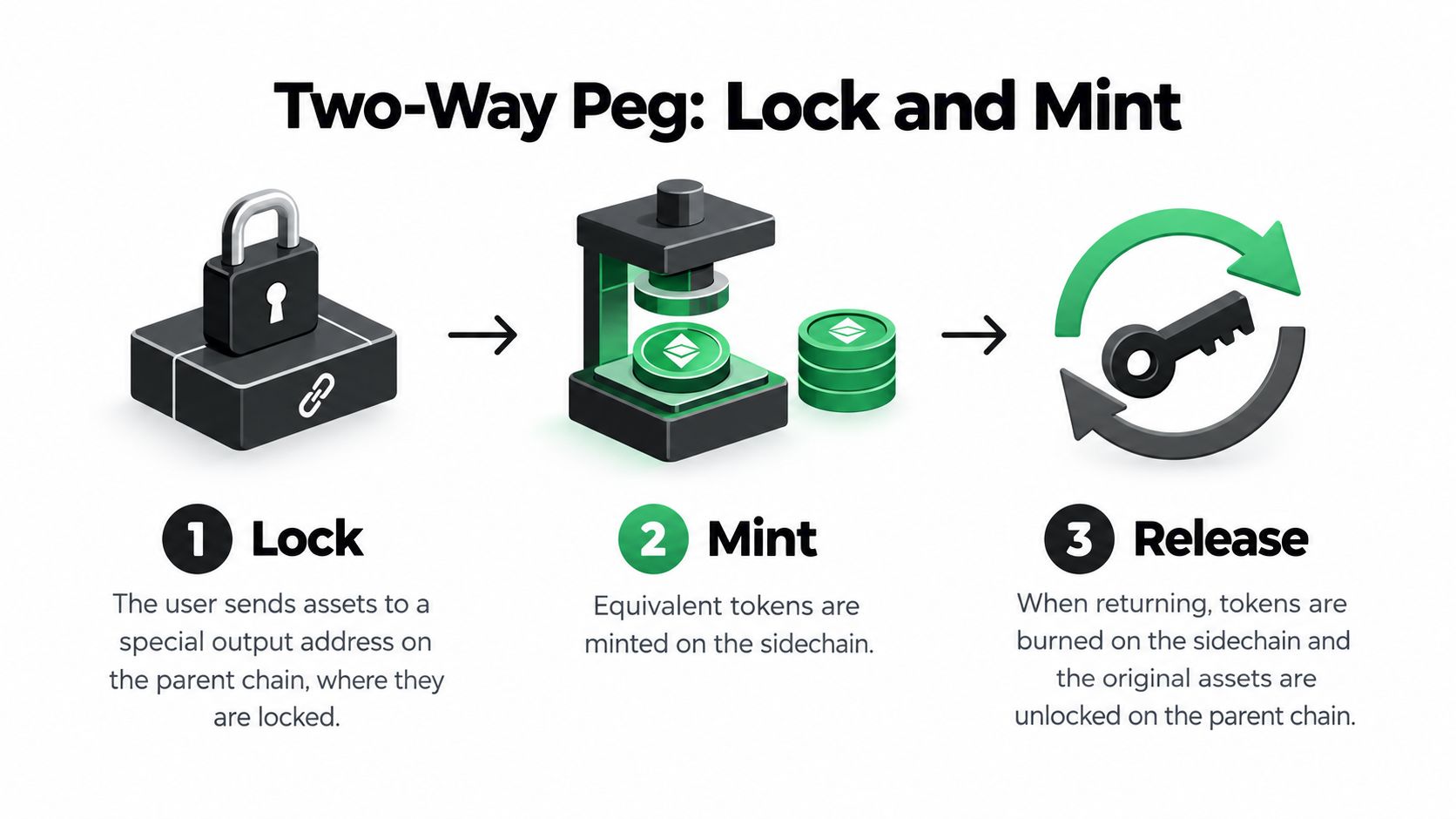
Returning to the parent chain
The reverse transaction is usually described as a peg-out. You send the sidechain representation to a contract or designated process, where the tokens are burned or locked. The peg then verifies that event and releases the original parent-chain asset to an address you control.
The bridge is therefore doing more than forwarding a message. It must maintain a supply relationship, prevent the same deposit from being redeemed repeatedly, and determine when a transfer is final enough to honor. Some designs rely on known operators, while others attempt to use cryptographic proofs or parent-chain verification rules.
Practical rule: A two-way peg tells you how assets move. It doesn't, by itself, tell you who can approve the movement or what happens when the approval system fails.
Peg design deserves the same scrutiny as the sidechain's application layer. Readers comparing architectures can use this guide to cross-chain bridges to understand why a bridge's verification model matters as much as its user interface.
Sidechains vs Layer 2 vs Parachains
These terms often appear together because all three architectures extend a blockchain ecosystem. They don't make the same security promise, however. The clearest comparison focuses on where transactions are executed, where data is posted, and which validators users ultimately trust.
| Criterion | Sidechain | Layer 2 Rollup | Parachain |
|---|---|---|---|
| Security inheritance | Uses its own consensus and generally doesn't inherit the parent chain's security | Uses the parent chain for settlement and, in rollup designs, security tied to data and verification posted there | Leases security from a relay chain through shared validators |
| Trust assumptions | Users trust the sidechain's validator set, federation, bridge, or peg mechanism | Users rely on the parent chain's dispute or proof system, plus implementation assumptions | Users rely on the relay chain's shared-security model and parachain rules |
| Data posting | Sidechain state may be periodically committed or anchored to the parent chain | Transaction data or commitments are posted to the parent chain for verification and settlement | Parachain information is coordinated through the relay-chain architecture |
| Sovereignty | High. The sidechain can choose its own consensus, block parameters, and transaction format | More constrained by the parent chain's settlement and data rules | Sovereign execution within a shared relay-chain security framework |
A Layer 2 rollup executes activity away from the base chain but posts relevant transaction data or commitments back to it. Optimistic rollups assume transactions are valid unless someone successfully disputes them, while zero-knowledge rollups use validity proofs to demonstrate correct execution. The important distinction is that the rollup's settlement model is designed around the parent chain.
A parachain takes a different route. In the Polkadot model, it operates as a specialized chain connected to a relay chain and uses shared validators supplied through that wider system. It has room for its own application logic, but its security relationship differs from an independent sidechain.
Sidechains sit on the sovereign end of the spectrum. Their independence can make them easier to tune for gaming, DeFi, payments, or tokenized assets, but the sidechain's own security budget and operators become central to the risk assessment. This overview of Layer 2 scaling solutions provides useful context for why execution capacity and security inheritance shouldn't be treated as the same feature.
Liquid and Other Real-World Sidechain Examples
What does a sidechain look like after the theory becomes a working network? The Liquid Network offers a clear example for Bitcoin users. Liquid went live on September 27, 2018, as Blockstream's first production Bitcoin sidechain, after a 2014 whitepaper, a 2015 implementation announcement, and a 2016 development funding round of 55 million dollars, according to the IEEE discussion of sidechain development.
Liquid uses a federation of known institutions rather than Bitcoin's own miner set. At genesis, the network reportedly had support from 23 institutions. That design matters because transferring Bitcoin to Liquid also means accepting the federation's role in operating the peg. Bitcoin is locked on the parent chain, and the user receives L-BTC on Liquid. Returning to Bitcoin reverses the process, subject to Liquid's operating and withdrawal conditions.
Liquid also supports stablecoins and tokenized securities. These use cases show why a user or issuer might accept a different security and trust model in exchange for confidential transactions, specialized asset issuance, and a Bitcoin-connected environment. The network is therefore more than a route for moving BTC. It provides a separate setting for assets and applications that do not fit Bitcoin's base-layer design.
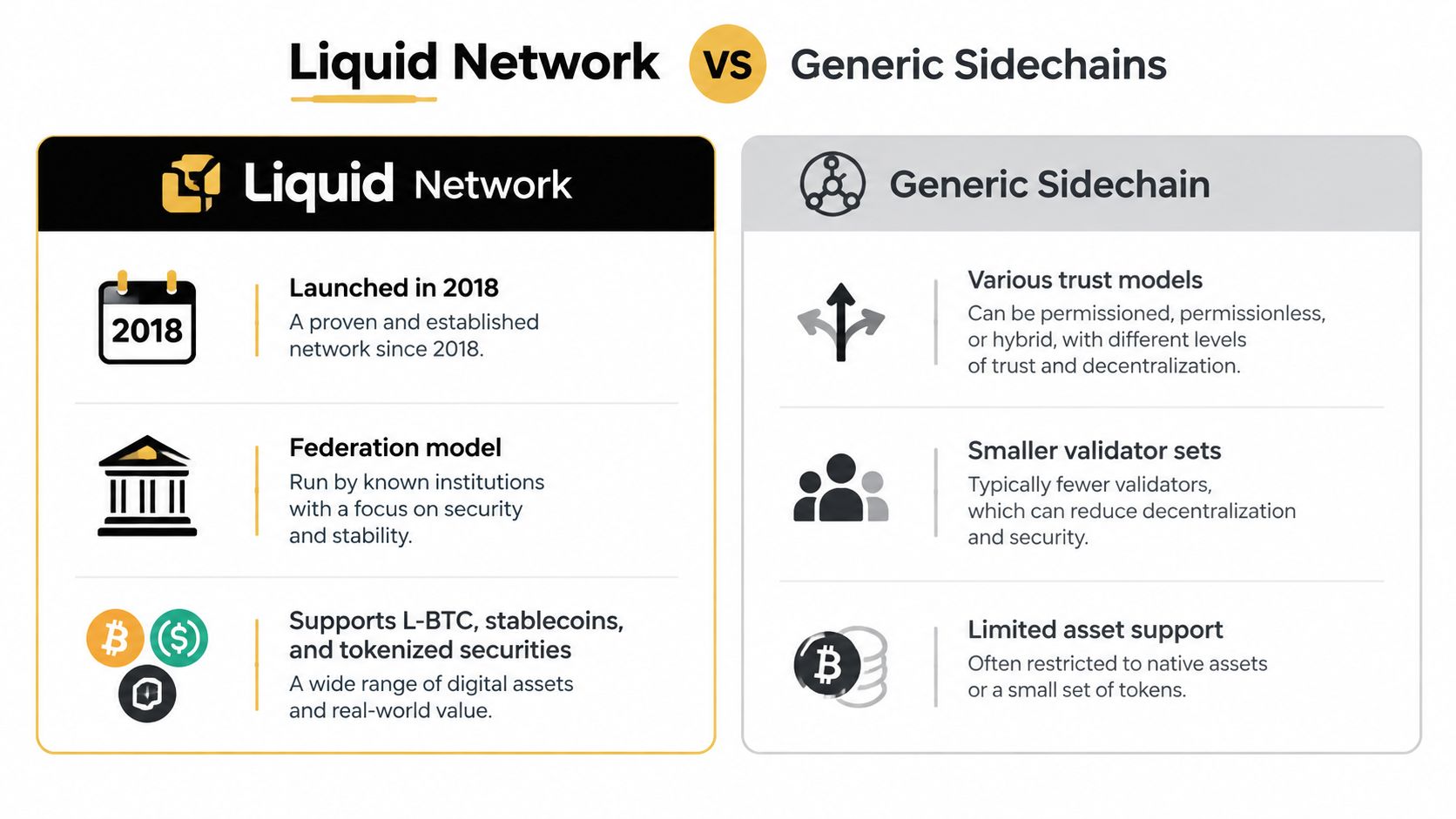
Different networks, different assumptions
Rootstock, often called RSK, adds smart-contract functionality through a separate Bitcoin-linked network and asset model. Its appeal is bringing Ethereum-style application concepts closer to the Bitcoin ecosystem. The Bitcoin connection does not remove the need to examine Rootstock's consensus and peg arrangements.
Polygon PoS has also been part of a long-running classification debate. It sends checkpoints to Ethereum, but it uses its own validator set and consensus process. That makes its security profile closer to a sidechain than to a rollup designed to inherit Ethereum's settlement security.
Drivechains represent another proposed direction for Bitcoin sidechains. They remain an experimental design direction, not a universal deployment standard. The practical lesson is simple: sidechain describes a connection pattern, not a quality grade. Before moving funds, ask which operators secure the network, how the peg works, and what happens if that arrangement fails.
What Sidechains Unlock for Users and Developers
Sidechains give developers room to alter the environment around an application without asking the parent chain to adopt every new feature. That flexibility can support experiments in virtual machines, fee markets, privacy systems, and signature schemes. A team can tune the execution layer for its application while keeping a connection to the liquidity and brand recognition of a larger network.
Experimentation without base-layer changes
A Bitcoin-linked sidechain can test smart-contract functionality or new spending conditions without changing Bitcoin's main consensus rules. An Ethereum-connected sidechain can use different block parameters or execution policies for applications that need a distinct operating environment. This separation can reduce pressure on the parent chain's governance process, although users still bear the risks of the experimental network.
Throughput is another attraction. Sidechains can choose larger blocks, shorter block intervals, or different consensus arrangements to process activity away from the parent chain. Research has described the architecture as a kind of compression mechanism, where transactions execute off the main chain, state persists on the sidechain, and commitments anchor that state back to the parent chain. The SyncChain technical paper reports peg-in times as low as 30 minutes and peg-out times as low as 2 hours for its described merge-mined Bitcoin sidechain design, illustrating why bridge latency remains part of the user experience.
Portability and specialized applications
A peg can give sidechain assets access to parent-chain liquidity. L-BTC is one example, while stablecoins and tokenized securities demonstrate how sidechains can support assets with different issuance and transfer requirements. In DeFi, that portability can connect a specialized execution environment to wallets, exchanges, and applications outside the sidechain.
Privacy features may also be easier to introduce on a separate network. Developers can explore confidential transactions or alternative signature schemes without requiring every parent-chain participant to accept those changes.
The trade-off is bundled into every benefit: faster execution, richer programmability, and application-specific rules don't remove security obligations. They relocate some of them to the sidechain's validators, federation, and peg.
For gaming, NFTs, high-frequency DeFi, and real-world asset tokenization, a sidechain can offer a more customized environment. The decision still depends on whether the application's users accept the destination chain's trust model.
The Security Trade-Off Most Explainers Skip
A sidechain isn't just a slower Layer 2. The two systems can both move execution away from a parent chain, but they answer the security question differently.
A sidechain runs its own consensus process and validator set. If those validators are captured, collude, misbehave, or go offline, the parent chain doesn't automatically restore the sidechain's state or guarantee that users can recover their assets. Anchoring a commitment to the parent chain can provide evidence about state, but it doesn't necessarily make the parent chain responsible for validating every sidechain transaction.
A genuine rollup is designed to post data or proofs to the base chain so that the base chain can enforce settlement rules. Depending on the rollup architecture, users may be able to force transaction inclusion or begin a withdrawal through the parent chain if the operator stops cooperating. Those properties distinguish rollups from independent sidechains, although each Layer 2 implementation still has its own contracts, upgrade controls, and operational risks.
Why Polygon creates confusion
Polygon PoS illustrates why labels can mislead. Polygon has been described in different ways over time, but its independent validator set and checkpoint-based relationship with Ethereum place it in the sidechain security column for this comparison. The network's connection to Ethereum doesn't mean Ethereum supplies the same security inheritance that a rollup seeks to provide.
Ethereum's documentation makes the general point directly. Sidechains run independently, use separate consensus and block parameters, and don't inherit Ethereum Mainnet security or post their full state back to it, as summarized in this sidechain explainer from Ledger Academy.
Risk follows consensus, not marketing. Before bridging, identify the people, machines, contracts, or economic incentives that can approve transactions and release funds.
The practical result is a different custody question. On a large public chain, users primarily rely on that chain's miners or validators. On a sidechain, they may also rely on a smaller or more identifiable operator group and the bridge that connects the networks. The principle behind not your keys, not your coins becomes especially relevant when a peg depends on external signers.
Practical Tips Before You Bridge to a Sidechain
Bridging shouldn't begin with a button labeled “transfer.” Begin by mapping the trust and exit path behind that button.
Identify the peg mechanism. Determine whether the bridge is federated, custodial, multisignature, SPV-based, or governed by an automated contract. Each model gives different parties or proofs the power to recognize deposits and authorize withdrawals.
Find the operators. Look for the validator set or federation members. Ask whether those participants are known institutions, anonymous signers, delegated operators, or a changing group selected through staking. The answer tells you who can influence finality and what happens if participants disagree.
Trace the exit route. Confirm how assets return to the parent chain, what triggers release, and whether a withdrawal delay applies. A fast deposit doesn't guarantee a fast exit. The SyncChain documentation illustrates that peg-in and peg-out timing can differ materially.
Review contracts and incidents. Use the bridge interface to verify the actual contract addresses involved. Read published audits, security disclosures, governance proposals, and incident reports rather than relying on an app's branding.
Test before scaling up. Send a small amount, complete a return transaction, and verify that the destination asset arrives in the wallet you control. This test checks network selection, token representation, fees, wallet support, and the practical withdrawal path.
A sidechain can be useful without being appropriate for every balance. Keep the size and duration of exposure consistent with your confidence in the operators, contracts, peg, and exit process.
The Core Idea to Remember
A sidechain is a separate blockchain whose connection to a parent chain lets assets move between networks, but that connection doesn't mean the sidechain inherits the parent's security. You may carry Bitcoin's asset representation onto a Bitcoin sidechain or use Ethereum-connected assets in a separate execution environment, while relying on a different validator set, federation, bridge contract, or consensus process to protect the destination network. The trust shifts from the strongest available security model of the parent chain toward the parties and mechanisms that operate the sidechain.
That trade-off explains both the appeal and the limitation. Developers gain flexibility, throughput, smart-contract support, privacy experimentation, and application-specific control. Users gain access to new markets and Web3 applications, but they also need to understand who can validate blocks, pause operations, approve withdrawals, or influence upgrades.
The most useful question isn't only “what is a sidechain?” Ask instead, “who secures the chain I'm entering, and how do I get out?” If you can answer those questions clearly, you can evaluate a sidechain on its actual design rather than its label. If you can't, faster and cheaper transactions shouldn't be treated as evidence that the network is safer.
Visit Coiner Blog for clear guides and balanced analysis covering Bitcoin, Ethereum, Layer 2 networks, DeFi, Web3, tokenomics, and emerging blockchain infrastructure. Explore its practical coverage of bridges and scaling systems to keep evaluating not only what a network can do, but also what you're trusting when you use it.