
Digital Artwork for Sale: Your 2026 Investment Guide
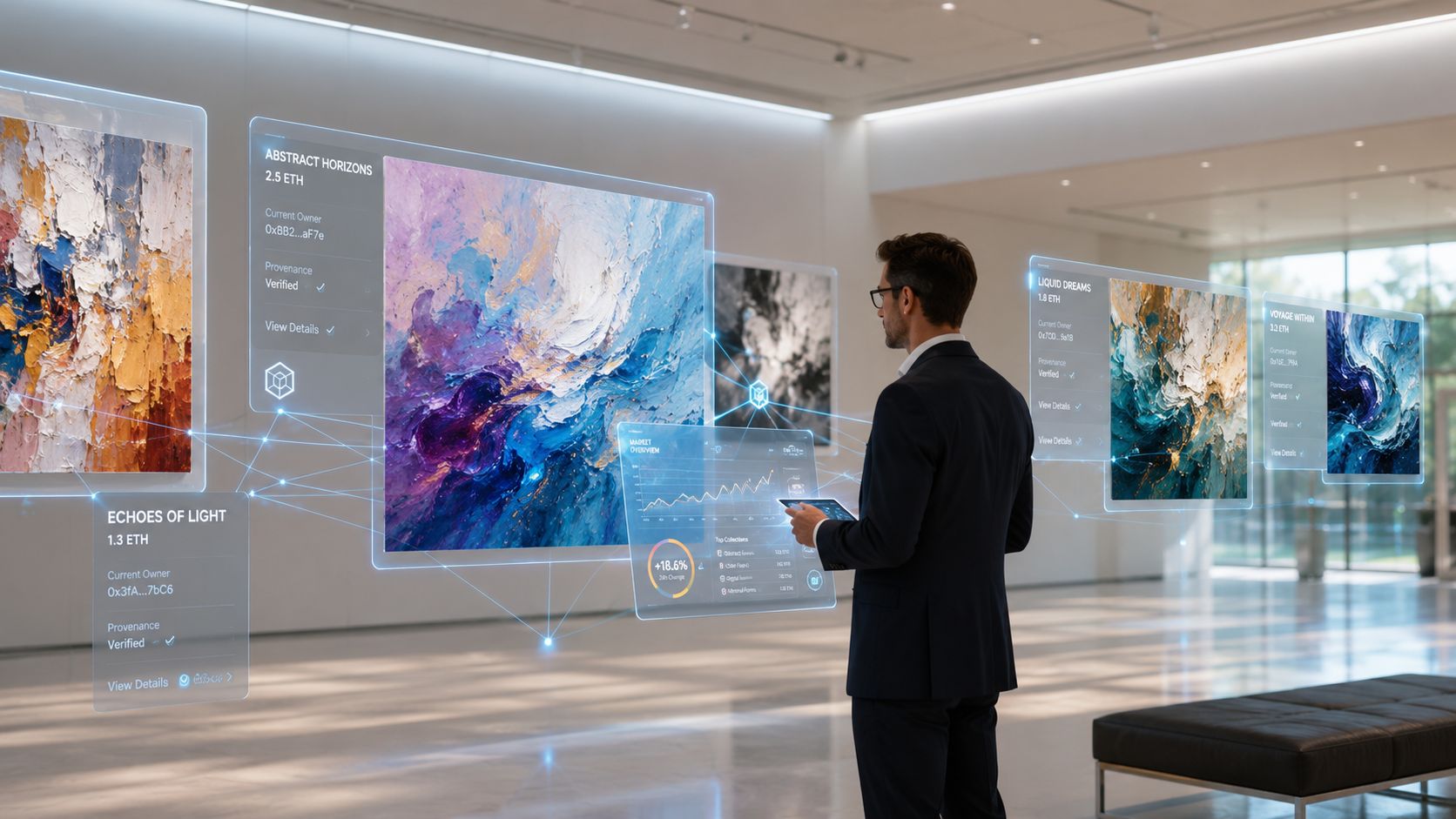
Online art sales reached about $11.09 billion in 2024 and represented nearly 18% of the global art market, while the broader art market was valued at $57.5 billion. Independent market tracking also projects online art sales to reach $19.25 billion by 2033 at a 6.3% CAGR from 2025 to 2033, according to Grand View Research's online art market analysis. That changes the way serious buyers should think about digital artwork for sale.
The old framing was too simple. People used to ask whether buying digital art meant paying for a JPEG. In Web3, that's often the wrong question. The better question is what exactly you control: the file, the token, the display rights, the commercial rights, the provenance trail, or some combination of them.
That distinction decides value. It also decides whether you're buying a collectible, a license, a speculative asset, or a legally constrained media file with good branding around it.
Table of Contents
- The New Digital Canvas Why Art Is Migrating On-Chain
- Navigating the Digital Art Marketplaces
- The Smart Collector's Due Diligence Checklist
- Executing Your Purchase Wallets Gas and Transactions
- Beyond the Purchase Valuation Security and Legal Realities
- Your Next Move in the Digital Art Ecosystem
The New Digital Canvas Why Art Is Migrating On-Chain
Digital art didn't become important because crypto made images tradable. It became important because blockchains gave collectors a way to verify ownership, trace provenance, and transfer an asset without relying on a single gallery database or private spreadsheet.
Digital ownership has moved from theory to market structure
Collectors already buy art online at scale. The rise in online art sales isn't a niche signal. It shows that digital distribution has become a normal part of the market. That's the backdrop for tokenized collecting, not a side story.
In practical terms, on-chain art fits the broader shift toward digital property in Web3. Wallets now hold coins, governance tokens, game assets, and increasingly cultural assets. If you want the wider context for that ownership model, Coiner Blog's primer on what Web3 technology is is a useful starting point.
Why collectors care about programmable provenance
Traditional art markets have always priced certainty. Buyers pay for attribution, authenticity, exhibition history, and chain of title. NFTs translate some of that logic into code.
A smart contract can define edition size, automate royalty logic where supported, and anchor provenance to a public ledger. That doesn't eliminate fraud or bad metadata. It does make verification more systematic for buyers who know what to inspect.
Practical rule: In digital art, scarcity only matters when the market can verify it.
That's why the strongest digital artwork for sale usually has more than visual appeal. It has an ownership architecture. A piece backed by transparent mint data, a known contract, and clean provenance carries a different profile than the same image file passed around as a download.
Confusion often arises among new entrants. They see digital art as media first and asset second. Experienced buyers often reverse that order. They still care about aesthetics, but they assess the wrapper too: contract design, rights language, storage method, and resale portability across Web3 venues.
NFTs vs Digital Files Understanding What You Actually Own
The sharpest divide in this market isn't expensive art versus cheap art. It's tokenized ownership versus file possession.
A file is access. A token is recorded ownership
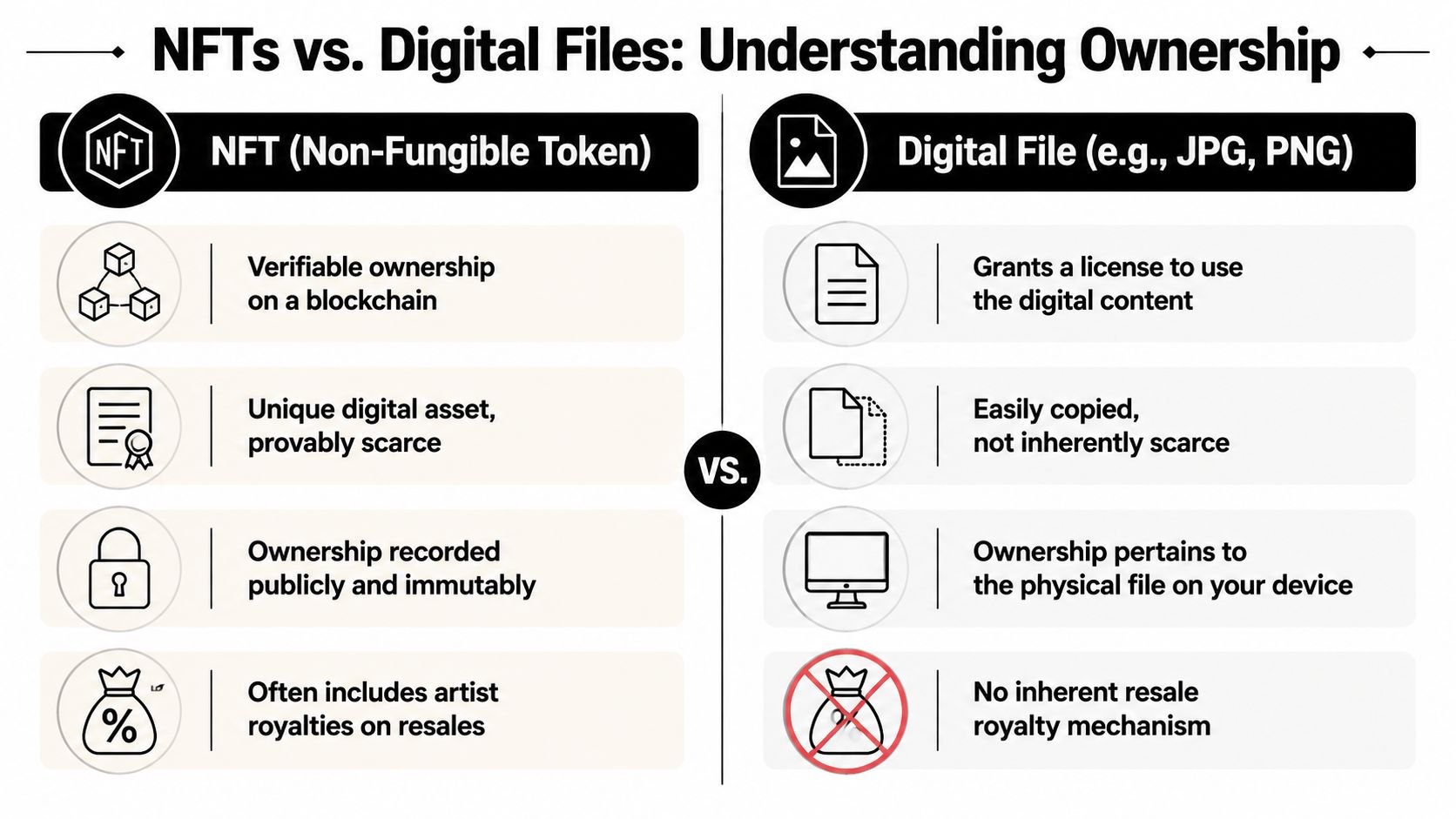
When you buy a standard digital file, you usually receive a copy of the work and some level of license to use or display it. That can be valuable. It can also be perfectly legitimate art collecting. But the ownership claim usually sits in a sales receipt, platform account, or licensing terms, not on a public blockchain.
An NFT works differently. The token acts as a blockchain-recorded claim tied to a wallet address. That gives the buyer a verifiable ownership trail, even though the media itself may be stored on-chain, off-chain, or through decentralized storage.
The mainstreaming of that model is hard to ignore. According to the Art Basel and UBS Survey of Global Collecting 2025, 51% of surveyed high-net-worth collectors bought a digital artwork in 2024 or 2025, and the share of digital art in collections rose from 3% in 2024 to 13% in 2025.
If you need the mechanics behind minting, wallets, and transfer logic, this walkthrough on how NFTs work covers the technical foundation.
Where the value gap appears
A simple analogy helps. A digital file is like buying a poster from a museum shop. You own the physical item you received, subject to whatever terms came with it. An NFT is closer to owning a signed, numbered certificate linked to a specific edition in a public registry.
That doesn't mean every NFT is valuable. It means the market can price qualities that ordinary files struggle to express:
- Scarcity: A contract can define a one-of-one or a limited edition.
- Provenance: Wallet history can show origin and transfer path.
- Interoperability: The token can appear across compatible marketplaces, wallets, and displays.
- Programmability: Royalties, metadata rules, and transfer conditions may be embedded or referenced.
Most mistakes happen when buyers assume token ownership automatically includes broad usage rights. It often doesn't.
Quick comparison for buyers
| Feature | NFT | Standard digital file |
|---|---|---|
| Ownership record | Public blockchain entry | Platform receipt or file possession |
| Scarcity | Can be contract-defined and verifiable | Not inherent |
| Resale path | Native to secondary marketplaces | Usually manual or contract-based |
| Royalties | May be coded or platform-supported | No built-in mechanism |
| Rights to use image | Depends on license terms | Depends on license terms |
The last row matters most. In both cases, rights come from the legal terms, not from vibes, screenshots, or social media assumptions.
Navigating the Digital Art Marketplaces
Marketplaces aren't interchangeable. They shape discovery, buyer behavior, curation, and the kind of risk you inherit.
NFT-native venues
NFT-native platforms are built around wallets, smart contracts, primary drops, and secondary market activity. Buyers who are comfortable with MetaMask, Phantom, signing requests, and reading contract data usually feel at home there.
These venues often suit collectors looking for:
- On-chain provenance
- Direct artist drops
- Secondary market liquidity
- Wallet-based identity and community access
The tradeoff is that the buyer bears more technical responsibility. You need to understand signature prompts, collection verification markers, contract addresses, and how a listing differs from a bid acceptance or mint transaction.
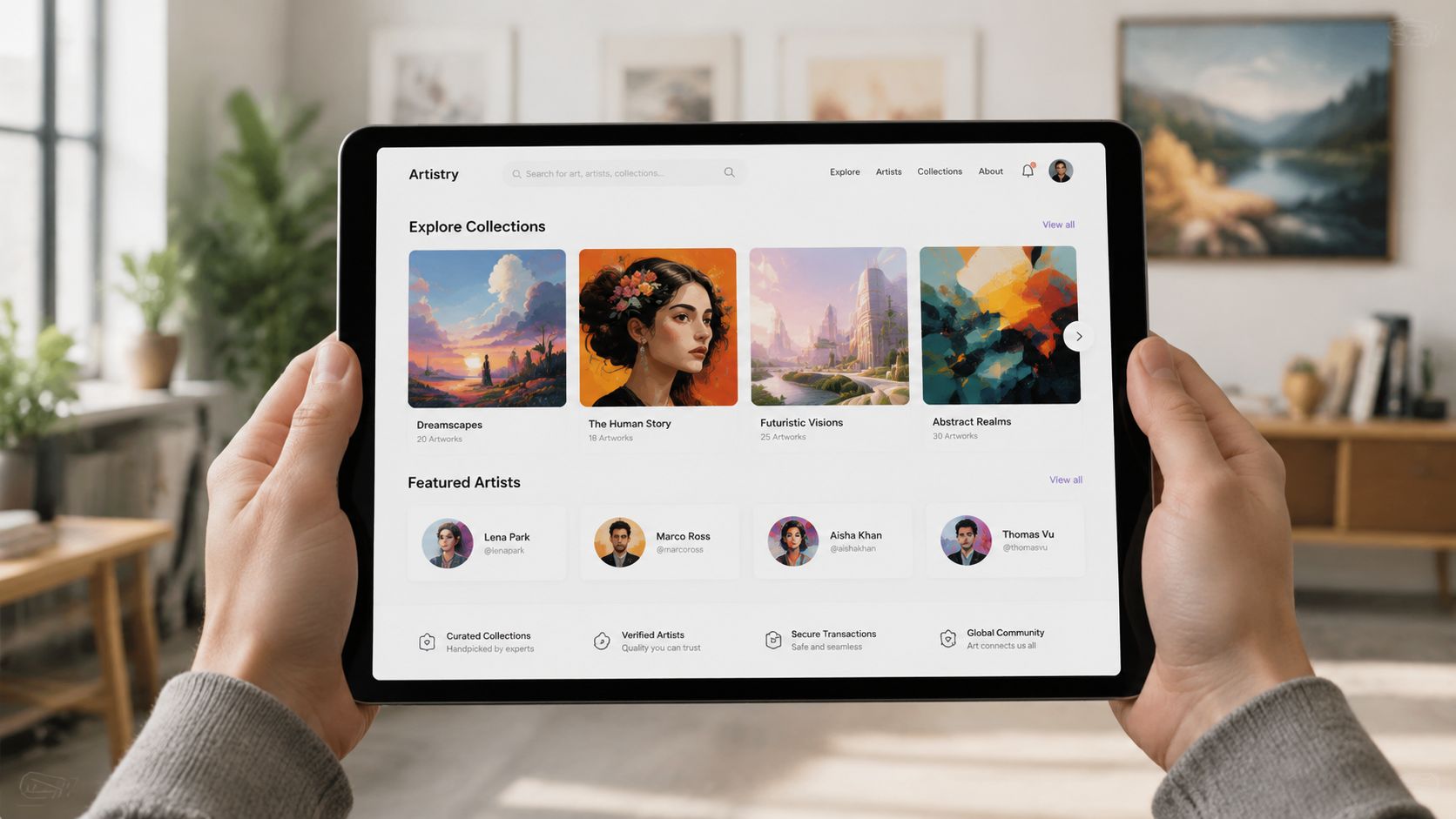
Collectors who follow shifts in liquidity, marketplace behavior, and buyer sentiment can get useful context from Coiner Blog's coverage of NFT market trends.
Traditional art platforms selling digital works
Traditional online galleries approach digital art differently. They often reduce wallet friction, emphasize artist presentation, and frame digital works in language familiar to fine art buyers rather than crypto traders.
That matters for collectors crossing over from photography, video art, or editioned prints. These platforms may offer stronger contextual curation, more legible artist biographies, and less pressure to interact with raw smart contract interfaces.
The downside is portability. Some platforms offer a smoother buying experience but less transparency into token mechanics, metadata architecture, or transfer conditions. For some buyers, that's fine. For others, especially those who treat digital artwork for sale as an asset class, it's a meaningful limitation.
How to choose the right venue
Use the venue that matches the type of confidence you need.
- Choose NFT-native marketplaces if you want direct on-chain verification, wallet custody, and active secondary market participation.
- Choose gallery-style platforms if you care more about curation, artist discovery, and simplified purchase flows.
- Avoid platform-first thinking if the work itself doesn't hold up. Good UX doesn't fix weak provenance or vague rights.
A seasoned collector usually searches in both worlds. The best opportunities often appear where art quality, contract clarity, and audience fit line up at the same time.
The Smart Collector's Due Diligence Checklist
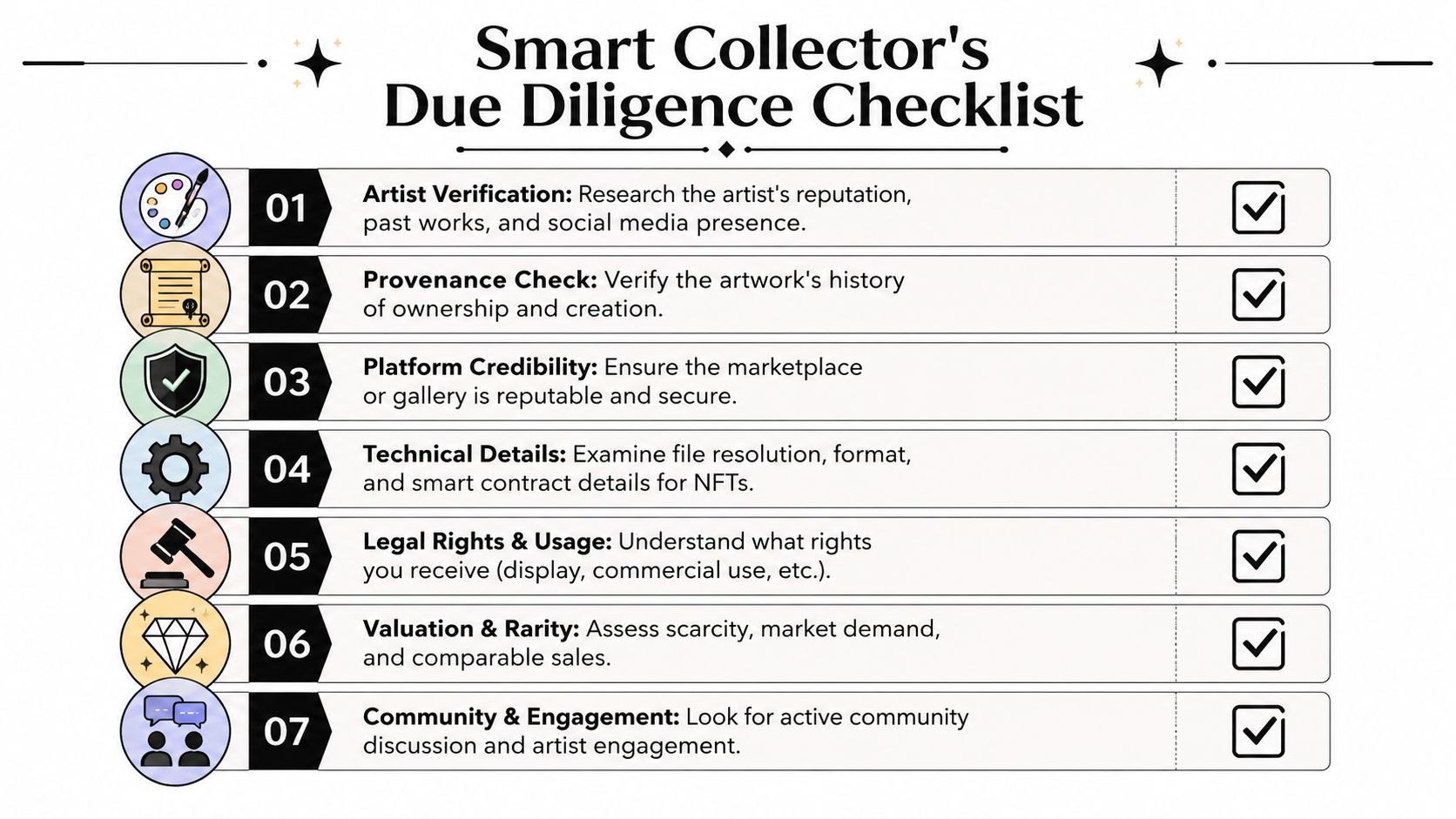
The thumbnail is the least important part of the purchase. Serious due diligence starts after the art catches your eye.
Start with provenance and creator verification
First, verify that the seller controls the artist account or wallet tied to the work. In NFT markets, impersonation often happens through lookalike collections, cloned listings, or misleading profile names.
Check for consistency across:
- Artist website and social profiles
- Linked wallet address
- Collection contract address
- Marketplace verification markers
- Creation timeline and prior releases
If you're buying from a gallery-style platform, inspect the work's provenance records and edition details with the same seriousness you'd apply to a print or photograph.
Collector's note: If provenance is fuzzy before the sale, resale will be harder after the sale.
Inspect the asset, not just the thumbnail
Expert buying guidance from Artsy's digital art advice emphasizes checking edition size, file quality and format, usage rights, and smart-contract terms plus metadata/provenance. Those aren't administrative details. They are value drivers.
The technical side matters more than many buyers expect. According to the College Art Association's digital format guidelines, professional presentation standards recommend 1280 px on the long edge at 72 ppi for on-screen submissions, while 300 ppi supports higher-quality output. For digital video, works are typically constrained to 1280 × 720, under 100 MB, with a practical compression range of about 20 MB/min for SD to 150 MB/min for 1080p.
That has direct collecting implications:
- Low-resolution masters can limit printing or high-end display.
- Aggressive compression can damage gradients, texture, and motion quality.
- Odd formats or codecs can create playback issues on digital frames, gallery screens, or archive systems.
- Off-chain hosting risk can leave the token intact while the associated media becomes difficult to access.
A useful habit is to ask what the buyer receives on delivery. Is it the token only, a high-resolution master file, a display file, a certificate, or a bundle with multiple formats?
A short explainer on fraud patterns and red flags is available in Coiner Blog's guide on how to avoid crypto scams.
Here's a useful walkthrough before you commit capital:
Rights, royalties, and resale friction
Many buyers overpay through misunderstanding. Owning the token doesn't automatically grant copyright. Owning the file doesn't automatically permit commercial use. Rights must be stated.
Review:
- Display rights for personal screens, frames, or virtual galleries
- Commercial restrictions on merchandise, branding, or sublicensing
- Edition controls that affect scarcity
- Royalty logic and whether the marketplace recognizes it
- Metadata mutability, especially if the creator can alter referenced media
Community still matters
Some collectors dismiss community as hype. That's a mistake. Community quality can tell you whether an artist has serious long-term support or just short-term promotional noise.
Look for signs of durable engagement:
- thoughtful collector discussion
- artist consistency across releases
- coherent visual development
- credible curation or collaborations
In digital art, social context often becomes part of provenance.
Executing Your Purchase Wallets Gas and Transactions
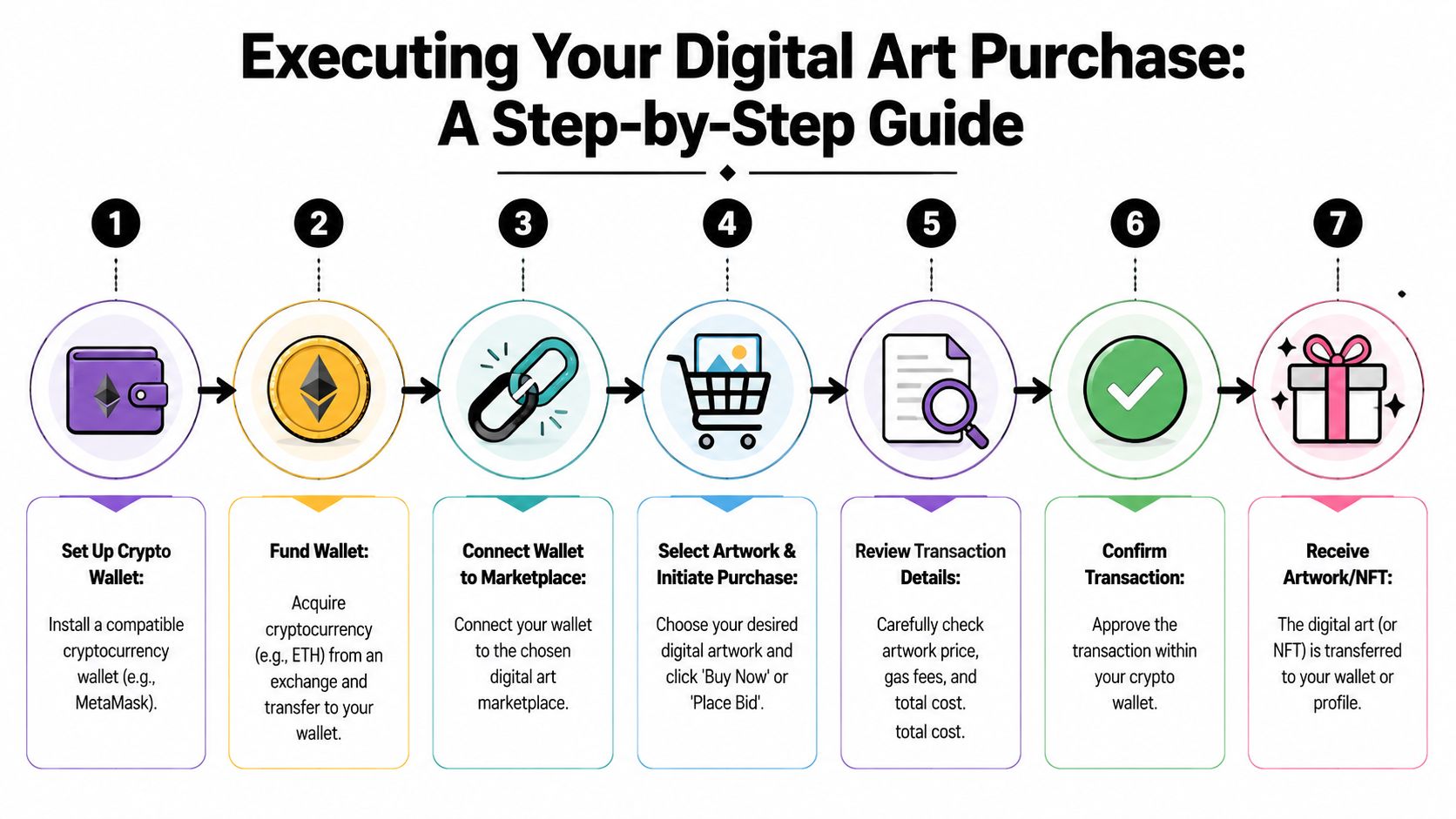
A clean purchase starts before you click buy. It starts with wallet setup, network awareness, and transaction discipline.
Set up the transaction path first
Use a non-custodial wallet that matches the chain where the artwork is listed. Ethereum-based marketplaces usually pair with wallets such as MetaMask. Solana-based ecosystems often use Phantom. If you're new to that setup, this introduction to Phantom Wallet helps explain the basics.
Then fund the wallet with the native asset required for the purchase and network fees. Keep the buying wallet separate from large long-term holdings if possible. That simple separation reduces damage if you connect to the wrong app or sign a malicious request.
Layer 2 networks also matter here. Many buyers now prefer lower-cost environments for entry-level collecting because transaction friction is lower and experimentation is easier. For digital artwork for sale, that can make a real difference when you're placing bids, accepting offers, or moving pieces between wallets.
Review the transaction like an investor
Before you sign anything, inspect the full transaction path:
- Collection identity: Does the contract match the intended project?
- Token details: Are the token ID and listing details correct?
- Network selection: Are you on the intended chain or Layer 2?
- Approval scope: Are you approving one transaction or broad access to assets?
- Total cost: Does the wallet show price plus gas or marketplace fees?
Approvals deserve more attention than the purchase price. A bad approval can expose more than one artwork.
The asset you receive should also match the technical expectations of the listing. Delivery quality matters. As noted in the earlier technical guidance, digital artwork often depends on constraints such as 1280px minimum presentation standards, 300 ppi for higher-quality output, and under 100MB for certain video formats. Buyers should confirm that the delivered media aligns with what the listing promised.
Confirm delivery and preserve records
After confirmation, verify the transfer in three places:
- your wallet
- the marketplace profile
- the relevant block explorer
Also save the listing description, rights language, contract address, and transaction hash. If a dispute appears later, those records matter.
Collectors who treat digital art casually often lose track of provenance documents and rights terms. Collectors who archive everything make future resale, insurance discussions, and estate planning much cleaner.
Beyond the Purchase Valuation Security and Legal Realities
Buying is the easy part. Owning well is harder.
Valuation is part art history, part market microstructure
Digital art valuation sits at the intersection of aesthetics, reputation, and token mechanics. A strong work can still be overpriced if the edition structure is loose, the collector base is shallow, or the contract architecture limits portability.
When I assess value, I look at three layers.
First is the artwork itself. Does it hold up outside the hype cycle? A collector should be able to defend the piece on artistic terms, not just market terms.
Second is the issuer context. Is the artist building a coherent body of work, or just releasing disconnected drops optimized for short-term demand? Serious markets reward continuity.
Third is the ownership design. Provenance quality, edition discipline, metadata resilience, and interoperability all shape future liquidity. In Web3 terms, tokenomics matter even in art. Not because art should be reduced to token design, but because supply structure still influences collector behavior.
Custody becomes serious once the work matters
A valuable NFT in a casually managed hot wallet is a security problem waiting to happen. Hot wallets are convenient for minting, bidding, and browsing. They're not ideal for long-term storage of important pieces.
Many advanced collectors separate functions:
- a hot wallet for marketplace interaction
- a cold wallet for long-term custody
- a vault or multi-signature setup for high-value holdings or shared entities
That model mirrors how serious crypto holders manage treasuries. The overlap with DeFi and broader digital asset security is obvious. The more digital artwork behaves like a financialized collectible, the more it inherits the custody discipline of the wider crypto market.
This is also where Layer 2 and cross-chain environments create new complexity. Lower-cost execution is attractive, but each bridge, wrapper, or migration path can add operational risk. Convenience should never outrun verification.
Ownership is not the same as copyright
The legal distinction is the point most buyers miss.
The landmark Beeple sale made this unusually visible. The buyer paid $69 million for Everydays, but the transaction highlighted that what changed hands was a token verifying blockchain ownership, not the copyright to the image, as reported by PBS NewsHour's coverage of the Beeple NFT auction.
That has major consequences. You may own:
- the token
- the right to display it privately
- the right to resell it
- perhaps some limited promotional use
You may not own:
- commercial reproduction rights
- trademark rights
- the right to mint derivatives
- the right to stop the artist from using the image elsewhere unless the contract says so
Buy the rights document with the same seriousness you buy the art.
That distinction will only matter more as AI-generated media, tokenized real-world assets, and hybrid licensing models spread across Web3. The future of digital collecting won't just depend on scarcity. It will depend on clearly packaged rights.
Your Next Move in the Digital Art Ecosystem
The best way to enter this market is to narrow your scope, not expand it. Pick one chain, one wallet stack, and one category of work you understand.
Start narrow and learn the market mechanics
Many new buyers overtrade. They jump between Ethereum, Solana, Layer 2 drops, profile-picture collections, generative art, and AI-assisted media before they've learned how to evaluate any of them properly.
A better approach is simpler:
- Choose one niche: generative art, 1/1 illustration, video art, or photography-based NFTs
- Study artist consistency: recurring themes often tell you more than floor chatter
- Use smaller buys as tuition: early mistakes are easier to absorb when position size is modest
- Follow rights language closely: that habit compounds in value
Build an information edge
Good collectors don't rely on marketplace homepages. They build a repeatable research process.
That process usually includes:
- artist feeds and community channels
- block explorer checks
- smart contract review
- portfolio tracking tools
- broader reading across Web3, DeFi, tokenization, and AI-plus-crypto trends
The reason is straightforward. Digital art no longer sits outside the rest of crypto. It's increasingly connected to wallet identity, social graphs, creator economies, and programmable ownership systems that look a lot like other tokenized markets.
Think like a collector, not just a trader
If you only ask whether a piece can flip, you'll miss most of the value in this category. The strongest digital artwork for sale combines artistic quality, credible provenance, technical durability, and rights clarity.
That's what separates disposable hype from lasting digital property.
The collectors who do best over time usually have two habits. They learn the underlying infrastructure, and they buy works they'd still want to own if the market went quiet for a while.
If you want more clear, grounded analysis on NFTs, Web3, DeFi, Layer 2 ecosystems, and the risks that matter before you commit capital, explore Coiner Blog. It's a strong resource for readers who want practical crypto insight without the usual noise.