
Cross Chain Swaps: The Ultimate Guide for 2026
You're probably in this exact spot right now. You hold assets on one chain, then a better yield farm, a token launch, or a GameFi market opens on another. Your capital isn't stuck because crypto is slow. It's stuck because blockchains still behave like separate countries with different roads, rules, and currencies.
That's why cross chain swaps matter. They promise a simpler outcome: move value from one network to another without manually stitching together bridges, wrapped assets, DEX trades, wallet setup, and gas management. In a multi-chain DeFi world, that's not a minor convenience. It's core infrastructure.
The catch is that the term sounds simpler than the reality. A “cross-chain swap” might be a trust-minimized atomic swap, a lock-and-mint bridge, a liquidity network, an aggregator route, or a centralized service hiding the complexity behind a clean interface. If you don't know which model you're using, you don't really know your risks, costs, or what can fail.
Table of Contents
- Why Cross-Chain Swaps Are a Game Changer for Web3
- How Cross-Chain Swaps Actually Work Under the Hood
- Comparing the Different Cross-Chain Swap Models
- Your Step-by-Step Guide to Performing a Swap
- Understanding the Security Risks of Swapping Chains
- Best Practices for Safe and Efficient Swaps
- Conclusion Your Gateway to a Multi-Chain Future
Why Cross-Chain Swaps Are a Game Changer for Web3
Why the multi-chain problem became unavoidable
You spot a better yield on Base, but your funds are sitting on Arbitrum. Or you want to buy into a Solana ecosystem app while most of your capital is parked in Ethereum-based assets. That friction is now a normal part of using crypto.
Web3 has grown into a network of separate cities, each with its own apps, liquidity pools, fee market, and user base. Ethereum still matters, but so do Solana, Layer 2 networks, appchains, gaming chains, and platforms built for tokenized real-world assets. Value is spread across all of them.
If you need a refresher on why this fragmented system exists in the first place, Coiner Blog's guide to Web3 technology gives useful background.
The problem is simple. Capital and opportunity often live on different chains. The cost of closing that gap is not simple at all. Users may need to bridge assets, swap into a different token, reserve gas on the destination chain, and hope liquidity is still there by the time everything settles.
Why cross-chain swaps matter in practice
Cross-chain swaps try to compress that messy sequence into one intended outcome. Send value from one chain. Receive the asset you want on another chain.
That sounds like a convenience feature, but it changes how people use Web3. Without cross-chain swaps, each move between ecosystems becomes a manual relay race with more steps, more fees, and more chances to make a mistake. With them, capital can move where it is needed faster, which makes a multi-chain market more usable.
That matters across several areas:
- DeFi mobility: Traders and allocators can shift funds between lending markets, DEXs, and yield strategies without rebuilding positions from scratch.
- Chain-specific apps: Gaming, NFT, and social ecosystems often live on one network. Cross-chain swaps make it easier to enter those economies directly.
- Layer 2 usage: As more activity moves to scaling networks, moving assets across chains stops being a niche task and becomes routine account management.
- Tokenized assets: If funds, treasuries, or commodities are issued on different chains, users need practical ways to reach those venues.
The bigger point is easy to miss. Cross-chain swaps do not remove fragmentation. They make fragmentation tolerable.
That distinction matters because the term often gets marketed as if every swap route offers the same benefits. It does not. Some systems rely more heavily on third parties. Some routes are cheaper but expose you to bridge risk. Others reduce trust assumptions but support fewer chains or worse execution. For users, true value is not just access. It is understanding what kind of system is carrying their assets across the gap.
How Cross-Chain Swaps Actually Work Under the Hood
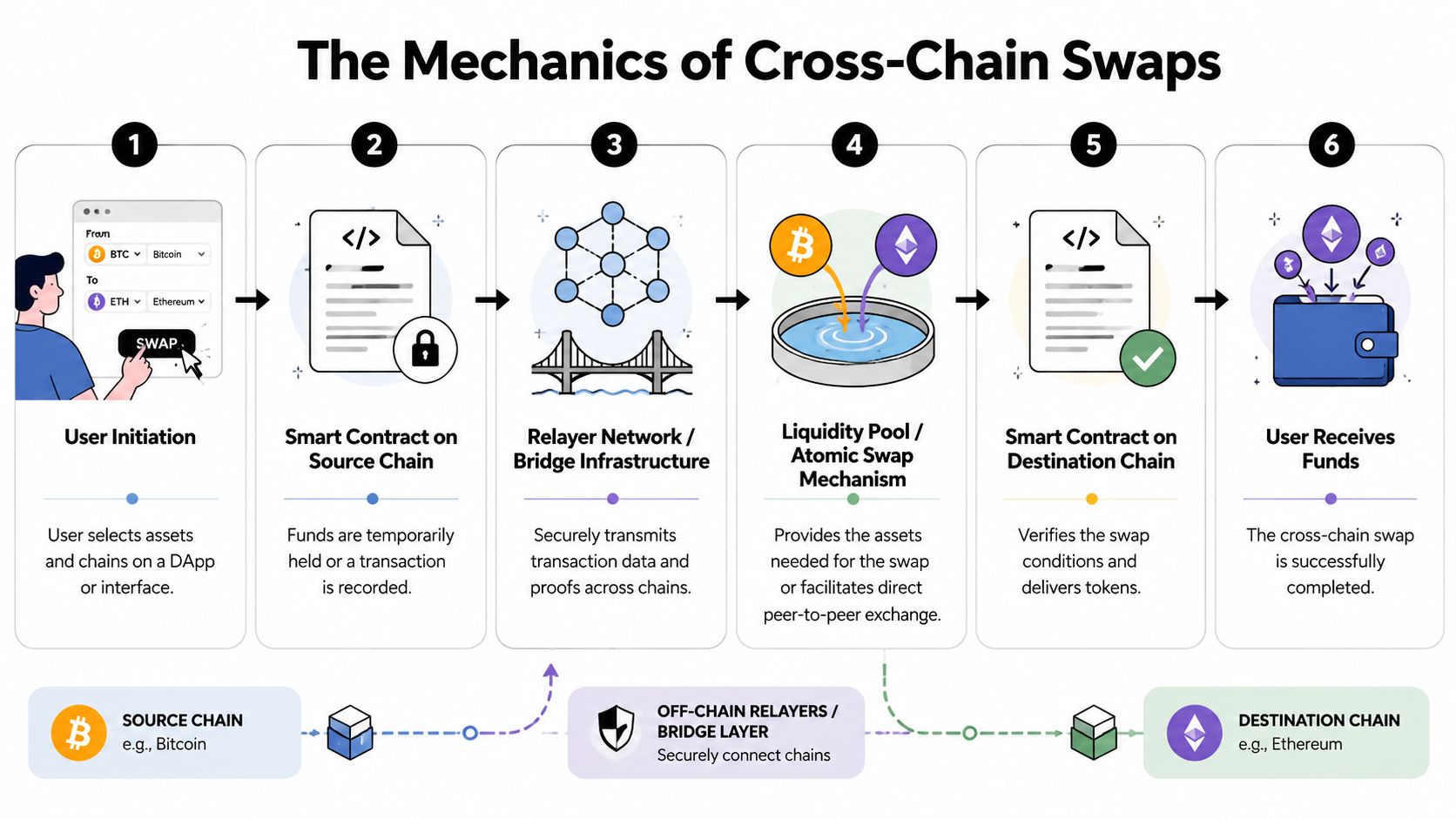
You open a swap app, choose USDC on Arbitrum, and ask for SOL on Solana. The button says “swap” as if this were one transaction. Under the surface, it is closer to a relay race. One system takes custody or verifies funds on the source chain, another passes a message or proof across networks, and a third system delivers the asset you want on the destination side.
That hidden machinery is the whole story. “Cross-chain swap” sounds like one feature, but the label covers several technical designs with very different trust assumptions.
Atomic swaps and the all-or-nothing model
The most trust-minimized version is the atomic swap. A widely cited arXiv paper describes atomic cross-chain swaps as a coordination problem between chains, often using Hash Time-Locked Contracts, or HTLCs, to let two parties trade assets such as bitcoin and ether without handing control to a middleman (atomic cross-chain swaps research on arXiv).
An HTLC works like a locked box with a secret code and an expiry time. Both parties lock funds under the same cryptographic condition. If one party reveals the secret before the deadline, the other side can complete the matching claim. If the deadline passes, both sides can recover their original funds.
The appeal is clear. You reduce reliance on a bridge operator or custodian.
The catch is just as clear. Both chains need compatible scripting features, timing rules, and hashing support. That makes atomic swaps elegant in theory and narrow in practice. They are useful for understanding the ideal. They are not the model behind most swaps users see in major wallets and aggregators.
Bridge-plus-swap and why it dominates
Most live routes use a multi-stage process instead.
A common path looks like this:
- Your asset is locked, burned, or deposited on the source chain.
- A bridge, messaging network, or liquidity provider makes value available on the destination chain.
- A DEX or market maker converts that value into the token you asked for.
This explains why a “single swap” can involve several contracts, multiple validators or relayers, and more than one source of fees. It also explains why pricing can vary so much between routes. Depth on the destination venue matters, and cryptocurrency liquidity across trading venues often determines whether a route is cheap and clean or expensive and slippage-heavy.
For users, the biggest point is simple. Convenience usually comes from added infrastructure, not from fewer steps in the backend.
That trade-off is easy to miss in polished interfaces. You may approve one transaction and see one quote, but the system may still depend on bridge inventory, relayer behavior, destination-chain liquidity, and final settlement logic. Each component introduces its own cost and failure mode.
Native interoperability and messaging layers
A third design tries to treat cross-chain communication as a messaging problem first and an asset movement problem second. Instead of relying mainly on wrapped tokens, these systems send verified instructions or proofs between chains so contracts on the destination chain know what happened on the source chain.
That can produce cleaner integration for developers. It can also reduce the visible role of wrapped assets in some routes.
But “native” does not mean trust-free. Someone still has to verify messages, relay state, or validate proofs. Depending on the architecture, that role may be handled by light clients, validator sets, relayer networks, or protocol-specific security mechanisms. The user experience may feel simpler while the backend becomes more complex.
A useful mental model is to ask one question at every step: who is being trusted to confirm that value moved, and what happens if that assumption fails?
| Model | Core mechanism | Main advantage | Main trade-off |
|---|---|---|---|
| Atomic swap | HTLCs coordinate a direct exchange between two parties | Strong trust minimization | Limited chain compatibility and slower UX |
| Bridge-plus-swap | Value is moved or represented on the destination chain, then traded | Broad support and flexible routing | More intermediaries, more fees, more failure points |
| Native interoperability | Chains exchange messages or proofs to trigger settlement | Better contract-level integration | More architectural complexity and model-specific trust assumptions |
The phrase “cross-chain swap” hides those differences. Under the hood, each model answers the same user request in a different way, and the fundamental trade-offs are not marketing terms like speed or convenience. They are trust, security, liquidity access, and how many systems need to work perfectly for your swap to settle.
Comparing the Different Cross-Chain Swap Models
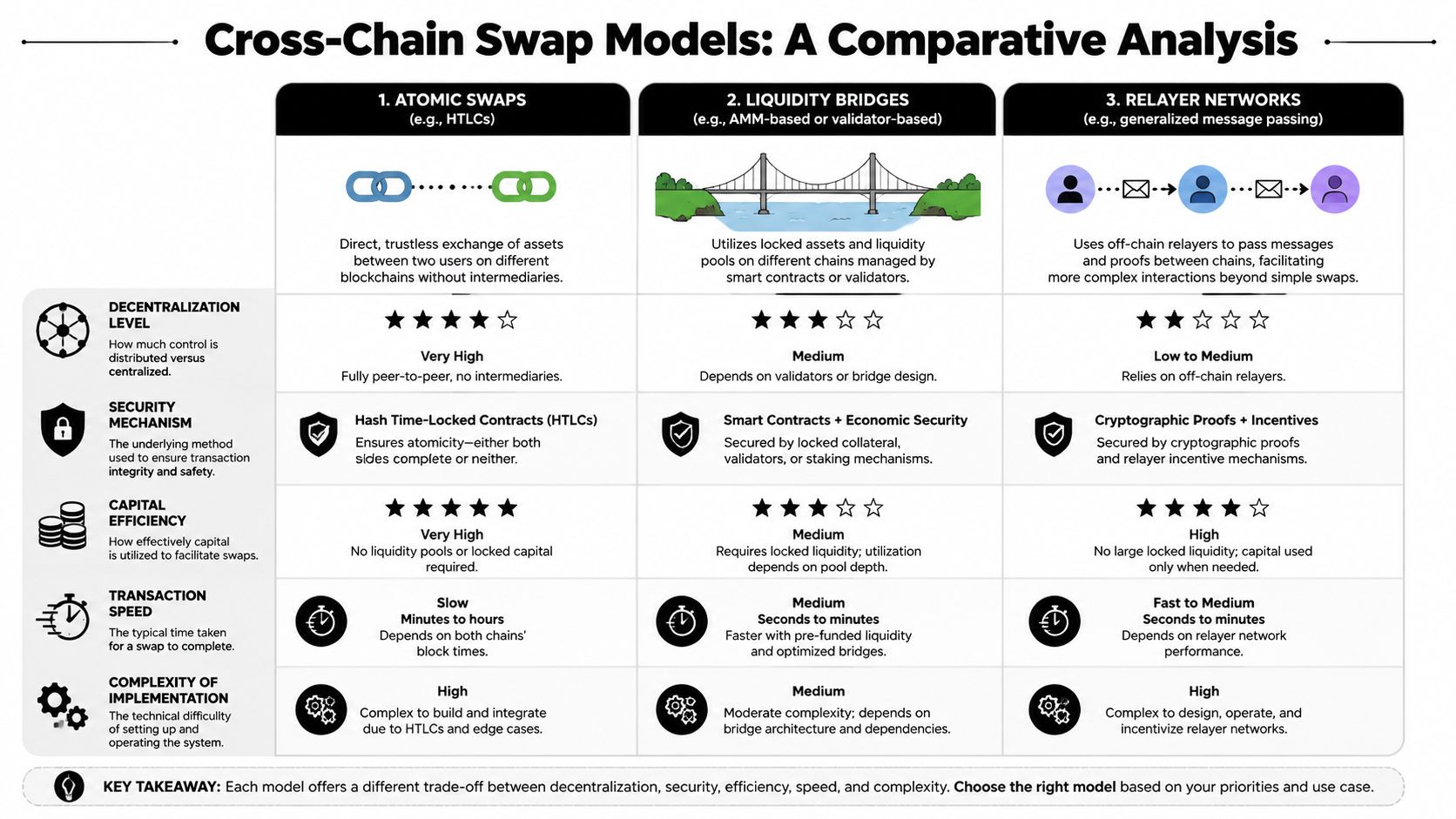
Why one label hides very different systems
One of the biggest mistakes in crypto education is treating cross chain swaps like a single product category. They aren't. TRM Labs describes the space as an umbrella covering at least seven distinct models, including protocol-native layers, DeFi liquidity bridges, lock-and-mint bridges, centralized instant swap desks, and custodial internal swaps (TRM Labs on seven cross-chain swap models).
That matters because the trust model changes everything. A direct atomic swap doesn't ask you to trust a custody layer in the same way a centralized instant swap service does. A bridge aggregator may route through several protocols you never see. A custodial platform may settle the swap mostly inside its own internal system.
If you follow MEV and route execution, Coiner Blog's explainer on what MEV is adds useful context for understanding why order flow and execution paths matter in multi-step swaps.
A practical comparison of the main models
The easiest way to compare these systems is by asking where the “truth” of the swap lives.
| Model | Who or what coordinates it | What users usually like | What users often miss |
|---|---|---|---|
| Atomic swaps | Smart contract logic across compatible chains | Minimal counterparty risk | Limited chain support and route flexibility |
| Lock-and-mint bridges | Bridge contracts and validation logic | Familiar, broadly supported structure | Wrapped asset risk and bridge dependence |
| Liquidity bridges | LPs, solvers, or liquidity networks | Faster fulfillment and smoother UX | Settlement may happen later or differently than users assume |
| Centralized instant swaps | Service inventory and internal systems | Simple interface, fewer visible steps | Trust shifts to the operator |
| Custodial internal swaps | Exchange ledger | Convenience | The actual swap may not be provable on-chain |
Some people care most about speed. Others care about decentralization, traceability, or minimizing smart contract exposure. There's no universal winner because each model optimizes for a different trade-off.
Questions to ask before you swap
Before using any provider, ask a few blunt questions:
- Who holds the assets mid-route: Is the process contract-based, liquidity-based, or custodial?
- What can fail first: Messaging, relayers, destination liquidity, or the operator itself?
- Can I verify the route: Do I get a transparent path, or just a promise of output?
- What kind of asset arrives: Native token, wrapped asset, or something that still needs another trade?
A polished UI can hide a very centralized backend. In cross chain swaps, the interface tells you less than the settlement model.
This is the contrarian but useful takeaway. “Cross-chain swap” is now a marketing label as much as a technical one. Smart users look through the label and identify the model.
Your Step-by-Step Guide to Performing a Swap
A realistic example from one chain to another
Let's use a practical example. Say you want to swap USDC on Polygon for SOL on Solana through an aggregator. The exact interface changes across products, but the user journey is broadly similar.
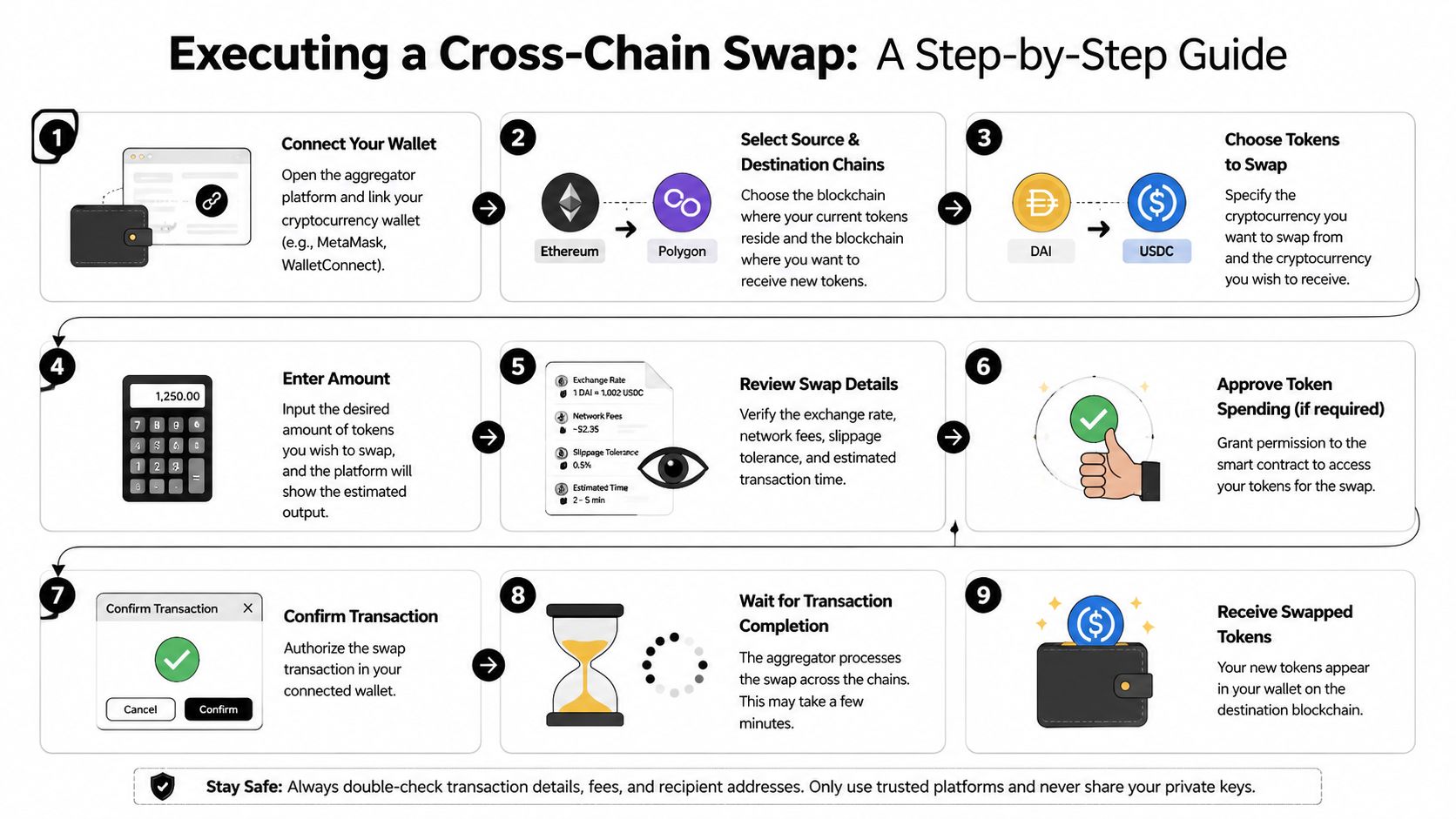
Connect your wallet. On the EVM side, that might be MetaMask or WalletConnect. On the Solana side, you may need a compatible destination wallet such as Phantom. If you're new to it, Coiner Blog has a straightforward guide on Phantom Wallet.
Choose the source and destination chains. Source: Polygon. Destination: Solana.
Select the assets. From USDC to SOL.
Enter the amount. The app will estimate what you receive and show a route.
Review the details carefully. At this stage, experienced users slow down. You're checking the route, expected output, price impact, bridge fee, and whether the destination token is native or wrapped.
Here's a visual walkthrough before the final confirmation:
What happens after you click swap
After approval and confirmation, the “simple” swap usually unfolds as a chain of actions.
- Approval step: If the source token is an ERC-20 style asset, you may first approve the contract to spend it.
- Source-chain transaction: Your USDC is sent into the bridge or routing contract.
- Cross-chain coordination: A bridge, relayer system, or liquidity network processes the move.
- Destination action: On the target network, value is released, minted, or fronted.
- Final swap: If needed, the protocol trades into the final asset, which in this case is SOL.
The important thing to remember is that most modern cross chain swaps are really a bridge-plus-swap workflow, where tokens are locked on the source chain, a wrapped version is minted on the destination chain, and then traded on a destination DEX. That's why the total cost includes both chains' gas, bridge fees, and DEX slippage (Chainlink's explanation of cross-chain swap mechanics).
Don't judge a route by the headline rate alone. Check whether the destination chain, wallet, and final asset setup actually match what you need.
If the app doesn't show route transparency, treat that as a warning sign. Convenience is good. Blind trust isn't.
Understanding the Security Risks of Swapping Chains
Why this infrastructure attracts attackers
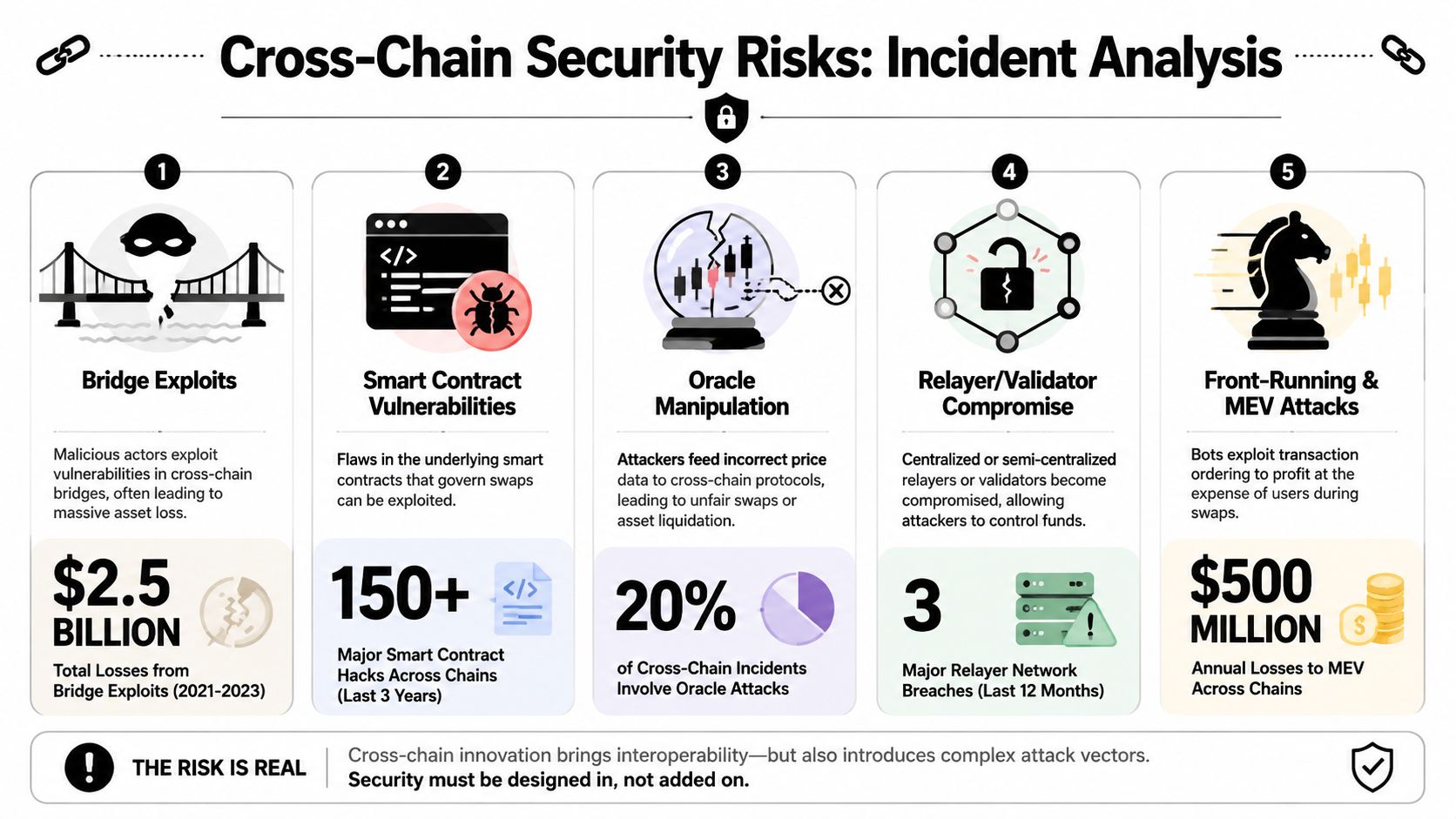
Cross-chain systems sit in a dangerous position. They coordinate value across multiple blockchains, hold or direct large pools of assets, and often rely on complicated smart contract and messaging logic. That makes them attractive targets.
The risk isn't theoretical. In 2022, breaches linked to bridges and interoperability systems caused nearly $1 billion in losses and accounted for 69% of total crypto-sector theft that year (Caudena's report on bridge-related losses).
That single data point explains why security analysts treat this category with so much caution.
The main ways users get hurt
Not every failure looks the same. Different models break in different ways.
- Smart contract exploits: Attackers find flaws in bridge or routing contracts and drain funds.
- Relayer or validator compromise: If a model depends on a smaller trusted set to attest messages, that set becomes a target.
- Custodial opacity: Centralized instant swap desks can fail in ways users can't audit on-chain.
- Malicious front ends and fake apps: Users connect wallets to copycat sites and sign the wrong transaction.
- Liquidity failure: The route may not be hacked, but poor destination liquidity can still produce a bad or incomplete outcome.
If you want broader defensive habits beyond swap mechanics, Coiner Blog's guide on avoiding crypto scams is worth reviewing.
How to reduce your exposure
Most users can't audit protocol code themselves. They can still reduce risk.
- Use established routes: Prefer providers with transparent documentation and visible routing logic.
- Read the transaction prompts: Wallet approvals often reveal more than the app interface does.
- Test with a small amount first: Especially when swapping into a new chain, wallet, or token standard.
- Confirm destination readiness: Make sure your wallet can receive and display the asset.
- Avoid chasing a slightly better quote from an unknown protocol: Saving a little on fees isn't worth adding major trust risk.
The most dangerous cross-chain swap is the one you think is simple. Complexity you can't see is still complexity.
Security in Web3 is rarely about one perfect tool. It's about reducing unknowns before your funds enter the route.
Best Practices for Safe and Efficient Swaps
Think like an operator, not just a trader
The smartest users treat cross chain swaps like an operational process. They don't just ask, “What rate do I get?” They ask, “What dependencies does this route assume?”
That mindset matters because even the smoothest interface can still leave you dealing with destination liquidity, missing gas tokens, wrapped asset handling, and routing surprises. Axelar notes that users still need sufficient liquidity on the destination DEX, gas tokens for both chains, and a route that may involve a wrapped asset before the final trade (Axelar on practical friction in cross-chain swaps).
A working checklist before you bridge anything
Use this checklist before hitting confirm:
- Check destination liquidity: If the final asset trades in a thin market, your route can degrade quickly.
- Hold gas on both sides: A successful arrival is useless if you can't move or swap the received asset afterward.
- Inspect the output asset: Make sure you're receiving the token format you expect, especially if wrapped assets are involved.
- Compare aggregator routes with direct routes: Aggregators can improve execution, but they also add another routing layer and more dependencies.
- Match the tool to the job: If you need hard trust minimization, a custodial instant swap may be the wrong fit. If you want speed and convenience, you may accept that trade-off deliberately.
- Keep records of route details: Transaction hashes, route IDs, and wallet confirmations help if support or manual tracing becomes necessary.
A good rule for DeFi, Layer 2 activity, tokenized real-world assets, and AI-linked on-chain apps is simple: interoperability isn't free. It shifts complexity around. Sometimes the app removes a step for you. Sometimes it just hides it.
The users who do best in this market aren't the ones who blindly optimize for speed. They're the ones who can tell whether the weak point is likely to be liquidity, gas, or routing before they start.
Conclusion Your Gateway to a Multi-Chain Future
Cross chain swaps are one of the clearest signs that crypto has moved beyond a single-chain mindset. They let users move capital where the opportunity is, which makes Web3, DeFi, Layer 2 ecosystems, and chain-specific apps far more usable.
But the most important lesson is also the least glamorous. Not all cross chain swaps are the same. Some are closer to trust-minimized coordination. Others depend on bridges, relayers, liquidity providers, aggregators, or outright custodians. The label stays the same while the risks change underneath.
If you understand the model, inspect the route, and plan for the actual costs, you'll use this infrastructure far more effectively. Multi-chain crypto is getting easier. It still rewards skepticism, patience, and technical curiosity.
If you want more practical crypto guides like this, follow Coiner Blog for clear analysis on blockchain infrastructure, DeFi, wallets, NFTs, crypto gaming, AI plus crypto, and the tools shaping the multi-chain market.