
How to Purchase Bitcoins Anonymously: 2026 Guide
Most advice on buying Bitcoin “anonymously” is too simple to be useful. It usually stops at a menu of options like P2P, ATMs, prepaid cards, or no-KYC platforms, then leaves out the part that determines whether your privacy holds up later.
That omission matters. A private purchase can still leave a visible trail through your internet connection, payment method, wallet behavior, and the way you spend or move coins afterward. If you want to understand how to purchase Bitcoins anonymously, the better question is how to reduce linkability across the entire workflow, not how to find one magic trick.
Privacy in crypto works more like layered security in Web3 than a single switch. The same mindset that helps in DeFi security, smart contract risk review, Layer 2 wallet segregation, and even AI-driven fraud detection applies here. Small mistakes connect datasets fast.
Table of Contents
- Why 'Anonymous' Is the Wrong Word for Bitcoin
- Building Your Privacy Foundation Before You Buy
- Comparing Private Bitcoin Purchase Methods
- The P2P Workflow A Practical Walkthrough
- Post-Purchase Transaction Hygiene
- Navigating Legal Realities And Your Threat Model
Why 'Anonymous' Is the Wrong Word for Bitcoin
Bitcoin gives you pseudonyms, not invisibility
Bitcoin isn't anonymous by design. It's pseudonymous, which means the blockchain doesn't store your name, but every transaction is publicly visible and can be traced with on-chain analysis, as explained in this overview of Bitcoin anonymity and pseudonymity.
That changes how you should think about privacy. You're not hiding from the ledger. You're managing how easily someone can connect your addresses, your devices, your payment methods, and your real identity.
A lot of mainstream discussion still frames privacy as a yes-or-no question. That's the wrong model. As noted in Business Insider's discussion of residual traceability in anonymous crypto purchases, the main issue is partial privacy. Regulated on-ramps, payment rails, and wallet activity can still create linkage even if the purchase itself avoids full KYC.
Practical rule: Stop chasing “perfect anonymity.” Build a workflow that reduces exposed links at each stage.
That mindset is closer to threat modeling than to marketing. If your goal is to avoid routine commercial profiling, you need a different setup than someone trying to minimize every possible metadata leak. The answer to how to purchase Bitcoins anonymously depends on who you're trying to stay private from, and what data they can access.
Think in terms of a privacy spectrum
A better mental model is a privacy spectrum.
At one end, you have convenience. Centralized exchanges, app-based wallets, and integrated fiat ramps are easy, fast, and familiar. They also create records. At the other end, you have higher-friction methods such as cash-based P2P trading, isolated devices, and stricter wallet discipline.
One often lands somewhere in the middle. That's normal.
The mistake is assuming one private entry point solves everything. It doesn't. If you buy through a privacy-conscious method and then merge those coins into a wallet tied to your usual exchange account, your privacy collapses. The same problem shows up elsewhere in crypto. A clean wallet can become noisy after one careless bridge, token swap, or wallet consolidation in a DeFi workflow.
If you want a deeper technical lens on why privacy tools matter over time, not just at the moment of purchase, this piece on the future of cryptography is useful background.
Building Your Privacy Foundation Before You Buy
Control the environment before the transaction
Most privacy failures happen before the first satoshi is purchased. People focus on the marketplace and ignore the operating environment.
Start with separation. Use a dedicated device if you can. If not, create a dedicated environment for Bitcoin activity and keep it isolated from your normal browsing, personal email, and exchange logins. The point isn't paranoia. It's preventing casual identity overlap.
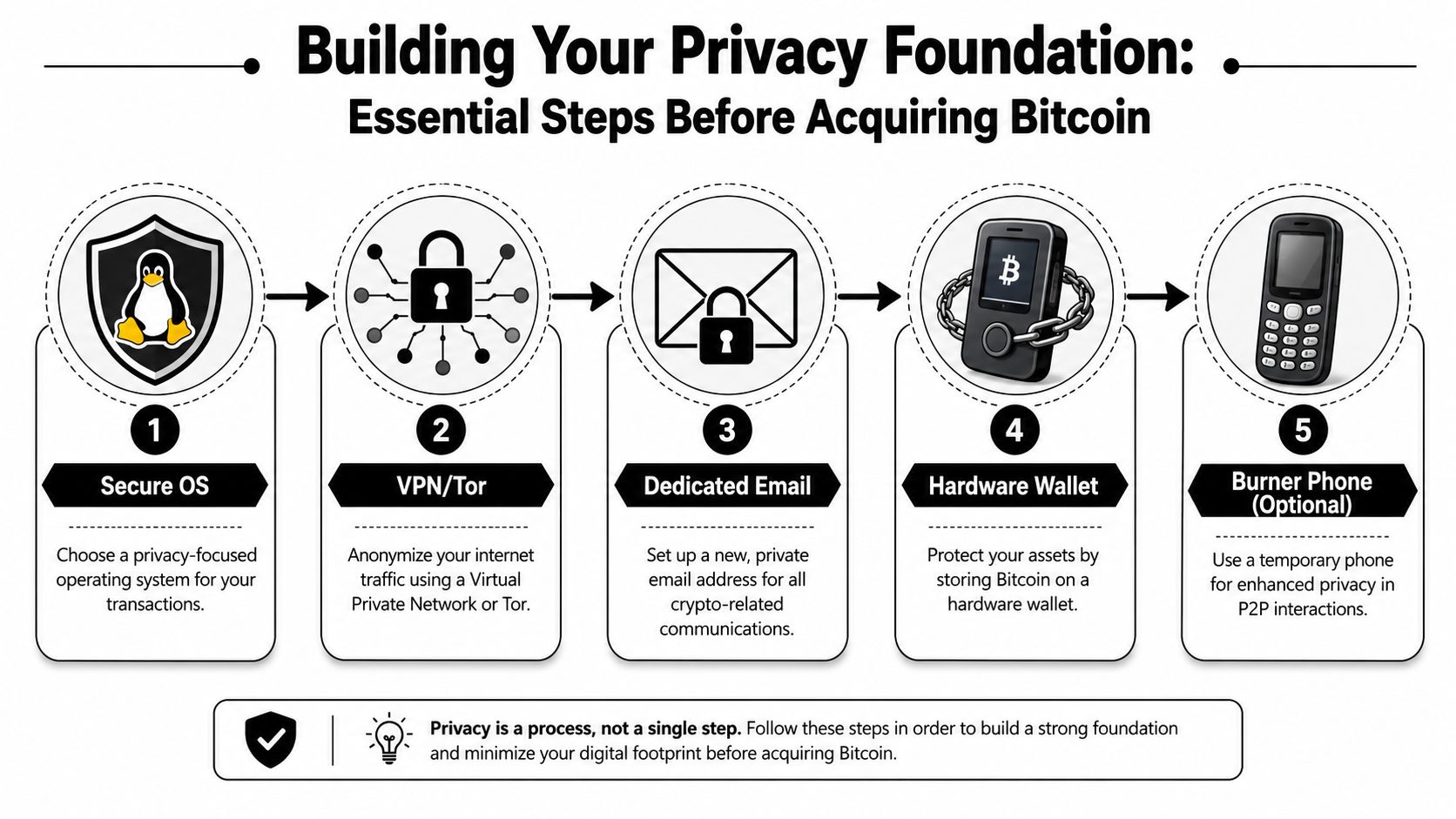
A solid baseline setup usually includes:
- A privacy-focused operating environment: Tails OS is popular for temporary, isolated sessions. A dedicated hardware device also helps reduce crossover with daily-use accounts.
- A non-custodial wallet: Electrum, Sparrow, and Wasabi are common choices. You control the keys, which is the whole point.
- A layered network path: Many privacy-focused buyers prefer Tor, a VPN, or both, depending on their threat model.
- A separate communications identity: Use a dedicated email for crypto-related coordination if the platform requires contact.
- An optional burner phone: Useful for P2P conversations where minimizing personal metadata matters.
If you're still storing significant value on custodial apps, fix that first. The logic behind not your keys, not your coin isn't ideology. It's operational reality.
Choose wallet and identity separation carefully
Wallet selection isn't just about features. It's about behavior. A good privacy workflow starts with a wallet that lets you generate fresh receive addresses easily and manage coins with intention.
Bitcoin.org guidance, summarized in the source cited earlier, recommends using a new address for each payment. That sounds minor, but it's one of the easiest habits to get right. Reusing addresses makes pattern analysis much easier.
Your preparation checklist should look like this:
- Create a fresh wallet specifically for the acquisition flow. Don't receive private buys into the same wallet you use for public payments or exchange withdrawals.
- Back up the seed phrase offline. Paper or another offline medium beats cloud storage and screenshots.
- Test the wallet first. Make sure you can generate receive addresses, label transactions, and understand basic UTXO views if your wallet supports them.
- Decide on your network route before logging in anywhere. Don't improvise halfway through the trade.
- Keep browser fingerprinting in mind. Privacy isn't only about blockchain analysis. It's also about what websites can infer from your device and connection.
A privacy setup is only as strong as the noisiest part of it. For many users, that's the browser, not the wallet.
DNS leaks are one example. If you're routing traffic through privacy tools but DNS requests still expose the wrong network path, you've weakened the whole stack. Marketers worry about this for campaign integrity, but the same principle applies to privacy-sensitive crypto activity. This guide on how to prevent DNS leaks in campaigns is a practical primer on the issue.
The result should feel boring. That's good. Clean privacy workflows usually look disciplined, not dramatic.
Comparing Private Bitcoin Purchase Methods
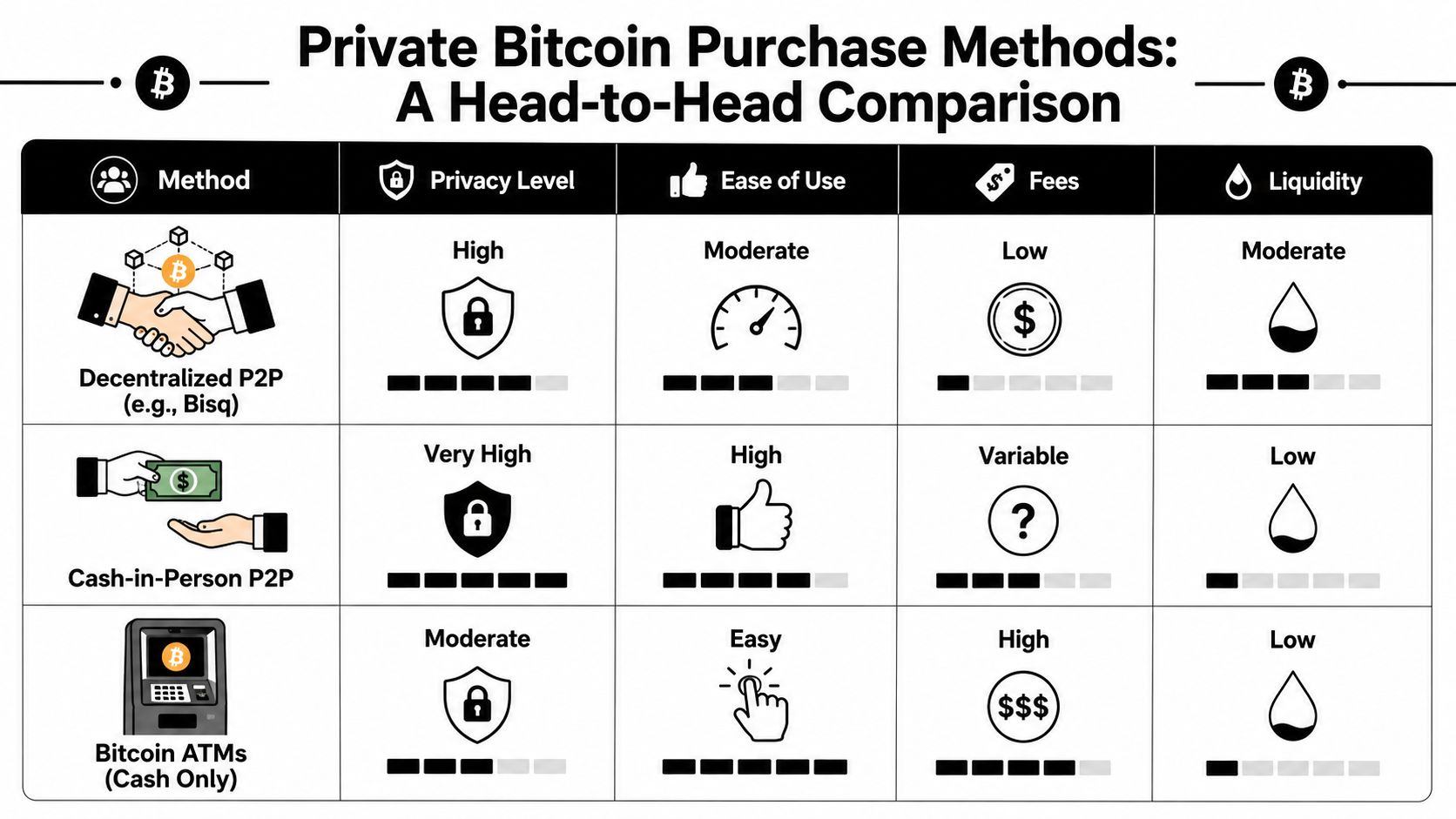
The best method depends on your threat model, location, amount, and tolerance for friction. There isn't one universal winner.
Cash-based methods are usually the most privacy-preserving. According to this guide on buying Bitcoin anonymously with cash, P2P, and ATMs, peer-to-peer cash trades and Bitcoin ATMs are typically the strongest options for smaller purchases. The same source also notes that regulated platforms increasingly limit these routes, and that full anonymity is nearly impossible for most users because other data trails can still connect activity to a person.
Method comparison at a glance
| Method | Privacy Level | Typical Cost | Speed | Ease of Use |
|---|---|---|---|---|
| Decentralized P2P marketplace | High | Low to moderate | Moderate | Moderate |
| Cash in-person P2P trade | Very high | Variable | Moderate | Low to moderate |
| Cash Bitcoin ATM | Moderate to high | High | Fast | Easy |
| OTC cash trade through personal network | High | Variable | Variable | Low |
This table captures the trade-off most buyers eventually discover. The more private the route, the more planning it usually requires.
What each route gets right and wrong
Decentralized P2P platforms
Bisq and HodlHodl are the first places I point privacy-conscious users because they align well with Bitcoin's original trust-minimized ethos. They avoid the account-heavy model of mainstream exchanges and use non-custodial structures rather than standard custodial order books.
The strengths are clear:
- Strong privacy posture: You can avoid the full identity capture common on major exchanges.
- Good balance of safety and control: Escrow and dispute mechanisms reduce some direct counterparty risk.
- Flexible payment methods: Depending on the platform and region, you may find methods that leak less personal data than bank-integrated exchanges.
The drawbacks are also real:
- More setup work: The interface and workflow aren't beginner-friendly.
- Patchy liquidity: Some regions and payment methods are thin.
- Counterparty judgment matters: A trade can still go badly if you choose poorly.
Cash in-person P2P
This is still one of the cleanest routes when done carefully. A direct cash trade with someone trustworthy, using a fresh wallet address and minimal digital coordination, leaves fewer records than most app-based options.
But there are trade-offs:
- Personal safety matters more here than in app-based trading
- You may pay a premium for privacy and convenience
- Finding reputable counterparties isn't easy
Private doesn't automatically mean safe. Counterparty risk and physical-world risk both go up when you leave regulated platforms.
Bitcoin ATMs
ATMs appeal to beginners because the flow is familiar. Insert cash, scan a wallet address, receive Bitcoin. For small buys, they can still be useful.
The problem is inconsistency. Some machines ask for less information than others. Some operators collect more metadata than users expect. Fees are often painful, and local regulation matters a lot.
If you value convenience and can tolerate weaker privacy than a careful P2P trade, ATMs still have a place. If you're optimizing for deeper operational security, they're rarely my first choice.
OTC cash through a personal network
This option gets ignored in most guides. If you already know long-term Bitcoin holders and can trade directly with cash, it can be one of the cleanest methods because there is no public marketplace account and no ATM operator in the middle.
Its weakness is obvious. Many individuals lack that network. Trust is social, not technical.
The P2P Workflow A Practical Walkthrough
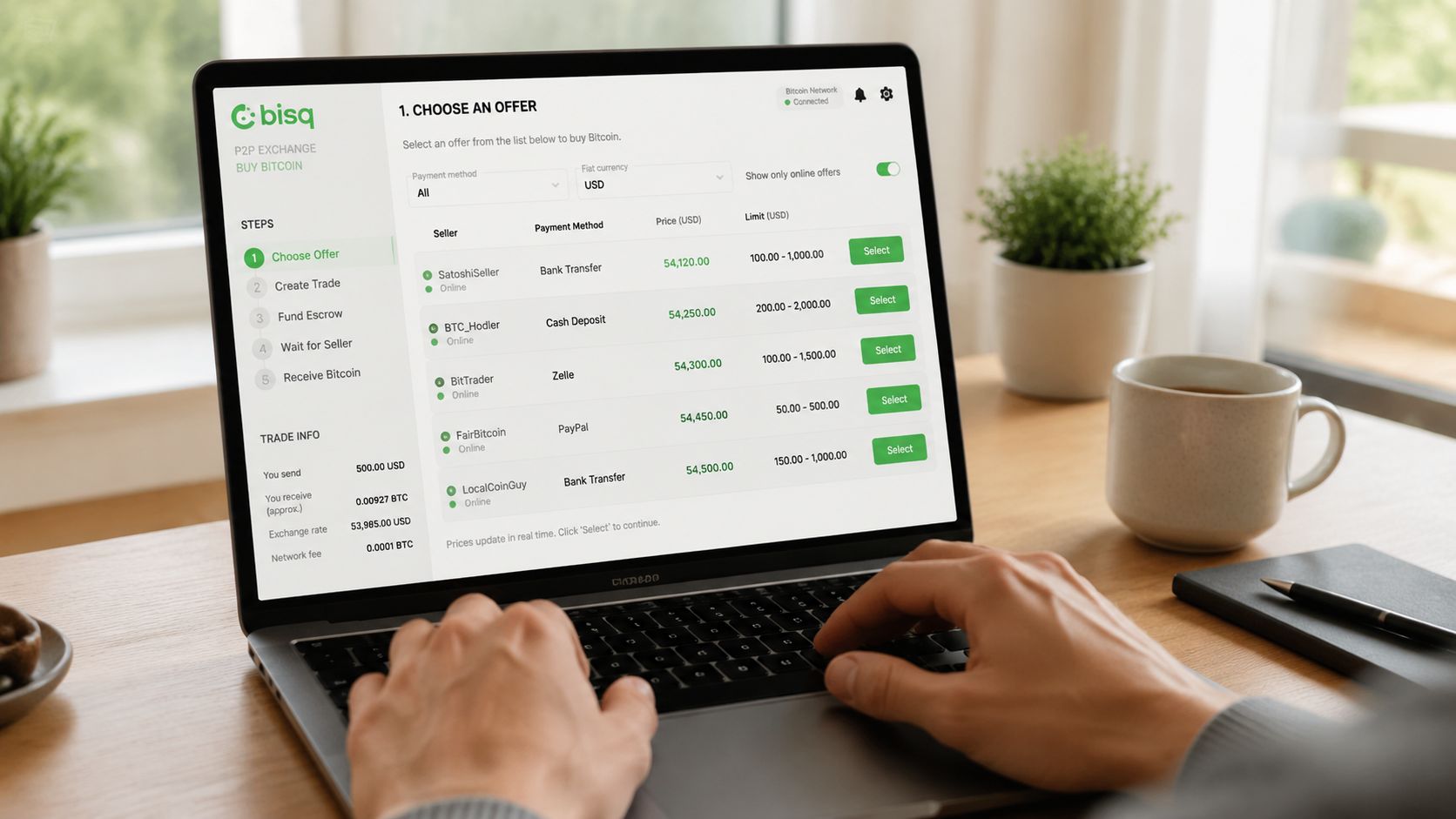
A realistic Bisq-style trade flow
If someone asks me for the most practical answer to how to purchase Bitcoins anonymously without relying on a centralized exchange, I usually point to a zero-KYC P2P marketplace such as Bisq.
The reason is structural. Bisq uses non-custodial smart contracts, which means the platform doesn't hold your coins the way a normal exchange does. That doesn't remove all risk, but it reduces one major category of exposure.
A clean workflow looks like this:
- Install the software in your isolated environment. Don't mix it with your normal crypto desktop if privacy is the goal.
- Fund the wallet carefully. You may need Bitcoin for trade deposits or fees, so plan that bootstrap step with the same discipline as the main purchase.
- Review offers instead of chasing the first available one. Payment method matters as much as price.
- Prefer payment routes that don't create obvious identity linkage. That's often more important than shaving a small amount off the exchange rate.
- Send purchased Bitcoin to a fresh address you control. Never treat the trade wallet as your forever wallet.
The process feels different from a mobile exchange app because it is different. You're doing more of the work yourself. In return, you get more control over what information exists.
For a visual walkthrough of the platform flow, this explainer helps:
Where people usually expose themselves
The technical workflow isn't the hard part. The discipline is.
One common pitfall is address reuse. Verified guidance on privacy-focused P2P purchasing notes that heuristic analysis tools like Chainalysis can de-anonymize transactions with 90% accuracy when users reuse addresses in major markets. That's why every serious privacy workflow starts with fresh addresses and careful wallet separation.
A few mistakes show up over and over:
- Using a familiar bank-linked identity trail. Even if the marketplace doesn't ask for KYC, your payment rail might.
- Chatting too casually with counterparties. Personal details leak in conversation faster than often understood.
- Moving coins straight into a public or exchange-linked wallet. That defeats the purpose.
- Skipping scam hygiene because the platform feels technical. Fraud still happens.
If you're trading with strangers, read basic crypto scam avoidance practices before sending a payment message or accepting a rushed offer.
Good privacy work is usually quiet. New wallet. Minimal metadata. No reused addresses. No unnecessary conversation.
Post-Purchase Transaction Hygiene
Your privacy work starts after the buy
The purchase is the easy part. Residual traceability is what catches people.
A private buy can still become a very public trail if the coins are handled carelessly afterward. The usual failure is not the first transaction. It is the follow-up. A wallet merge, a reused receive address, a transfer into an exchange account, or a casual move across chains can rebuild the link you were trying to avoid.
As noted earlier, fresh addresses matter. So does wallet separation. Keep one wallet for long-term storage, one for routine spending, and one for testing tools or receiving funds from higher-risk counterparties. That separation costs a little more time and attention, but it prevents simple clustering mistakes that are hard to undo later.
UTXO management matters for the same reason. If two coins came from different contexts, spending them together can tell an analyst they belong to the same person. I treat each UTXO as carrying history. Before sending anything, check what you are combining and why.
A clean spending setup matters
CoinJoin is one of the first tools people hear about, but poor execution ruins much of the benefit. The goal is not to make coins invisible. The goal is to make transaction graph analysis less reliable, then avoid undoing that work with sloppy spending.
A practical post-purchase routine often looks like this:
- Receive the purchased Bitcoin into a fresh wallet
- Wait for confirmation and label the UTXOs
- Review what you would reveal if you spend those UTXOs together
- Use privacy features only if they match your threat model and wallet setup
- Move long-term holdings to cold storage
- Keep spending activity separate from savings activity
The labeling step gets ignored far too often. If you do not track where coins came from, you will eventually merge clean and dirty history by accident. Privacy wallets help, but they do not save users from bad habits.
Cross-system activity creates another layer of residual traceability. A swap, bridge, Lightning channel, or wallet import may be convenient, but each step adds metadata, timing clues, and service logs outside the base chain. If you use interoperable tools, understanding how cross-chain swaps affect metadata and wallet linkage will help you avoid creating a new trail after a careful purchase.
Privacy also has a legal and operational side. Service providers, wallet apps, and payment tools can collect more information than the blockchain itself. Reviewing basic digital privacy principles from Throughwire privacy is worthwhile if you are building a workflow that is meant to stay private beyond the chain.
Privacy is not a single transaction. It is a repeatable habit of keeping identities, wallets, and spending contexts separate.
Navigating Legal Realities And Your Threat Model
Privacy goals are not all the same
Privacy is legitimate. So is compliance. Mature Bitcoin users don't confuse those two ideas.
Your first question shouldn't be “How anonymous can I get?” It should be “What am I protecting, from whom, and at what cost?” Some people want to reduce corporate data collection. Others want to keep personal finances from becoming a searchable profile. Those are different goals, and they justify different trade-offs.
A useful way to think about this is to define your threat model in plain language:
- Low-intensity privacy need: Avoid excessive profiling and routine data collection.
- Moderate privacy need: Reduce wallet linkage and keep personal holdings less visible.
- High-intensity privacy need: Minimize technical, financial, and physical-world exposure across the full chain.
Law, surveillance, and practical restraint
Legal boundaries vary by jurisdiction, and they change. That alone should make you cautious about overconfident advice.
Bitcoin ATMs are a good example. A verified warning attached to this topic notes that ATM geolocation tracking can lead to a 40% de-anonymization rate, and that strict rules such as Europe's AMLD5 can require ID over certain thresholds, making genuine anonymity harder in practice. That's why ATM privacy should never be treated as automatic.
If you care about how service providers frame data handling more broadly, reviewing a company privacy notice can sharpen your instincts. This Throughwire privacy policy is one example of the kind of document worth reading critically. Not because it solves Bitcoin privacy, but because it trains you to notice what organizations collect, retain, and share.
The same realism applies if you're comparing privacy-first buying methods with regulated conversion routes later on. Even something as ordinary as checking a BTC to GBP conversion reference reminds you that the moment crypto touches conventional rails, visibility tends to rise.
The right goal isn't fantasy-level invisibility. It's disciplined, lawful, technically informed privacy.
If you want more grounded crypto guides that cut through hype and explain trade-offs in Bitcoin, DeFi, Web3, Layer 2 tools, tokenomics, and emerging blockchain trends, visit Coiner Blog.