
How to Trade Crypto Options: A Practical 2026 Guide
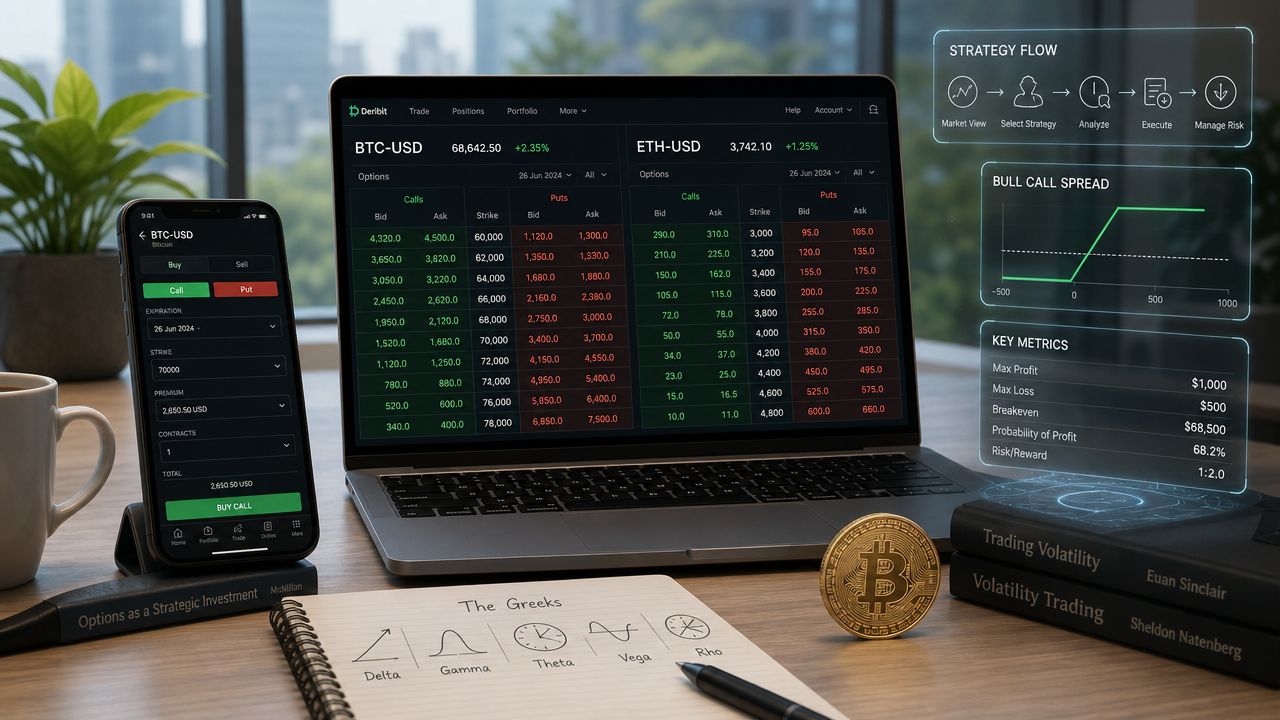
You're staring at an options chain, the BTC chart is moving while you're reading, and every strike looks like a bet you haven't learned how to price yet. That's the right place to start. How to trade crypto options well is less about finding a clever setup and more about understanding what you're buying, what can go wrong while you sleep, and why a contract that looks cheap can still be expensive once spreads, decay, and volatility hit your account.
Table of Contents
- What a Crypto Option Actually Is
- The Greeks That Move Your P&L
- Picking a Venue and Setting Up Your Account
- Placing Your First Crypto Options Trade
- Strategies That Actually Work for Beginners
- Risk Management in a Market That Never Closes
- Fees, Taxes, and Security You Should Not Skip
What a Crypto Option Actually Is
The first mistake new traders make is treating an options chain like a menu of weird tickers. It isn't. It's a list of contracts with very specific rights, deadlines, and pricing rules, and if you don't know the four basics, you're guessing in a market that punishes guessing fast.
A crypto option gives the holder the right, but not the obligation, to buy or sell an underlying cryptocurrency at a preset strike price until a specified expiry date. The two basic forms are calls, which give the right to buy, and puts, which give the right to sell, as explained in Crypto.com's introduction to crypto trading options. A long call on BTC is a bet that Bitcoin can climb above the strike before expiry. A long put is insurance or a bearish bet, depending on whether you already own spot.
Read the chain without panic
If BTC is trading near $60,000, a $100,000 call expiring in three weeks will usually cost far less than an at-the-money call because the market is assigning a smaller chance of finishing in the money. That doesn't make it a bargain. It usually means the strike is far away, so the premium reflects distance, time left, and the market's expectation of future volatility rather than some hidden edge.
Exercise style matters too. In traditional options, an American-style contract can usually be exercised before expiry, while a European-style contract is exercised only at expiry. Crypto traders often meet both formats through different venues, so the key habit is simple, read the contract specs before you click. If you want a quick market snapshot before comparing expiries and strikes, review the 2026 crypto outlook and then come back to the contract terms with a calmer eye.
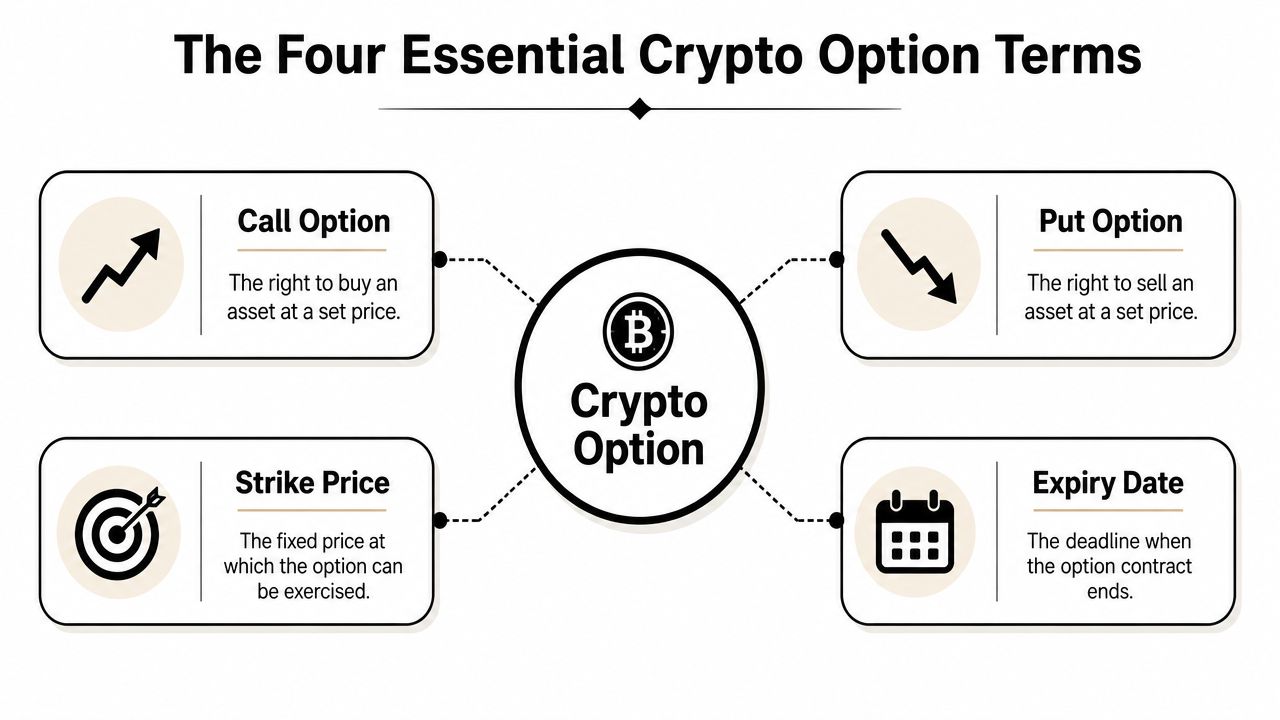
Practical rule: if you can't explain the strike, the expiry, and whether you're buying a call or a put in one sentence, you're not ready to place the trade.
The Greeks That Move Your P&L
Most beginner guides mention the Greeks like they're optional jargon. They aren't. In crypto options, they're the mechanics that decide whether your trade behaves the way you expected or melts while you're waiting for direction to show up.
Delta, theta, gamma, and vega in plain language
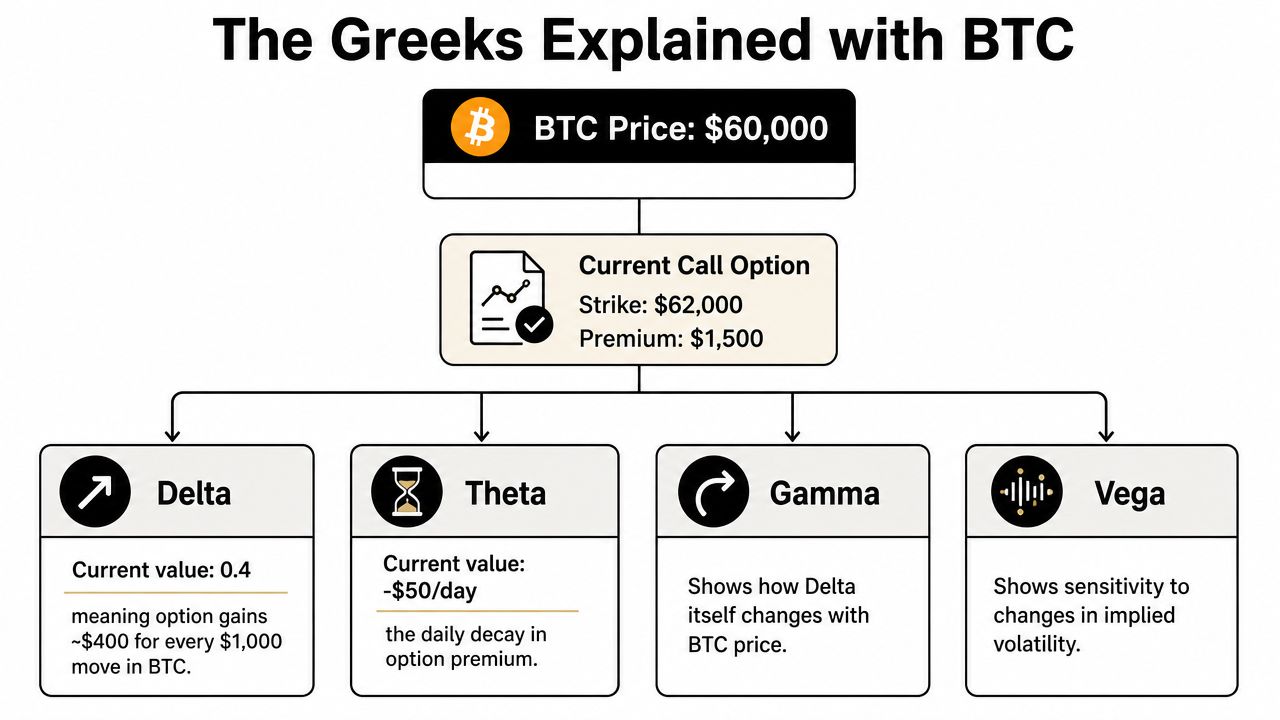
Start with a BTC call. If BTC is near $60,000, your contract might have a strike of $62,000 and a premium of $1,500, matching the BTC example in the infographic below. If the option's delta is 0.4, the contract should gain roughly $400 for every $1,000 move in BTC, all else equal. That is why delta matters so much, it tells you how much direction you're buying.
Theta is the daily decay. In the same example, theta of -$50/day means the option loses value because time passes. Crypto traders feel this most when they buy an out-of-the-money contract over a quiet weekend and wake up to a smaller premium even though the coin barely moved.
Gamma measures how fast delta changes as BTC moves. If price starts running, your call may stop behaving like a mild directional bet and start acting much more aggressively. Vega measures sensitivity to implied volatility, so a contract can get more expensive or cheaper even if spot barely moves, especially around major events.
A cheap option isn't automatically a good trade. If implied volatility is already rich and realized volatility stays quiet, the premium can still decay against you.
That difference matters because implied volatility is what traders expect, while realized volatility is what happened. You can buy a contract that looks inexpensive on screen, only to discover the market already priced in more movement than you get. The diagram below gives the cleanest way to keep the Greeks tied to the actual ticket, not an abstract formula.
Picking a Venue and Setting Up Your Account
The venue you choose shapes everything that comes after it. A clean strategy on a thin platform can still become a bad trade if the bid-ask spread is wide, the contract list is shallow, or you can't get out when the market moves against you.
Match the platform to the trade
Retail traders usually run into three broad venue types. Regulated derivatives exchanges tend to offer clearer controls, tighter process, and more formal permissions, but they usually require more verification. Crypto-native options platforms can feel faster and more flexible, but the user needs to think harder about counterparty risk and execution quality. DeFi options protocols add smart-contract risk on top of market risk, which is a real issue if you're still learning how strikes and expiry work.
Liquidity is the part people underprice. It's not just “the market has volume.” It's whether you can buy or sell the specific strike you care about at a price that doesn't punish you. This discussion of liquidity in crypto markets is useful background, because in options the same idea gets sharper, wider spreads and thin strikes can turn a reasonable idea into a bad fill.
Build a short list, not a fantasy list
Open an account only after you've checked the basics. Identity verification, funding method, derivative permissions if they're separated from spot, and whether the venue even lists the coins you want all matter. Some platforms limit options to a handful of large-cap assets, which is why most beginners should start with BTC or ETH rather than hunting for obscure altcoin contracts.
A good shortlist is usually two or three venues, not ten. One should be the best fit for your jurisdiction and account type, one should be the best fit for execution quality, and one can serve as a backup if access or spreads get ugly. That way you're comparing real trade-offs, not chasing the illusion of the perfect exchange.
Placing Your First Crypto Options Trade
The first trade should be boring on purpose. A beginner's job isn't to look professional, it's to learn how the order ticket behaves, how the Greeks shift after entry, and what a fill ultimately costs once the market gets involved.
A long BTC call and an ETH put
Take a simple BTC call. You think Bitcoin may rally before a catalyst, so you choose an expiry far enough out that the move has time to happen, then select a strike that matches your conviction and budget. You enter a limit order instead of a market order because the spread on crypto options can quietly eat more than you want to admit. If the ticket shows delta, theta, and implied volatility at entry, treat those numbers like the first snapshot of your risk, not decorative metadata.
A day later, the same contract can look very different. If BTC drifts sideways, theta works against you and the premium may soften even if your thesis hasn't changed. If BTC moves hard in your direction, delta will change too, and the contract may behave less like a mild bet and more like a sharper directional position.
Now flip the logic for an ETH protective put. If you already hold ETH spot, the put acts like insurance against a drop. You're not trying to predict a moonshot. You're deciding how much downside you're willing to pay to cap, or at least soften, the pain.
The workflow stays simple for a reason. CoinTracker's crypto options guide recommends starting with a venue that has sufficient liquidity and low bid-ask spreads, funding and verifying the account, then using single-leg calls or puts before moving into defined-risk spreads. That sequence keeps the learning curve honest, because you understand strike, expiry, and premium behavior before adding more moving parts.
Practical rule: if the fill is bad, the trade starts in a hole. In options, that hole can matter more than the direction you picked.
First-time mistakes tend to repeat. Traders oversize, choose a strike that is so far out of the money it behaves like a lottery ticket, or ignore funding-style costs on products that look simple on screen. This stop-loss guide pairs well with that mindset, because a trade plan that has no exit is usually just optimism wearing a borrowed coat.
Strategies That Actually Work for Beginners
A beginner does not need every options strategy. They need a small set of structures that match a clear view and limit damage when the market behaves normally, not perfectly.
Covered calls, protective puts, and verticals
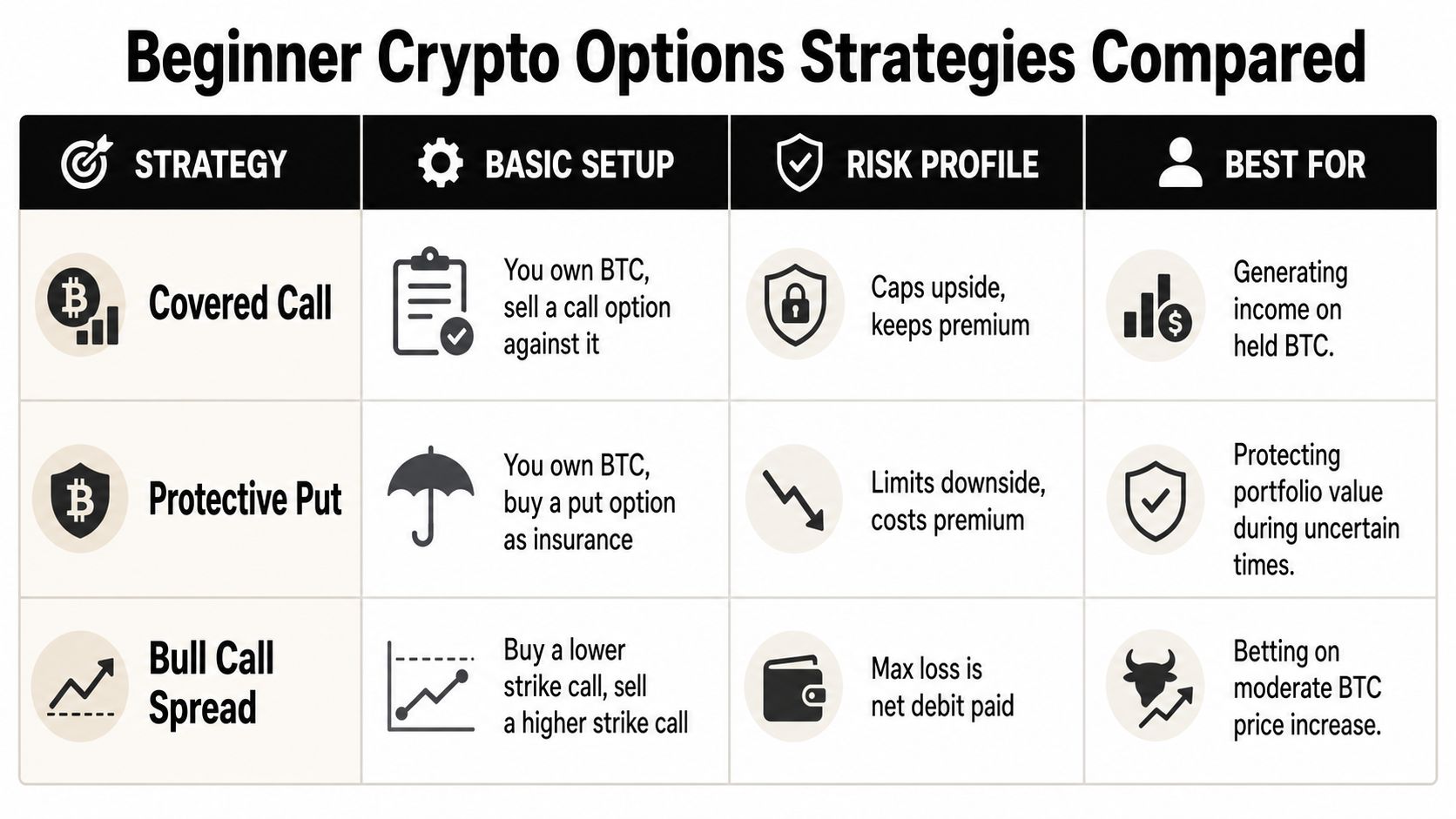
A covered call fits the trader who already owns BTC and wants to earn premium while giving up some upside. If you hold spot and sell a call above the current price, you collect premium if BTC stays below the strike. The trade-off is simple, upside becomes capped once price moves through your sold strike. That's fine if your main goal is to keep the coin and add income, not chase every rally.
A protective put is the opposite use case. You already own ETH, you buy a put, and you accept the premium cost as insurance against a drop. The put won't make you rich if ETH goes sideways, but it can make the drawdown much easier to live with when the market suddenly turns.
A bull call spread or bear put spread keeps risk defined by pairing one option with another. In a bull call spread, you buy a lower-strike call and sell a higher-strike call. Your upside is limited, but so is your loss, because the short leg helps fund the long leg. That structure is often cleaner for beginners than a naked long call, especially when they have a moderate view rather than an extreme one.
Bitcoin options are no longer a side market. Bitcoin options open interest reached $65 billion, while Bitcoin futures open interest was $60 billion in notional terms, according to CoinDesk's January 2026 report. That scale matters because the liquid strikes behave better than the thin ones. You want to trade where other people trade, not where the chart looks exciting.
Prefer defined risk whenever you can. Naked short options can move from “small premium collected” to “too much margin, too fast” with very little warning.
Risk Management in a Market That Never Closes
Crypto options punish sloppy risk control because the market never really shuts off. A position that looks comfortable at dinner can be deep in trouble by the time you check it the next morning, especially if a major move happened while liquidity was thin.
The habits that keep traders alive
Weekend risk is real because price discovery keeps moving when many traders are offline. That matters for options because delta, gamma, theta, and margin all keep changing against a live market. A fast move can squeeze a short premium seller, and a trader who was comfortable at midnight can wake up to a position that's harder to defend than it looked hours earlier.
The right answer is not heroics. It's sizing and exits. A practical approach is to keep each position small relative to the account, avoid stacking too many simultaneous bets, and define the trade before entry, profit target, stop-loss, and time-based exit. If the remaining premium is likely to get eaten by decay, closing early can be the smarter move than waiting for a final tick that never comes.
Practical rule: if you need the trade to work fast just to justify the premium, the structure probably isn't doing enough for you.
TradeAlgo's crypto options guidance favors defined-risk structures such as spreads, covered calls, and protective puts over naked positions because crypto's fast price swings can make margin requirements and losses expand quickly, especially when implied volatility is high. That's the core lesson many retail traders learn late. Direction is only part of the edge. The rest is surviving long enough for the strategy to matter.
This risk management guide is worth keeping nearby if you want a second checklist. The market will not reward confidence by itself, but it will reward traders who know exactly how much they can lose before the trade starts.
Fees, Taxes, and Security You Should Not Skip
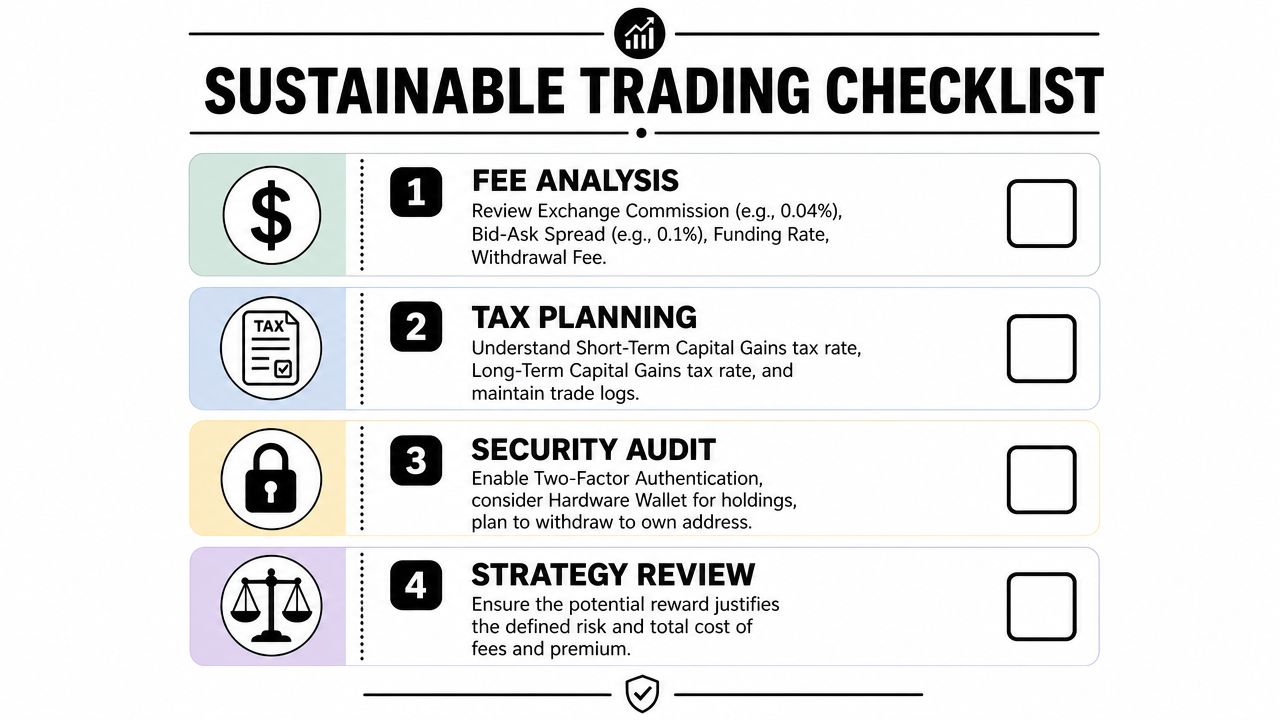
The quiet killers in crypto options are usually not dramatic price moves. They're the costs that stack up around the trade, then show up later as a smaller account than you expected.
The unglamorous side of the trade
Your cost stack can include exchange commissions, the bid-ask spread, funding on perpetual-style products, and withdrawal fees. None of those feel large in isolation, but they compound fast when the account is small or when you trade often. A thin contract can also make the spread itself behave like a hidden fee, which is why “cheap premium” can be misleading if the exit is expensive.
Taxes add another layer of friction. Options can receive different treatment depending on holding period and jurisdiction, and wash-sale rules vary by location. That means good recordkeeping matters even if you're not ready to think about optimization.
Security should be treated like part of the strategy. Use two-factor authentication, consider a hardware wallet for holdings you don't need on the venue, and keep only active trading capital on the exchange. Withdrawal whitelists help too, because one compromised login should not become a lost account.
A simple pre-trade ritual helps. Check the fee estimate, confirm the strike and expiry, verify the exit plan, review the risk to the account, and make sure the venue is the right one for the trade. If any one of those feels fuzzy, don't click yet.
If you want more clear-eyed crypto guides like this one, Coiner Blog covers Bitcoin, Ethereum, DeFi, Web3, and the risk management habits that matter when markets move fast. Visit it for more practical breakdowns that help you read the trade before you place it, not after the damage is done.