
Quantum Resistant Blockchain: Securing Crypto’s Future In

You probably hold crypto in a wallet that feels secure because nobody knows your seed phrase and the network itself looks mathematically locked down. That assumption still holds against normal computers. It gets shakier if a cryptographically relevant quantum computer can attack the signature systems that Bitcoin, Ethereum, Solana, and many other chains rely on.
That looming shift is often called Y2Q, short for Year to Quantum. The idea is simple. Crypto doesn't need the world to get fully quantum before it has a problem. It only needs quantum hardware to become good enough at breaking the specific public-key systems used for signatures and key management. Once that threshold is crossed, the industry won't be debating theory anymore. It will be racing to protect exposed addresses, upgrade wallets, and keep consensus stable.
For readers who know blockchain but haven't gone deep on post-quantum cryptography, the most useful way to think about this topic is practical rather than futuristic. Which parts of today's crypto stack are exposed? Which fixes are real engineering versus marketing copy? And how do established ecosystems migrate without wrecking user experience, DeFi integrations, exchange infrastructure, or smart contract compatibility?
Table of Contents
- Why We Need Quantum Resistant Blockchains Now
- The Quantum Threat to Your Crypto
- Exploring Post-Quantum Cryptography Solutions
- Quantum Resistance in the Wild Projects and Adoption
- Practical Migration Strategies for Blockchains
- What Quantum Resistance Means for You
- Conclusion The Road to a Quantum Secure Future
Why We Need Quantum Resistant Blockchains Now
A quantum resistant blockchain is a blockchain designed so that a future quantum computer can't easily forge signatures, steal funds, or undermine core network security. In practice, that usually means replacing or supplementing vulnerable signature systems with post-quantum cryptography, then making sure wallets, nodes, validators, and applications can all handle the change.
This matters now because the market has already stopped treating quantum resistance as a fringe research topic. As of November 2025, the quantum-resistant cryptocurrency sector surpassed $9.37 billion in market capitalization, with daily trading volumes exceeding $1.58 billion, according to BeInCrypto's report on the quantum-resistant token market. That doesn't prove every project is sound, but it does show that investors and builders increasingly view post-quantum security as a real design category, not a science fair demo.

Why this isn't just a niche altcoin story
Bitcoin, Ethereum, and Web3 infrastructure all depend on cryptographic assumptions. If those assumptions change, the consequences spill outward fast. Exchanges need new custody flows. DeFi protocols need wallet compatibility. Layer 2 networks need upgraded bridging logic. Smart contracts that verify signatures may need new primitives or account models.
If you want a clean refresher on the foundations before going deeper, Coiner Blog's guide to blockchain technology basics is a useful starting point.
Practical rule: The quantum story isn't mainly about whether a new token says "PQC" on its homepage. It's about whether entire ecosystems can upgrade without freezing users out or exposing funds during the transition.
The hard part isn't inventing one new chain with better cryptography. The hard part is migrating live financial networks with users, wallets, custodians, bridges, tokenized assets, and years of technical debt already in production.
The Quantum Threat to Your Crypto
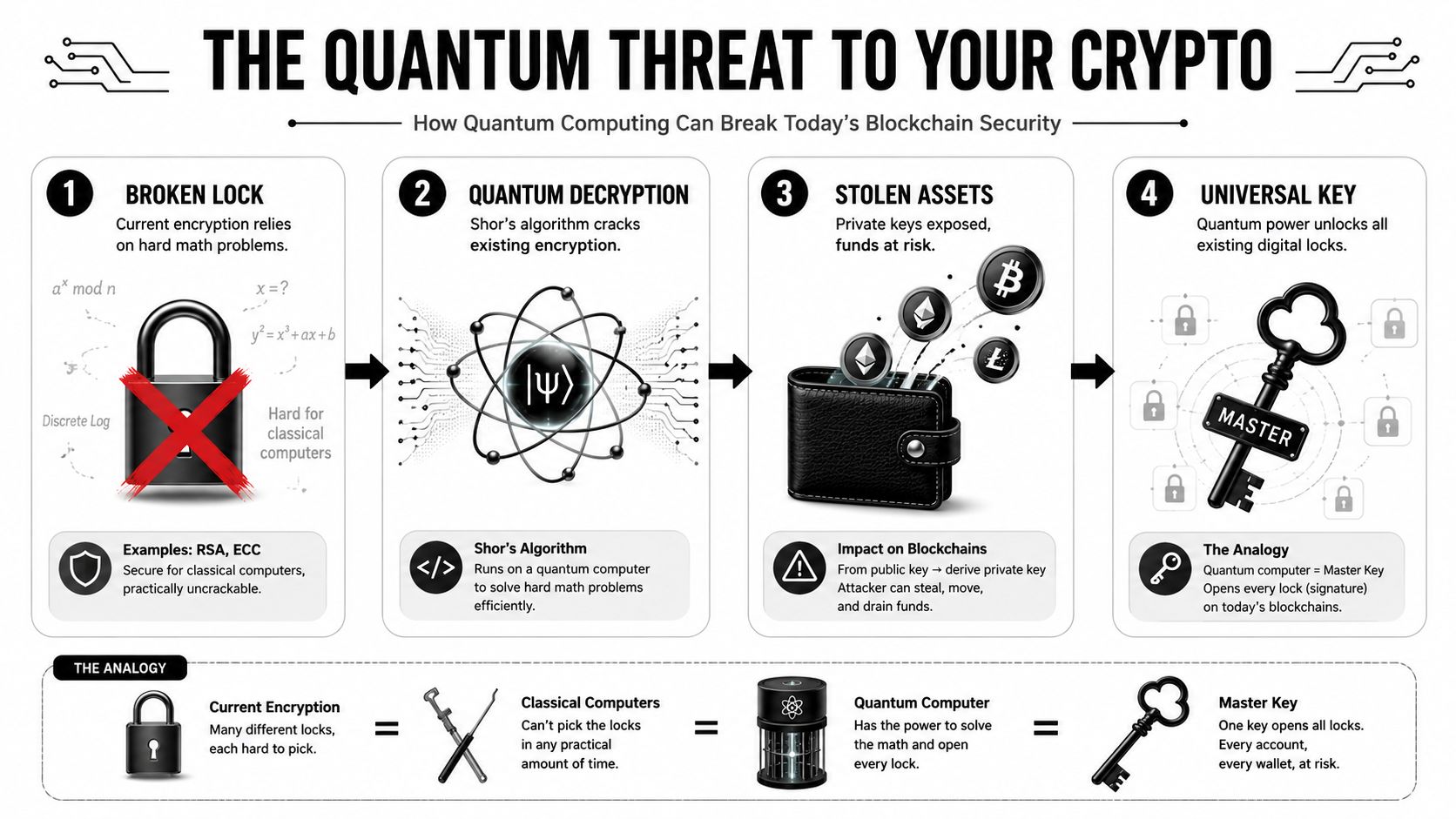
The most common confusion starts here. People hear "quantum attack on blockchain" and assume it means someone mines blocks faster or breaks hashing overnight. That's not the immediate issue. The sharper risk is that a quantum computer running Shor's algorithm can attack the public-key cryptography behind transaction signatures.
Why signatures matter more than mining myths
Bitcoin and Ethereum both rely on signature systems tied to elliptic-curve cryptography. A cryptographically relevant quantum computer can use Shor's algorithm on elliptic-curve public keys and derive the corresponding private key. Once that happens, an attacker can forge signatures and steal funds.
The easiest analogy is this: current crypto signatures work like showing the world a lock while keeping the key hidden. With ordinary computers, seeing the lock doesn't help much. A powerful quantum computer changes that. It acts more like a master tool that can reconstruct the key from the lock itself.
For readers who want a straightforward refresher on how public and private keys work before layering on the quantum risk, this primer on encryption for MSP security is useful because it explains the core model in plain language.
The timeline is still uncertain, but it isn't open-ended. Google researchers predict that encryption-breaking quantum computers could emerge by 2029, and the same report notes that the Ethereum Foundation is working toward that horizon for full quantum protection, as covered by Blockchain Council's analysis of quantum-resistant blockchain security.
Here's where readers often get tripped up. The report also notes that breaking Bitcoin's elliptic-curve encryption within a short window would require hardware far beyond current systems. Today, the gap is still large. But "not possible today" isn't the same as "safe to ignore," especially for systems that need years to coordinate upgrades.
A short explainer helps before going further:
The overlooked threat to consensus randomness
Key theft gets most of the attention. Consensus integrity deserves more.
Some post-quantum research highlights a second danger: quantum systems may compromise the randomness used for validator selection, nonce generation, or timing assumptions in consensus. That matters most for Proof-of-Stake style systems. If an attacker can predict or bias the randomness used to choose who validates next, they may destabilize block production even when private keys themselves remain protected.
A chain can harden transaction signatures and still leave an opening if its randomness pipeline remains predictable.
That's why a serious quantum resistant blockchain conversation can't stop at wallet keys. It also has to include randomness quality, validator selection, and whether the protocol uses stronger entropy sources or quantum-aware consensus designs. This is especially relevant for modern Web3 networks where staking, sequencing, and cross-chain messaging all depend on orderly validator behavior rather than simple transaction signing alone.
Exploring Post-Quantum Cryptography Solutions
Once you understand the threat, the next step is sorting the solution space without drowning in math. Post-quantum cryptography, usually shortened to PQC, means cryptographic systems designed to resist both classical and quantum attacks.
The important thing isn't memorizing every algorithm name. It's understanding the families, the trade-offs, and why no serious engineering team treats migration as a one-click swap.
The main families in plain language
Think of PQC as a toolbox with different design philosophies.
Lattice-based cryptography is the current center of gravity for many blockchain discussions. A simple analogy is a huge multidimensional grid full of noisy shortcuts and hidden structure. The math is hard for both classical and quantum attackers, but practical enough for modern systems. This family includes CRYSTALS-Dilithium, standardized by NIST as ML-DSA.
Hash-based signatures lean on a simpler foundation: secure hash functions. That makes them conceptually attractive because hash functions are well-studied. The trade-off is that these schemes can be operationally awkward, especially when signatures are larger or when certain forms require state tracking.
Code-based cryptography comes from error-correcting code problems. It's respected academically, though it appears less often in mainstream blockchain product discussions.
Isogeny-based approaches attracted attention because of their elegant math and compactness ambitions, but they aren't the default answer for practical blockchain migration today.
If you want a broader context for why cryptographic upgrades matter beyond the quantum angle, Coiner Blog's piece on the future of cryptography is worth reading alongside this topic.
The same transition pressures show up outside crypto too. Work on securing cloud platforms with encryption is a good parallel because it shows how infrastructure teams handle algorithm changes, compatibility issues, and trust boundaries when security assumptions evolve.
Here's the high-level comparison that matters most:
| PQC Family | Core Idea | Pros | Cons |
|---|---|---|---|
| Lattice-based | Uses hard problems on structured mathematical lattices | Good balance of security and efficiency, strong momentum in standards and implementations | More complex math and implementation details |
| Hash-based | Builds signatures from hash function security | Conservative design, well-understood foundations | Can create operational friction, often with larger signatures or state management concerns |
| Code-based | Relies on hard decoding problems from error-correcting codes | Long research history | Less common in blockchain product design discussions |
| Isogeny-based | Uses hard problems involving mappings between elliptic-curve structures | Appealed to designers seeking compact constructions | Not the practical default for current blockchain migration planning |
Why hybrid signatures matter right now
The smartest near-term pattern isn't always full replacement. Often it's hybrid cryptography.
Modern architectures are already combining classical signatures such as Ed25519 with NIST-standardized PQC algorithms like CRYSTALS-Dilithium, so that the post-quantum layer still protects the ledger even if the classical signature becomes vulnerable. That hybrid model is described in Solo Engineer's analysis of quantum-resistant blockchain architecture.
This is a practical engineering answer to an awkward reality. Existing wallets, exchanges, smart contract systems, and custody platforms can't all switch at once. Hybrid signatures buy time. They let networks preserve compatibility while they phase in new trust assumptions.
Design insight: In a migration period, "both" is often safer than "either." Classical plus post-quantum protection is messy, but messy is better than exposed.
Quantum Resistance in the Wild Projects and Adoption
The good news is that quantum resistance isn't stuck in whitepapers. Several projects have already turned it into live infrastructure, though they're solving different pieces of the puzzle.

The early specialist chain
Quantum Resistant Ledger (QRL) remains the clearest example of a chain built around this problem from the start. According to the framework paper that surveyed the space, QRL is the only purpose-built blockchain with a mainnet utilizing the NIST-approved XMSS hash-based signature scheme, giving it immediate, forward-secure protection against quantum attacks. The same source contrasts that with Ethereum, which is still working toward quantum readiness through its roadmap, as discussed in the quantum resilient blockchain framework paper.
That distinction matters. Genesis-level design is cleaner than retrofitting security into an ecosystem that already secures DeFi, token bridges, NFTs, Layer 2 rollups, and smart contract wallets. QRL doesn't carry the same migration baggage as Ethereum or Bitcoin.
Another useful data point from the broader context is that QRL has operated a Proof-of-Work mainnet continuously since June 2018 and uses XMSS with Winternitz one-time signatures, according to QRL's overview of its protocol design. That makes it a real operating network, not just a concept label.
Mainstream networks start to experiment
More interesting for the wider market is what happens when large ecosystems begin testing real post-quantum features.
Algorand marked a major milestone in November 2025 when it executed one of the first quantum-resistant transactions on a live public mainnet using Falcon signatures, extending post-quantum protection to real assets, as described in Algorand's post-quantum technology page. That's important because it moves the discussion from archival security or lab work into live user-facing execution.
Solana also introduced a Winternitz Vault mechanism in 2025 based on the Winternitz One-Time Signature scheme for account recovery and key rotation. The catch is just as important as the feature itself: it is non-default and does not amount to a full network-wide transition, according to the research note covering Solana's Winternitz Vault.
A few patterns stand out from these examples:
- Purpose-built chains move faster: They can bake in quantum resistance at genesis instead of negotiating upgrades across years of legacy infrastructure.
- Large ecosystems start with narrow features: Recovery vaults, optional accounts, or pilot transactions are easier than rewriting an entire base layer.
- Marketing language can blur the difference: A chain may offer one quantum-safe component without being a fully quantum resistant blockchain.
QuanChain is another example of a project framing the problem at the architecture level. It describes a TADEQS parent-child key design where spending authorization avoids exposing underlying key material and replaces ECDSA-style signatures with post-quantum alternatives, as outlined in QuanChain's comparison of quantum-resistant and traditional blockchains.
Practical Migration Strategies for Blockchains
The subject becomes particularly challenging. Building a new chain with quantum-safe cryptography is hard. Upgrading Bitcoin, Ethereum, and the broader Web3 stack is harder because every change ripples outward into wallets, custodians, exchanges, hardware devices, smart contracts, Layer 2 systems, and user behavior.
Why legacy chains have the hardest job
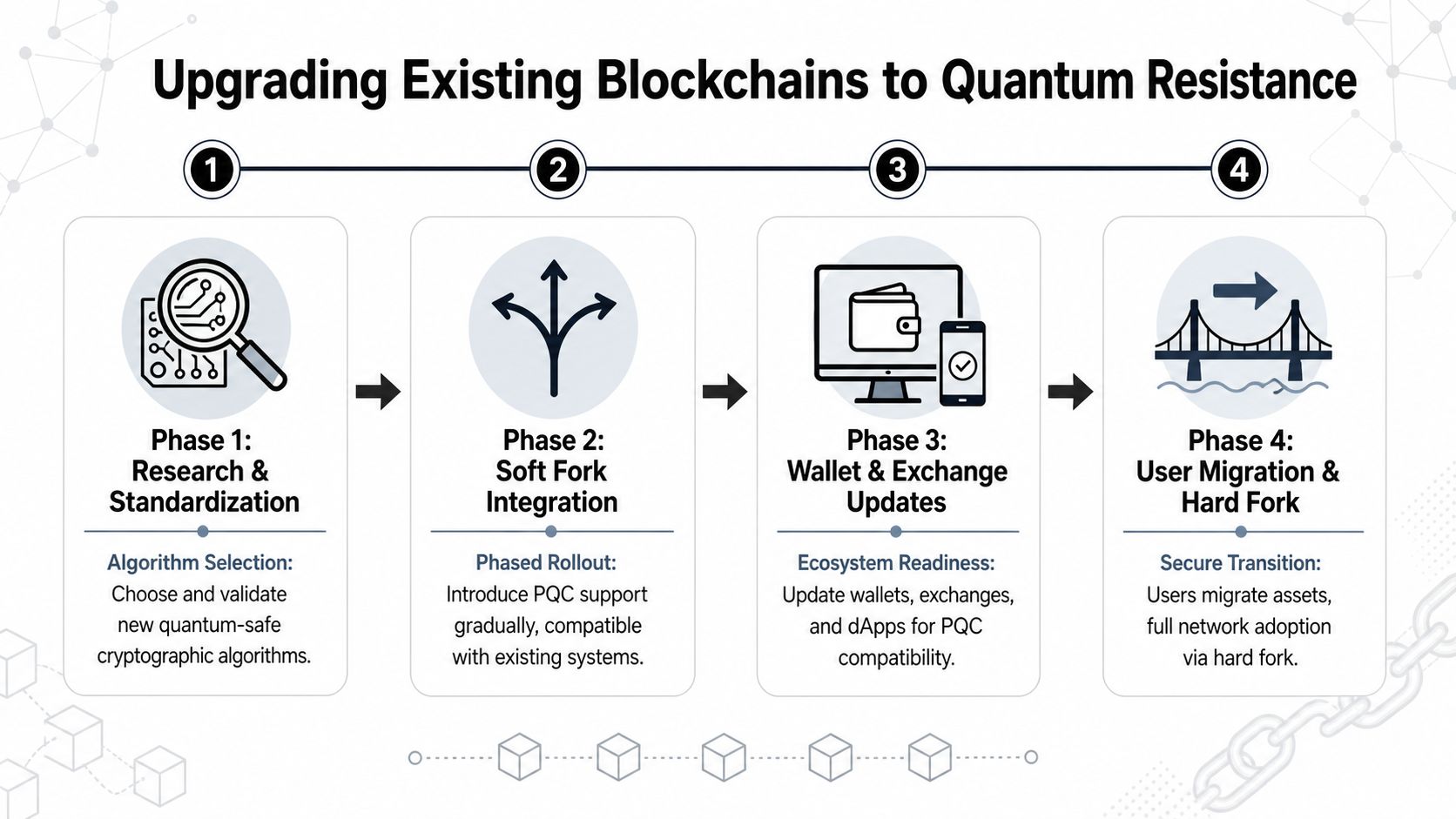
A major challenge is migrating existing blockchains like Bitcoin and Ethereum to post-quantum cryptography without a hard fork, while the immediate threat remains signature forgery once a public key is revealed. That makes interim tools like hybrid cryptography especially important for custodians and exchanges, as discussed in Nervos's analysis of blockchain quantum resistance.
That framing cuts through a lot of noise. The urgent question isn't "Will Bitcoin die?" A more pertinent question is much more operational: How do you move an enormous live system from one signature regime to another without losing funds, breaking wallets, or fragmenting the ecosystem?
Anyone who works in infrastructure will recognize the pattern. This kind of transition looks less like a silver-bullet upgrade and more like a staged enterprise migration. A useful analogy is a digital transformation roadmap, where the technology change is only one layer of the work. Governance, tooling, user behavior, and backward compatibility often dominate the schedule.
What a realistic migration path looks like
For legacy chains, the most plausible path is phased rather than dramatic.
Optional support first
New address types, account models, or transaction formats can introduce post-quantum signatures without forcing every participant to switch immediately.Hybrid periods next
Wallets and custody platforms may require both a classical signature and a post-quantum signature for sensitive flows. That reduces single-point dependence on aging cryptography.Ecosystem tooling catches up
Exchanges, hardware wallets, block explorers, DeFi front ends, and smart contract systems need time to support new formats reliably.Mandatory migration eventually
At some point, old exposed key patterns likely become unacceptable. That's where governance gets difficult.
Ethereum may have a more flexible path than Bitcoin because account abstraction can help wallets adopt new verification logic without requiring every change to be hard-coded into the simplest account model. That doesn't make migration easy. It only makes it more programmable.
Legacy chains don't fail because engineers lack cryptography. They fail if the migration path is too disruptive for users and infrastructure operators to follow safely.
This is why crypto-agility matters so much. A chain that can swap or layer cryptographic primitives with minimal disruption has a real advantage over one that treats signatures as a forever assumption.
What Quantum Resistance Means for You
If you're a user, trader, builder, or long-term investor, the quantum story matters less as abstract cryptography and more as wallet risk plus project quality.
For holders, one practical takeaway stands above the rest. Your security isn't only about seed phrases anymore. Over time, it will also be about whether your wallet software, custody provider, and preferred chains can migrate cleanly to stronger signature systems. If that sounds familiar, it should. The core principle behind not your keys not your coin still applies. Control over keys remains central. The difference is that the definition of a safe key setup may evolve as signature standards evolve.
A due diligence checklist for users and investors
When a project claims to be quantum-ready, don't stop at the headline.
- Check the cryptography story: Does the project name a real post-quantum approach such as hash-based or lattice-based signatures, or does it just say "quantum secure" with no implementation detail?
- Look for migration planning: If it's an established chain or application layer, does the team explain how existing users, wallets, and assets would move to new addresses or account models?
- Separate feature from system: A recovery vault, optional wallet mode, or one test transaction can be meaningful. It isn't the same thing as full network-wide protection.
- Examine dependency risk: If a protocol relies heavily on smart contracts, bridges, staking systems, or DeFi integrations, ask whether those layers are also part of the quantum security plan.
- Watch for usability trade-offs: Some post-quantum systems create larger signatures, more complex wallet flows, or state-management constraints. Security that users can't operate safely often fails in practice.
A final nuance matters for serious readers. Some signature designs are stateful, meaning the signer must carefully track usage to avoid security mistakes. Others are stateless, which tends to be easier for consumer wallets and exchange workflows. You don't need to become a cryptographer, but you should expect credible teams to discuss this kind of operational detail.
Security claims are cheap. Migration details are expensive. The teams that publish the second are usually more credible than the teams that only market the first.
None of this is personalized financial advice. It's a filter for evaluating whether a protocol is treating Y2Q as an engineering problem or a branding opportunity.
Conclusion The Road to a Quantum Secure Future
Quantum risk isn't a reason to panic about crypto tomorrow morning. It is a reason to stop treating blockchain cryptography as permanent.
The strongest takeaway is that the industry has already moved past the "is this real?" phase. We now have purpose-built chains such as QRL, live-mainnet experimentation from Algorand, limited but meaningful tooling from Solana, and growing attention on hybrid signatures, crypto-agility, and the painful migration path for legacy networks. Just as important, the discussion is broadening beyond key theft to include consensus randomness and validator security.
For developers, the priority is clear. Build systems that can change cryptographic primitives without breaking everything around them. For users, stay alert for wallet and address migration requirements. For investors, add quantum readiness to basic due diligence and ignore hand-wavy marketing.
A quantum resistant blockchain isn't one product category. It's becoming a design requirement for any network that expects to survive the next era of computing.
Coiner Blog covers the kind of crypto topics that matter before they become obvious to everyone else, from blockchain security and DeFi infrastructure to Layer 2s, tokenomics, AI and crypto, and emerging Web3 architecture. If you want more clear, grounded analysis like this, explore Coiner Blog.