
What Is DePIN and How Does It Actually Work

DePIN stands for Decentralized Physical Infrastructure Networks, a way of using crypto tokens and smart contracts to coordinate many independent operators who deploy real-world hardware such as wireless hotspots, storage drives, sensors, or GPUs. The sector grew from about 650 projects in 2022 to 1,170 in 2024, while reported revenue rose from about $100 million to $5 billion over the same period, according to Messari-linked DePIN market coverage.
The popular advice is to start with the token. That's usually backward. The more useful question is whether a network can get people to install, maintain, and operate useful hardware, then persuade customers to pay for the resulting service. The token is the coordination mechanism, not proof that the infrastructure works.
Table of Contents
- A New Way to Build Real-World Networks
- The Two Layers That Make DePIN Work
- How a DePIN Network Actually Runs
- Major Projects Putting DePIN Into Practice
- Why Token Charts and Real Revenue Disagree
- How to Evaluate a DePIN Project
- Where DePIN Goes From Here
A New Way to Build Real-World Networks
DePIN looks like a crypto category, but its first problem is logistical. Someone still has to buy a hotspot, mount an antenna, keep a storage machine online, install a dashcam, or supply a GPU. The blockchain can record rules and payments, but it can't place hardware in a building or repair a failed device.
In a conventional infrastructure model, one company funds the rollout. A telecom operator pays for towers and network equipment, a cloud provider builds data centers, and a mapping company operates vehicles or contracts data collection. Those firms carry the capital cost, control the assets, and recover expenses through subscriptions, usage fees, or commercial contracts.
A DePIN network distributes that deployment burden among independent operators. The protocol uses tokens, smart contracts, identity systems, and verification tools to reward contributors for supplying infrastructure. The core idea is described in research on DePIN's cryptoeconomic design, which distinguishes DePIN from ordinary decentralized software because the incentivized action is the provisioning of physical infrastructure itself.
Start with the physical contribution
A useful way to understand DePIN is to separate two questions:
- What does an operator provide? Wireless coverage, storage capacity, mapping data, compute, sensor readings, or another measurable resource.
- What does the protocol provide? A shared system for registering devices, checking contributions, calculating rewards, collecting payments, and changing network rules.
That structure can make deployment easier in places where a centralized provider sees insufficient commercial return. An individual operator may be willing to place equipment locally when a large company wouldn't justify the full rollout. The network can then aggregate many small contributions into a service that customers can access.
This doesn't mean DePIN automatically beats a centralized provider. Centralized operators usually offer simpler procurement, established service-level agreements, and direct accountability. DePIN introduces its own costs, including hardware onboarding, maintenance, variable rewards, uncertain token prices, and more complicated verification.
If you're still separating blockchain from physical infrastructure, this introduction to Web3 technology provides useful background on the decentralized coordination layer. The practical mental model is simple: operators supply the equipment, protocols measure the work, and customers create the economic reason to keep that equipment running.
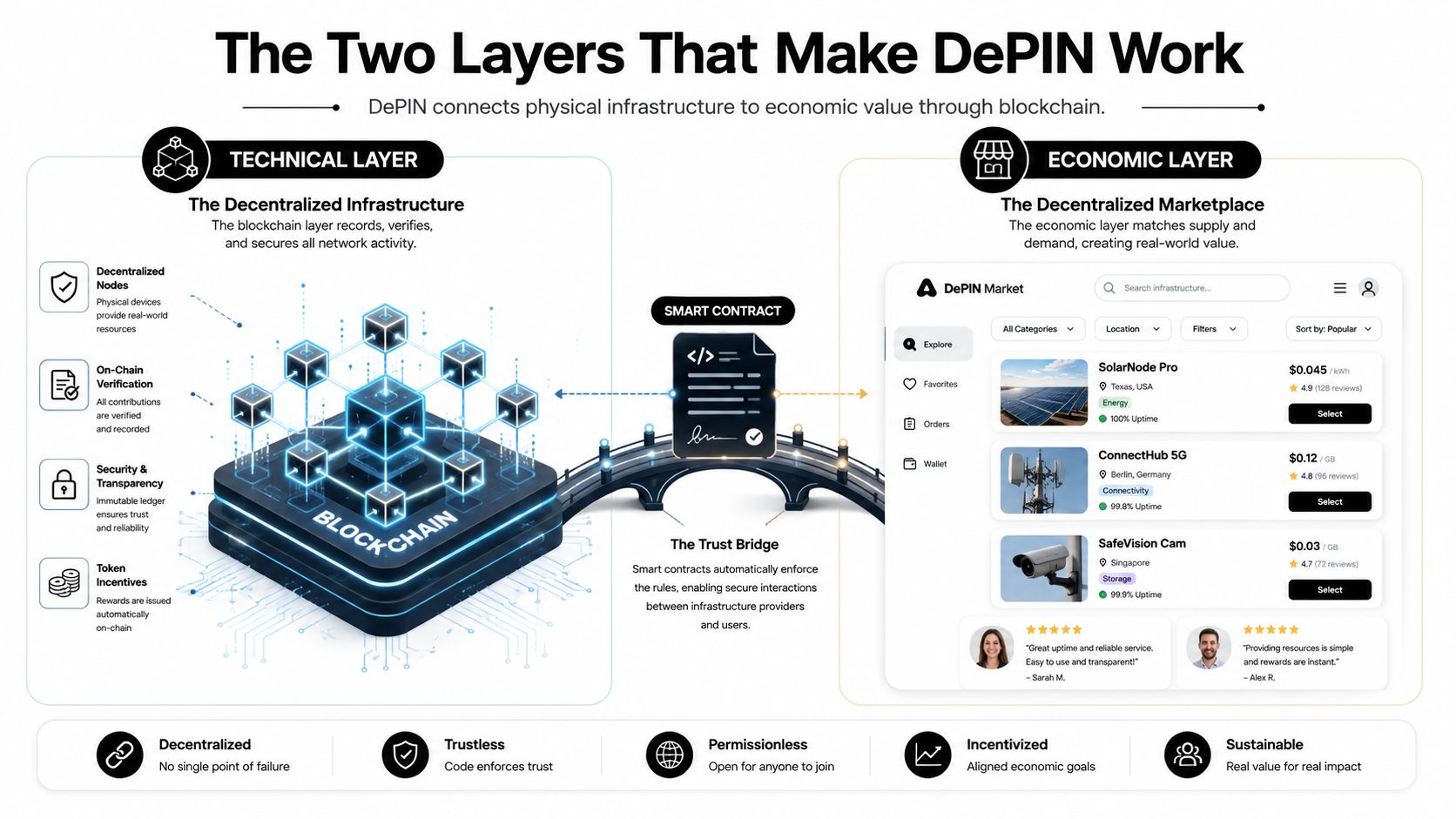
The Two Layers That Make DePIN Work
A DePIN network resembles an Airbnb-style marketplace for infrastructure. Airbnb coordinates hosts, guests, listings, identity, reviews, and payments without owning every property. DePIN coordinates infrastructure providers and users, but it must also prove that a physical device delivered what it claimed.
The first layer is technical. It usually includes a blockchain, smart contracts, device identity, off-chain data collection, and verification systems. Depending on the design, the blockchain may be an L1 or L2 settlement layer. Smart contracts define reward formulas, payment rules, and possible penalties. Identity registries connect a wallet or protocol identity to a device, while oracles and attestations bring evidence about real-world activity into the blockchain environment.
A modular architecture can include hardware abstraction, connectivity, a sequencer, data availability, long-term storage, off-chain computing, blockchain, identity, and governance, as outlined in the IoTeX DePIN architecture report. Not every project exposes these components as separate products, but the framework helps explain why a token alone isn't a functioning network.
The economic layer converts proof into incentives
The second layer handles value:
- Operator rewards: The protocol may issue tokens or distribute usage revenue to contributors whose work passes verification.
- Customer payments: Users pay for storage, coverage, compute, mapping, or data access through tokens, stablecoins, or internal credits.
- Demand monetization: Prepaid, non-transferable credits can be consumed when customers use the service. Examples in the literature include Helium Data Credits, Render Credits, and Hivemapper Map Credits.
- Market pricing: Tokens can trade on secondary markets, creating liquidity but also exposing operators and investors to speculation.
The connection between the layers matters. A wireless proof-of-coverage system exists because the protocol must prevent one person from creating many fake identities and claiming rewards for nonexistent coverage. A storage proof exists because customers need evidence that a provider still holds retrievable data. A compute verification system exists because a buyer needs more than a provider's claim that a job completed.
Solana's DePIN development guidance emphasizes that rewards should be tied directly to verified contribution and are often distributed in small, discrete amounts. The underlying principle is more important than the implementation: the economic layer only remains credible when real demand pays for the service that the technical layer verifies. Readers comparing distributed infrastructure models can also review next edge network architecture explained for adjacent context on edge systems.
How a DePIN Network Actually Runs
Take a wireless or mapping network. The operator experience begins outside the blockchain, with hardware, electricity, connectivity, and a physical location.
Step one, install and identify the device
An operator purchases compatible equipment, such as a hotspot or mapping dashcam. The device receives an identity or key, and the operator links that identity to a wallet before activating the hardware at a chosen location.
This registration step gives the protocol a way to associate activity with a particular device. It doesn't prove that the device is useful. It only creates the identity that later measurements and rewards will reference.
Step two, verify the service
The network then collects evidence. A wireless system might require one hotspot to communicate with another and submit timing or location information. A mapping network could verify that a dashcam supplied valid imagery from a plausible route. Storage networks use proofs that data remains available, while compute networks verify completed workloads.
The difficult engineering question is how to make false claims expensive and honest work measurable. Some systems use cryptographic challenges, consensus-based checks, trusted hardware, telemetry, or combinations of on-chain and off-chain verification.
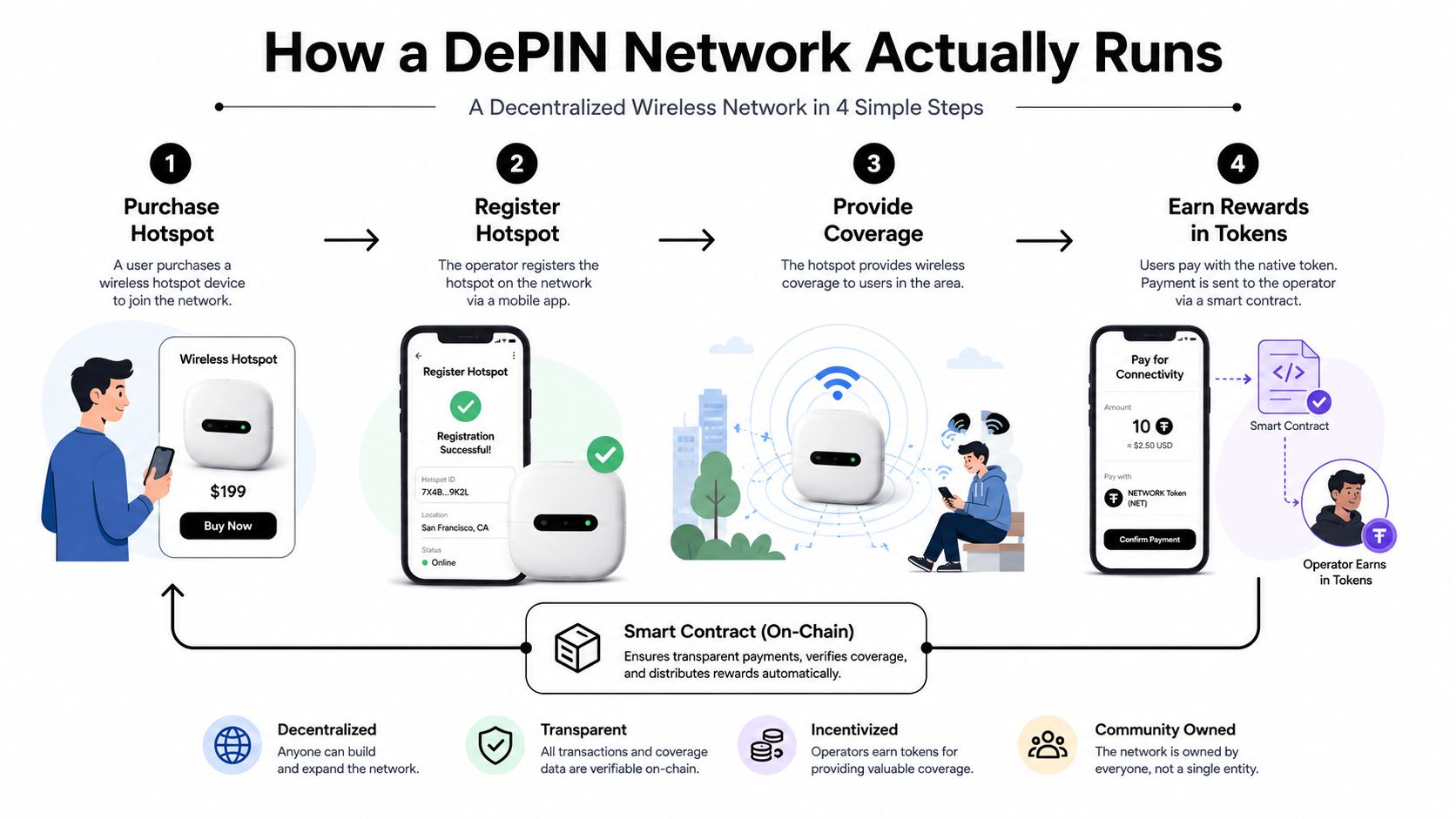
Step three, calculate and release rewards
After verification, the smart contract or reward engine calculates what the operator earned. The formula may consider uptime, location scarcity, data quality, successful jobs, or other network-specific measures. Rewards can come from token issuance, customer fees, or both.
Step four, collect customer revenue
When a customer pulls a map tile, queries a sensor, uses wireless coverage, stores a file, or submits a GPU job, the payment flows through the protocol's settlement system. The Frontiers research on DePIN demand monetization describes models using prepaid credits, native-token payments, and stablecoins, with burning or issuance rules that connect usage to token economics.
Step five, change the rules
Governance participants may vote on emission schedules, hardware eligibility, coverage priorities, collateral requirements, or verification parameters. Governance can improve the system, but it can also create risk if token holders change rules without understanding operator economics.
The same loop applies to storage, GPU compute, and sensor networks. The hardware and proof mechanism change, but the sequence remains: deploy, identify, verify, reward, serve customers, and adjust parameters. For readers interested in the development side, Web3 application development offers broader context on building applications around blockchain infrastructure.
Major Projects Putting DePIN Into Practice
The clearest DePIN examples fall into four infrastructure groups. Each group solves a different supply problem, serves a different customer, and accepts different trade-offs compared with centralized incumbents.
| Project | Category | Hardware Deployed | Primary Customer | Main Trade-off vs Incumbent |
|---|---|---|---|---|
| Filecoin | Storage | Storage servers and drives | Data owners and applications | Availability and retrieval coordination can be more complex than AWS S3 |
| Arweave | Storage | Storage providers | Archival and long-term data users | Permanent-storage economics and retrieval experience differ from conventional cloud |
| Helium | Wireless | Hotspots and wireless equipment | Mobile and connectivity users | Coverage quality, carrier integration, and operator incentives must remain aligned |
| Pollen Mobile | Wireless | Community-operated wireless hardware | Connectivity users and network partners | Smaller distributed supply can be harder to manage than a tower operator |
| Hivemapper | Mapping | Dashcams and contributor devices | Logistics, mapping, robotics, and automotive users | Data quality, geographic coverage, and freshness require continuous contributor activity |
| Geodnet | Mapping | GNSS reference stations | Positioning and geospatial users | Accuracy depends on station distribution and reliable data validation |
| Render | GPU compute | Contributor GPUs | Rendering and compute customers | Distributed capacity may be less predictable than a hyperscaler's managed fleet |
| Akash | GPU and cloud compute | Provider servers and GPUs | Developers and compute buyers | Workload scheduling, reliability, and support differ from centralized cloud platforms |
Storage changes who supplies disk space
Filecoin and Arweave turn storage capacity into a marketplace resource. Providers supply drives and server capacity, while customers pay to place data under the network's rules. The appeal is not merely that storage is distributed. Buyers may also value provider choice, geographic diversity, verifiable commitments, or a different cost structure.
The comparison with AWS S3 is practical rather than ideological. Centralized object storage offers familiar APIs, mature support, predictable billing, and a clear vendor relationship. DePIN storage asks customers to assess retrieval performance, provider reliability, deal terms, and the protocol's ability to enforce commitments.
Wireless distributes the last-mile contribution
Helium and Pollen Mobile use community-operated equipment to provide connectivity or wireless capacity. Operators accept hardware, placement, uptime, and maintenance responsibilities. The network must then show that a device provides useful coverage, not just that it is powered on.
The incumbent comparison includes tower and telecom infrastructure operators such as Crown Castle. A distributed model may reach locations or use cases that don't fit a centralized rollout, but wireless customers still care about coverage quality, roaming, latency, support, and regulatory compliance. Token rewards can't substitute for those requirements.
Mapping turns activity into a data product
Hivemapper uses dashcams and contributor activity to collect fresh geospatial information. Geodnet focuses on distributed positioning infrastructure through GNSS stations. Their customers can include logistics firms, mapping services, robotics companies, and automotive users that need timely or precise location data.
The bottleneck isn't adding more devices. It is maintaining consistent data quality, avoiding duplicated or manipulated submissions, and converting raw observations into a product customers can integrate.
Compute aggregates underused machines
Render coordinates distributed GPUs for rendering and related workloads. Akash provides a decentralized marketplace for compute capacity, including environments relevant to developers and AI workloads. Their alternatives include hyperscalers such as AWS and specialized providers such as Lambda Labs.
Centralized providers win on standardized environments and operational support. DePIN compute can be attractive when buyers value price discovery, additional capacity, or access to otherwise idle machines. The hard test is utilization. A large provider base that receives emissions but rarely completes paid work is supply, not a durable cloud business.
Why Token Charts and Real Revenue Disagree
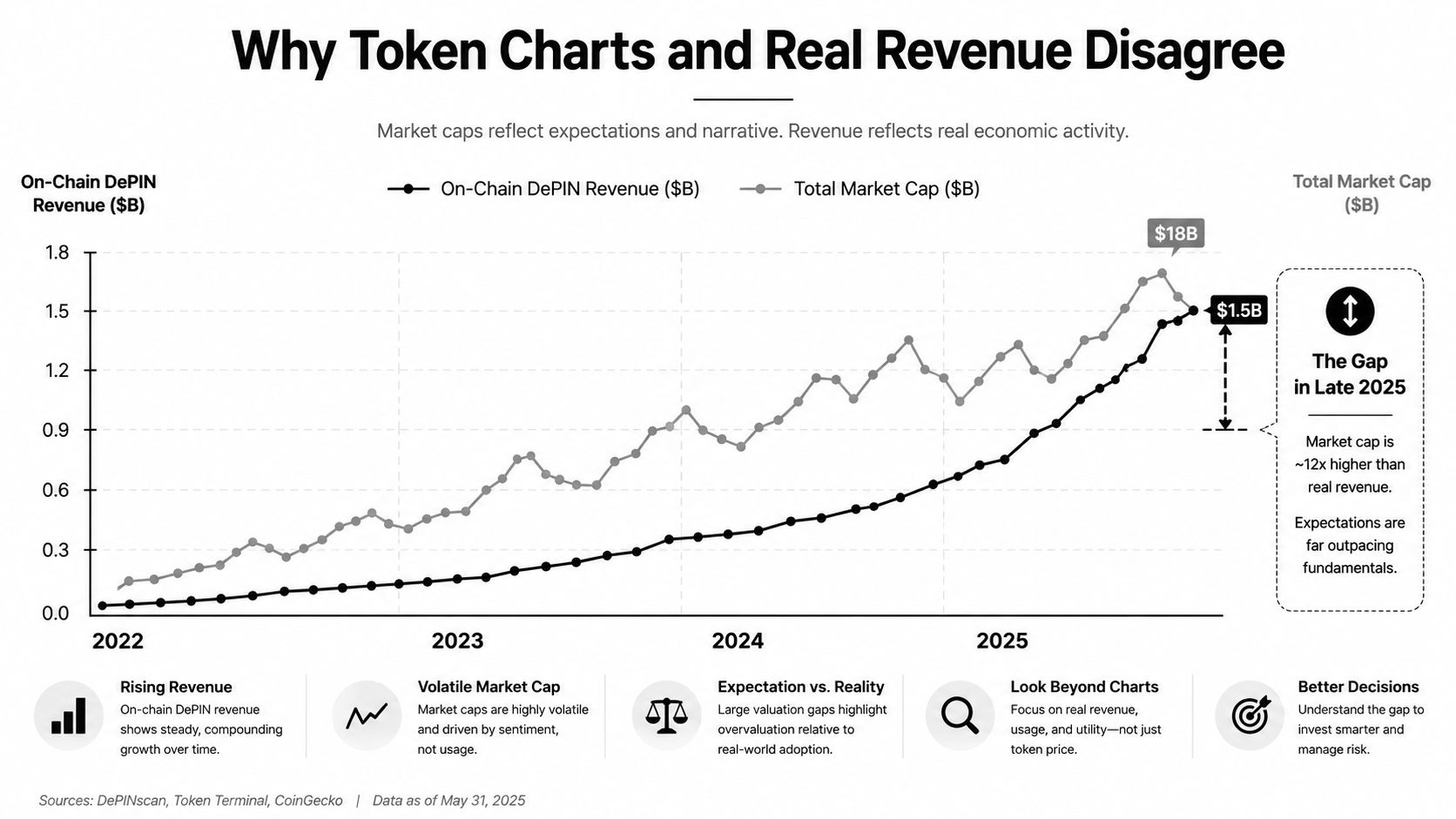
A DePIN token can fall while the underlying network keeps processing paid activity. That isn't a contradiction once you separate protocol revenue, token supply, and investor expectations.
The supplied market evidence shows the tension clearly. Sector coverage cited about $72 million in on-chain revenue in 2025, while the same reporting said DePIN projects raised nearly $1 billion that year and many older DePIN tokens remained 94% to 99% below their all-time highs. The figures don't prove that every network is weak. They show that infrastructure activity and token performance can move in different directions. See the reported DePIN sector analysis for that market context.
Three reasons the gap persists
First, not all protocol activity represents external enterprise demand. Some usage can come from other crypto protocols, internal ecosystem incentives, or subsidized experiments. Revenue has stronger signaling power when a customer outside the token economy pays repeatedly for a service.
Second, emissions can grow faster than fee capture. A network may distribute tokens generously to attract hardware before customers arrive. Operators then sell rewards to cover power, maintenance, or hardware costs, adding supply pressure even when the network's physical footprint expands.
Third, vesting and release schedules can create a persistent overhang. Early contributors, investors, and teams may receive tokens over time, and markets can discount future supply before those tokens enter circulation.
How to read the bullish and bearish cases
The bullish argument is that revenue is becoming more tangible across wireless, storage, mapping, and AI compute. Distributed infrastructure can aggregate capacity that centralized providers don't own, while token incentives help finance deployment before demand reaches full scale.
The bearish argument focuses on capital efficiency and valuation. A network can have real devices, real payments, and still fail to generate adequate returns after rewards, maintenance, and dilution. DePIN market-size estimates also vary widely because researchers count projects, devices, market capitalization, or revenue differently. That makes a headline valuation less useful than utilization, customer retention, fee composition, and net operator economics.
Tokenization can help connect physical assets with digital ownership, but this guide to crypto tokenization is a useful reminder that representing an asset on-chain doesn't automatically create demand for it. Participants should treat token charts as market expectations, not as a substitute for service-level evidence.
How to Evaluate a DePIN Project
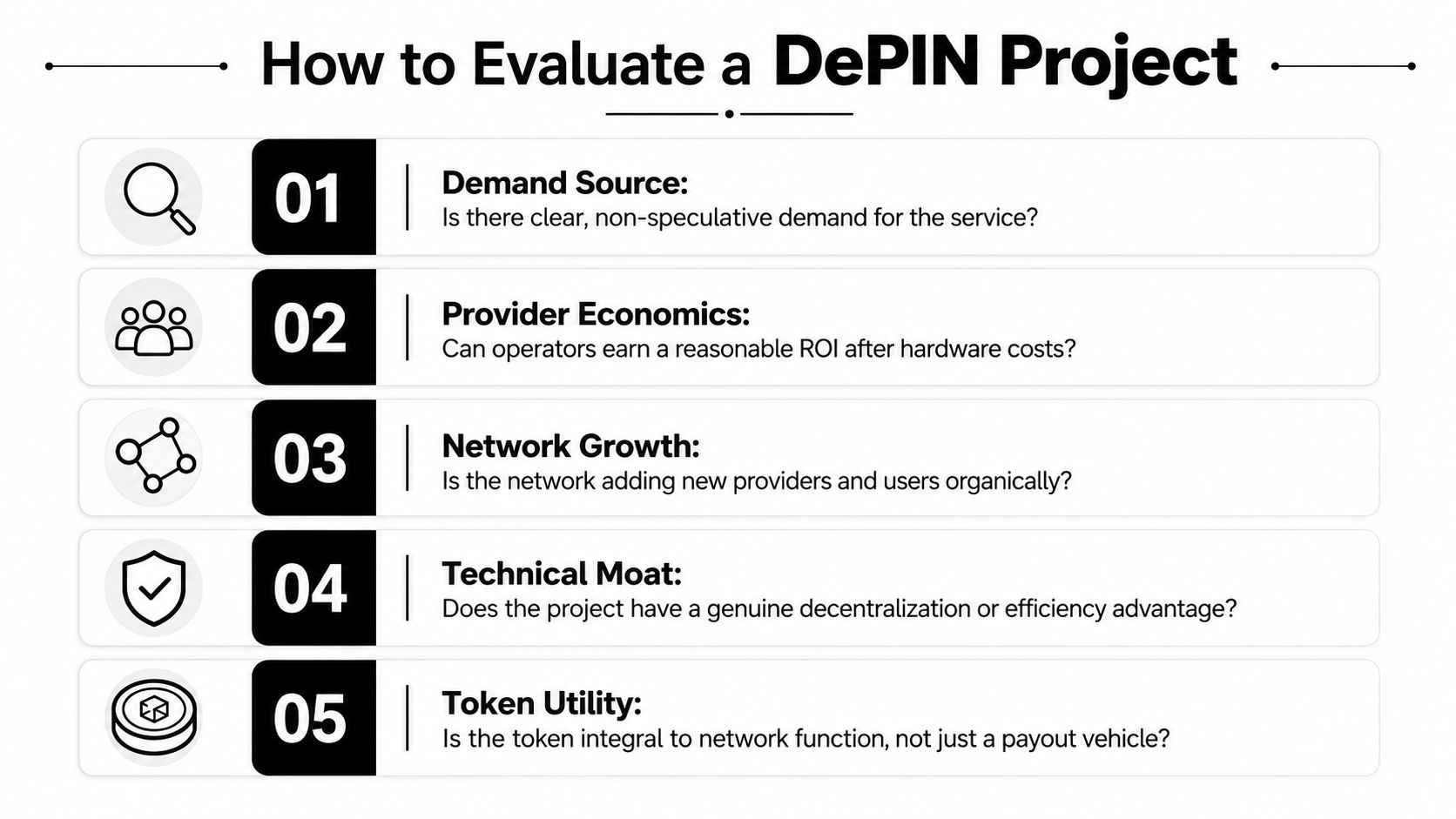
Before buying a token, deploying hardware, or staking collateral, evaluate the network like an infrastructure business. The token may be liquid, but the underlying equipment is usually illiquid, location-dependent, and exposed to operating costs.
Five filters for serious due diligence
Demand source: Identify who pays. Is revenue coming from external customers, or is most activity generated inside the protocol by people pursuing emissions? A network that can't name a clear buyer has a supply bootstrapping mechanism, not yet a proven business.
Hardware economics: List the purchase cost, power requirements, connectivity expense, maintenance burden, and expected useful life. A reward calculator that ignores depreciation or downtime gives an incomplete picture. Operators need to know whether revenue can cover costs without relying on a rising token price.
Tokenomics design: Read the emissions schedule, vesting terms, structure, and fee distribution. Separate rewards funded by customer payments from rewards funded by newly issued tokens. A token can have utility for settlement or access while still suffering from excessive supply growth.
Verification model: Examine the exact proof system. Wireless networks may use proof of coverage, storage networks use proof of storage or retrieval, and location networks may use device attestation or positioning evidence. Ask how an operator could fake activity, how the protocol detects that behavior, and who bears the loss when verification fails.
Governance and treasury control: Review who can change emissions, approve hardware, move treasury assets, or alter verification rules. Multisignature controls, signatory transparency, foundation structure, and legal entities matter because a decentralized interface can still depend on concentrated administrative power.
Operator rule: Treat projected rewards as variable revenue until customers, utilization, and fee flows demonstrate otherwise.
Red flags that deserve extra scrutiny
- No hardware evidence: Anonymous teams that announce infrastructure but can't show device shipments, installation data, or verifiable service deserve skepticism.
- Leverage-driven trading: If market activity centers on leverage rather than usage, token liquidity may say little about network health.
- Emission-only demand: A network whose users appear mainly to be future reward recipients may struggle when incentives decline.
- Unclear accountability: A protocol that cannot explain who handles outages, disputes, privacy issues, or regulatory obligations creates operational risk for both users and operators.
Coiner Blog publishes educational material on Bitcoin, Ethereum, DeFi, Web3 applications, tokenomics, and emerging blockchain systems. Its coverage can help readers build broader context, but no article removes the need to inspect a specific DePIN's contracts, economics, and legal terms.
Where DePIN Goes From Here
The most dramatic DePIN forecasts should be treated as scenarios, not established outcomes. One WEF-linked forecast cited in sector coverage projected that DePIN could reach $3.5 trillion by 2028, yet the verified market evidence is much smaller today. Separate reporting placed the sector at roughly $10 billion, with about $72 million in on-chain revenue in the prior year and more than 13 million devices involved in daily operations, while market estimates vary by methodology. That gap doesn't disprove the long-term thesis. It shows how much execution must occur before a large total-addressable-market narrative becomes recurring business revenue.
The sector already has measurable scale. DePIN Scan reported more than 10.3 million total devices across about 199 countries or regions as of July 14, 2025, while later coverage cited roughly 8.8 million active devices and more than 650 active projects by March 2026. Counts differ because trackers use different definitions, but both signals point to a substantial physical footprint rather than a purely conceptual market. The DePIN Scan network map is useful for checking how these measurements are presented.
Signals that matter more than headline forecasts
- Enterprise contracts: Look for repeat customers that pay for usable storage, compute, coverage, mapping, or sensor data.
- Fiat-denominated revenue: Token payments can be meaningful, but off-chain revenue reported in conventional currency makes demand easier to compare with incumbent infrastructure.
- Utilization and retention: Devices, nodes, and providers matter less than whether customers return and whether operators remain profitable after costs.
- Verification quality: More hardware won't fix weak proof systems. Better attestation, fraud detection, and service-level reporting could improve buyer confidence.
- AI and edge demand: GPU compute, edge inference, energy coordination, and sensor networks could expand the addressable use cases, but each category still needs measurable workloads.
| DePIN Category | Common Narrative or TAM Claim | Measurable 2025–2026 Metric | Self-Sustaining? |
|---|---|---|---|
| Wireless | Community coverage can challenge centralized telecom | Device counts and coverage activity are measurable, while paid usage remains the key test | Depends on recurring offload and coverage demand |
| Storage | Distributed providers can become an alternative to cloud storage | Storage capacity and protocol payments can be tracked on-chain | Requires reliable retrieval and durable customer contracts |
| Compute | Idle GPUs can serve AI and rendering demand | Paid jobs and protocol revenue provide the clearest evidence | Promising where utilization covers provider costs |
| Mapping and sensors | Distributed contributors can produce fresher, richer data | Device activity and data submissions are visible, but buyer quality standards matter | Still dependent on data customers and verification |
Wireless, storage, and compute have the clearest path to durable economics because customers already understand the services. Mapping and sensor networks may offer valuable data, but they must prove freshness, accuracy, privacy, and buyer willingness to pay. The gap between revenue and token performance could narrow if fee growth outpaces emissions and unlocks. It could widen if networks add hardware faster than they add customers.
Coiner Blog offers clear guides and balanced analysis on cryptocurrency, blockchain infrastructure, tokenomics, DeFi, Web3, and emerging areas such as AI and real-world asset tokenization. Visit Coiner Blog to follow practical crypto explainers that separate measurable adoption from token speculation and help you ask better questions before participating.