
The 10 Best AI Crypto Trading Bots of 2026 Reviewed

Automated trading already sits at the center of crypto execution. One market summary cited in 2023 said global cryptocurrency trading volume exceeded $94 trillion and bots executed over 70% of all trades. That's the clearest reason the search for the best AI crypto trading bots keeps growing. Automation isn't a side tool anymore. For many traders, it's the operating layer.
That doesn't mean every bot is good, or that "AI" means profitable. Most platforms still boil down to the same practical question: can this software help you execute a repeatable strategy better than you can do manually, after fees, slippage, and exchange friction? That's where most reviews get lazy. They list features, repeat marketing copy, and skip the parts that actually matter when real money is on the line.
This guide focuses on fit. Some bots are better for beginners who want presets and low-friction setup. Others are built for active traders, quant-minded users, or investors who care more about disciplined portfolio automation than signal chasing. If you're tracking the broader AI and Web3 convergence, Alpha Scala AI trading insights are also worth reading alongside platform reviews.
The crypto market still trades around the clock. DeFi, Layer 2 ecosystems, tokenized assets, and fast-moving altcoin rotations make manual execution harder every year. A good bot can help. A bad one can multiply mistakes faster than you can stop them.
Table of Contents
- 1. 3Commas
- 2. Cryptohopper
- 3. Bitsgap
- 4. Coinrule
- 5. Pionex US
- 6. Kryll.io
- 7. HaasOnline
- 8. Shrimpy
- 9. TradeSanta
- 10. Stoic AI by Cindicator
- Top 10 AI Crypto Trading Bots, Features & Performance
- Your Next Move in Automated Crypto Trading
1. 3Commas

3Commas remains one of the easiest platforms to recommend when someone wants both guided automation and room to grow. It isn't just a bot launcher. It's a full trading workspace with SmartTrade, DCA bots, Grid bots, paper trading, and an AI Assistant that helps users shape and backtest ideas without forcing them straight into code.
That mix matters. Beginners can start with templates and guardrails, while more active traders can fine-tune exits, trailing logic, and multi-target setups. In practice, that's the sweet spot for people who aren't full quants but still want more control than exchange-native bots usually allow.
Why 3Commas still works
3Commas is strongest when you treat it as a disciplined execution layer, not a shortcut to instant alpha. The AI-assisted setup is useful for translating strategy ideas into actual bot logic, but its edge comes from how much control it gives you over trade management.
A few strengths stand out:
- Balanced toolset: You get SmartTrade for manual and semi-automated execution, plus DCA and Grid bots for systematic entries and exits.
- Good learning runway: Paper trading and historical backtesting let you test logic before risking capital.
- Multi-exchange convenience: If you trade across several venues, one dashboard is much easier than juggling separate terminals.
- Useful for strategy building: If you're refining entries, practical trading strategy ideas pair well with 3Commas' rule and exit controls.
Practical rule: 3Commas works best for traders who already know what kind of market they want to trade. Trend, range, or accumulation. If you don't know that yet, AI prompts won't solve it for you.
The main trade-off is complexity. Advanced settings are good, but they also create more ways to overbuild weak systems. Legacy subscriptions can also create confusion if you're expecting newer AI features that sit behind updated plans.
2. Cryptohopper

Cryptohopper is one of the better options for traders who want a cloud bot that keeps running without local setup and gives them access to a strategy marketplace. Its appeal is simple: you can combine automation, copy-style discovery, paper testing, and portfolio management in one account.
That convenience is real. So is the risk. Marketplace-driven ecosystems often pull beginners toward shiny backtests and copied strategies they don't fully understand.
Best use case
Cryptohopper fits traders who want a cloud-first platform and like the idea of browsing strategies rather than building everything from scratch. The AI Strategy Designer is the key differentiator, but it's important to frame it correctly. AI here is strategy assistance and configuration support, not a guarantee that the platform will discover durable edge for you.
Kraken's guide makes that broader point well. It notes that AI bots analyze market data and execute strategies, but they aren't automatic profit machines. The same guide references a study that found Bitcoin movement prediction at 66% accuracy using machine learning, which is useful but far from enough to promise net profitability after costs.
- Cloud native setup: No VPS, no local machine, no uptime babysitting.
- Wide strategy access: Spot bots, market-making options, arbitrage tools, and a marketplace.
- Good testing stack: Paper trading and backtesting are there, which is essential before going live.
- Execution reality check: If you're copying marketplace systems, understand how slippage affects trading results before trusting headline returns.
Cryptohopper's weakness is feature gating. The more interesting AI functionality sits higher in the plan stack, and marketplace quality varies a lot. If you're disciplined, it's flexible. If you're easily swayed by top-performing screenshots, it can become expensive noise.
3. Bitsgap

Bitsgap has become a strong option for traders who want variety without moving into full scripting territory. The platform combines a unified trading terminal with several bot types, including Grid, DCA, LOOP, QFL, and futures-oriented COMBO setups, plus an AI Assistant that helps with launch and optimization.
This is a good fit for users who like structured automation but don't want to code every decision themselves. It also helps that Bitsgap supports a broad exchange mix, including several venues accessible to US-based users.
Where Bitsgap stands out
Bitsgap feels most useful in choppy crypto conditions where one bot type doesn't fit everything. Grid bots can work in ranges. DCA bots can suit accumulation. Futures tools can be useful for traders who already understand advanced trading strategies and market structure. Having those options in one interface is the platform's main practical value.
Its AI Assistant is best viewed as a setup accelerator. It can help you configure and tune, but you still need to know whether the pair and market regime make sense. That's especially true in weak macro conditions or a broad crypto bear market environment, where many bot presets look better in theory than they perform live.
Some traders want one bot that works in every regime. That's usually the wrong goal. Bitsgap is better when you switch tools based on the market instead of forcing one template to do everything.
A few trade-offs are worth noting:
- Deep bot menu: More flexibility than stripped-down beginner platforms.
- Cloud workflow: Easy to manage if you don't want self-hosting.
- Tiered limits: Advanced features and deeper backtesting sit on higher plans.
- Regional friction: Futures availability still depends on exchange access in your jurisdiction.
Bitsgap is one of the stronger middle-ground choices. It gives active traders room to adapt without pushing them all the way into developer mode.
4. Coinrule

Coinrule is for traders who think in conditions, not code. If your natural style is "if BTC breaks this level, then reduce exposure" or "if volume and momentum align, then scale in," Coinrule's no-code structure feels intuitive fast.
It doesn't try to be a hardcore quant platform. That's a good thing. Most retail traders don't need scripting power. They need rules that are clear enough to test, monitor, and adjust without turning the system into a mess.
Who should use Coinrule
Coinrule is strongest for non-coders who want to automate logic-driven strategies and keep full visibility into what the bot is doing. The combination of templates, marketplace options, AI optimizations, and higher-tier TradingView integration gives it a broad range without making it feel too technical.
Where traders get into trouble is overfitting. Rule builders make it easy to stack conditions until a backtest looks perfect. Then live performance falls apart because the system was tuned too closely to old price action rather than a durable market behavior.
- Clear automation style: The IF-THIS-THEN-THAT format is beginner-friendly and easy to audit.
- AI-assisted tuning: Useful when you want optimization help without surrendering control.
- Scalable plans: Works for hobbyist users and larger operators alike.
- Execution caution: Fast, complex rule chains still need careful testing before live deployment.
Coinrule is a better tool for process-driven traders than for adrenaline traders. If you like building and refining decision trees, it fits. If you want a plug-and-play black box, it probably won't.
5. Pionex US

Pionex US is the easiest recommendation on this list for someone who wants built-in bots inside the exchange and doesn't want to pay a separate bot subscription. That alone makes it attractive. The setup path is shorter, and there are fewer moving parts than with third-party automation suites.
The platform offers native Grid, DCA and related bot modes with AI-recommended presets you can copy and run. For a beginner, that's often enough to get started without fighting API configuration or a complicated dashboard.
Why exchange native bots matter
Exchange-native bots solve one of the biggest practical problems in automation. They reduce the distance between strategy and execution. Fewer external dependencies usually means fewer account-linking headaches and less friction when you just want to launch a simple system.
That said, simple doesn't mean harmless. Fast-turnover bot styles still depend heavily on market depth and trading costs. If you're using Grid or martingale-like logic, understanding crypto market liquidity matters more than the preset label suggests.
- Low friction: No separate software subscription for bot access.
- Beginner-friendly defaults: AI-recommended settings lower the setup barrier.
- Exchange-native execution: Good for users who want fewer integration points.
- Less customization: Not the right tool if you want highly specific multi-condition logic.
Pionex US is best for entry-level automation and convenience-first users. It isn't the most flexible platform here, but that's exactly why it works for many traders. Fewer knobs can mean fewer bad decisions.
6. Kryll.io

Kryll.io takes a different route into crypto automation. Instead of emphasizing pure bot subscriptions, it leans into a visual strategy builder, a marketplace for published systems, and a pay-as-you-use model. That's appealing if you don't want another monthly platform bill just to experiment.
The newer Kryll³ layer also pushes the platform toward AI and machine-learning-assisted research. In practice, that makes Kryll as much a strategy discovery environment as a trade execution tool.
Marketplace upside and downside
Kryll is interesting for traders who like to explore quantified ideas from other users and then adapt or rent them. The drag-and-drop design lowers the barrier for building logic, and the marketplace can surface approaches you might not have considered.
The catch is familiar. Marketplace quality varies. Some strategies are thoughtful. Others are just overfit templates wrapped in better presentation. That's not unique to Kryll, but the platform makes due diligence mandatory.
A rented strategy isn't a substitute for understanding what triggers entries, how it exits, and what kind of market usually breaks it.
Kryll makes the most sense for users who want flexibility in cost structure and enjoy research-driven experimentation. The KRL-based fee model won't suit everyone, and token-based platform economics add another variable to track. But for builders who like modular workflows, it has a real niche.
7. HaasOnline
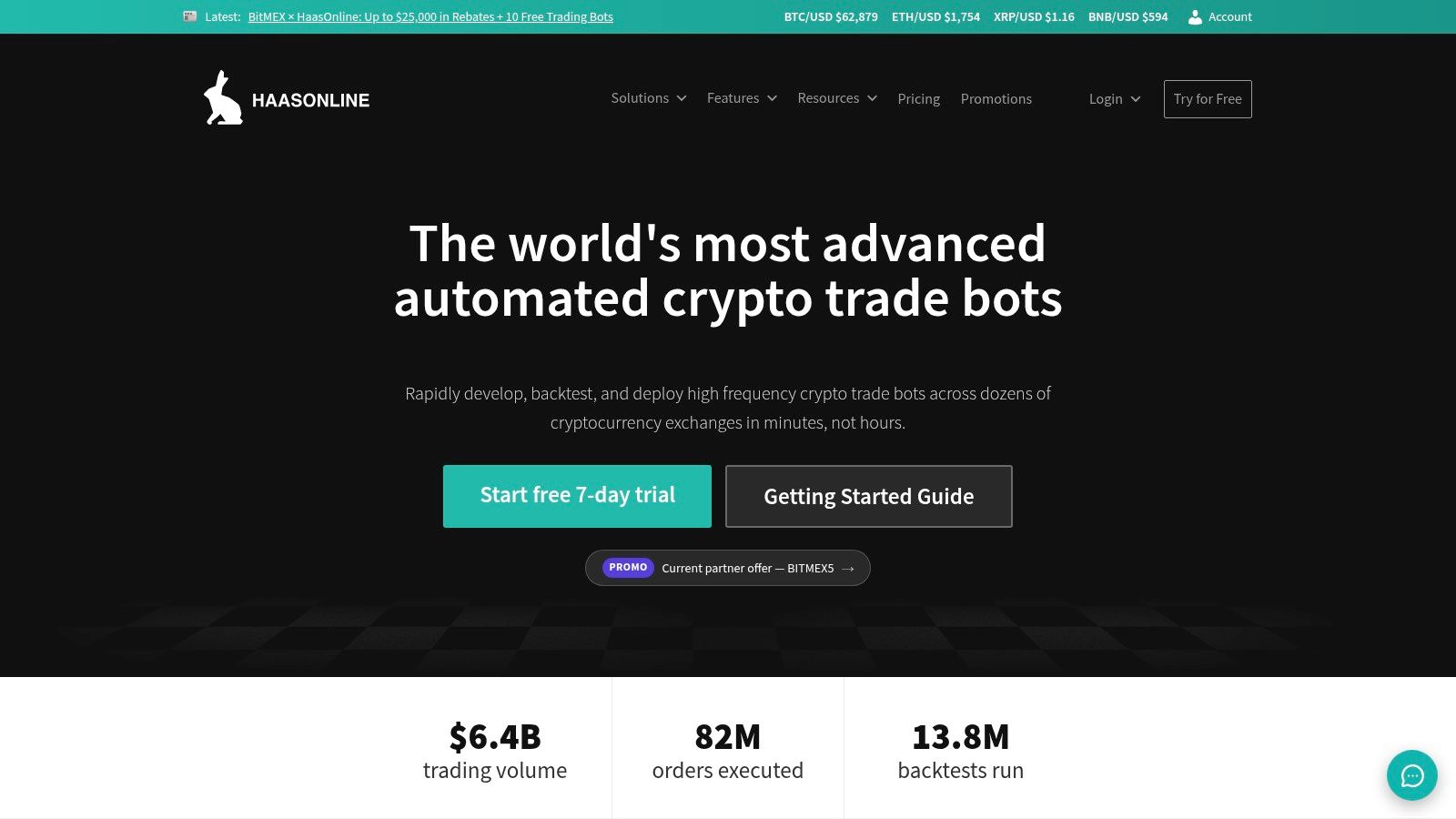
HaasOnline is for serious tinkerers, system builders, and traders who don't want a simplified interface deciding what "AI" should mean for them. It has long been one of the more advanced names in crypto automation, and that still shows in the product design.
You get a broad set of bot types, backtesting, paper trading, and a proprietary scripting environment through HaasScript. There are also cloud and self-hosted deployment paths, which matters if you care about operational control.
Why pros still like HaasOnline
HaasOnline is one of the few platforms here that still feels built for traders who think like developers. If you want custom logic, layered conditions, and full control over execution structure, it's a better fit than no-code tools.
That power comes with overhead. Setup takes longer. Testing takes longer. Maintenance takes longer. If you don't actually need custom scripting, you'll probably get more done on a simpler platform.
A few reasons advanced users still choose it:
- Custom logic depth: HaasScript gives power users room to build beyond template constraints.
- Deployment flexibility: Self-hosting appeals to traders who want tighter control over environment and keys.
- Broad bot coverage: Market making, arbitrage, grid, and other specialized workflows are available.
- Steep learning curve: This isn't a casual weekend setup for most users.
HaasOnline isn't one of the best AI crypto trading bots for beginners. It is one of the best options for users who care more about system design than convenience.
8. Shrimpy
Shrimpy belongs on this list even though it doesn't fit the standard "AI bot" mold. That's exactly why it's useful. Many people searching for the best AI crypto trading bots do not need active signal trading. They need disciplined portfolio automation.
Shrimpy focuses on indexing, rebalancing, DCA, and copy-style allocation management across connected exchanges. If your style is closer to long-term investing than short-term trading, that can be more valuable than another Grid bot.
Best for investors, not active traders
Shrimpy works best for investors who want to maintain target allocations without micromanaging every rebalance. It fits the user who cares about exposure, diversification, and staying systematic through market swings.
For beginners, that's often the healthier starting point. Instead of trying to outtrade every rotation, you can build an allocation framework and automate the maintenance of it. If that's your lane, this broader guide to investing in cryptocurrency for beginners complements Shrimpy's approach well.
- Portfolio-first design: Better for allocation discipline than tactical trading.
- Multi-exchange support: Helpful if your holdings are spread across venues.
- Lower complexity: Easier to manage than feature-heavy trading suites.
- Limited AI identity: The focus is rules-based portfolio management, not advanced predictive trading.
Shrimpy is a good reminder that automation doesn't have to mean constant trading. For many investors, less activity is the smarter system.
9. TradeSanta

TradeSanta keeps things simple. That's its advantage. If you want cloud-based Grid and DCA bots, quick setup, optional TradingView signals, and a copy strategy marketplace, it gets you there with less clutter than the larger platforms.
Not every trader needs a huge bot catalog. Sometimes a narrower tool with decent execution and cleaner onboarding is the better choice.
Where TradeSanta fits
TradeSanta is a solid budget-conscious pick for beginners who want to automate common crypto strategies without spending days configuring a workspace. Its DCA and Grid focus covers two of the most widely used retail bot styles, and the cloud model means you don't need to keep anything running locally.
The flip side is that it doesn't pretend to be a deep AI platform. Compared with larger suites, the strategy range is narrower and the edge comes more from convenience than from innovation.
Most beginners don't fail because they picked the wrong bot brand. They fail because they run a strategy they don't understand in a market that doesn't fit it.
TradeSanta makes sense if you want:
- Fast deployment: You can get from signup to live bot quickly.
- Core strategy coverage: DCA and Grid are enough for a lot of users.
- Marketplace assistance: Copy features help users who don't want to configure from scratch.
- Simple signal integration: TradingView support adds flexibility without major complexity.
TradeSanta is best treated as an entry-level execution tool. If you outgrow it, you'll know why. That's not a weakness. That's a good progression path.
10. Stoic AI by Cindicator
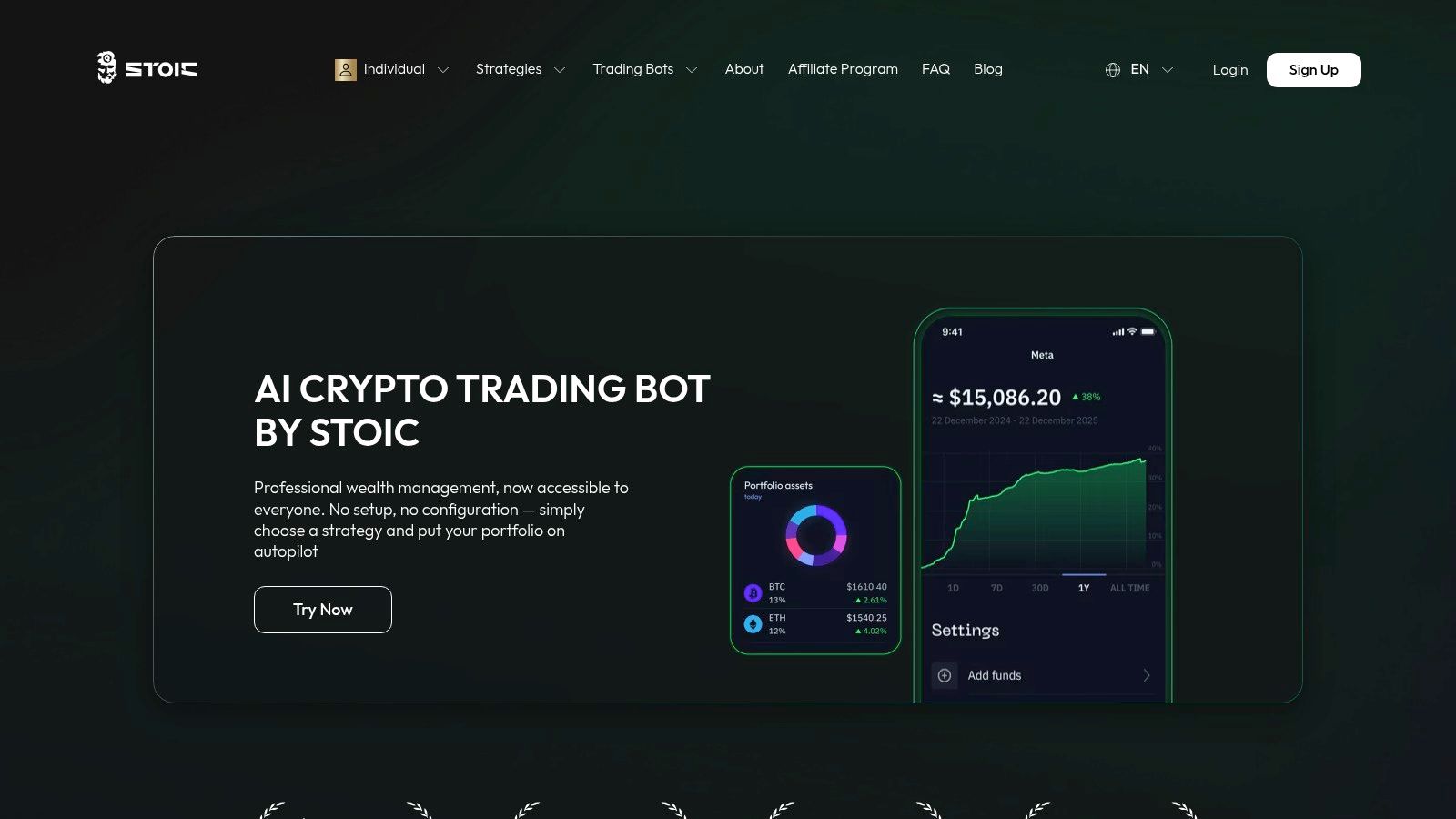
Stoic AI by Cindicator is the closest thing here to a managed "personal quant" product. Instead of asking you to build strategies, it asks you to choose from pre-built approaches and let the system handle execution through your exchange account via API.
That distinction matters. Stoic is for users who want automation without becoming bot operators themselves. Funds remain on the connected exchange, and the experience is designed around managed strategy selection rather than endless customization.
Best for hands off automation
Stoic's pitch is straightforward. Connect your exchange, choose a strategy, and let the system run. For investors and busy professionals, that's appealing. It removes much of the setup burden that comes with rule builders and bot dashboards.
The trade-off is control. If you enjoy adjusting triggers, swapping conditions, or designing your own systems, Stoic will feel restrictive. If you want a hands-off programmatic approach, that same limitation becomes a benefit.
This category is also where software trust matters most. The ecosystem is expanding into more open-source agents and API-based execution tools, and that makes bot security a practical concern, not a footnote. A useful high-level reference is this discussion of AI trading agent security and execution risk, especially around API permissions and operational failure modes.
Stoic is one of the better fits for investors who want automation to feel managed rather than assembled. Just make sure that's the experience you want. Convenience is valuable, but only if you can accept giving up DIY control.
Top 10 AI Crypto Trading Bots, Features & Performance
| Platform | Core Features | UX & Quality ★ | Value / Pricing 💰 | Audience & USP 👥✨🏆 |
|---|---|---|---|---|
| 3Commas | AI Assistant, DCA/Grid/SmartTrade, multi-exchange, backtests | ★★★★☆ | 💰 Tiered subscriptions; AI on newer plans | 👥 Beginners → Pros; ✨ human-in-loop AI + SmartTrade; 🏆 balanced UX & pro tools |
| Cryptohopper | Cloud bots (spot/MM/arbitrage), AI Strategy Designer, copy marketplace | ★★★★ | 💰 Tiered, core AI on top plan | 👥 24/7 cloud users; ✨ social/copy marketplace; 🏆 cloud-native convenience |
| Bitsgap | Unified terminal, DCA/Grid/LOOP/QFL/futures COMBO, AI Assistant, 17+ exchanges | ★★★★ | 💰 Mid-high; advanced gated to top tiers | 👥 Multi-exchange traders (US-friendly); ✨ wide bot variety & US exchange support |
| Coinrule | No-code IF-THIS-THEN builder, AI Optimizations, Agentic Mode, templates | ★★★★ | 💰 Scales from hobbyist → Fund servers | 👥 Non-coders → Institutions; ✨ Agentic AI + no-code scaling; 🏆 easy rule automation |
| Pionex US | Exchange-native Grid/DCA/futures bots with AI-recommended presets | ★★★★ | 💰 Low cost, no separate bot subscriptions | 👥 Beginners wanting low-friction setup; ✨ copyable AI presets; 🏆 cheapest native bots |
| Kryll.io | Drag-and-drop editor, marketplace, unlimited backtests, pay-per-use KRL fees | ★★★☆ | 💰 Pay-as-you-use (KRL token model) | 👥 Strategy publishers & renters; ✨ marketplace + AI research layers |
| HaasOnline | HaasScript scripting, 11+ bot types, self-host or cloud, enterprise options | ★★★★☆ | 💰 Premium for pro/enterprise users | 👥 Quants & power users; ✨ custom scripting & flexible deployment; 🏆 highly extensible |
| Shrimpy | Indexing, smart/time/threshold rebalancing, DCA, social/copy analytics | ★★★★ | 💰 Good value for portfolio automation | 👥 Long-term, risk-aware investors; ✨ hands-off portfolio rebalancing |
| TradeSanta | Cloud Grid & DCA bots, TradingView signals, copy marketplace, mobile apps | ★★★☆ | 💰 Budget-friendly tiers | 👥 Beginners on a budget; ✨ low-friction Grid/DCA execution |
| Stoic AI (Cindicator) | Managed AI "Meta" strategies combining 200+ sub-strategies, exchange-API execution | ★★★★ | 💰 Managed service model (fee-based) | 👥 Hands-off investors; ✨ fully managed AI quant strategies; 🏆 simple connect-and-run |
Your Next Move in Automated Crypto Trading
The best AI crypto trading bots aren't the ones with the loudest landing pages. They're the ones that fit your actual operating style, your risk tolerance, and your willingness to monitor what the software is doing. That's the part too many traders skip. They compare feature lists, ignore execution details, then wonder why live results don't resemble backtests.
The market for these tools is expanding fast. One market research source says the global crypto trading bot market was valued at USD 47.43 billion in 2025 and is projected to reach USD 200.1 billion by 2035, implying a 14% CAGR. That growth makes sense. AI plus crypto is now part of the broader Web3 tooling stack, alongside DeFi automation, smart contract analytics, Layer 2 execution environments, and tokenomics-driven strategy design.
But adoption doesn't remove the core trading problem. A bot can automate discipline. It can't fix a bad thesis. It can't rescue a strategy that ignores fees, poor liquidity, slippage, or weak market structure. That's why the right way to choose among the best AI crypto trading bots is by user type.
If you're a beginner, start with low-friction platforms like Pionex US, TradeSanta, or 3Commas in paper mode. Focus on one simple setup. A basic Grid or DCA system on a liquid pair is easier to evaluate than a complicated multi-condition machine that you barely understand.
If you're a pro or serious active trader, platforms like HaasOnline, Bitsgap, Coinrule, and 3Commas give you more room to shape execution. That's useful, but only if you test rigorously. Backtesting is where many traders fool themselves. They optimize too many variables, tune rules to past noise, and assume the future will cooperate. It won't. Better testing means fewer parameters, tougher assumptions, and a willingness to reject strategies that only look good on perfect historical slices.
If you're more of an investor than a trader, Shrimpy and Stoic sit in a different category. They help automate portfolio behavior and managed execution rather than encouraging constant tactical decisions. In many cases, that's the healthier approach. Constant activity feels productive, but it often increases cost and stress without improving outcomes.
Security deserves the same weight as strategy. Treat every bot as software risk first, trading tool second. Use trade-only API keys when possible. Keep withdrawal permissions off. Limit exchange balances allocated to automation. Review bot activity regularly. If a platform makes permission scopes unclear, that's a real warning sign.
One final point matters more than any ranking. Start smaller than your confidence says you should. Run one strategy. Watch fills, fees, and behavior across different market conditions. Then scale only after the bot proves it can behave the way you expected. That's how automated crypto trading becomes useful instead of expensive.
If you're also planning around reporting and portfolio cleanup, it's worth taking time to understand crypto tax rules before your automation creates a bookkeeping mess.
If you want more practical crypto guides that cut through hype, follow Coiner Blog. The site covers crypto trading, DeFi, Web3, tokenomics, Layer 2 trends, NFTs, and blockchain analysis with a balanced focus on opportunity, risk, and what works in live markets.