
Bitcoin Halving Explained: Your 2026 Investor’s Guide

Bitcoin halving is a pre-programmed event in Bitcoin's code that cuts the reward for mining new blocks in half, roughly every four years, to control issuance and keep total supply capped at 21 million BTC. The most recent halving happened on April 20, 2024, when the block reward dropped from 6.25 BTC to 3.125 BTC.
That's the simple version. The more important version is that halving isn't just a scarcity headline for traders. It's the mechanism that shapes Bitcoin's tokenomics, miner incentives, and long-term security model across the broader Web3 economy.
Most guides stop at “less new supply could mean higher prices.” That's useful, but incomplete. The full story is what happens after the reward cut, when miners have to secure the same network with a much smaller subsidy, and Bitcoin moves one step closer to a future where transaction fees matter far more than they do today.
Table of Contents
- Why the Bitcoin Halving Is Crypto's Most Important Event
- What Exactly Is a Bitcoin Halving
- A Historical Timeline of Past Halvings
- The Halving's Ripple Effect on Bitcoin's Price
- Miner Economics and Network Security Post-Halving
- Beyond Price Speculation Practical Implications
- Frequently Asked Questions About the Bitcoin Halving
Why the Bitcoin Halving Is Crypto's Most Important Event
Roughly every four years, Bitcoin cuts the number of new coins issued to miners in half. Few major financial systems reduce new supply on a schedule that anyone can inspect in advance, and that is a big reason the halving sits at the center of Bitcoin's story.
The event matters for more than scarcity headlines. A halving is one of the clearest moments when Bitcoin's monetary policy, miner economics, and network security all collide at once. The issuance rule is public, the timing is predictable within Bitcoin's block schedule, and the consequences reach far beyond traders watching the price chart.
Bitcoin's monetary rule is visible years ahead
Bitcoin works more like a machine with a preset issuance curve than a currency managed by a committee. The protocol reduces the block subsidy at fixed intervals, so participants can prepare for the next drop long before it arrives. That level of transparency is rare in finance and even rare across crypto, where token supply often depends on governance votes, treasury decisions, or changing incentive programs.
That predictability turns each halving into a reference point. Investors watch it because new supply slows. Miners watch it because revenue from newly issued BTC drops overnight. Developers and analysts watch it because the event tests whether Bitcoin can keep funding security as block subsidies shrink over time.
Bitcoin halving puts Bitcoin's design under live market pressure. The code stays the same, but the economics around it must adapt.
Why it matters beyond Bitcoin holders
For those interested in the broader crypto market, the halving is significant because Bitcoin remains the benchmark asset for sentiment, liquidity, and risk appetite. When Bitcoin's supply schedule tightens, it often shapes how capital is priced across the rest of the field, from large-cap tokens to newer sectors competing for attention.
It also sharpens a question many explainers skip. Bitcoin's long-run security model cannot rely on large block subsidies forever. Each halving increases the pressure on miners, especially high-cost operators, and pushes the network one step closer to a future where transaction fees need to carry more of the security budget.
That is why the halving is not just a scarcity event. It is also a recurring stress test for Bitcoin's business model.
The scarcity narrative makes more sense once you understand Bitcoin's starting point and why its rules were set this way in the first place, beginning with the Bitcoin genesis block. For long-term observers, the deeper question is not only whether halvings influence price. It is whether Bitcoin can keep attracting enough transaction demand, and enough fee revenue, to support a secure network as newly issued coins keep declining.
What Exactly Is a Bitcoin Halving
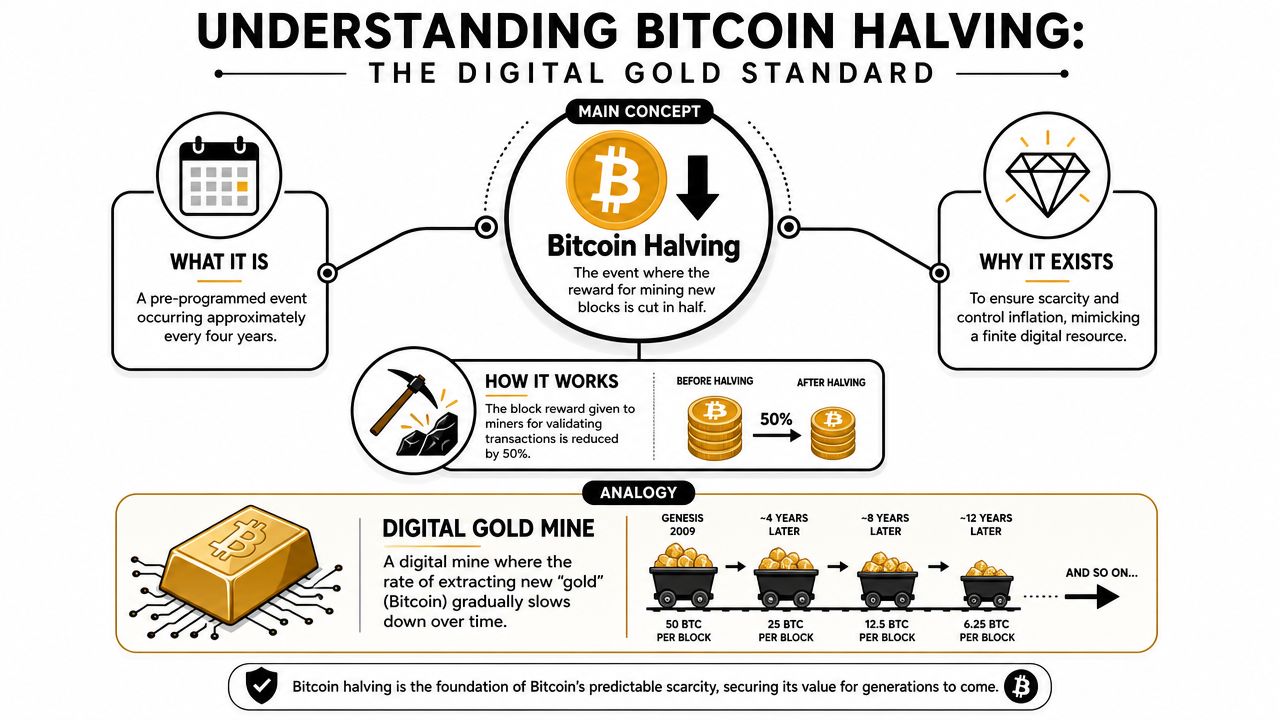
Every 210,000 blocks, Bitcoin cuts the number of new coins created in each block by 50 percent. That rule is built into the protocol itself, and the Bitcoin white paper explains the broader design of a system where new issuance follows a predefined schedule rather than a central bank's discretion.
The latest halving occurred on April 20, 2024, at block height 840,000. At that point, the block subsidy dropped from 6.25 BTC to 3.125 BTC.
The easiest way to understand it
Bitcoin's issuance works like a digital resource system with a pre-programmed extraction schedule. Early on, more new BTC enters circulation through mining. Then, at fixed intervals, that flow slows down automatically.
No company sets a new rate. No committee votes on a policy change. The software applies the rule on its own.
That framework helps clear up a common confusion, because people often mix together three separate parts of Bitcoin's system:
- Mining new Bitcoin: the process that releases new coins into circulation
- Validating transactions: the work miners do to assemble blocks and secure the chain
- Owning Bitcoin: the BTC already sitting in your wallet
A halving affects the first item directly. It leaves the third untouched.
What gets cut and what does not
The halving reduces only the subsidy attached to a newly mined block. It does not reduce the amount of BTC already in circulation, and it does not cut the balance in anyone's wallet.
What changes is the pace of issuance.
That distinction matters because the word "halving" can sound harsher than the mechanism really is. Existing holders keep the same number of coins. Miners receive fewer newly created coins for the same basic job of producing valid blocks.
Here's a short visual explainer before the next layer of detail:
Why this mechanism matters
Bitcoin's fixed cap of 21 million BTC only means something because the issuance rate keeps slowing on a published schedule. Halvings are the mechanism that enforces that slowdown.
They also create an economic squeeze that many simple explainers skip. After each halving, miners must cover electricity, hardware, and operating costs while earning half as much new BTC per block. If Bitcoin's price, transaction fees, or mining efficiency do not rise enough to offset that cut, higher-cost miners come under pressure and some are forced out.
That is why a halving is more than a scarcity story. It is also a test of whether Bitcoin can keep paying for its own security with a smaller subsidy.
Over the long run, that pressure points toward a larger transition. Newly issued coins are meant to become a smaller share of miner revenue over time, while transaction fees carry more of the network's security budget. The timeline behind that shift becomes clearer when you look at when all Bitcoins will be mined.
Practical rule: Halving is a scheduled monetary policy built into Bitcoin's code. It reduces new issuance, leaves existing holdings unchanged, and increases the importance of miner profitability and fee revenue over time.
A Historical Timeline of Past Halvings
Every 210,000 blocks, Bitcoin cuts the number of new coins paid to miners in half. That schedule has now repeated four times, at the same programmed interval, across very different market conditions. For a protocol that has no central bank and no policy committee, that consistency matters.
A useful way to read halving history is to track two clocks at once. One clock measures issuance. The block reward keeps stepping down on schedule. The other measures miner pressure. Each halving lowers the subsidy that pays miners to secure the chain, which slowly pushes Bitcoin toward a system where transaction fees have to carry more of that burden.
Bitcoin halving history at a glance
| Event | Date | Block Height | New Block Reward (BTC) |
|---|---|---|---|
| First Halving | November 2012 | 210,000 | 25 |
| Second Halving | July 2016 | 420,000 | 12.5 |
| Third Halving | May 2020 | 630,000 | 6.25 |
| Fourth Halving | April 20, 2024 | 840,000 | 3.125 |
These dates and block heights are documented in Bitcoin's own issuance schedule and protocol history, which the Bitcoin Wiki halving page summarizes clearly.
The pattern is simple. The reward starts high to distribute coins and attract miners in Bitcoin's early years. Then it keeps shrinking. A factory with the same machines but half the output every few years would need either higher prices, lower costs, or a new revenue stream to stay profitable. Miners face the same arithmetic after every halving.
How each halving changed Bitcoin's role
The 2012 halving was the first real test of whether Bitcoin's monetary policy would function as advertised. Until then, the 50 BTC block reward was the default setting of a young network. Cutting it to 25 BTC turned Bitcoin's scarcity model from theory into operating history.
The 2016 halving happened in a larger and more liquid market. By then, traders were already watching the event as a known supply reduction, and miners were operating in a more competitive industry. The halving no longer looked like a one-time novelty. It looked like recurring monetary policy.
The 2020 halving arrived after mining had become far more industrial. Large operators, specialized ASIC fleets, and tighter margins made the reward cut more than a headline event. It was a direct profitability test. That matters for anyone trying to understand why Bitcoin keeps rising in certain market cycles, because the halving changes both new supply and the economics of the entities producing that supply.
The 2024 halving pushed that pressure further. The reward fell to 3.125 BTC per block, which means miners now rely even more on efficient hardware, cheap power, treasury management, and periods of strong fee activity. It also sharpened a long-term question that price-only explainers often skip. As subsidies keep shrinking, can transaction fees provide enough revenue to support the level of security the network needs?
That question will take years to answer, but the historical timeline already shows the direction of travel. Each halving reduces Bitcoin's dependence on new issuance and increases the importance of fees, miner efficiency, and market structure. For readers thinking beyond the next cycle, that is the fundamental backdrop behind any future bitcoin value outlook.
The Halving's Ripple Effect on Bitcoin's Price
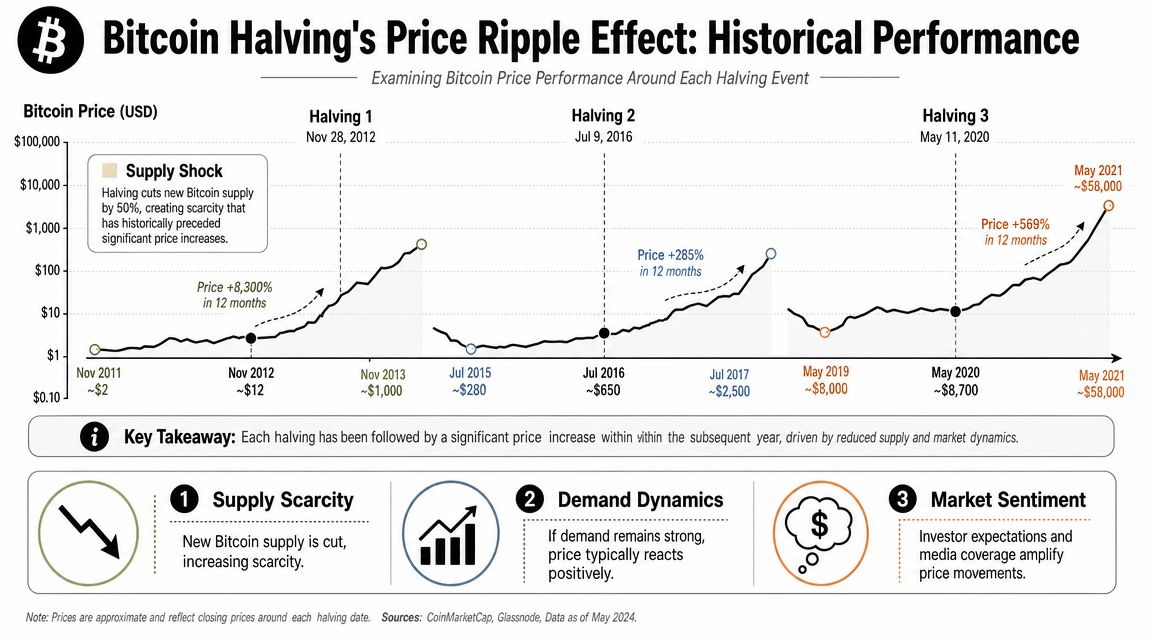
The price conversation starts with one idea: a halving is a supply shock. According to CoinGecko's Bitcoin halving page, the April 2024 halving reduced gross new issuance from about 900 BTC per day to about 450 BTC per day, making newly issued Bitcoin mechanically scarcer.
That's why the event gets so much attention. If demand stays steady or grows while new supply falls, investors expect tighter market conditions. But “expect” is the key word. Halving can shape conditions without guaranteeing a straight-line price response.
Why investors call it a supply shock
Miners are one of the main natural sources of new Bitcoin entering the market. When their fresh issuance is cut, the flow of newly created BTC available to be sold also drops.
That doesn't mean price must rise immediately. Markets also react to liquidity, macro conditions, regulation, sentiment, and how much of the halving was already anticipated. Still, the mechanical change is real. Fewer new coins are being produced each day after the halving than before it.
A useful way to think about it:
- Scarcity can improve: New supply falls on schedule.
- Demand can vary: Buyers may become more aggressive, less aggressive, or opt to wait.
- Timing stays messy: Markets often move before, during, and after major events in ways that don't fit clean narratives.
Scarcity models help but they don't decide price alone
Models like Stock-to-Flow became popular because they tried to convert Bitcoin's scarcity into a valuation framework. The intuition is understandable. If an asset becomes harder to produce, people may assign greater value to it.
But no model gets the final word. Bitcoin doesn't trade in a vacuum. It trades inside a larger financial environment that includes risk cycles, institutional positioning, ETF flows, liquidity conditions, and competition for attention from other sectors such as DeFi, tokenized real-world assets, and AI-linked crypto plays.
If you're thinking longer term, a more grounded approach is to study the supply side while also reading broader scenario work such as this future Bitcoin value outlook, then compare those narratives with market structure rather than treating any forecast as destiny.
For a shorter-term lens, it also helps to understand why Bitcoin is rising in a given period, because halving is only one piece of the puzzle.
Miner Economics and Network Security Post-Halving
After the 2024 halving, the base reward miners receive for adding a block fell from 6.25 BTC to 3.125 BTC. For miners, that is not a narrative shift. It is an overnight revenue cut.
Mining works like a commodity business with unusually fast feedback. A miner spends money on electricity, machines, cooling, repairs, and financing, then earns revenue from two sources: the block subsidy and transaction fees. The subsidy gets cut on a schedule. Power bills do not. Chainalysis explains this clearly in its Bitcoin halving 2024 analysis: if bitcoin's price and fee income do not rise enough to offset the reduced subsidy, less efficient miners can be pushed out.

The profitability squeeze starts at once
A halving is like a factory being told that every unit it sells will now bring in half as much revenue, while rent and energy stay the same. The factory does not get months to adjust. It has to deal with the new math immediately.
That is why the post-halving period often acts as a filter. Newer ASICs with better energy efficiency can stay online longer. Older machines, especially in regions with higher power costs, can move from profitable to marginal very quickly. Operators with weak balance sheets also face a harder choice. Sell more BTC, shut off inefficient rigs, or wait and hope fee spikes or price appreciation improve margins.
Three pressure points matter most:
- Power costs: Cheap, stable electricity creates room to survive thinner margins.
- Hardware quality: Modern ASICs produce more hash rate per unit of energy.
- Fee income: Fees become more important each cycle because the subsidy keeps shrinking.
Survival favors industrial-scale discipline
The miners that tend to hold up best after a halving usually treat mining as infrastructure, not as a casual bet on bitcoin's price. They negotiate energy contracts early, upgrade fleets before old hardware turns into a liability, and manage treasury decisions with more caution.
That sorting process can reshape the network. If weaker operators exit and larger firms gain share, hash power can become more concentrated across companies with better financing, better machines, and better access to energy. Concentration does not mean Bitcoin fails. It does mean decentralization should be watched in practical terms, such as who controls major pools, where machines are located, and how exposed the network is to regional policy or grid disruptions.
Readers comparing direct mining exposure with outsourced options often look at services in the best cloud mining platforms comparison, but the core equation stays the same. Revenue has to exceed costs, and halving makes that test stricter.
The bigger issue is Bitcoin's long-term security budget
This is the part many halving explainers leave too thin.
Bitcoin miners are paid to secure the chain. Today that payment comes from a mix of newly issued coins and transaction fees. Over time, newly issued coins keep declining by design, so Bitcoin has to rely more on fees to maintain a strong incentive for miners to keep committing hash power. The Bank for International Settlements examines this long-run problem in its work on mining the environment and the public security budget, noting that Bitcoin's security model increasingly raises questions about whether fee revenue can support the network as issuance falls.
That shift matters because a security budget is not an abstract idea. It is the pool of economic reward that persuades miners to spend real money securing Bitcoin instead of directing resources elsewhere. If that reward weakens for a long period, the network may still function, but the margin of safety changes.
A simple way to frame it helps. In Bitcoin's early years, security was funded mostly by inflation in the form of block subsidies. In its mature form, security is expected to be funded more by users paying for scarce block space. The system is slowly moving from “miners are paid to introduce new coins” toward “miners are paid to process transactions and finalize settlement.”
That transition has several implications:
- For miners: Revenue becomes more cyclical because fees are less predictable than the subsidy.
- For users: Competing for block space may matter more during periods of heavy demand.
- For Layer 2 networks: Their relationship to Bitcoin settlement becomes economically important, because they can increase demand for final settlement without placing every activity directly on-chain.
- For long-term holders: Price is only part of the story. The durability of Bitcoin also depends on whether enough fee demand exists to keep miners strongly incentivized.
Investors who trade around halving periods often focus on price volatility first, but miner stress can be just as important for risk assessment. A tool like this unlock profit potential guide can help frame entries and exits during periods when miner selling pressure, fee spikes, and sentiment all move at once.
The key takeaway is simple. Every halving makes Bitcoin scarcer, but it also asks more of the network's fee market. The long-term question is not only whether bitcoin becomes more valuable. It is whether Bitcoin can keep converting real user demand for settlement into enough miner revenue to protect the chain after subsidies fade.
Beyond Price Speculation Practical Implications
If you're an investor, the halving is useful because it gives you a framework for thinking in cycles without assuming any cycle will repeat exactly. If you're a builder, it's a signal that Bitcoin's economic design keeps creating new incentives around block space, settlement, and scaling.
What long-term investors should watch
Long-term holders usually get more value from understanding structure than from chasing every halving headline. The useful questions are simple:
- What is changing in issuance? Halving answers that directly.
- What is changing in miner pressure? That affects network behavior and sell-side dynamics.
- What is changing in market mood? That shapes volatility around the event.
For active traders, the halving is a reminder to separate conviction from risk management. A bullish thesis can still be poorly timed. Tools like this unlock profit potential guide can help frame trade setups more realistically when volatility gets noisy.
Some investors also use halving periods to reassess whether they're prepared for downside conditions, not just upside narratives. That's where studying a cryptocurrency bear market is often more valuable than reading another hype thread.
Why builders should care too
Bitcoin halving isn't only an investor event. It has consequences for product design across crypto.
If transaction fees matter more over time, then Layer 2 networks, payment rails, wallet UX, and settlement tools become more relevant. If Bitcoin block space becomes more valuable, then applications that settle efficiently or create fee demand may matter more too. That intersects with broader Web3 themes such as tokenization, cross-chain liquidity, and smart contract ecosystems that interact with Bitcoin through wrappers, bridges, or side systems.
It also shapes adjacent narratives:
- AI and crypto integration: Better analytics can help miners, traders, and treasury teams evaluate post-halving conditions.
- DeFi growth: Bitcoin liquidity increasingly participates in DeFi through wrapped or synthetic exposure.
- Real-world asset tokenization: As crypto matures, investors compare Bitcoin's fixed issuance with more flexible token models elsewhere.
The practical takeaway is that halving isn't just a date on Bitcoin's calendar. It's a recurring stress test for how the entire digital asset ecosystem prices scarcity, security, and on-chain utility.
Frequently Asked Questions About the Bitcoin Halving
Will the halving reduce the Bitcoin I already own
No. Halving only reduces future mining rewards. It doesn't reduce coins already in circulation, and it doesn't cut the BTC sitting in your wallet.
Does halving guarantee a bull run
No. Halving reduces new supply, but price still depends on demand, liquidity, macro conditions, regulation, and sentiment. It can be a major catalyst without being a guarantee.
If you remember one thing, remember this: halving changes issuance with certainty, but the market response is never certain.
Is Bitcoin halving the same as Ethereum's Merge
No. Bitcoin halving is a recurring issuance cut built into Bitcoin's mining-based system. Ethereum's Merge was a different kind of protocol change tied to Ethereum's consensus design. They both affect tokenomics, but they aren't the same event.
When is the next halving
The next Bitcoin halving is expected around 2028, based on the established schedule described earlier. The exact timing depends on block production, because the trigger is block height rather than a fixed calendar date.
Why do miners matter so much in this conversation
Because miners secure the chain. When subsidies shrink, the network has to keep enough economic incentive in place for miners to continue validating transactions and protecting Bitcoin against attacks.
Is the halving only relevant to Bitcoin
No. Bitcoin often sets the tone for the broader crypto market. Its halving can influence sentiment across altcoins, DeFi, Layer 2 projects, and other parts of the digital asset space.
If you want more grounded crypto analysis without the usual noise, explore Coiner Blog for practical guides on Bitcoin, DeFi, NFTs, Web3 trends, AI and blockchain, and the market risks that serious readers should understand.
1 Comment