
What Is a DAO: Decentralized Autonomous Organizations
A DAO is a digital co-op or internet-native organization run by code and owned by its members. In practical terms, it uses blockchain-based rules and token voting so people can coordinate money and decisions online without a traditional management hierarchy.
A few friends want to fund an open-source tool. One person holds the wallet, another runs the spreadsheet, and everyone else debates decisions in chat. It works until trust gets strained. Who approves spending, where are the rules written down, and what happens when the group grows across time zones and countries?
That's the problem DAOs try to solve. They take the familiar idea of a club, co-op, or internet community and add blockchain rails: transparent rules, shared treasury control, and voting that can trigger actions on-chain. The idea stopped being a niche crypto experiment when DAO treasuries reportedly jumped from about $400 million to $16 billion in 2021, while DAO interest holders rose from 13,000 to 1.6 million in the same year, according to Harvard Law School's Corporate Governance Blog in its primer on DAOs.
Table of Contents
- Welcome to the Internet of Organizations
- The Engine of a DAO How They Actually Work
- From The DAO to Today A Brief History of Decentralization
- Where DAOs Thrive Common Use Cases and Examples
- The Double-Edged Sword Benefits vs Risks of DAOs
- Joining the Collective How to Evaluate and Participate in a DAO
- The Next Evolution Future Trends for DAOs in 2026
- Frequently Asked Questions About DAOs
Welcome to the Internet of Organizations
A DAO makes the most sense when you stop thinking about it as a weird crypto acronym and start thinking about it as a new operating system for groups.
Take a global community that wants to fund software, sponsor research, or manage a DeFi protocol. In the old model, someone opens a company, appoints managers, gets a bank account, and becomes a gatekeeper by default. In the DAO model, members can coordinate through on-chain rules, shared wallets, and voting rights tied to governance tokens.
That's why DAOs sit so naturally inside Web3. They're one answer to a broader question: how do people on the internet organize ownership, incentives, and decision-making without relying on a single firm or founder? If you want the broader context, this guide to Web3 technology helps connect DAOs to the larger shift toward user-owned networks.
A familiar analogy that actually helps
The cleanest analogy is a digital co-op.
In a co-op, members share control. In a DAO, that control is usually expressed through token-based governance and rule enforcement through smart contracts. You can also think of it as the internet version of a member-run association. If you're curious how traditional organizations coordinate members, events, and operations, this explainer on how to grow your association offers a useful contrast.
DAOs didn't become interesting because the acronym sounded futuristic. They became interesting because online groups finally had a way to manage shared capital with transparent rules.
What catches new readers off guard is that a DAO isn't always fully autonomous, and it isn't always fully decentralized. Many are hybrids. Code handles part of the workflow. Humans still handle strategy, communication, and plenty of real-world execution.
That tension is the whole story. A DAO can be more open than a company and more programmable than a club, but it can also hide concentrated power behind the language of community ownership.
The Engine of a DAO How They Actually Work
If the phrase what is a DAO still feels abstract, zoom in on the machinery. A DAO usually combines rules, voting rights, and pooled assets into one on-chain system.
A useful analogy is a digital vending machine. You don't negotiate with a vending machine manager. You insert the required input, and the machine follows prewritten rules. Smart contracts work similarly. They execute defined logic when conditions are met.
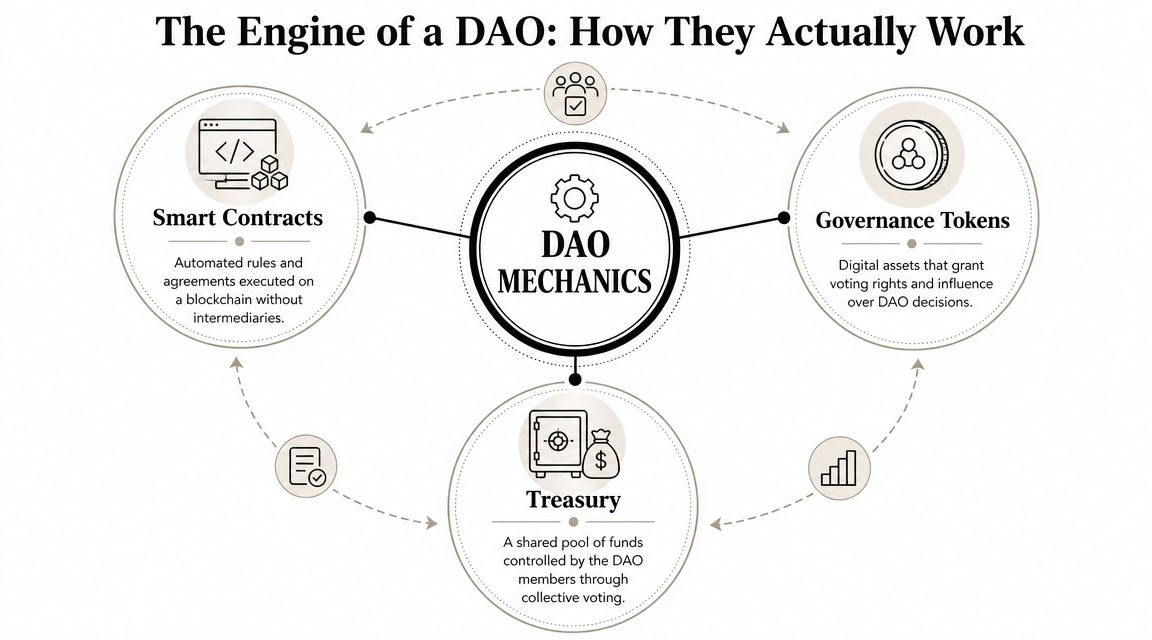
According to a paper hosted by CEUR Workshop Proceedings, a DAO's decision rights are encoded in smart contracts, so proposal rules, quorum thresholds, and execution logic can be enforced automatically on-chain, while records and rules remain publicly auditable in its technical discussion of DAO governance. If you want a quick refresher on the underlying rails, this primer on blockchain technology basics is worth a read.
The three moving parts
Most DAOs rely on three core pieces.
- Smart contracts control the rules. They can define who may propose changes, how long voting stays open, what counts as quorum, and what happens if a proposal passes.
- Governance tokens represent membership power. In many DAOs, more tokens means more voting weight, though some systems use delegation or other adjustments.
- Treasury holds the assets. This can include crypto reserves used for grants, protocol incentives, operations, or investments.
Those pieces interlock. The token gives you influence. The contract defines how influence gets used. The treasury is what that influence often controls.
How a proposal becomes action
Here's the simple version of a DAO workflow:
A member submits a proposal
That proposal might request funding, change tokenomics, upgrade a protocol parameter, or approve a partnership.The community debates it
Discussion often starts off-chain in forums, Discord, or governance portals before the formal vote begins.Token holders vote
Voting power is commonly tied to token holdings, though some DAOs allow delegates to vote on behalf of others.The contract checks the rules
If quorum and approval requirements are met, the system recognizes the outcome.Execution happens
In some DAOs, the winning result can trigger an on-chain action automatically. In others, multisig signers or ops teams still carry out parts of the decision.
Practical rule: A DAO isn't just a group chat with a wallet. It becomes a real governance system when rules, voting, and execution are connected.
This is why DAOs matter in DeFi, treasury management, grants programs, and increasingly in Web3 communities experimenting with cross-border coordination. They turn governance into something closer to software.
From The DAO to Today A Brief History of Decentralization
The history of DAOs isn't a smooth victory lap. It's a story of ambition, failure, and redesign.
Act one and act two
The early vision was bold. Put organizational logic on Ethereum, pool capital on-chain, and let token holders govern it directly. That dream became famous with The DAO, an early Ethereum-based experiment that showed both the promise and fragility of on-chain coordination.
Then came the event that every serious DAO participant should know: The DAO hack in 2016. The exploit became a defining warning for Ethereum governance, smart contract security, and the risks of putting large pools of capital behind immature code.
The lesson wasn't “DAOs don't work.” The lesson was harsher and more useful: code can enforce rules, but flawed code can enforce bad outcomes just as efficiently.
What changed after the early shock
Modern DAOs grew up in response to that pain.
Builders became more careful about audits, contract modularity, treasury controls, voting design, and staged governance. Instead of treating decentralization as a binary switch, many projects adopted more gradual governance. Teams kept some operational guardrails early on, then expanded community control over time.
That shift helped create the diverse array of DAOs people recognize now: protocol governance groups, grant DAOs, investment collectives, NFT communities, and contributor networks. Some feel more like online republics. Others feel more like software-governed operating committees.
The key historical takeaway is simple. The DAO model survived its earliest crisis because the underlying need never disappeared. Internet communities still wanted a better way to own things together, fund work together, and make decisions together.
Where DAOs Thrive Common Use Cases and Examples
Not every DAO looks the same, and that's where newcomers often get lost. “DAO” is a governance structure, not a single business model.
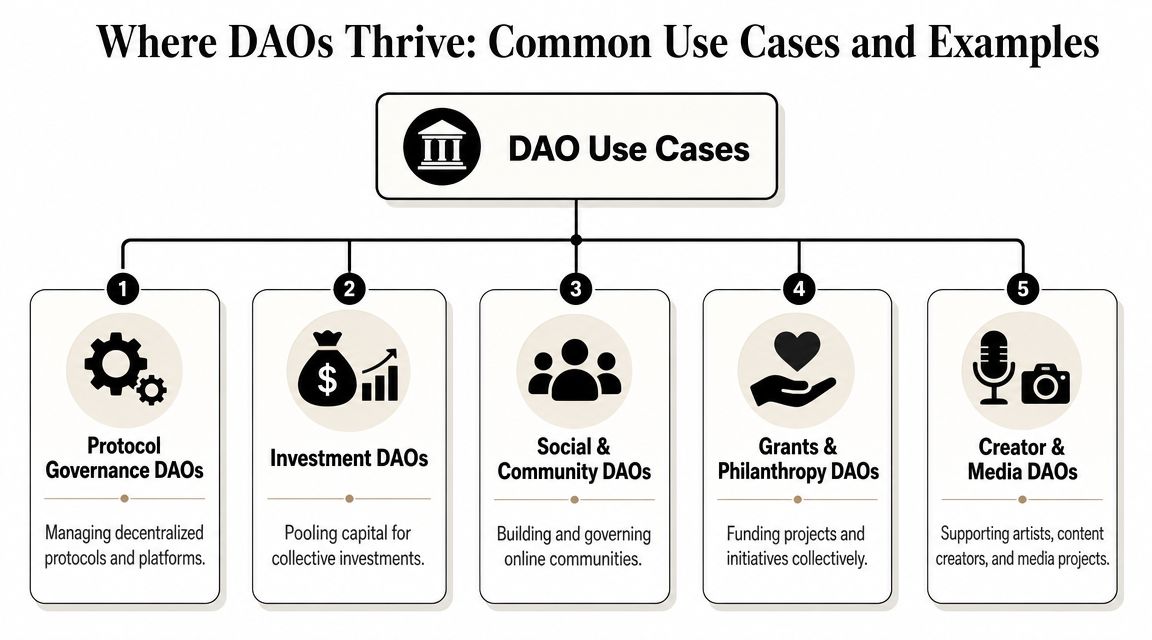
Chainalysis notes in its introduction to DAOs that their strength comes from pluggable governance and execution, where token-based votes can trigger transactions, making them a strong fit for DeFi, grant allocation, and treasury management.
Protocol and treasury coordination
The most natural home for DAOs is protocol governance.
A DeFi protocol like Uniswap or MakerDAO needs ongoing decisions. Fees change. Incentives shift. Treasury assets need management. Grants need approval. A DAO gives the protocol a way to govern itself without turning every major decision into a founder decree.
Common examples include:
Protocol governance DAOs
These manage decentralized exchanges, lending systems, or staking platforms. They often vote on upgrades, incentives, and risk settings.Grants DAOs
These allocate funding to builders, researchers, and ecosystem projects. The DAO acts like an internet-native grants committee.Treasury DAOs
These focus on capital stewardship. Members debate how reserves should be deployed, diversified, or distributed.
In these settings, the DAO isn't decoration. It's the control panel.
Community capital and creator models
Other DAOs revolve less around code upgrades and more around shared identity, ownership, or opportunity.
- Investment DAOs pool capital so members can decide together what to back. That could mean digital assets, NFT collections, early-stage protocols, or tokenized real-world assets.
- Social DAOs organize people around a network, city, profession, or niche interest. Their value often comes from access, contribution, and coordination rather than yield.
- Creator and media DAOs support artists, writers, podcasters, and communities that want collective ownership over a creative brand or media treasury.
- Gaming and NFT DAOs coordinate asset ownership, guild activity, or game strategy. These models overlap with GameFi and digital ownership.
A simple way to understand it:
| DAO type | What it governs | Why the model fits |
|---|---|---|
| Protocol DAO | On-chain products and rules | Decisions can be transparent and executable |
| Investment DAO | Shared capital | Members can coordinate allocations collectively |
| Social DAO | Community membership | Tokens can gate access and signal stake |
| Creator DAO | Media or creative projects | Fans and contributors can share ownership |
| Grants DAO | Funding decisions | Public proposals improve accountability |
Some of the most interesting DAOs don't replace companies. They replace committees, grant boards, and online communities that used to run on trust and spreadsheets.
This is also where newer trends start to matter. DAOs are showing up in DeFi, creator economies, tokenized communities, and experiments around real-world asset coordination. As Layer 2 networks get cheaper and Web3 interfaces improve, more of these use cases become practical for normal users, not just crypto power users.
The Double-Edged Sword Benefits vs Risks of DAOs
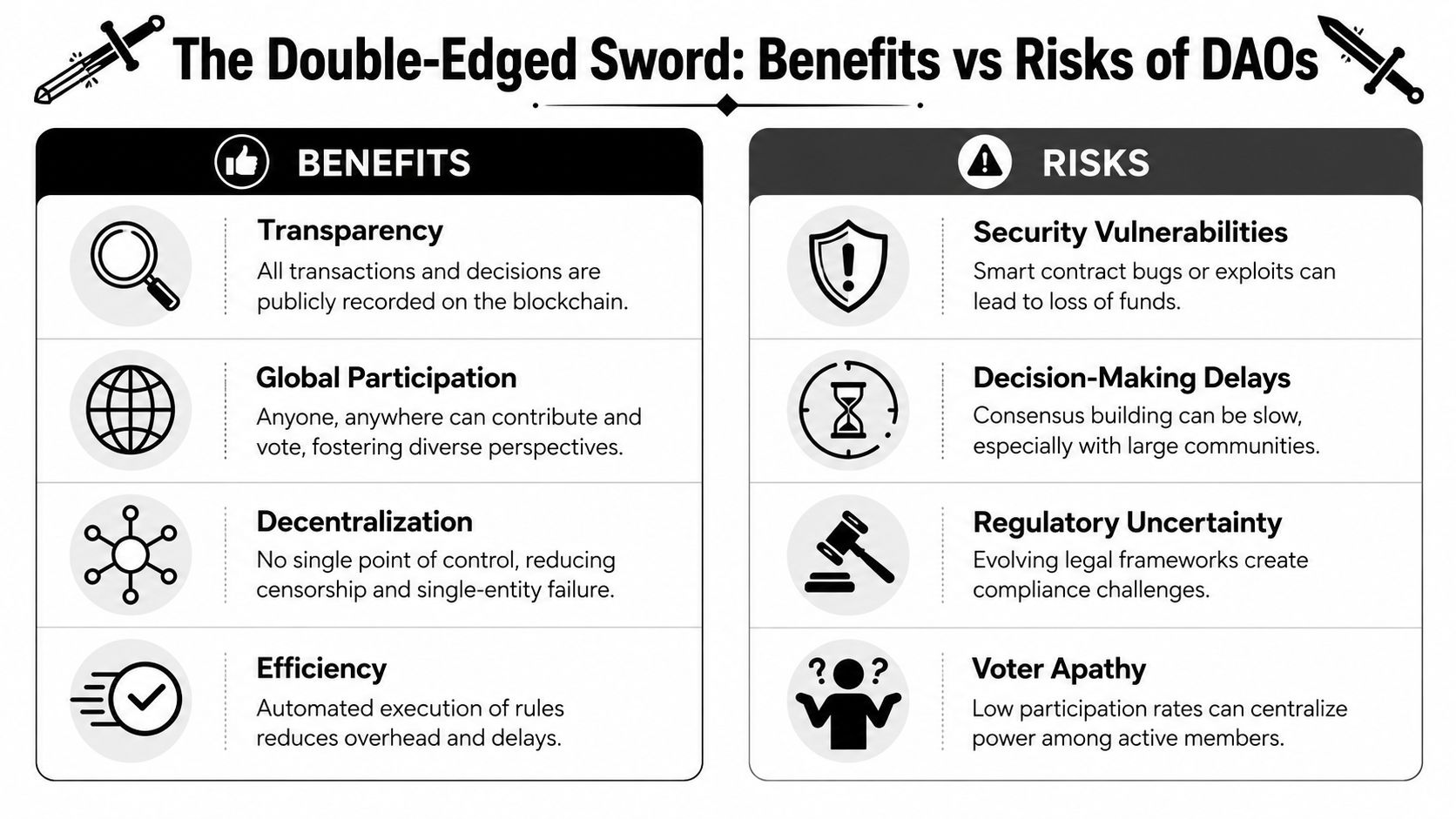
DAOs are appealing for reasons that are easy to understand. They also fail in ways that are easy to underestimate.
Why people are drawn to DAOs
Start with the upside.
Transparency
Rules, treasury movements, and votes can be visible on-chain. That makes political and financial behavior easier to inspect.Global participation
Contributors don't need to live in one city or work under one employer. DAOs are naturally cross-border and internet-native.Programmable execution
A passed vote can connect directly to an on-chain result. That can reduce friction in areas where rules are clear and repeatable.Shared ownership
Governance tokens can align contributors, users, and stakeholders around a common mission.
For crypto-native systems, that's powerful. A DAO can feel like the missing organizational layer between a protocol and its community.
Where the model breaks down
The downside starts where the theory meets reality.
- Smart contract risk
If governance or treasury logic has bugs, the system can fail in public and at machine speed. - Governance fatigue
Communities don't vote on everything forever. People tune out, delegate, or stop participating. - Whale influence
Token-weighted systems can drift toward the largest holders, even when the branding says “community owned.” - Operational messiness
Real work still needs people to write docs, negotiate deals, manage vendors, and coordinate contributors.
The legal side is even murkier. Wikipedia's overview of decentralized autonomous organizations notes that DAO legal status remains highly uncertain, especially around contracts, taxes, and liability, and that “autonomous” often overstates how much human coordination is still required. For a related blockchain power dynamic, this guide on MEV helps show how incentives and infrastructure can create outcomes users don't always see from the surface.
Here's the clean comparison:
| Benefit | Matching risk |
|---|---|
| Transparent voting and treasury records | Public systems can still hide concentrated influence |
| Open participation | Most members may never vote |
| Automated execution | Bugs can automate damage too |
| Decentralized ownership | Legal accountability can become blurry |
The biggest mistake is treating a DAO as trustless in every sense. Code reduces some trust assumptions. It doesn't remove politics, power, or legal exposure.
That's why serious participants judge DAOs less by slogans and more by design.
Joining the Collective How to Evaluate and Participate in a DAO
The smartest way to approach a DAO is not as a fan joining a movement, but as an analyst inspecting a governance machine.
Ethereum's DAO explainer points to the issue many beginner guides skip in its overview of how DAOs work in practice: power isn't defined only by token-weighted voting. You also need to inspect delegation, quorum rules, and token distribution to see whether a DAO is community-run or mostly controlled by a small set of holders.
What to inspect before you join
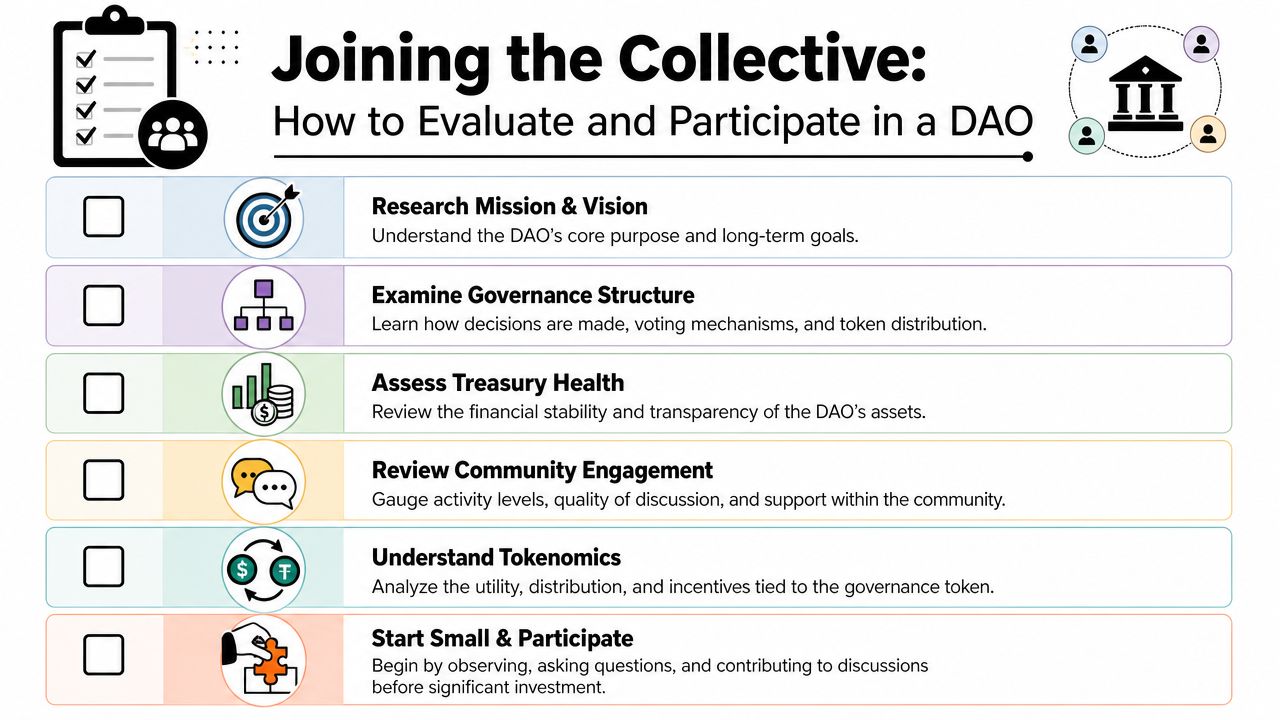
Use this checklist before buying a governance token or committing meaningful time.
Mission quality
Is the DAO solving a real coordination problem, or is it just attaching a token to a chat community?Governance structure
Read the rules. Who can submit proposals? What counts as quorum? Can delegates dominate outcomes? Are emergency powers concentrated?Token distribution
Look for concentration. If founders, treasury insiders, or early backers hold outsized influence, decentralization may be more branding than reality.Treasury design
What does the DAO actually control, and how carefully is capital deployed? A treasury is only useful if members can govern it responsibly.Community quality
Productive disagreement is a good sign. Empty hype, low-context voting, or rushed proposals usually aren't.
Because scams and low-quality token communities still exist, it also helps to review basic crypto hygiene before participating. This guide on how to avoid crypto scams covers the habits that matter.
How to participate without getting reckless
You don't need to start by buying a large token position.
A better approach is to move in layers:
Observe governance first
Read recent proposals and votes. You'll quickly see whether the DAO discusses substance or just reacts to personalities.Track delegates and repeat voters
In many DAOs, real power flows through a small set of active delegates rather than the entire token base.Start contributing before speculating heavily
Join calls, comment on proposals, or help in working groups. You'll learn more from participation than from price charts.Separate token value from governance quality
A token can trade well while governance is weak. The reverse can also happen.Watch for hidden centralization
Multisigs, off-chain influence, foundation control, and insider coordination all matter, even if the governance interface looks decentralized.
A good DAO isn't the one with the loudest community. It's the one where the decision process still makes sense when you look past the branding.
By 2025, one statistics roundup reported more than 13,000 DAOs worldwide, over 6,000 regularly active, more than 6.5 million governance token holders, average voter participation of 17%, top DAOs exceeding 22% in critical votes, and collective management of about $21.4 billion in liquid assets with $24.5 billion in total tracked treasury value, according to a 2026 DAO statistics roundup. Those figures make one thing obvious: participation is real, but so is the persistent challenge of low voter engagement.
The Next Evolution Future Trends for DAOs in 2026
The next stage for DAOs probably won't come from better slogans. It'll come from better infrastructure.
What likely improves next
Layer 2 scaling is one obvious advantage. Governance on expensive base layers can discourage smaller holders from participating. Cheaper transactions make voting, delegation, and treasury operations more practical. That matters if DAOs want broader involvement instead of rulemaking by only the most capitalized users.
AI plus crypto could also improve DAO operations. Not by replacing governance, but by helping participants process it. AI tools can summarize proposals, compare versions, surface treasury changes, and flag governance patterns that humans might miss. In a noisy DAO, that's useful. In a large one, it may become necessary.
Real-world asset tokenization opens a different frontier. If more off-chain assets become tokenized, DAOs could coordinate ownership and management of things that don't live purely on crypto rails. That introduces legal and custodial complexity, but it also expands what a treasury can represent.
Here's the bigger pattern:
- Layer 2s address cost and speed.
- AI systems address information overload.
- RWA tokenization addresses the narrowness of purely digital treasuries.
- Modular governance tools address the reality that not every decision belongs in one token vote.
The best future version of a DAO probably looks less like pure direct democracy and more like a programmable organization with specialized roles, delegated authority, and on-chain accountability.
That's also why the future of DAOs overlaps with the broader future of cryptography. Better privacy, stronger verification, and more flexible coordination tools will shape whether DAOs remain crypto-native curiosities or become durable institutions.
Frequently Asked Questions About DAOs
| Question | Answer |
|---|---|
| Can a DAO be hacked? | Yes. If a DAO relies on flawed smart contracts, treasury logic, or weak operational security, attackers can exploit it. “Code is law” cuts both ways. |
| How do DAOs make money? | It depends on the DAO. A protocol DAO may receive revenue from a DeFi product. An investment DAO may benefit from asset appreciation. A creator DAO may earn from memberships, media, or community products. |
| Do I need to be a coder to join a DAO? | No. Many DAOs need researchers, writers, designers, community managers, analysts, operators, and voters. Technical knowledge helps, but it isn't a requirement for meaningful participation. |
If you want more clear-eyed crypto explainers like this one, follow Coiner Blog for practical guides on blockchain, DeFi, Web3, tokenomics, NFTs, crypto gaming, and the risks that matter just as much as the upside.