
What Is Price Discovery? a Crypto Trader’s Guide

You're probably looking at a chart right now. A token ripped higher after a listing rumor, stalled on one exchange, traded at a slightly different price on a DEX, and then snapped back a few minutes later. The natural question is simple: where did that price come from?
That question sits at the center of crypto. Traders stare at candles, but candles are only the surface. Underneath them, buyers place bids, sellers post asks, liquidity providers rebalance pools, arbitrage bots compare venues, and derivatives traders express opinions about future value before spot traders catch up. The number on your screen isn't a fixed truth. It's the latest result of a nonstop negotiation.
Price discovery is the name for that negotiation. As Britannica's explanation of price discovery puts it, it's the process by which buyers and sellers simultaneously agree on a transaction price for an asset at a given moment, with that price reflecting supply, demand, and available information. In crypto, that process runs all day, every day, across centralized exchanges, decentralized exchanges, smart contracts, and derivatives platforms.
If you've ever wondered why the same asset can look stable on Binance and briefly mispriced on Uniswap, or why a futures market can feel “smarter” than spot, you're asking the right question. And if you want a useful companion concept, this guide on crypto liquidity helps explain why some prices hold steady while others jump around on small orders.
Table of Contents
- The Unseen Forces Behind Every Price Chart
- The Classic Engine How Order Books Create Prices
- The DeFi Revolution Automated Market Makers
- Advanced Crypto Signals Derivatives and On-Chain Data
- How to Observe Price Discovery in Real-Time
- A Token Launch Case Study Price Discovery in Action
- The Future of Price Discovery in a Tokenized World
The Unseen Forces Behind Every Price Chart
Open a new token chart after a launch and you'll often see chaos disguised as precision. One candle says buyers are in control. The next says sellers have taken over. On social media, people call the move manipulation, momentum, adoption, or hype. Usually, it's a mix of those things filtered through market structure.
A price is an argument that keeps changing
In crypto, price discovery isn't one event. It's a continuous argument between people with different information, different time horizons, and different tools. A retail trader might buy because a Layer 2 ecosystem looks promising. A market maker might sell because inventory is getting unbalanced. An arbitrage bot might buy on a DEX and sell on a CEX because the same token is briefly priced differently.
That's why the phrase what is price discovery matters more in digital assets than it does in many traditional markets. Crypto doesn't sleep, trades across fragmented venues, and mixes human behavior with algorithmic execution. In Web3 and DeFi, smart contracts themselves become part of the pricing process.
Price is not a verdict. It's the latest temporary agreement the market can reach.
Why crypto makes the process easier to see
Traditional finance often hides the plumbing. Crypto doesn't. On-chain swaps, wallet movements, liquidity pool balances, perpetual funding, and exchange order books all leave clues. If you know where to look, you can watch price discovery happen instead of treating price as a mysterious output.
That's especially important in markets shaped by:
- DeFi mechanics: AMMs price tokens from pool balances, not from a queue of posted bids and asks.
- Layer 2 activity: New venues can become fresh centers of liquidity and shift where fair value gets established.
- Tokenomics changes: Token releases, staking incentives, and emissions can alter supply pressure.
- AI-driven trading: More systems now scan order flow, on-chain activity, and derivatives data at the same time.
Most confusion starts when readers assume every market finds price the same way. Crypto breaks that assumption immediately.
The Classic Engine How Order Books Create Prices
Binance, Coinbase, Kraken, and similar venues use the mechanism most traders recognize first. An order book. If you want the cleanest traditional answer to what is price discovery, start here.
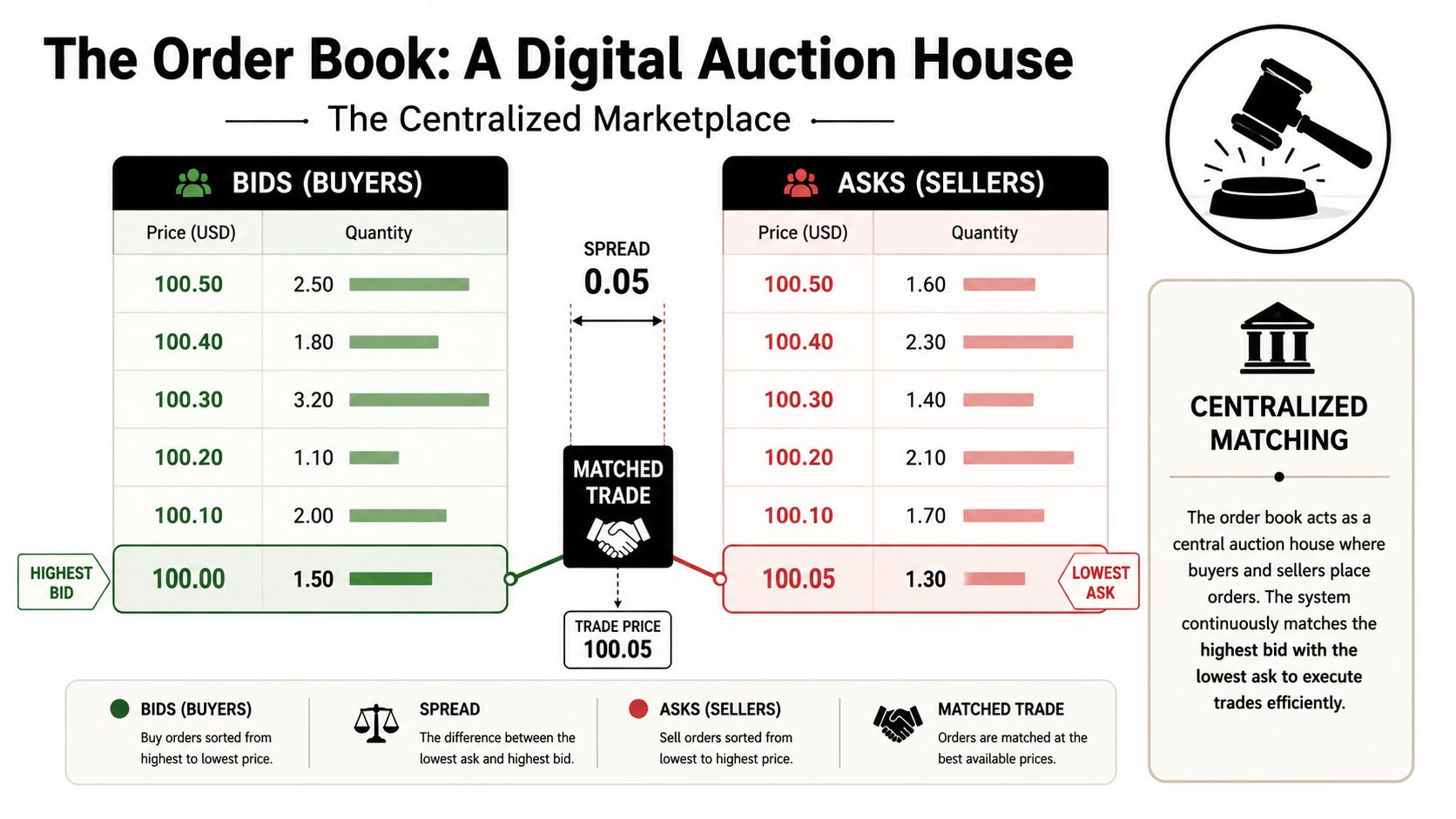
The order book is a live auction
Think of an order book as a digital auction house that never closes. Buyers line up with bids. Sellers line up with asks. The highest bid and the lowest ask sit closest together. When they meet, a trade happens.
A simple version looks like this:
| Side | Meaning | What it tells you |
|---|---|---|
| Bid | A buyer's offered price | How much demand exists below market |
| Ask | A seller's offered price | How much supply exists above market |
| Spread | Gap between best bid and best ask | How tight or loose the market is |
| Depth | Size of orders around current price | How much pressure the market can absorb |
The last traded price gets printed on the chart, but that number only tells you where the latest trade happened. It doesn't tell you how strong that price is. For that, traders look at the spread and the depth behind it.
What traders are really reading
In liquid markets, the mid-price sits between the best bid and best ask. According to IG's overview of price discovery and market spreads, in liquid markets the mid-price can revert to the discovered fair value within milliseconds, and major assets often show bid-ask spreads below 0.05% during normal trading. That's what strong price discovery looks like in practice. Tight spread, deep book, quick response.
When the book gets thin, the picture changes fast.
- Narrow spread: Buyers and sellers agree closely on value.
- Deep book: Large orders can hit the market without moving price much.
- Wide spread: Uncertainty is higher, and a single order can push price harder.
- Thin depth: Traders become more vulnerable to slippage and sharp wicks.
If you've ever bought a small-cap token on a CEX and gotten a much worse fill than expected, you've already met the practical edge of price discovery. That's why learning what slippage in trading means matters. Slippage is often the moment when market structure stops being theory and starts costing you money.
Why market makers matter
Order books don't run smoothly on enthusiasm alone. Market makers post buy and sell quotes to keep trading active. They help tighten spreads and provide inventory when natural buyers and sellers don't arrive in perfect balance.
Without them, many crypto pairs would look jumpy and unreliable. With them, price discovery becomes smoother, especially on major spot pairs and futures markets.
Practical rule: Don't judge a chart by the last price alone. Judge it by the spread, the depth, and how the book reacts when size hits it.
The DeFi Revolution Automated Market Makers
Crypto didn't stop at copying the exchange model. DeFi rebuilt it. On Uniswap, PancakeSwap, and other DEXs, you often won't find a traditional order book at all. You'll find a liquidity pool and a pricing formula.
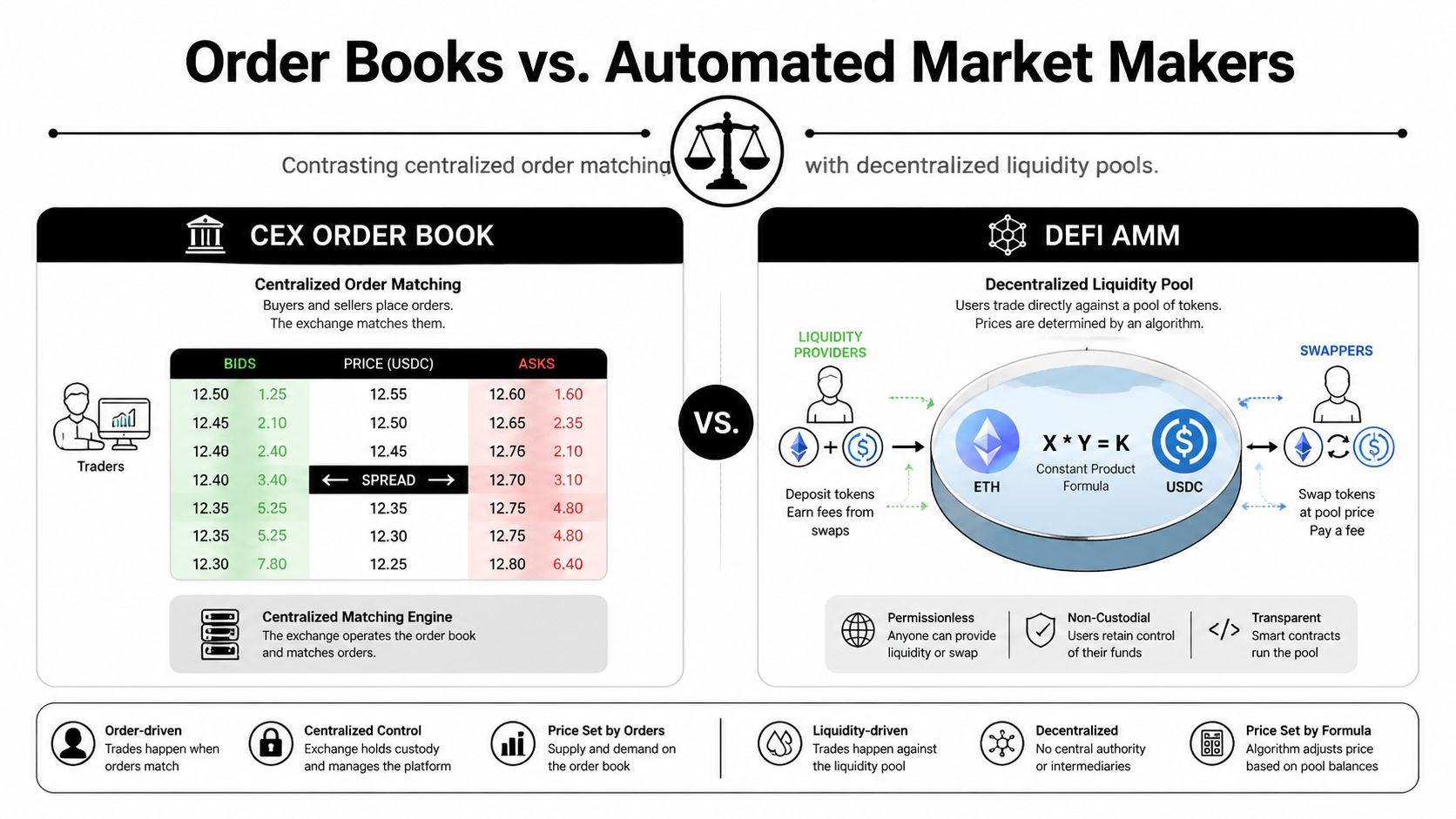
How an AMM sets a price
An automated market maker, or AMM, uses pooled assets instead of a list of resting orders. In a common setup, a pool might hold ETH and USDC. Traders swap one for the other, and the pool adjusts the price based on the changing reserve ratio.
This process resembles a balancing scale. If traders keep buying ETH from the pool with USDC, ETH becomes scarcer inside that pool. The AMM raises the implied ETH price. No market maker has to manually update a quote. The smart contract does the adjustment.
This is one of DeFi's most important contributions to Web3 market structure:
- Permissionless access: Anyone can trade against the pool.
- Permissionless liquidity: Anyone can become a liquidity provider.
- On-chain transparency: Pool reserves and swaps are visible.
- Programmable markets: Smart contracts handle matching logic.
A short visual helps if you want to see the mechanism in motion.
Why DEX and CEX prices drift apart
The difference between CEX and DEX pricing is central to crypto-native price discovery. As Investopedia's discussion of price discovery in modern markets notes, AMMs on DEXs derive prices algorithmically from liquidity pool ratios, while centralized venues use order-book-based pricing. That difference can create temporary price discrepancies and arbitrage opportunities.
Here's the practical version. Suppose Binance traders aggressively buy a token after a project update. The order book price jumps first. On Uniswap, the pool may lag for a moment if no one has traded enough size through it yet. Arbitrage bots then step in, buying where the token is cheaper and selling where it's richer. Their trades pull the two venues back toward each other.
That's why what is price discovery in DeFi can't be answered with a generic supply-and-demand definition alone. You need to know the mechanism producing the quote.
A quick comparison makes the contrast clearer:
| Feature | CEX order book | DEX AMM |
|---|---|---|
| Price source | Bids and asks | Token reserve ratios |
| Matching | Exchange engine | Smart contract formula |
| Liquidity role | Market makers and traders | Liquidity providers |
| Main weakness | Thin books can widen spreads | Pool imbalance can amplify slippage |
The DeFi upside is openness. The tradeoff is that large swaps can move price sharply, especially in smaller pools. That's where impermanent loss, pool depth, and execution path start to matter for both traders and liquidity providers. If you provide liquidity yourself, an impermanent loss calculator is useful because AMM price discovery can work against LP returns when prices move hard.
A DEX doesn't ask, “Who wants to sell at this price?” It asks, “Given these pool balances, what price does the formula imply right now?”
Advanced Crypto Signals Derivatives and On-Chain Data
Spot charts tell you where price printed. Crypto's edge comes from reading the layers underneath. Two matter most for active analysis: derivatives data and on-chain data.
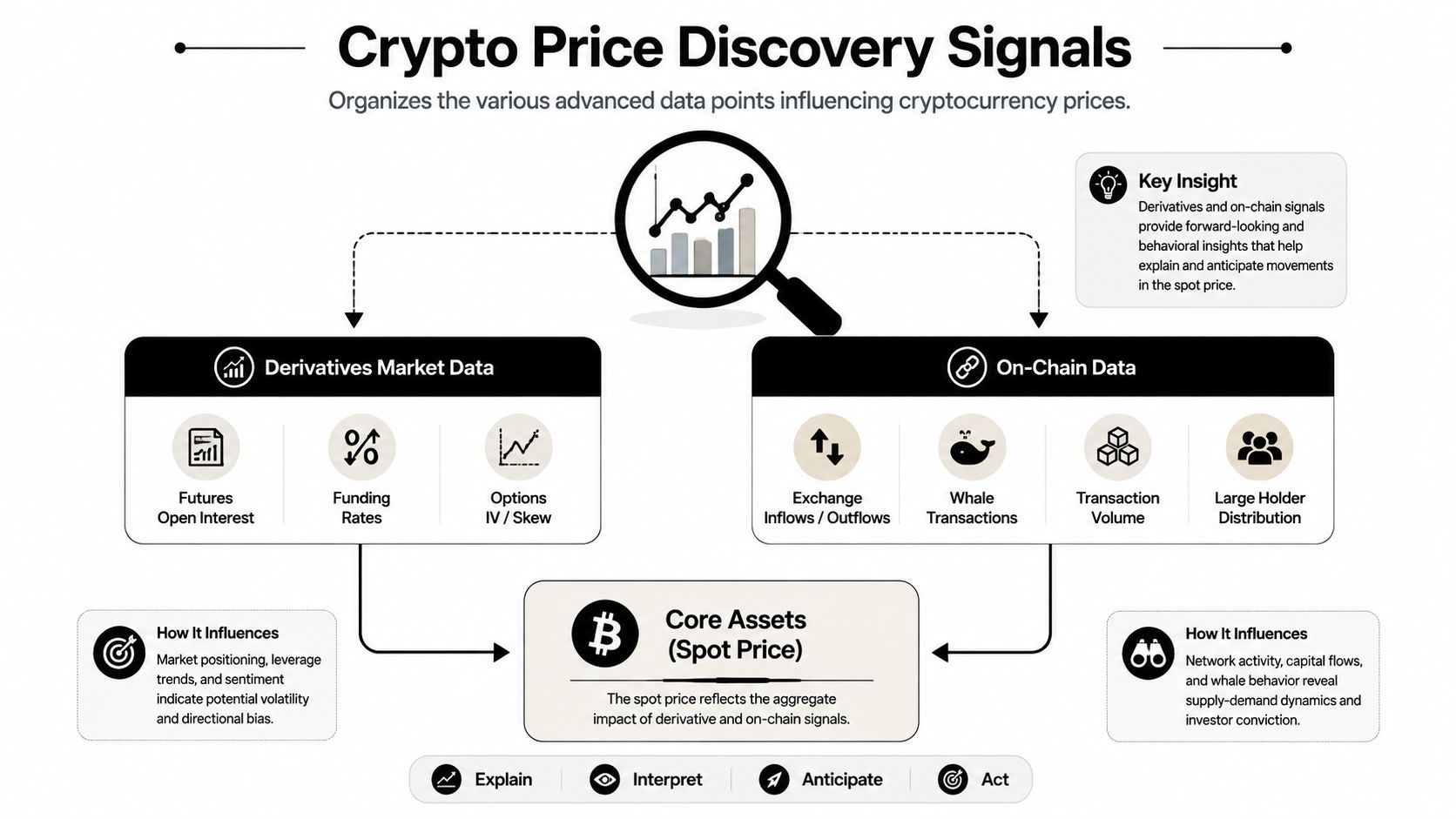
Why futures often lead spot
Derivatives markets often process information faster than spot because they compress expectations, market amplification, and positioning into one place. Wikipedia's overview of price discovery notes that futures markets are widely recognized as leading indicators for spot markets. In crypto, perpetual futures make this especially visible through funding rates and the futures-spot basis.
If perpetual traders keep paying positive funding, that signals aggressive long positioning. If the futures price trades rich to spot for a sustained period, traders are expressing a stronger forward view than the spot market alone might suggest. That doesn't guarantee direction, but it tells you where speculative pressure is building.
Three signals matter most:
- Funding rates: Show whether longs or shorts are paying to hold positions.
- Open interest: Shows whether new positions are building or existing ones are being closed.
- Basis: Shows how futures are priced relative to spot.
These tools are especially useful around Bitcoin, Ethereum, and large-cap altcoins where derivatives participation is heavy. For traders exploring structured bets, this broader guide to cryptocurrency options trading adds another layer to the same idea. Options markets can reveal where traders expect volatility or where they're hedging.
What on-chain data adds
On-chain data gives crypto a native information channel that traditional markets rarely match. You can watch wallet behavior, exchange inflows and outflows, liquidity migrations, and smart contract interactions in near real time.
That doesn't mean every large transfer predicts a move. It means some transfers change the context of price discovery.
Consider these examples:
- Exchange inflows: Tokens moving onto exchanges can signal potential sell pressure.
- Exchange outflows: Tokens leaving exchanges can suggest holders prefer custody over immediate sale.
- Whale transactions: Large movements can alter short-term order flow expectations.
- Protocol interactions: Heavy activity in staking, bridging, or DeFi farms can change circulating supply conditions.
On-chain analysis works best when paired with market structure, not treated as magic. A whale deposit means more if the order book is thin. A bridge inflow into a Layer 2 matters more if a token launch or incentive program is live. Smart traders combine these clues rather than forcing one data type to explain every move.
Watch where traders are placing leveraged bets, then check whether on-chain flows support or contradict that story.
Why this matters in AI, DeFi, and tokenized markets
As AI systems get better at parsing on-chain events and derivatives dashboards together, price discovery should become even more competitive. Bots already monitor CEX books, DEX pools, and blockchain activity simultaneously. Add tokenized real-world assets, more Layer 2 venues, and more composable DeFi protocols, and you get a market where fair value is assembled from many signals at once.
That fragmentation can feel messy. It's also where opportunity lives.
How to Observe Price Discovery in Real-Time
Most traders say they watch price. Fewer watch the machinery producing it. If you want to understand what is price discovery in practice, you need a repeatable way to monitor the market while it's moving.
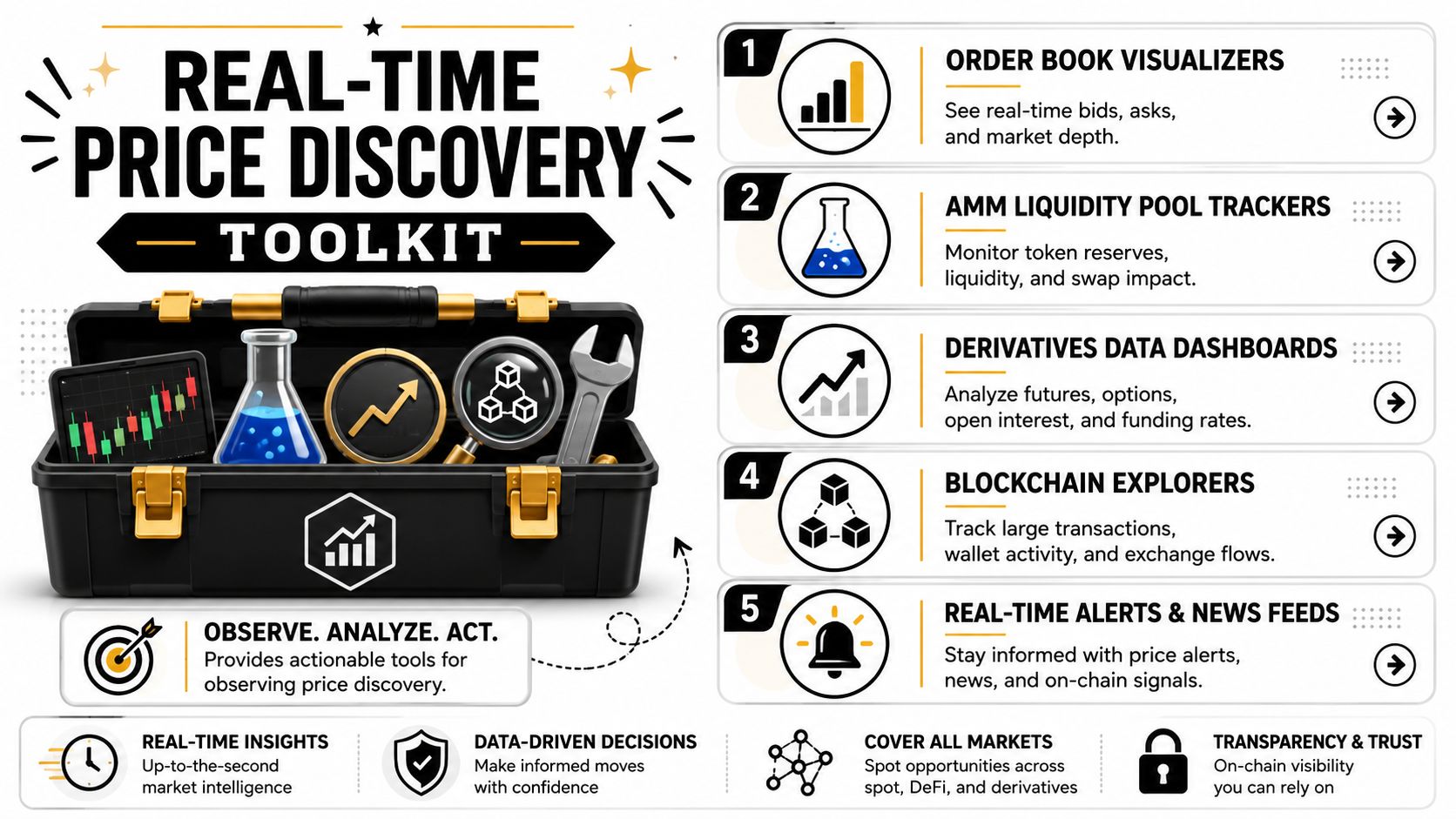
A practical trader checklist
Open a charting platform like TradingView next to a live exchange interface. Then stop looking only at candles and start checking the following in sequence.
- Start with the spread: A tight spread usually means the market is functioning smoothly. A sudden widening often tells you uncertainty or volatility is rising before the chart fully reflects it.
- Scan nearby depth: Look for large resting bids below price and large asks above it. They don't guarantee support or resistance, but they show where significant interest sits.
- Compare volume to movement: A strong move with clear participation usually carries more information than a drift on weak activity.
- Check venue agreement: Compare a major CEX with a leading DEX. If prices diverge, ask whether arbitrage is catching up or whether the market is still digesting news.
- Review derivatives posture: Funding, basis, and open interest help you judge whether traders engaging in margin trading are reinforcing or fighting the spot move.
A lot of this can be monitored manually. For broader market monitoring, teams that track pricing across many sites often use web scraping for price intelligence to compare listings, product prices, and venue discrepancies at scale. The same mindset applies in crypto when you're trying to see how fragmented prices line up across platforms.
What to watch across venues
A move on one exchange doesn't always mean the market has agreed. Sometimes one venue leads and others follow. Sometimes a DEX pool gets pushed around by a single large swap while the broader market barely reacts.
Use this framework:
| Signal | What you're checking | What it may imply |
|---|---|---|
| CEX spread and depth | Tightness and available liquidity | Confidence or fragility in the current quote |
| DEX pool reserves | Balance between paired assets | Whether swaps will move price sharply |
| Cross-exchange gap | Difference between venues | Arbitrage opportunity or delayed convergence |
| Derivatives dashboard | Funding, basis, open interest | Leveraged sentiment and forward expectations |
| On-chain flows | Wallet and exchange activity | Supply pressure or demand migration |
Reading the tape without overreacting
The common mistake is treating every tick as meaningful. Price discovery includes noise. Bots reposition. Liquidity providers hedge. Traders fade headlines. A single candle can be less important than the way multiple venues behave over the next several minutes.
Watch for confirmation instead of chasing the first move.
Market habit: When price jumps, ask three questions. Did volume support it? Did other venues confirm it? Did derivatives lean with it or against it?
This approach matters most in DeFi, meme coin trading, and fresh token listings where fair value is still unstable. In those moments, price isn't just moving. The market is actively trying to figure out what the asset is worth.
A Token Launch Case Study Price Discovery in Action
A new Layer 2 token launches after a widely watched mainnet announcement. Traders are ready before the first swap clears. Some are on Uniswap. Others wait for a centralized exchange listing. A few are already watching wallets tied to the team, early investors, and market makers.
Phase one on-chain price formation
The first real price often appears on a DEX. A project seeds a liquidity pool, and early traders begin swapping against it. Because AMM prices depend on pool balances, even modest early demand can push the quote around sharply if the pool isn't deep.
Newer traders often face confusion regarding the initial price. They think the first visible price is the true value. It isn't. It's the opening offer produced by a small and still unstable market.
Phase two cross-market convergence
Soon after, a CEX opens trading. The order book begins forming its own view of fair value. If the DEX price and CEX price differ, arbitrageurs step in. They buy on the cheaper venue, sell on the richer one, and compress the gap.
At the same time, perpetual futures may start trading or become more active. Funding and basis begin revealing whether speculative traders expect the launch premium to persist or fade.
This is also when public news has the strongest effect. As the BIS analysis of announcement-driven price adjustment shows in traditional markets, 40% to 70% of a price adjustment can occur within the first 5 minutes of a scheduled announcement. Crypto launch events often show the same pattern qualitatively. Most of the hard repricing happens fast, then the market spends longer testing whether that first reaction was too high or too low.
A launch checklist might look like this:
- DEX opening trades: Establish the first rough quote.
- CEX listing: Introduces deeper order-book competition.
- Arbitrage activity: Pulls different venue prices toward each other.
- Derivatives response: Reveals amplified sentiment.
- On-chain wallet tracking: Adds context around supply and holder behavior.
For readers who follow early-stage launches closely, these dynamics are part of what makes lists of best crypto presales for 2025 so interesting. The challenge isn't finding a new token. It's understanding how its initial price gets formed, challenged, and revised.
Early launch prices are usually fragile. The first quote tells you where trading began, not where value has settled.
The Future of Price Discovery in a Tokenized World
Price discovery is getting broader, faster, and more fragmented. That's not a flaw. It's the natural result of crypto adding new venues and new data sources faster than old market models can absorb them.
Layer 2 networks are creating fresh liquidity pockets where assets can trade actively with lower friction. DeFi keeps turning smart contracts into market infrastructure. Tokenized real-world assets will introduce new forms of collateral, new information flows, and new arbitrage relationships between on-chain and off-chain markets. AI systems will keep improving how traders and market makers interpret order flow, pool imbalances, and on-chain events.
The key idea doesn't change. What is price discovery? It's the process that turns disagreement into a tradable number. In crypto, that process happens across order books, AMMs, derivatives venues, and blockchains at the same time.
The traders who do best usually aren't the ones who memorize the prettiest chart pattern. They're the ones who understand where the price came from, who is pushing it, and which venue is leading the conversation.
Coiner Blog publishes sharp, practical analysis for readers who want more than recycled crypto headlines. If you're into DeFi mechanics, tokenomics, Layer 2 ecosystems, AI and blockchain trends, NFTs, GameFi, and the underlying market structure behind digital assets, explore more at Coiner Blog.
2 Comments