
World Coin Index: A 2026 Guide for Crypto Traders

You're checking a coin price, and the number looks different on every site you open. One exchange says one thing, another platform says something else, and the “market cap” keeps changing while you refresh. That's the exact kind of mess that World Coin Index was built to reduce, because it gives crypto traders a single, indexed view of prices, volume, and market cap across a very large slice of the market.
Table of Contents
- What World Coin Index Actually Is
- How the Platform Aggregates Price and Market Data
- Reading the Dashboard and Key Metrics
- World Coin Index Versus CoinMarketCap and CoinGecko
- Clearing Up the Worldcoin WLD Confusion
- Practical Use Cases and When to Look Deeper
What World Coin Index Actually Is
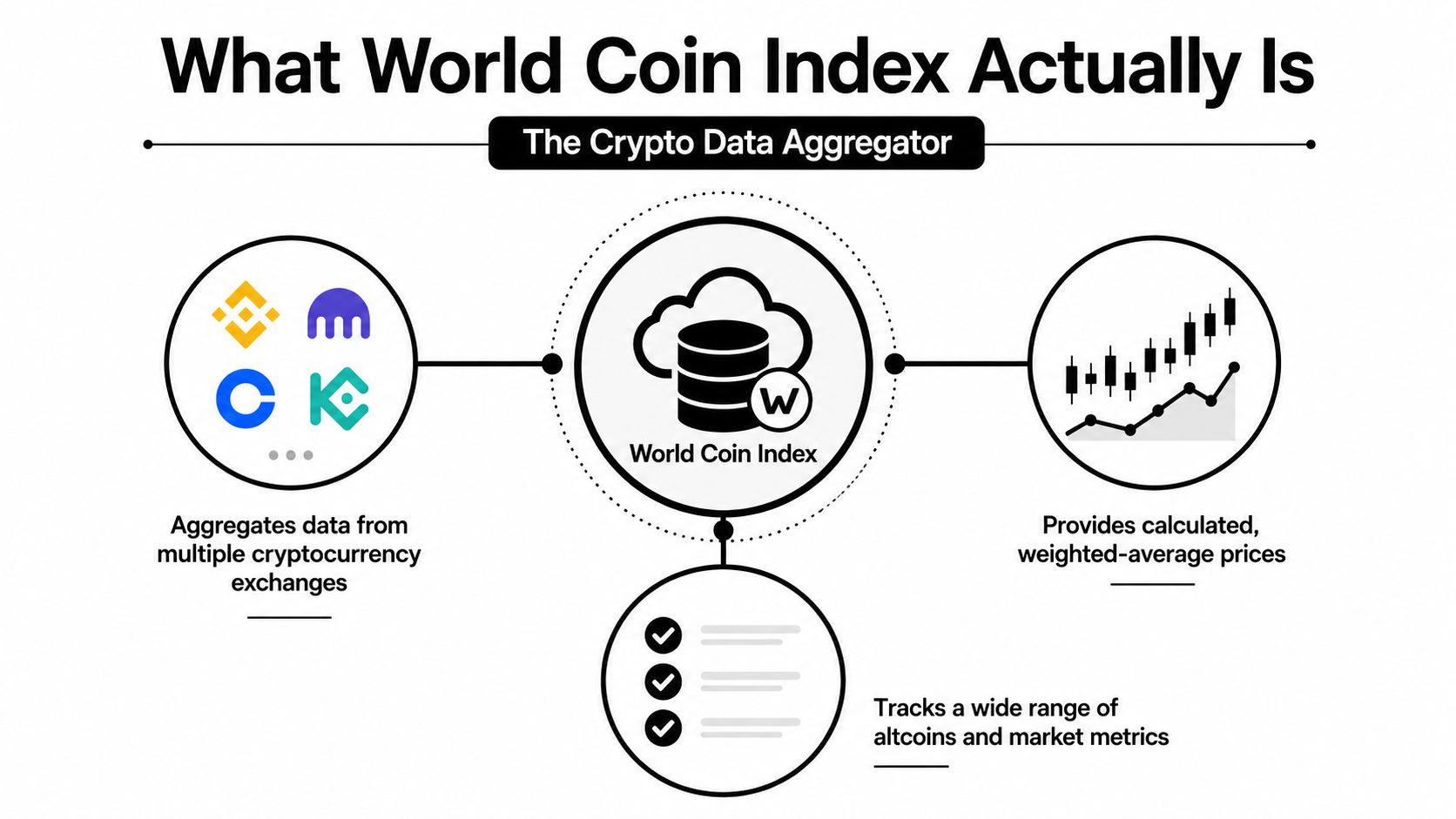
A trader who wants to check a coin properly usually doesn't want a single-exchange quote. They want a quick read on whether a price is being supported by real volume, whether the day's range is calm or chaotic, and whether the coin even matters enough to rank at the top of the board. World Coin Index exists for that exact workflow, it turns fragmented exchange data into one navigable dashboard.
A market index, not a trading venue
WorldCoinIndex presents itself as a cryptocoin price index and market cap dashboard, and its structure is built around broad comparison rather than execution. Its core table tracks price, 24-hour change, 24-hour high/low, 24-hour volume, number of coins, and market cap for listed assets, with coins ranked by 24-hour trading volume (WorldCoinIndex homepage). That ranking logic matters because it pushes liquid, active markets toward the top instead of rewarding a thin market with a flashy price.
An independent description of the service says it launched in 2014, monitors more than 150 cryptocurrency exchanges and over 15,000 cryptocurrency markets, tracks over 3,000 digital currencies, and includes data on daily trade volume and open interest from more than 900 crypto derivatives contracts (DailyCoin's WorldCoinIndex overview). Those coverage numbers explain why the site became useful to traders, it was designed for breadth.
Practical rule: if you're trying to judge a coin's real market presence, a platform that aggregates many venues is more useful than a page that only reflects one exchange.
Why the index format became useful
Crypto markets grew from a handful of names into a space with thousands of tradeable assets. That created a simple problem, too many tokens, too many venues, and too much noise to scan manually. World Coin Index helped normalize that chaos by putting many assets into one consistent format, which made discovery, comparison, and sentiment checks faster for retail users and professionals alike.
That's also why World Coin Index matters historically. It reflects the move from isolated coin pages to index-style discovery tools, a shift that helped make crypto data easier to consume at scale. If you want to understand why market dashboards became infrastructure, a good companion read is this market microstructure overview, because the way prices form across venues is the core reason aggregation matters.
How the Platform Aggregates Price and Market Data
If you open a coin page and see a single clean quote, remember that the market behind it is usually fragmented. WorldCoinIndex says it calculates prices using an average weighted price formula, updates prices every few seconds, and defines volume as the number of coins traded across all cryptocurrency exchanges it tracks (WorldCoinIndex About Us). That makes it different from a feed that repeats the last trade from one venue.
Why weighted-average pricing matters
A last-trade price can be misleading when it comes from a thin exchange or a short-lived spike. A weighted-average price tries to reflect the broader market by giving more influence to venues where more trading is taking place. For a retail trader, that means the displayed price is less likely to be thrown off by one small exchange or a brief outlier print.
The point of aggregation is not perfection. It is to get closer to a market-wide reference than any single exchange can provide.
Becoming a niche expert matters because the quality of the quote depends on how the platform collects, normalizes, and refreshes its inputs. If you want a closer look at how competitors build price monitoring systems, the price scraping architecture guide breaks down collection, normalization, and refresh cycles in a way that fits the same problem. For readers trying to understand market data tools, that is the part that explains why index pages are built the way they are.
What the dashboard is actually doing
World Coin Index is combining price inputs, volume inputs, and supply-related fields into one quote experience. Because it refreshes frequently, the page can stay closer to live market conditions instead of feeling stale, which matters in crypto where short-lived moves can disappear quickly.
A useful way to read it is to separate the quote from the mechanics underneath. The quote tells you the current level, while the aggregation process tells you how much confidence you should place in that level.
The market is fragmented, and the platform is compressing that fragmentation into something a human can read in seconds. For a clearer explanation of how prices form across venues, the crypto market structure discussion is a helpful companion.
A concrete example makes the method easier to see. WorldCoinIndex's Bitcoin page shows BTC at $62,938, with a -1.01% 24-hour move, $640.57M in 24-hour volume, a $1.26T market cap, a 24-hour high of $63,853, and a 24-hour low of $62,579 (Bitcoin on WorldCoinIndex). That single page gives you the current quote, the day's trading band, liquidity context, and size context at once.
If you are comparing this kind of page to other market tools, the important question is not just whether the number looks current. It is whether the number reflects broad activity across venues, rather than one exchange's momentary print.
Reading the Dashboard and Key Metrics
The main table on World Coin Index is easy to glance at, but each column answers a different question. If you read it properly, you can tell whether a coin is active, thinly traded, or moving within a narrow band. That's more useful than chasing the biggest green number on the page.
How to interpret the core columns
The site's core table tracks price, 24-hour change, 24-hour high/low, 24-hour volume, number of coins, and market cap, and it ranks coins by 24-hour trading volume (WorldCoinIndex homepage). Each field tells you something specific. Price tells you where the market is now, volume tells you how much attention it's getting, and market cap tells you how large the asset is in aggregate.
| Metric | What It Shows | Why It Matters |
|---|---|---|
| Price | The current quoted level | Helps you compare the asset against your entry or exit target |
| 24-hour change | The day's move direction and size | Gives a fast sentiment check |
| 24-hour high/low | The session's trading range | Shows whether volatility is expanding or compressing |
| 24-hour volume | Activity across tracked exchanges | Helps separate real interest from thin-market noise |
| Number of coins | Supply listed on the page | Gives context for valuation and token distribution |
| Market cap | Price multiplied by supply | Shows the asset's scale in the market |
If you want a deeper practical lens on why volume matters, this liquidity guide for cryptocurrency is a helpful next read. The short version is that a high price doesn't mean much if very little trades.
How to use the table without overreading it
A volume-first table is great for screening, but it's not a full investment thesis. A coin can rank high because it's liquid, not because it's strong. Another coin can look cheap because its supply is large, not because it has hidden upside.
WorldCoinIndex's Worldcoin listing is a good example of how to read the page responsibly. It shows WLD at $0.383486, with -1.22% over 24 hours, $62.87M in 24-hour volume, 3.37B coins, and $1.29B market cap, plus a 24-hour high of $0.389369 and 24-hour low of $0.378383 (WorldCoinIndex Worldcoin page). That combination tells you the coin is liquid enough to monitor, but you still need to ask why the supply is so large before making any judgment.
World Coin Index Versus CoinMarketCap and CoinGecko
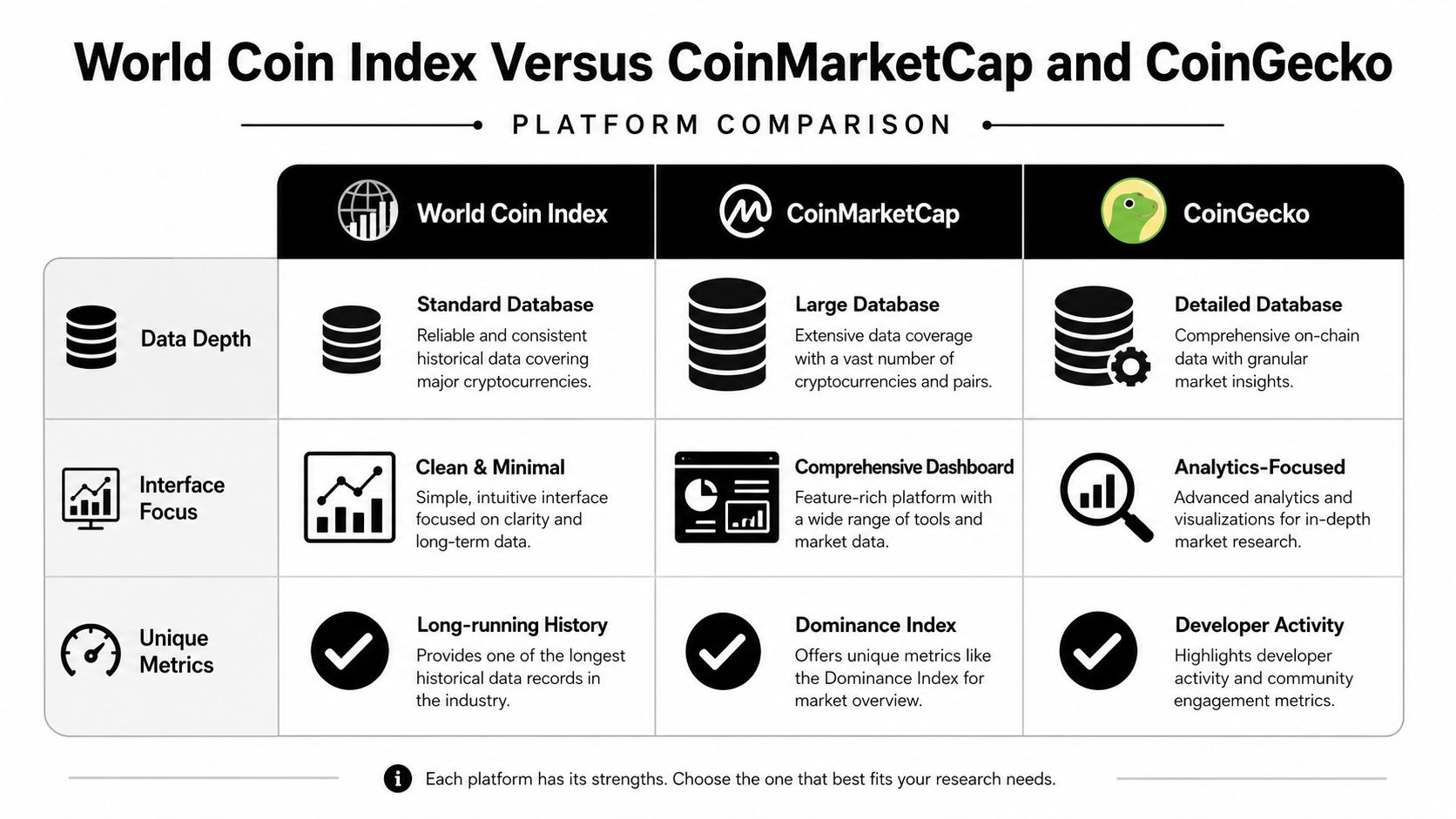
Most readers compare World Coin Index with CoinMarketCap and CoinGecko almost immediately, and that's the right instinct. These tools overlap, but they don't serve the exact same workflow. The best choice depends on whether you want a fast market snapshot or a richer research environment.
Where World Coin Index stands out
World Coin Index's biggest strength is its volume-first ranking and its long-running role as a broad market index. That makes it especially useful when you want quick screening across a lot of assets, including smaller names and derivative-market context (DailyCoin's description). The interface is more direct than the larger platforms, and that simplicity can be an advantage if you're checking conditions quickly.
For traders who care about price discovery, the way markets set quoted values matters more than a polished dashboard. This is why a market-price determination guide is relevant here, the best data platform is the one that mirrors the market mechanism you're trying to read.
Where larger platforms usually offer more
CoinMarketCap and CoinGecko are generally stronger for breadth of educational content, portfolio tracking, token pages, ecosystem summaries, and community-adjacent features. They tend to support deeper exploration once you've identified a coin worth researching. World Coin Index, by contrast, is more of a focused market lens.
Good workflow: use World Coin Index for screening, then use a larger platform and primary sources for research before making any trade decision.
A simple comparison helps. World Coin Index is best when you want speed and liquidity context. CoinMarketCap and CoinGecko are usually better when you want research depth, tools, and a broader user experience. None of them should be treated as the final word, especially when you're evaluating thinly traded altcoins or newer ecosystems.
Clearing Up the Worldcoin WLD Confusion
A lot of people searching for World Coin Index are looking for Worldcoin and its WLD token. That confusion is understandable because the names are close, but the two things are very different. WorldCoinIndex is a market data platform, while Worldcoin (WLD) is a separate blockchain project.
Why the distinction matters
Worldcoin's documentation says WLD can be claimed through Orb verification or a passport credential, with monthly distributions over one year, which creates a token release and circulating-supply dynamic that can affect price and ranking interpretation (Worldcoin supply explainer). In plain language, that means supply is not static, and the market can reprice the token as more units circulate.
That matters because index pages can make a token look “large” or “small” based on a snapshot that doesn't explain the vesting schedule behind it. If you're comparing projects, tokenomics has to be part of the reading process, not an afterthought.
How to avoid the most common mistake
A clean way to think about it is this. The index tells you what the market is doing, while the tokenomics tell you why the market might be doing it. If you only look at a ranking, you can miss the supply mechanics that shape the ranking.
Becoming a niche expert matters. A useful primer on that mindset is becoming a niche expert with topical authority, because the best crypto analysis comes from connecting market data to the mechanics underneath it.
Worldcoin's own market data shows why the distinction matters. On the WorldCoinIndex page, WLD trades under $1, with substantial 24-hour volume and a multi-billion coin supply (WorldCoinIndex Worldcoin page). That combination makes it clear why a simple rank check is never enough on its own.
Practical Use Cases and When to Look Deeper
The best way to use World Coin Index is to treat it like a fast first pass, not a final verdict. That applies to day traders, long-term investors, and anyone exploring smaller crypto sectors like gaming or tokenized assets. The page is most valuable when it saves you time and points you toward the right follow-up questions.
Who gets the most value from it
- Day traders: Use it for a fast read on volume, intraday range, and short-term sentiment before checking a pair more closely.
- Altcoin hunters: Use the broad listings to spot coins worth a second look, especially when a name has enough activity to matter.
- Long-term investors: Use the table as a discovery layer, then move to whitepapers, tokenomics, and on-chain data before committing capital.
- Researchers and builders: Use it as a reference point for how market data is being aggregated across venues.
If you want a broader toolkit for portfolio monitoring, this crypto portfolio tracker guide is a practical complement. World Coin Index can tell you what the market looks like now, but not whether your full portfolio is balanced.
When to look beyond the dashboard
The platform has clear limits. It does not replace deep fundamental research, it doesn't give you a full view of a project's treasury, governance, roadmap, or smart-contract risk, and it shouldn't be used alone for large trade decisions. If you're about to size into a position, you still need exchange-native order books and primary project sources.
Use it for speed, not certainty. If the page makes you interested, that's a good outcome. If the page makes you confident enough to skip deeper research, that's where mistakes begin.
World Coin Index is strongest when you need a broad snapshot of the market and a quick sense of where liquidity sits. It's weaker when you need detailed fundamentals, ecosystem context, or execution-grade pricing for a large trade.
If you want more clear-eyed crypto analysis that connects market structure, tokenomics, and practical investing habits, visit Coiner Blog for more guides and updates. It's a solid next stop if you're trying to understand how tools like World Coin Index fit into the wider crypto research stack.