
What Is Tokenization Crypto? Your 2026 Guide to Digital

Tokenization in crypto is the process of converting rights to an asset into a digital token on a blockchain, making that asset easier to trade, divide, and manage. It matters now because the tokenized real-world asset market grew from less than $3 billion in mid-2024 to more than $30 billion by last month, and is now stabilizing near $34 billion, excluding stablecoins.
That single shift changes how people should think about crypto. For years, many readers treated blockchain as mostly a story about Bitcoin, altcoins, meme coins, and speculative trading. But tokenization points to something much broader. It uses blockchain rails to represent ownership or claims on things people already understand, such as real estate, bonds, commodities, art, and government securities.
This is why the question what is tokenization crypto deserves a better answer than a one-line definition. In practice, tokenization sits at the intersection of Web3 infrastructure, smart contracts, compliance, market access, and traditional finance. It can power DeFi products, run on public chains like Ethereum, and also operate in more controlled environments that institutions prefer.
The most important distinction is this: asset-backed tokenization is not the same thing as speculative crypto tokens. One can represent a real financial claim or ownership structure tied to an underlying asset. The other may rely mostly on market demand, tokenomics, and sentiment. If you blur those together, you miss the true financial significance of what's happening.
Table of Contents
- Why Tokenization Is Reshaping Finance in 2026
- How Crypto Tokenization Actually Works
- Understanding Key Token Types and Standards
- Real-World Use Cases Revolutionizing Industries
- The Major Benefits and Hidden Risks of Tokenization
- How to Evaluate a Tokenization Project
- Your Next Steps into the World of Tokenization
Why Tokenization Is Reshaping Finance in 2026
A market that moved from experiment to infrastructure
The strongest reason to pay attention is scale. The market for tokenized real-world assets surged from less than $3 billion in mid-2024 to more than $30 billion by last month, currently stabilizing near $34 billion, excluding stablecoins. That was more than 10-fold growth in one year, and projections cited by a16z crypto place the longer-term range between $2 trillion and $30 trillion by the early 2030s depending on the forecast source (a16z crypto analysis of tokenized RWA market growth).
That kind of movement tells you tokenization isn't just another niche corner of DeFi. It has become one of the clearest bridges between blockchain and mainstream finance. Instead of asking whether blockchains can represent real assets, markets are increasingly asking which assets should move on-chain first.
Practical rule: When a crypto trend starts pulling in bonds, funds, and government securities, you're no longer looking at a purely speculative cycle.
Why this matters beyond crypto trading
Tokenization changes market structure. It can turn a hard-to-trade asset into something divisible, programmable, and easier to distribute across a wider investor base. That's a very different value proposition from launching a token with no clear connection to a cash flow, claim, or underlying instrument.
It also fits a broader regulatory and institutional shift. If you're tracking how policymakers are tightening market rules across Europe, Portugal's EU crypto regulations offer useful context for why compliant digital asset structures matter more than ever.
Real estate is a good example because people immediately grasp the value of fractional ownership. A building is expensive, illiquid, and difficult to split into small investable units. Tokenization can change that, which is why interest in tokenized real estate investing models has grown among both crypto-native and traditional investors.
How Crypto Tokenization Actually Works
The simple building analogy
The easiest way to understand tokenization is to start with a building.
Say an office property exists in the physical world. Under traditional finance, ownership is usually concentrated, transfers are paperwork-heavy, and access is limited to larger buyers. Tokenization takes the economic rights tied to that property and expresses them as digital tokens on a blockchain. Instead of selling one indivisible building, the issuer can create many digital units that represent defined ownership interests or claims.
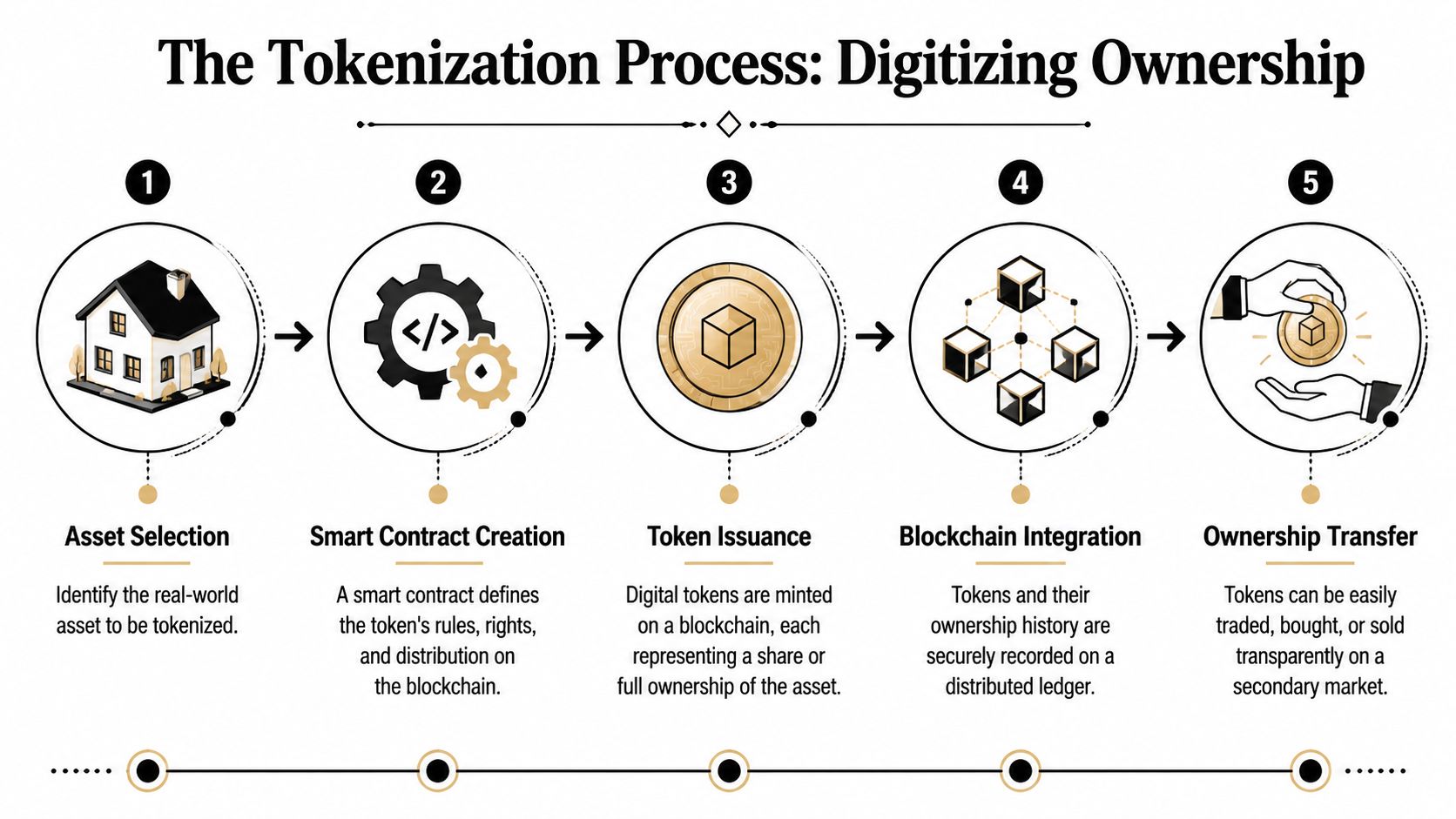
That doesn't mean the blockchain magically holds the building. It means the blockchain records the tokenized representation, while legal agreements and custody arrangements connect those tokens to the physical asset.
The four operational stages
McKinsey describes tokenization through four key steps: asset sourcing, digital-asset issuance, distribution/trading, and asset servicing. It also notes that this model applies to assets such as art, corporate bonds, commodities, and government securities, with blockchain networks creating tamper-resistant and transparent transaction records (McKinsey explainer on tokenization).
To put that in plain language:
Asset sourcing
Someone chooses the asset to tokenize. That could be a bond, a fund interest, a piece of real estate, or a commodity-backed structure.Digital issuance
The issuer creates tokens on a blockchain such as Ethereum, Solana, or Avalanche. Smart contracts define supply, transfer rules, and other logic.Distribution and trading
Investors buy, sell, or hold those tokens through approved platforms or marketplaces.Asset servicing
Ongoing actions still matter. Revenue distributions, reporting, compliance checks, and corporate actions have to be handled correctly after issuance.
If you want a deeper look at the contract layer behind this process, this guide on how blockchain strengthens digital contracts is a helpful companion read. It pairs well with a primer on what smart contracts do on-chain, because smart contracts are the automation engine that makes tokenized systems work.
Why the legal wrapper matters
Many beginners find this concept confusing. A token isn't valuable just because it exists on-chain. It has value when the legal structure behind it gives the token holder enforceable rights.
A serious tokenization project usually needs clear documentation for asset custody, ownership claims, transfer restrictions, investor eligibility, and how off-chain events map to on-chain records. Without that, you may have a tradable token but a weak legal bridge to the underlying asset.
The blockchain handles recording and automation. The legal structure determines whether the token actually means what buyers think it means.
That distinction is especially important in tokenized securities. The tech can be elegant, but if the rights, obligations, and enforcement framework are vague, the token may not deliver the protection investors assume it does.
Understanding Key Token Types and Standards
Fungible and non-fungible tokens
Not every tokenized asset uses the same design. The two foundational standards most readers run into are ERC-20 and ERC-721.
According to Chainlink's educational overview, tokenized assets commonly rely on ERC-20 for fungible assets and ERC-721 for non-fungible assets. The same infrastructure can also use Chainlink Proof of Reserve so minting stays locked to off-chain reserve balances and supports 1:1 backing (Chainlink asset tokenization overview).
A simple way to think about the difference:
- ERC-20 works for interchangeable units. One token is functionally the same as another. That's useful for tokenized bonds, fund shares, or standardized claims.
- ERC-721 works for unique items. Each token is distinct. That's useful for digital representations of specific collectibles, artworks, or unique property records.
Some projects also use ERC-1155 for mixed token environments, especially where platforms want both fungible and unique items under one architecture. That's common in NFT ecosystems, GameFi, and digital property systems, even though the core tokenization conversation still centers on ERC-20 and ERC-721.
Comparison of Major Token Standards
| Standard | Type | Primary Use Case | Example |
|---|---|---|---|
| ERC-20 | Fungible | Bonds, fund units, tokenized shares, standardized claims | Tokenized Treasury exposure |
| ERC-721 | Non-fungible | Unique assets or records | A specific artwork token |
| ERC-1155 | Semi-fungible or mixed | Gaming assets, mixed digital inventories, hybrid Web3 systems | In-game items with different scarcity rules |
For readers who want a clearer foundation on collectible-style tokens, this explanation of how NFTs work in practice helps connect ERC-721 concepts to real usage.
Security tokens and utility tokens are not the same
The technical standard tells you how a token is built. It doesn't fully tell you what the token legally represents.
That distinction matters a lot:
- Security tokens usually represent an investment interest, claim on an asset, or rights tied to returns and ownership structures.
- Utility tokens usually grant access to a network, product, service, or application feature.
In other words, a token can be coded like an ERC-20 and still fall into very different legal buckets depending on the rights attached to it. That's why smart contracts, tokenomics, and blockchain architecture are only part of the analysis. Compliance, disclosures, and legal classification matter just as much.
If you're evaluating a tokenized asset, don't stop at the contract standard. Ask what legal right the holder actually receives.
Real-World Use Cases Revolutionizing Industries
Treasuries, real estate, and art
Tokenization becomes much easier to grasp when you map it to assets people already know.
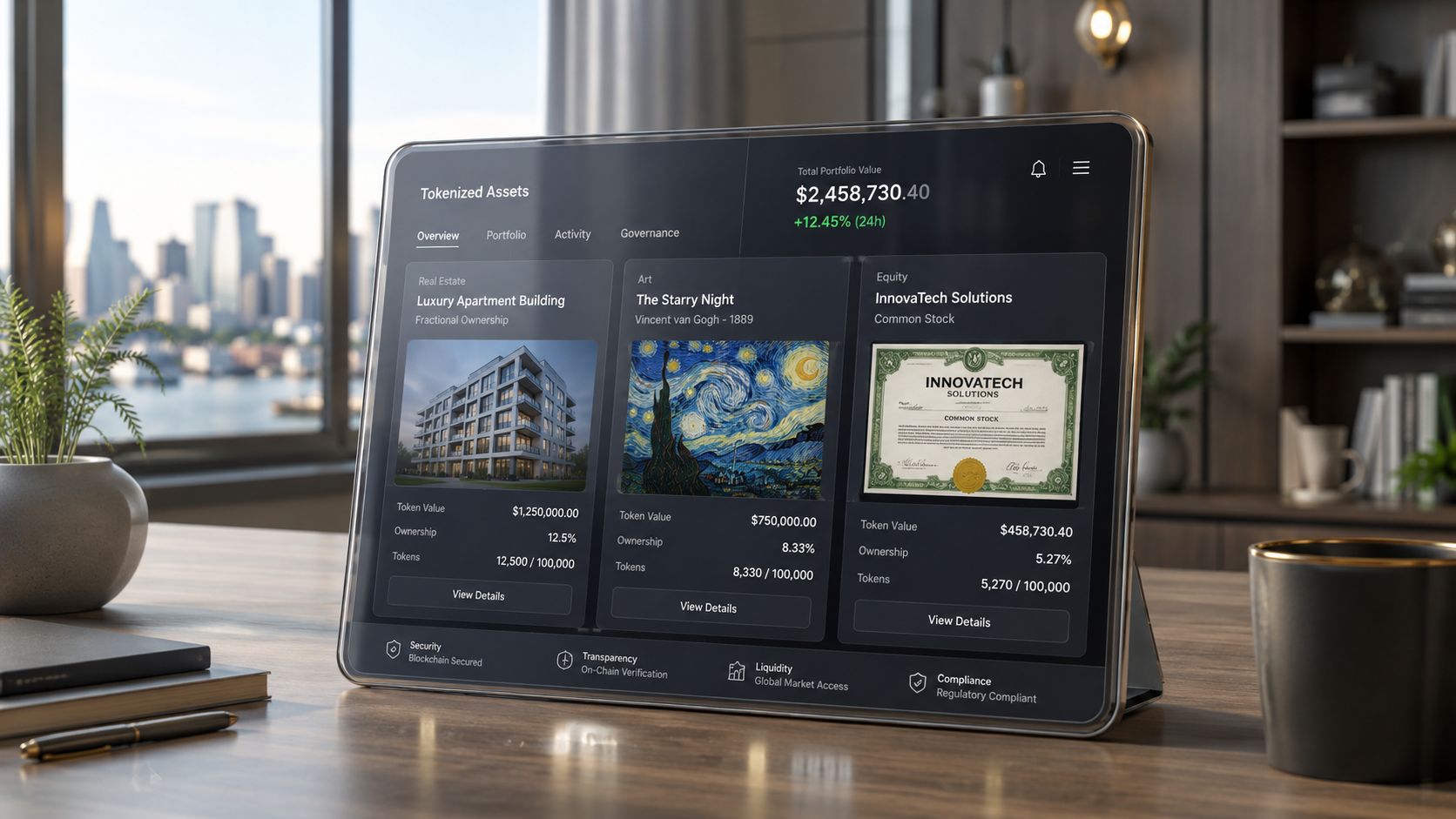
Real estate is the classic example. A large property can be split into digital units so more participants can get exposure without buying the whole asset. Art works similarly. A single high-value piece can be represented through tokens that divide economic participation, even if the legal details vary by structure.
The clearest live market signal right now comes from fixed income. In 2026, tokenized US Treasuries accounted for $12.88 billion of the RWA market, making them the largest single asset class in the tokenized real-world asset ecosystem, ahead of tokenized stocks and commodities (MetaMask overview of RWA tokens in 2026).
That matters because Treasuries aren't niche crypto experiments. They're core financial instruments. Once they move on-chain at scale, tokenization starts looking less like a novelty and more like a new distribution and settlement layer for mainstream assets.
Where DeFi, payments, and digital property fit in
Tokenized assets also plug into DeFi in ways that speculative tokens often can't. A tokenized Treasury product can serve as collateral, treasury management infrastructure, or yield-bearing cash parking for crypto-native users. That connects traditional asset exposure to on-chain capital efficiency.
Payments are part of the story too. As platforms explore settlement and programmable finance, the relationship between tokenized assets and transaction rails becomes more important. If that angle interests you, this breakdown of tokenization in payments is worth reading.
Here's a short visual explainer that helps put the ecosystem in motion:
GameFi and Web3 also show a lighter version of the same idea. In-game items, virtual land, and digital collectibles turn into portable blockchain assets that players can hold, transfer, or trade. Those aren't the same as regulated tokenized securities, but they teach the same core lesson: blockchain can make ownership more programmable and portable.
The Major Benefits and Hidden Risks of Tokenization
Where tokenization improves finance
The appeal of tokenization is easy to see once you focus on market mechanics instead of crypto hype.
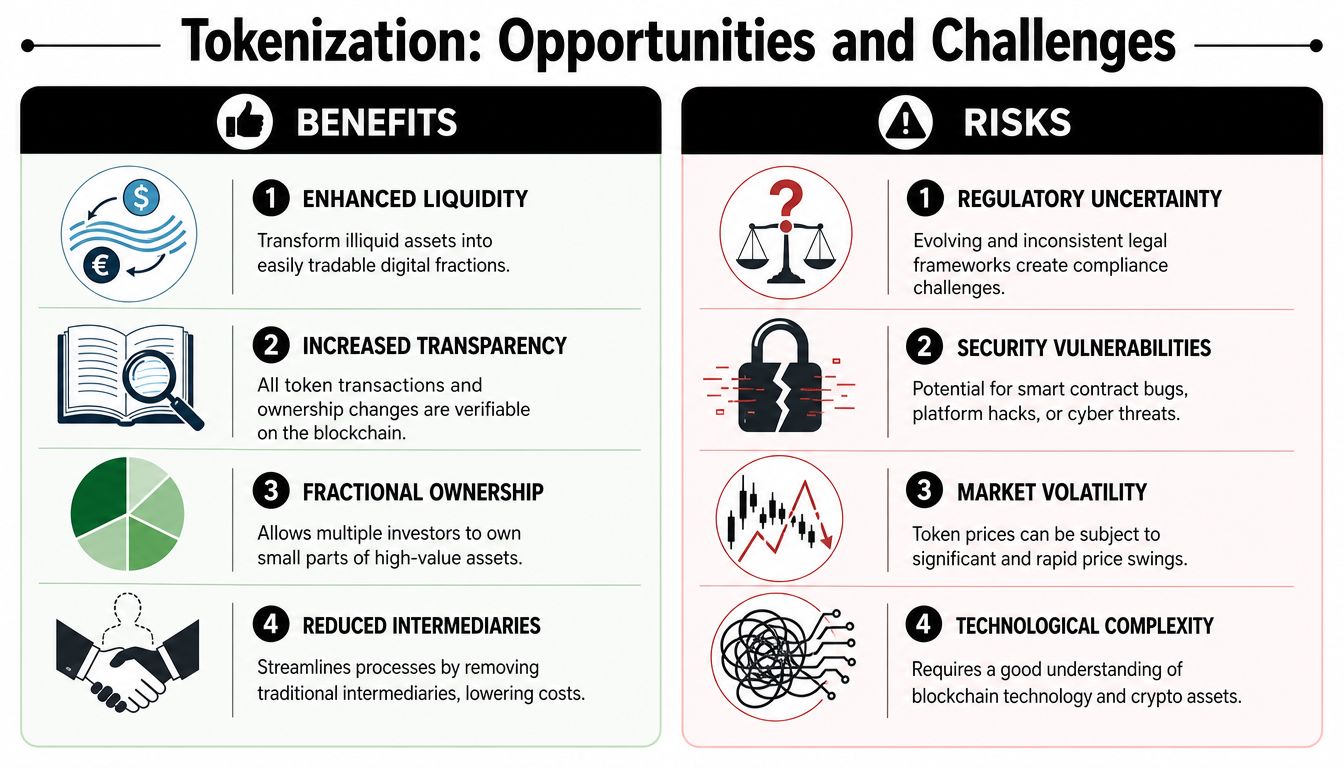
A well-designed tokenization system can offer:
- Fractional access: Investors can gain exposure to assets that would otherwise require large capital commitments.
- Programmable operations: Smart contracts can automate transfers, restrictions, and servicing tasks.
- Improved transparency: Blockchain records create a clearer transaction history than many fragmented legacy systems.
- Broader market reach: Digital assets can be distributed more efficiently across online platforms and interoperable Web3 environments.
- Potential DeFi utility: Some tokenized assets can move into lending, collateral, and liquidity workflows.
This is also where Layer 2 infrastructure becomes relevant. Faster and cheaper blockchain environments can make tokenized systems more practical for higher-frequency use cases, especially when institutions want efficiency without sacrificing auditability.
The legal and technical risks people overlook
The bullish case is only half the story.
A critical issue in tokenization is the gap between technical representation and legal ownership rights. A discussion referencing IOSCO's 2025 report highlights risks around ownership finality, smart contract bugs, and private key loss, noting that investors may wrongly assume on-chain ownership automatically equals full legal entitlement (analysis of unresolved tokenization ownership issues).
That point deserves extra attention because it's where many explainers fail. If a wallet holds a token, that proves wallet control. It doesn't automatically prove the holder can enforce every off-chain right tied to the asset in every jurisdiction and under every dispute scenario.
Reality check: A token can be technically valid, easy to transfer, and still leave important legal questions unresolved.
Other risks sit closer to the crypto stack itself:
- Smart contract risk: Bugs or flawed logic can affect issuance, transfer rules, or servicing.
- Custody risk: Private key management remains a real operational issue.
- Platform risk: The marketplace, issuer, or administrator may become the weak point.
- Regulatory uncertainty: Rules differ across regions and asset types.
- Narrative confusion: Retail investors sometimes treat serious asset-backed tokenization as if it were just another high-beta token trade.
Identity and compliance systems help here. Strong onboarding, transfer controls, and wallet screening matter far more in tokenized finance than in meme coin culture, which is why blockchain identity verification is part of the infrastructure conversation, not a side topic.
How to Evaluate a Tokenization Project
Questions that matter more than hype
Evaluating a tokenization project isn't the same as evaluating a speculative altcoin. The first question isn't whether the chart looks strong. It's whether the underlying asset, legal structure, and operational design make sense.
Start with the asset itself. Is it a Treasury product, a private fund interest, a real estate structure, or something harder to verify? The more opaque the underlying asset, the more careful you should be.
Then look at the rights attached to the token. Does the token represent direct ownership, a beneficial interest, a contractual claim, revenue participation, or just platform exposure? Many readers skip this step and end up analyzing only the token's branding and tokenomics.
A practical due diligence checklist
Use a checklist, not a vibe.
- Check the asset link: Understand what sits behind the token and how that asset is held.
- Read the legal structure: Look for clarity on investor rights, transfer restrictions, and dispute handling.
- Review the smart contracts: Audits, contract transparency, and upgrade permissions all matter.
- Study the team and operators: You're trusting issuers, custodians, administrators, and technical builders.
- Inspect liquidity realistically: A token can be tradable in theory but thin in practice.
- Understand chain choice: Ethereum, Solana, Avalanche, and Layer 2 networks each come with trade-offs around cost, ecosystem fit, and control.
- Separate utility from noise: If the marketing leans harder on hype than on asset details, slow down.
AI tools may improve compliance workflows, document review, and asset monitoring across tokenized markets. But AI doesn't replace due diligence. It just helps serious teams process complexity faster.
A credible tokenization project should answer basic questions about asset custody, investor rights, and smart contract design without forcing you to guess.
Your Next Steps into the World of Tokenization
Tokenization is one of the clearest signs that blockchain is maturing beyond speculation. At its best, it brings real assets, programmable finance, and more efficient market infrastructure into the same system. At its worst, it wraps old legal uncertainty in new technology and hopes buyers won't notice.
The smart approach is simple:
- Learn the structure before the symbol
- Separate asset-backed tokens from narrative-driven crypto
- Check the legal bridge, not just the blockchain
- Pay attention to custody, audits, and transfer rules
- Follow how DeFi, AI, and Layer 2 scaling improve the user experience without ignoring compliance
If you're planning to buy, trade, or report digital assets connected to tokenized markets, tax treatment can get complicated fast. A solid comprehensive crypto tax guide can help you think through the record-keeping side before activity becomes hard to untangle.
Tokenization isn't replacing finance. It's rebuilding parts of finance on new rails. Readers who understand that distinction will be in a much better position to evaluate what deserves attention and what deserves skepticism.
Coiner Blog publishes clear, practical analysis for readers who want to understand crypto beyond the headlines. If you want more breakdowns on tokenization, DeFi, NFTs, AI and blockchain, Layer 2 trends, and the opportunities and risks shaping digital assets, explore Coiner Blog.
1 Comment